
动物保健

Search documents
瑞普生物:猫干扰素预计今年可以推向市场
Zheng Quan Ri Bao Zhi Sheng· 2025-09-12 11:08
Core Viewpoint - The company announced that it expects to launch cat interferon in the market this year, while the development of the cat quadrivalent vaccine is still ongoing [1] Group 1 - The company is actively preparing to advance its research and development efforts for the cat quadrivalent vaccine and aims to enter clinical trials as soon as possible [1]

瑞普生物:公司坚持创新驱动高质量发展,积极加快第三代疫苗与新型药物开发
Zheng Quan Ri Bao Zhi Sheng· 2025-09-12 11:08
Core Viewpoint - The company emphasizes innovation-driven high-quality development in response to profound changes in the animal health industry [1] Group 1: Strategic Initiatives - The company is accelerating the development of third-generation vaccines and new drugs [1] - There is a continuous deepening of strategic cooperation with breeding groups [1] Group 2: Long-term Strategies - The company is advancing internationalization, pet economy, and synthetic biology as part of its medium to long-term strategies [1] - These initiatives are aimed at laying a solid foundation for high-quality development and creating long-term investment value for shareholders [1]
农林牧渔行业双周报(2025、8、29-2025、9、11):关注产能调控-20250912
Dongguan Securities· 2025-09-12 08:49
Investment Rating - The report maintains an "Overweight" rating for the agriculture, forestry, animal husbandry, and fishery industry [1][48]. Core Views - The SW agriculture, forestry, animal husbandry, and fishery industry slightly outperformed the CSI 300 index, rising by 4.16% from August 29, 2025, to September 11, 2025, exceeding the index by approximately 2.28 percentage points [2][9]. - Most sub-sectors recorded positive returns, with only animal health showing a negative return of -2.65%. The sectors of breeding, feed, fishery, agricultural product processing, and planting increased by 6.23%, 5.93%, 3.31%, 1.37%, and 0.45%, respectively [12][16]. - The overall price-to-book (PB) ratio for the industry is approximately 3.02 times, indicating a recovery in valuation, yet it remains at a relatively low historical level, around the 67.6 percentile since 2006 [19][21]. Summary by Sections Market Review - The SW agriculture, forestry, animal husbandry, and fishery industry outperformed the CSI 300 index during the reporting period [9]. - Most sub-sectors achieved positive returns, with a notable performance in breeding and feed sectors [12][16]. - Approximately 62% of stocks in the industry recorded positive returns [13]. Important Industry Data - **Pig Farming**: The average price of external three yuan pigs decreased from 13.69 yuan/kg to 13.31 yuan/kg during the reporting period. The profit for self-bred pigs is 16.84 yuan/head, while the profit for purchased piglets is -161.93 yuan/head [22][26]. - **Chicken Farming**: The average price for meat chicken chicks is 3.25 yuan/chick, and for white feathered chickens, it is 7.02 yuan/kg, both showing slight declines [28][33]. - **Feed Costs**: As of September 11, 2025, corn prices are at 2365.49 yuan/ton, and soybean meal prices are at 3060 yuan/ton, with slight fluctuations noted [24][25]. Industry News - A meeting on pig production capacity regulation is scheduled for September 16, 2025, involving 25 leading companies to discuss current production conditions and future regulatory measures [37][38]. Company Insights - Key companies to watch include Muyuan Foods (002714), Wens Foodstuff Group (300498), and others, focusing on their market positions and growth potential in the current environment [49].
动物保健板块9月12日跌0.21%,大禹生物领跌,主力资金净流出1543.66万元
Zheng Xing Xing Ye Ri Bao· 2025-09-12 08:31
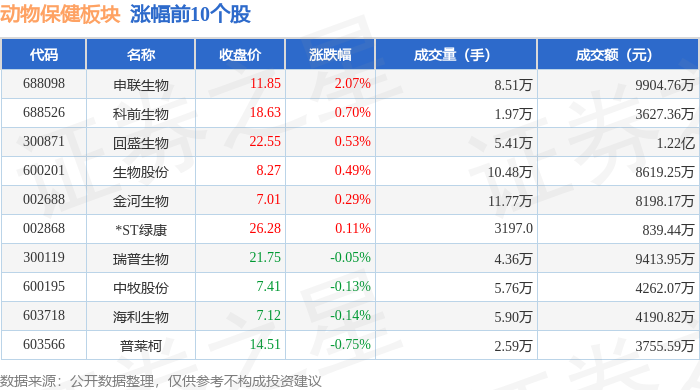
Market Overview - The animal health sector experienced a decline of 0.21% on September 12, with Dayu Biological leading the drop [1] - The Shanghai Composite Index closed at 3883.69, up 0.22%, while the Shenzhen Component Index closed at 12996.38, up 0.13% [1] Individual Stock Performance - Shunlian Biological (688098) closed at 11.85, up 2.07% with a trading volume of 85,100 shares and a turnover of 99.05 million yuan [1] - KQ Biological (688526) closed at 18.63, up 0.70% with a trading volume of 19,700 shares and a turnover of 36.27 million yuan [1] - Huisheng Biological (300871) closed at 22.55, up 0.53% with a trading volume of 54,100 shares and a turnover of 122 million yuan [1] - Dayu Biological (871970) led the decline, closing at 10.73, down 3.85% with a trading volume of 76,600 shares and a turnover of 82.31 million yuan [2] Capital Flow Analysis - The animal health sector saw a net outflow of 15.44 million yuan from institutional investors, while retail investors experienced a net outflow of 9.04 million yuan [2] - Speculative funds recorded a net inflow of 24.47 million yuan [2] Detailed Capital Flow for Selected Stocks - Shunlian Biological had a net inflow of 14.94 million yuan from institutional investors, but a net outflow of 21.09 million yuan from retail investors [3] - Huisheng Biological experienced a net outflow of 7.83 million yuan from institutional investors, while retail investors had a net inflow of 9.81 million yuan [3] - KQ Biological saw a net outflow of 1.73 million yuan from institutional investors, with a minor net inflow from retail investors [3]




动物保健板块9月11日涨0.92%,大禹生物领涨,主力资金净流出7070.72万元
Zheng Xing Xing Ye Ri Bao· 2025-09-11 08:40
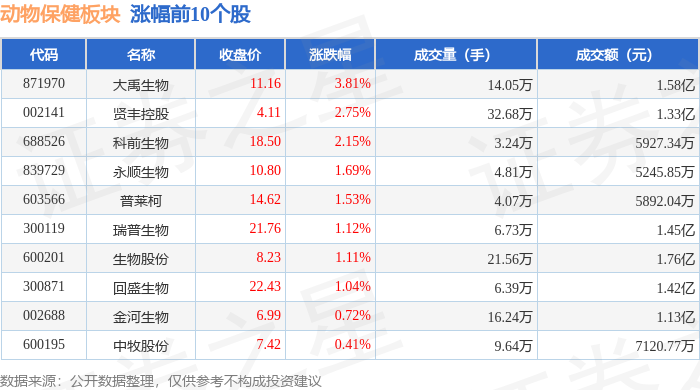
Core Viewpoint - The animal health sector experienced a rise of 0.92% on September 11, with Dayu Biological leading the gains, while the overall market indices also showed significant increases [1]. Group 1: Market Performance - The Shanghai Composite Index closed at 3875.31, up 1.65%, and the Shenzhen Component Index closed at 12979.89, up 3.36% [1]. - Dayu Biological's stock price increased by 3.81% to 11.16, with a trading volume of 140,500 shares and a transaction value of 158 million [1]. Group 2: Individual Stock Performance - Other notable performers included: - Houfeng Holdings, up 2.75% to 4.11, with a trading volume of 326,800 shares and a transaction value of 133 million [1]. - Keqian Biological, up 2.15% to 18.50, with a trading volume of 32,400 shares and a transaction value of 59.27 million [1]. - Yongshun Biological, up 1.69% to 10.80, with a trading volume of 48,100 shares and a transaction value of 52.46 million [1]. Group 3: Capital Flow Analysis - The animal health sector saw a net outflow of 70.71 million from institutional investors, while retail investors contributed a net inflow of 77.65 million [2][3]. - The capital flow for individual stocks showed varied trends, with significant outflows from stocks like Zhongmu Co., which had a net outflow of 11.86 million from institutional investors [3].



动物保健板块9月10日跌0.5%,永顺生物领跌,主力资金净流出8160.41万元
Zheng Xing Xing Ye Ri Bao· 2025-09-10 08:30
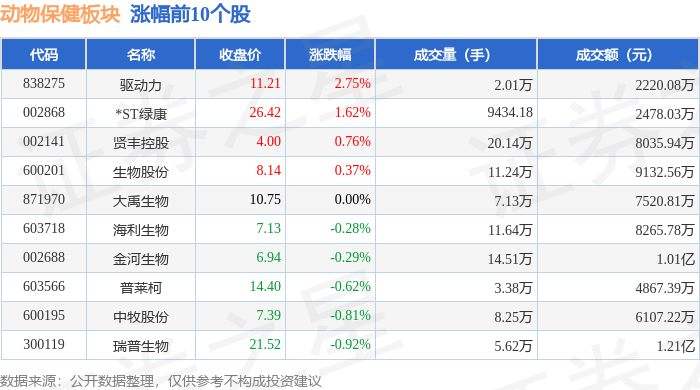
Market Overview - The animal health sector experienced a decline of 0.5% on September 10, with Yongshun Biological leading the drop [1] - The Shanghai Composite Index closed at 3812.22, up 0.13%, while the Shenzhen Component Index closed at 12557.68, up 0.38% [1] Stock Performance - Notable gainers included: - Qudongli (838275) with a closing price of 11.21, up 2.75% [1] - *ST Lvkang (002868) at 26.42, up 1.62% [1] - Houfeng Holdings (002141) at 4.00, up 0.76% [1] - Major decliners included: - Yongshun Biological (839729) at 10.62, down 3.28% [2] - Shilian Biological (688098) at 11.72, down 1.76% [2] - Huai Sheng Biological (300871) at 22.20, down 1.60% [2] Capital Flow Analysis - The animal health sector saw a net outflow of 81.6 million yuan from institutional investors, while retail investors contributed a net inflow of 53.0 million yuan [2] - The detailed capital flow for key stocks showed: - Repu Biological (300119) had a net inflow of 1.12 million yuan from retail investors [3] - Kexian Biological (688526) saw a net inflow of 14.78 thousand yuan from institutional investors [3] - Hai Li Biological (603718) experienced a significant net outflow of 22.66 million yuan from institutional investors [3]
全市场首只!农牧渔ETF今日正式开售!
Xin Lang Cai Jing· 2025-09-08 02:49
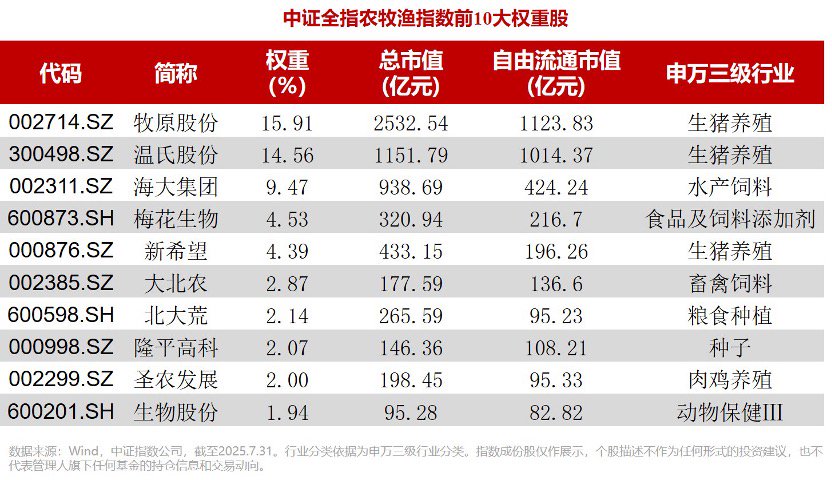
Core Viewpoint - The launch of the Agricultural, Animal Husbandry, and Fishery ETF (159275) by Huabao Fund is expected to capitalize on the recovery of the A-share market and the low valuation of the agricultural sector, particularly in the pig farming industry, which is poised for a price rebound [1][2][3]. Company Summary - Huabao Fund has served 64.12 million clients and generated a total profit of 83.2 billion yuan for fund holders, with cumulative dividends reaching 59.4 billion yuan as of June 2025 [1][8]. - The Agricultural, Animal Husbandry, and Fishery ETF (159275) is the first ETF in the market to track the CSI Agricultural, Animal Husbandry, and Fishery Index, which encompasses various segments of the agricultural industry [1][5]. - As of August 2025, Huabao Fund's equity ETF assets under management reached 117.4 billion yuan, solidifying its position as a leading institution in the public fund ETF business [8]. Industry Summary - The agricultural sector has experienced a significant downturn over the past three and a half years, but recent trends indicate a recovery, with the sector's valuation remaining low [3]. - The CSI Agricultural, Animal Husbandry, and Fishery Index has a price-to-book ratio of 2.65, which is lower than similar indices, indicating potential for growth [3]. - The pig farming industry is currently at a low price point, with limited downside risk, and is expected to see improved profitability due to a new normal of stable production and price increases over the next 1-3 years [3]. - The seed industry is receiving increased governmental focus, with advancements in biotechnology expected to enhance competitiveness among leading companies [4]. - The CSI Agricultural, Animal Husbandry, and Fishery Index has outperformed similar thematic indices and broad market indices since its inception, with a cumulative return of 85.73% from December 2013 to July 2025 [7].
千亿ETF大厂低位入局!业内首只!农牧渔ETF(159275)重磅开售
Xin Lang Ji Jin· 2025-09-08 01:16
Core Viewpoint - The launch of the Agricultural, Animal Husbandry, and Fishery ETF (159275) by Huabao Fund is expected to capitalize on the recovery of the A-share market and the low valuation of the agricultural sector, particularly benefiting from the upward trend in the pig cycle [1][2][6]. Company Summary - Huabao Fund has served 64.12 million clients and generated a total profit of 83.2 billion yuan for fund holders, with cumulative dividends reaching 59.4 billion yuan as of June 2025 [1][5]. - The Agricultural, Animal Husbandry, and Fishery ETF (159275) is the first ETF in the market to track the CSI Agricultural, Animal Husbandry, and Fishery Index, which covers key sectors such as pig farming, aquatic feed, animal health, and seeds [1][4]. - Huabao Fund has a total asset management scale of 117.4 billion yuan in equity ETFs, solidifying its position as a leading institution in the ETF business [5]. Industry Summary - The agricultural sector has experienced a significant rebound following a prolonged downturn, with the CSI Agricultural, Animal Husbandry, and Fishery Index currently at a price-to-book ratio of 2.65, which is lower than similar indices [2][4]. - The pig farming industry is at a low price point, with limited downside potential, and is expected to see improved profitability for quality enterprises in the next 1-3 years due to a new normal of stable production and price increases [2][3]. - The seed industry is receiving increased attention from national policies, with advancements in biotechnology and the potential for accelerated commercialization of genetically modified crops [3].
华安证券:给予普莱柯买入评级
Zheng Quan Zhi Xing· 2025-09-07 00:40
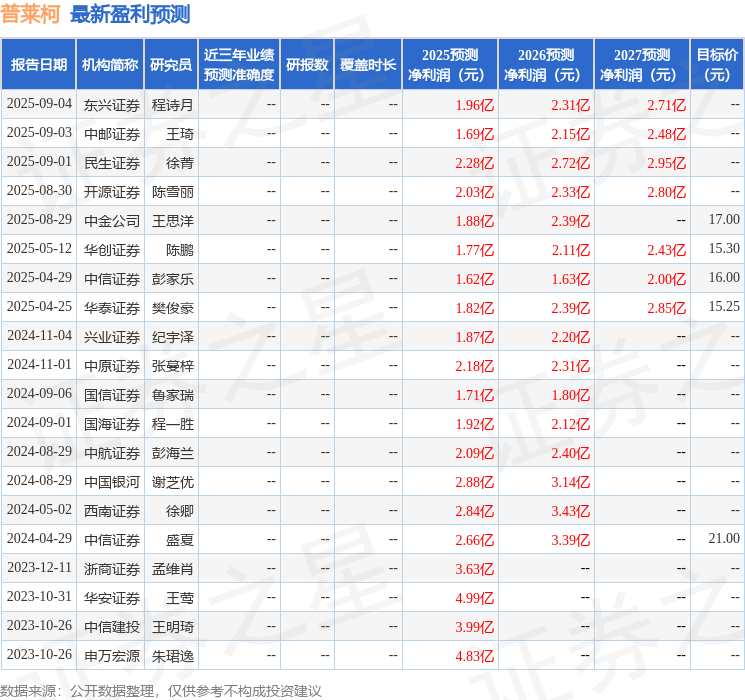
Core Viewpoint - The report highlights significant growth in poultry vaccines and the potential for the pet segment, with a "buy" rating for the company [1][5]. Financial Performance - In H1 2025, the company achieved a net profit of 116 million yuan, a year-on-year increase of 57.12% [2]. - The total revenue for H1 2025 was 559 million yuan, reflecting a 15.79% increase compared to the previous year [2]. - The company's non-recurring net profit was 100 million yuan, up 50.79% year-on-year [2]. - The sales expense ratio and management expense ratio were 22.2% and 6.7%, respectively, down 5.6 percentage points and 2.5 percentage points year-on-year [2]. Product Performance - The animal health industry faced increased competition, particularly in the swine vaccine segment, which saw a revenue decline of 11.49% to 131 million yuan [3]. - Poultry vaccine revenue grew by 30.01% to 259 million yuan, driven by the new production base in Nanjing and a nearly 60% increase in high pathogenic avian influenza vaccine revenue [3]. - The revenue from pet-related products reached 10.07 million yuan, with significant growth in functional health products, which increased by 124.47% [4]. Market Strategy - The company is focusing on both offline and online marketing strategies for its pet products, achieving over threefold growth in online sales [4]. - Various marketing activities and partnerships with distributors are being utilized to promote key products like the cat trivalent inactivated vaccine [4]. Future Outlook - The company is projected to achieve revenues of 1.216 billion yuan, 1.414 billion yuan, and 1.596 billion yuan for 2025, 2026, and 2027, respectively, with year-on-year growth rates of 16.6%, 16.3%, and 12.8% [5]. - Corresponding net profits are expected to be 181 million yuan, 234 million yuan, and 259 million yuan, with growth rates of 95.4%, 29.2%, and 10.5% [5].

瑞普生物:关于参加天津辖区上市公司2025年投资者网上集体接待日暨半年报业绩说明会活动的公告
Zheng Quan Ri Bao Zhi Sheng· 2025-09-05 12:17
Group 1 - The company, Reap Bio, announced its participation in the "2025 Investor Online Reception Day and Semi-Annual Performance Briefing" event on September 11, 2025, from 15:00 to 17:00 [1] - The event is guided by the Tianjin Securities Regulatory Bureau and co-hosted by the Tianjin Listed Companies Association and Shenzhen Panorama Network Co., Ltd [1]