核聚变能源

Search documents
【赛道掘金之可控核聚变】利好频出!5只概念股获融资资金大幅买入!
Zheng Quan Shi Bao· 2025-10-06 03:48
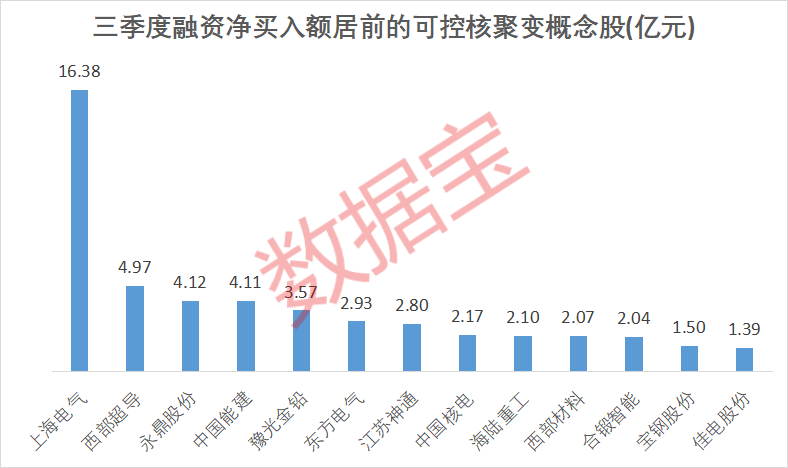
Group 1: Core Developments in Fusion Energy - The BEST project in Hefei, Anhui, has achieved a significant breakthrough with the successful development and installation of the Dewar base, marking a new phase in the construction of the fusion energy experimental device [1] - The BEST device utilizes compact high-field superconducting tokamak technology and aims to demonstrate nuclear fusion power generation for the first time internationally by 2027 [1] - Germany's government has approved an action plan to build the world's first nuclear fusion power plant, with over €2 billion allocated for research and infrastructure by 2029 [1] Group 2: Policy Support and Market Outlook - The newly passed Atomic Energy Law in China encourages and supports controlled thermonuclear fusion research and technology development, effective from January 15, 2026 [2] - The law establishes a management system tailored to fusion characteristics, promoting the application of fusion technology [2] - Analysts from CITIC Securities and Open Source Securities express optimism about the long-term growth of the controlled fusion industry, citing increased financing and accelerated construction of facilities [2] Group 3: Financial Performance of Related Companies - Shanghai Electric leads in net financing buy-ins among fusion-related stocks, with a total of ¥16.38 billion, followed by companies like Western Superconducting and Yongding Co., which also show significant buy-ins [3] - Predictions indicate substantial profit growth for several companies in the fusion sector, with Yongding Co. expected to see a 451.02% increase in net profit by 2025 [6][3] - Companies like Western Superconducting and Shanghai Electric are also projected to experience over 40% growth in net profits, reflecting strong market interest and institutional support [6][3] Group 4: Technological Contributions and Innovations - Shanghai Electric has been involved in the "artificial sun" fusion project since 2000, showcasing its core equipment at the recent Industrial Expo [5] - Western Superconducting is actively engaging with major domestic fusion projects, leveraging its superconducting materials for fusion applications [5] - Hezhong Intelligent has contributed to the development of the vacuum chamber, a critical component of the BEST fusion device [7]



目标2030年点亮“人造太阳” 我国核聚变赛道传来大利好
2 1 Shi Ji Jing Ji Bao Dao· 2025-10-03 07:56
Group 1 - The BEST project in Hefei, Anhui, has successfully completed the installation of its core component, the Dewar base, marking a significant milestone in the construction of the compact fusion energy experimental device [1] - The total assembly of the BEST project is set to begin on May 1, 2025, which is a crucial phase involving the precise installation of various fusion reactor components [1] - The installation process utilized a space-grade attitude control system, achieving millimeter-level precision for the 400-ton Dewar base, which sets a new record in the installation of large components [1] Group 2 - China's nuclear fusion industry has seen significant breakthroughs and advancements in core engineering, with three major fusion devices achieving phase results this year [2] - The EAST device achieved a record plasma operation time of 1066 seconds at 100 million degrees Celsius, demonstrating China's leading position in plasma confinement technology [2] - The China National Nuclear Corporation's new Tokamak device has entered the fusion burning experimental phase, achieving temperatures of 117 million degrees Celsius for atomic nuclei [2] Group 3 - Private enterprises in China are also making strides in nuclear fusion, with the Xuanlong-50U device achieving high-temperature, high-density plasma current, marking a significant step towards commercializing hydrogen-boron fusion [3] - The timeline for commercializing nuclear fusion is becoming clearer, with expectations to light the first "nuclear fusion lamp" in China by 2030 [3] - The BEST project aims to achieve its "lighting" goal by 2030, indicating a critical decade for the fusion industry [3] Group 4 - The Fusion New Energy (Anhui) Co., Ltd., a key player in the BEST project, was established in May 2023 with an initial registered capital of 5 billion yuan, which increased to 14.5 billion yuan in June 2024 [4] - The company is following a three-step approach from the BEST project to a commercial fusion reactor [4] - A preliminary supply chain for fusion energy has been established, with major research institutions leading the formation of industry alliances [5] Group 5 - The supply chain for the BEST project consists of 16 A-share listed companies, including Shanghai Electric and Western Superconducting, which provide essential components for the project [5] - The project involves collaboration with various enterprises and research institutions to accelerate the development of core fusion technologies [5]
超级赛道重磅不断,又有关键突破
Zheng Quan Shi Bao· 2025-10-02 12:35
Group 1: Breakthroughs in Fusion Energy Projects - The BEST (Compact Fusion Energy Experimental Device) project in Hefei, Anhui, has achieved a significant breakthrough with the successful development and installation of the key component, the Dewar base, marking a new phase in the project's construction [1][5] - The Dewar base, measuring approximately 18 meters in diameter and 5 meters in height, weighs over 400 tons and is the heaviest component of the BEST device, designed to support the main system's total weight of about 6,700 tons [5][6] - The successful delivery and installation of the Dewar base lay a solid foundation for the subsequent installation and debugging of core components, representing an important advancement in China's fusion research and engineering application [5][6] Group 2: Global Developments in Fusion Energy - The German government has approved an action plan titled "Germany's Path to Nuclear Fusion Power Plants," aiming to construct the world's first nuclear fusion power plant, with over 2 billion euros allocated for research and infrastructure by 2029 [2][7] - The year 2025 is anticipated to be a milestone for China's nuclear fusion commercialization, with significant advancements in policy and capital driving the acceleration of the fusion commercialization process [2][7] Group 3: Investment and Financing Trends - Nova Fusion Energy Technology (Shanghai) Co., Ltd. completed a 500 million yuan angel round financing, setting a record for the largest single financing for a private fusion company in China [2][9] - Commonwealth Fusion Systems (CFS) announced a funding round of 863 million USD, with total financing reaching approximately 3 billion USD since its inception, accounting for about one-third of global fusion energy industry financing [10][11] - Several listed companies are expanding into controllable nuclear fusion, with investments aimed at early-stage and mature projects within the fusion industry chain [11]
利好!超级赛道,重磅不断!又有关键突破→
Zheng Quan Shi Bao· 2025-10-02 12:33
Core Insights - The nuclear fusion sector is experiencing significant advancements, with key developments in both China and Germany aimed at commercializing fusion energy by 2025 and 2030 respectively [1][4][5]. Group 1: Developments in China - The BEST (Beijing Experimental Superconducting Tokamak) project in Hefei has achieved a critical breakthrough with the successful delivery and installation of the Dewar base, marking a new phase in its construction [3][4]. - The Dewar base, measuring approximately 18 meters in diameter and weighing over 400 tons, is the largest vacuum component in China's fusion research and will support the main system weighing about 6,700 tons [3]. - The BEST project aims to demonstrate fusion energy generation for the first time globally by 2025, with expectations to light the first lamp using fusion energy by 2030 [4]. Group 2: International Developments - Germany's government has approved an action plan to build the world's first nuclear fusion power plant, with over €2 billion allocated for research and infrastructure by 2029 [5]. - The plan emphasizes the importance of energy security and environmental sustainability, positioning nuclear fusion as a key technology for future energy needs [5]. Group 3: Investment and Market Trends - The nuclear fusion concept has gained traction in capital markets, with notable investments such as Nova Fusion's 500 million yuan angel round financing, setting a record for private fusion companies in China [1][7]. - Commonwealth Fusion Systems (CFS) in the U.S. secured $863 million in funding, with total financing reaching approximately $3 billion, representing a significant portion of global fusion energy investments [8]. - The nuclear fusion industry is witnessing a surge in interest from various companies, with plans to expand into fusion technology and related sectors, indicating a robust growth trajectory [6][9].
中国核聚变装置,取得关键突破!
Shang Hai Zheng Quan Bao· 2025-10-02 12:04
Core Insights - The BEST project in Hefei, Anhui, has achieved a significant breakthrough with the successful installation of the Dewar base, marking a new phase in the construction of the compact fusion energy experimental device [1][3] Group 1: Project Details - The Dewar base has a diameter of approximately 18 meters, a height of about 5 meters, and weighs over 400 tons, making it the heaviest vacuum component of the BEST device [3] - The installation precision of the Dewar base is critical for the stability and safety of the entire project, requiring a surface level difference of no more than 15 millimeters and a positional deviation of no more than 2 millimeters [3] - The total investment for the BEST project is 8.5 billion yuan, with construction expected to be completed by 2027 and the first demonstration of fusion power anticipated by 2030 [3] Group 2: Global Context and Investment Trends - The global interest in nuclear fusion has increased significantly since the initiation of the ITER project in 2010, leading to substantial investments in private fusion enterprises [4] - Energy security is a strategic priority for nations, and investments in nuclear fusion are seen as a means to secure long-term energy supply [4] - China is positioned at the forefront of fusion energy commercialization, supported by continuous policy backing and engineering advantages [4] Group 3: Domestic Fusion Energy Developments - Various companies are advancing nuclear fusion projects across China, with significant investments from state-owned enterprises and private sectors [5] - The China Fusion Energy Company, established with a registered capital of 15 billion yuan, aims to develop fusion energy by 2050, with a focus on the HL-4 fusion experimental device [6] - The company plans to invest 12 billion yuan in Shanghai for the construction of the HL-4 device, which will stimulate the development of high-temperature superconducting materials [6] Group 4: Material and Technology Insights - High-temperature superconducting materials are still in the early stages of industrialization, with applications extending beyond nuclear fusion to areas like MRI, particle accelerators, and maglev trains [8]
中德同步加码核聚变突破,天工国际(00826)受益材料赛道
智通财经网· 2025-10-02 07:37
Group 1 - The field of controllable nuclear fusion is accelerating towards commercialization, with significant advancements reported from China and Germany, marking an intensifying global competition in the "artificial sun" race [1] - In China, the BEST project in Hefei has achieved a key breakthrough with the successful development and delivery of the main component, the Dewar base. The total assembly work for BEST is set to officially start in May 2025, with completion expected in two years, aiming for the first demonstration of fusion energy generation globally [1] - Germany's government has approved an action plan to build the world's first nuclear fusion power plant, with over 2 billion euros allocated for research and infrastructure support by 2029 [1] Group 2 - China Galaxy Securities emphasizes the importance of controllable nuclear fusion as the sole direction for future energy, with around 35 countries engaged in fusion research, led by China, the US, Russia, Europe, and Japan [2] - The nuclear fusion industry chain consists of upstream materials, midstream superconducting magnets, first wall structures, vacuum modules, and downstream power plant operations. Companies are advised to focus on core projects in terms of industry development stages, high value, certainty, elasticity, and AI empowerment [2] - Industrial growth potential is highlighted for Tian Gong International (00826), which is positioned in the scarce core materials sector, particularly in titanium alloys and fusion materials, with significant growth opportunities in humanoid robotics [2]
中国核聚变震撼突破!1亿度狂奔1066秒,美国急追却吃尘,能源霸权要变天!
Sou Hu Cai Jing· 2025-10-02 02:46
Core Insights - China's recent breakthrough in nuclear fusion technology, achieving a stable operation at 100 million degrees Celsius for 1066 seconds, positions it ahead of the United States and other advanced nations in the energy sector [1][3][4] Group 1: Technological Achievements - The EAST (Experimental Advanced Superconducting Tokamak) successfully maintained a plasma temperature of 100 million degrees Celsius for 1066.76 seconds, setting a new world record [3][4] - This achievement marks a significant leap from previous milestones, indicating China's advancement into the "thousand-second era" of nuclear fusion [3][4] - The technology utilizes superconducting coils to create a strong magnetic field, capable of containing plasma at temperatures six times higher than the sun's core [3][4] Group 2: Competitive Landscape - Recent statistics indicate that China's magnetic field strength has surpassed that of the United States, with a 30% reduction in device size and a 50-fold decrease in construction costs [5] - China has developed a comprehensive innovation system from nuclear energy release to efficient energy utilization, enhancing its autonomy and competitiveness in the field [5][7] Group 3: Future Prospects - China aims to establish a fusion engineering experimental reactor by 2035 and targets commercial power generation by 2050, with ongoing projects like the "Kua Fu" device [7] - The country has filed over 2000 patents, expanding its research from traditional superconducting materials to cutting-edge fields like artificial intelligence [7] - The shift towards nuclear fusion could significantly alter the global geopolitical landscape, reducing reliance on fossil fuels and external energy sources [4][7]
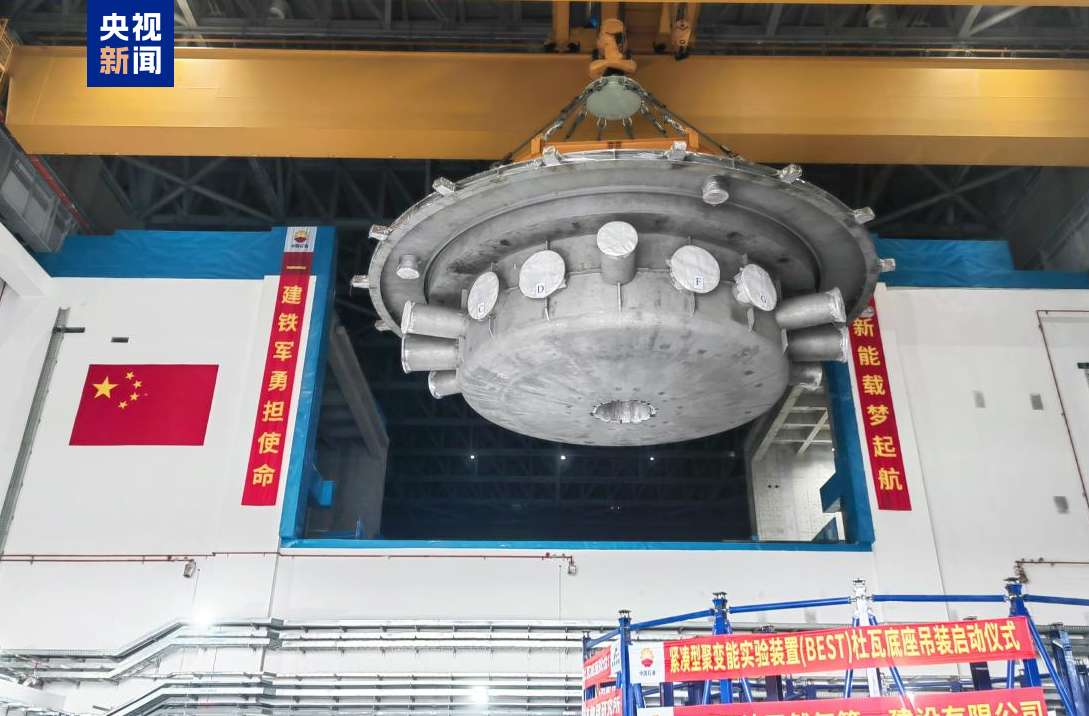
BEST装置首个关键部件杜瓦底座成功安装就位
Yang Shi Xin Wen· 2025-10-01 06:52
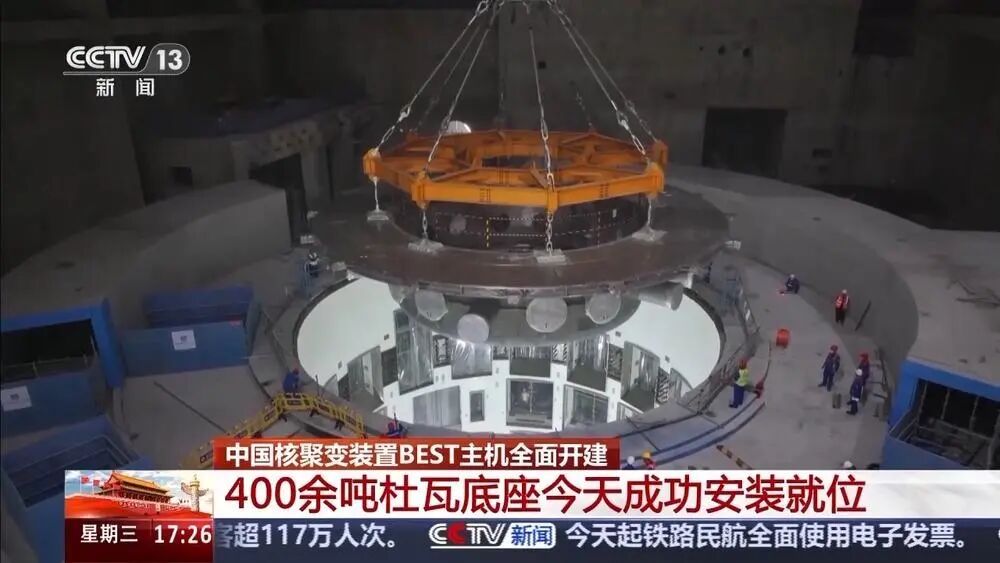
Core Insights - The BEST project in Hefei has achieved a significant breakthrough with the successful development and delivery of the key component, the Dewar base, marking a new phase in the construction of the project [1][5] - The Dewar base is the largest vacuum component in China's fusion field, measuring approximately 18 meters in diameter, 5 meters in height, and weighing over 400 tons, designed to support the main system's total weight of about 6700 tons [1][5] Group 1 - The installation of the Dewar base requires high precision, with surface level differences controlled within 15 millimeters and positional deviations not exceeding ±2 millimeters, highlighting the critical nature of its installation for overall project stability and safety [3] - The project team, led by the Hefei Institute of Plasma Physics under the Chinese Academy of Sciences, has overcome key technical challenges related to high-precision forming, welding, millimeter-level deformation control, and high vacuum sealing [5] - The successful manufacturing and installation of the Dewar base lays a solid foundation for the subsequent installation and debugging of core components in the BEST device, representing an important advancement in China's fusion research and engineering application [5] Group 2 - The Burning Experimental Superconducting Tokamak (BEST) aims to validate fusion energy generation in a real fuel environment, utilizing advanced technologies such as high-performance superconducting magnets and deuterium-tritium fusion fuel [7] - The total assembly of BEST is set to officially commence in May 2025, with completion expected two years later, aiming to demonstrate fusion energy generation for the first time globally [7] - By 2030, there is an optimistic outlook for achieving the first demonstration of fusion energy lighting a lamp [7]
民生证券:可控核聚变产业化进程有望加速 建议持续关注核聚变产业催化
智通财经网· 2025-09-30 02:00
Core Viewpoint - The commercialization of controlled nuclear fusion in China is accelerating, with private enterprises and capital entering the fusion energy sector [1] Group 1: Nuclear Fusion as an Energy Solution - Controlled nuclear fusion is seen as the ultimate solution to human energy problems, simulating the sun's fusion process to generate energy [1] - The process requires three conditions: high temperature (T), certain density (n), and energy confinement time (τE), collectively known as the fusion triple product [1] Group 2: Fusion Technology Routes - Research in nuclear fusion primarily follows two main paths: magnetic confinement and inertial confinement [2] - Magnetic confinement uses strong magnetic fields to contain high-temperature plasma, with major device types including Tokamak, stellarator, and field-reversed configuration (FRC) [2] - Inertial confinement relies on the inertia of particles to achieve fusion before they disperse, primarily using Z-pinch and laser methods [2] Group 3: Project Overview - Notable international projects include ITER (the world's first fully superconducting Tokamak), SPARC (the first high-temperature superconducting Tokamak), and Orion (the first fusion power plant) [3] - In China, key projects are led by major research institutes and private enterprises, including the BEST project (compact fusion experimental device) and the Jiangxi "Spark" project (fusion-fission hybrid reactor) [3] Group 4: Investment Recommendations - The rapid commercialization of the nuclear fusion industry suggests continued attention to catalysts in this sector [4] - Recommended companies include those involved in high-power electronic tubes, vacuum switches, and superconducting materials, among others [4]
中金 • 全球研究 | 2025年日本自民党总裁选举#4:候选人高市早苗
中金点睛· 2025-09-29 23:35
Core Viewpoint - The article emphasizes that Sanae Takaichi is a strong proponent of "Abenomics," advocating for monetary easing, yen depreciation, and fiscal expansion. If elected, the price fluctuations of various Japanese assets may align with the trends observed during the "Abenomics trade," although the magnitude of changes is expected to be weaker than in 2012-2013 due to significant transformations in Japan by 2025 [2]. Candidate Background - Sanae Takaichi, born on March 7, 1961, is a female politician from the Liberal Democratic Party (LDP) of Japan. She comes from a non-political family background and has a diverse educational and professional history, including studying at Kobe University and working in the U.S. Congress [3][4]. Political Career - Takaichi's political journey began in 1992, and she has held various significant positions, including Minister of Internal Affairs and Communications and Minister of Economic Security. She has been a prominent figure in the LDP and has supported Shinzo Abe in past elections [4][5]. Economic and Financial Policies - Takaichi's economic policies include: - **Tax Reduction**: Proposing to raise the income threshold for tax exemptions and implement cash subsidies for low-income families, reflecting a cross-party collaboration approach [7]. - **Monetary Policy**: She shows a clear preference for monetary easing, emphasizing the negative impacts of rapid interest rate hikes on corporate investment and housing loans [8]. - **Exchange Rate**: Takaichi appears to favor a weaker yen, arguing that yen depreciation benefits export industries and enhances foreign reserves [9]. - **Fiscal Policy**: Advocating for fiscal expansion and deficit financing, she emphasizes the importance of strategic investments to stimulate economic growth [10]. Market Outlook if Elected - If Takaichi is elected, the market may experience trends similar to those during the "Abenomics trade," including yen depreciation, rising Japanese stock prices, and a gradual increase in bond yields. However, the expected changes in magnitude are likely to be less pronounced than those seen in 2012-2013 [11].