
互联网广告

Search documents
ST联合:11月24日召开董事会会议
Mei Ri Jing Ji Xin Wen· 2025-11-24 17:01
Core Viewpoint - ST United (SH 600358) announced a temporary board meeting on November 24, 2025, to discuss internal organizational structure and job positions [1] Group 1: Company Financials - For the year 2024, ST United's revenue composition is as follows: Internet advertising accounts for 78.61%, e-commerce business for 13.92%, tourism and food services for 7.38%, and other businesses for 0.09% [1] - As of the report, ST United has a market capitalization of 2.9 billion yuan [1] Group 2: Related Events - Dapeng Industrial's strategic placement resulted in significant gains for insiders, with a subscription price of 9 yuan and a first-day listing price of 118 yuan, leading to a profit of 24.92 million yuan for the actual controller and his brother [1]

【小米集团(1810.HK)】汽车业务首次单季盈利转正,但手机&汽车毛利率或将面临压力——2025三季度业绩点评(付天姿/黄铮)
光大证券研究· 2025-11-20 23:03
Core Viewpoint - The company reported strong financial performance in Q3 2025, with significant growth in revenue and net profit, driven by innovative business segments like smart cars and AI [4]. Group 1: Financial Performance - Q3 2025 revenue reached 113.1 billion yuan, representing a year-over-year increase of 22.3% but a quarter-over-quarter decrease of 2.4% [4]. - Non-IFRS net profit for Q3 2025 was 11.3 billion yuan, up 80.9% year-over-year and 4.4% quarter-over-quarter, with a corresponding net profit margin of 10% [4]. Group 2: Smartphone Business - Revenue from smartphone sales in Q3 2025 was 46 billion yuan, down 3.1% year-over-year but up 1% quarter-over-quarter [5]. - The company shipped 43.3 million smartphones, achieving a slight year-over-year increase of 0.5%, maintaining a top-three global market share for 21 consecutive quarters [5]. - The average selling price (ASP) of smartphones decreased to 1,062.8 yuan, down 3.6% year-over-year and 1% quarter-over-quarter, primarily due to declining ASP in overseas markets [5]. - Smartphone gross margin was 11.1%, a decrease of 0.6 percentage points year-over-year and 0.4 percentage points quarter-over-quarter, impacted by rising core component prices and intensified competition in mainland China [5]. Group 3: IoT Business - IoT revenue for Q3 2025 was 27.6 billion yuan, reflecting a year-over-year increase of 5.6% but a significant quarter-over-quarter decline of 28.8% [6]. - The gross margin for IoT improved to 23.9%, up 3.1 percentage points year-over-year and 1.4 percentage points quarter-over-quarter, driven by higher sales of high-margin products [6]. - The company faces challenges in the IoT segment due to seasonal fluctuations and increased competition, with future strategies focusing on international expansion and product positioning [6]. Group 4: Internet Advertising - Internet revenue reached 9.4 billion yuan in Q3 2025, a year-over-year increase of 10.8% and a quarter-over-quarter increase of 3.1%, marking a historical high [7]. - The number of global monthly active users reached 742 million, up 8.2% year-over-year [7]. - Advertising revenue grew by 17.4% year-over-year to 7.2 billion yuan, with overseas internet revenue also increasing by 19.1% to 3.3 billion yuan, both achieving historical highs [8]. Group 5: Automotive Business - Revenue from automotive and innovative businesses was 29 billion yuan in Q3 2025, a year-over-year increase of 199.2% and a quarter-over-quarter increase of 36.4% [9]. - The company delivered 109,000 vehicles, with an ASP of 260,000 yuan, benefiting from high ASP models like Xiaomi YU7 and SU7 Ultra [9]. - The automotive segment achieved a gross margin of 25.5% and recorded a positive operating profit of 700 million yuan for the first time in a single quarter [9].


南极人,质检不合格!
Shen Zhen Shang Bao· 2025-11-18 17:45
Core Viewpoint - The recent quality inspection report from Suzhou's market supervision authority highlights that the "Nanji Ren" brand has once again failed quality checks, indicating a systemic issue related to its long-term "authorization" model [1][2]. Group 1: Quality Inspection Results - In the latest inspection, 30 batches of thermal underwear were tested, with 5 batches failing, resulting in an overall failure rate of 16.7% [2]. - Among the tested samples, 2 batches from manufacturers had a failure rate of 0%, while 25 batches from physical stores had 4 failures (16% failure rate), and 3 batches from e-commerce platforms had 1 failure (33.3% failure rate) [2]. - The specific failure for "Nanji Ren" was related to breathability, a critical performance indicator for thermal underwear that affects comfort and functionality [3]. Group 2: Company Background and Business Model - The manufacturer of the problematic "Nanji Ren" thermal underwear, Jiangyin Zimi Er Clothing Co., Ltd., is a small enterprise with a registered capital of 500,000 yuan [4]. - "Nanji Ren" operates primarily through a brand authorization model, having shifted away from direct production and sales since 2008, which has led to a diverse range of production partners [4]. - The company has faced multiple quality issues in recent years, with previous inspections revealing non-compliance in various products, including pH levels and fiber content [4]. Group 3: Financial Performance - In the first three quarters of 2025, "Nanji Ren" reported revenues of 1.99 billion yuan, a year-on-year decline of 17.3%, with a net profit of 42.79 million yuan, down 21.1% [5]. - The primary business of "Nanji Ren" is now focused on internet advertising, with brand authorization services being secondary, despite the latter having a significantly higher gross profit margin [6]. - The company has been adjusting its business model, moving from an open authorization system to a more selective franchise model, aiming to partner with higher-quality suppliers and distributors [6][7]. Group 4: Brand Strategy and Market Position - "Nanji Ren" is attempting to transition from a "hands-off" authorization approach to a more engaged brand management strategy, including the opening of its first brand pop-up store [7][8]. - Despite these efforts, "Nanji Ren" has become synonymous with low-quality "private label" products, raising questions about its ability to regain consumer trust [8].


广告界大震撼:亚马逊推出全新AI工具,颠覆广告投放方式
Jing Ji Guan Cha Wang· 2025-11-12 03:24
Core Insights - Amazon's advertising business has evolved from a retail-centric model to a comprehensive media network that includes streaming TV, audio, display ads, and third-party publisher inventory [2][3] - The introduction of a unified "Campaign Manager" aims to simplify the advertising process for marketers of all sizes, allowing for easier planning, execution, and measurement of ad effectiveness [2][3] - The shift towards a more accessible advertising platform is expected to attract small and medium-sized advertisers, similar to the models of Google and Meta [4][5] Advertising Ecosystem Changes - The new Campaign Manager integrates Amazon DSP and Ads Console into a single purchasing tool, facilitating a full-funnel advertising approach [2][3] - Advertisers can continue using existing sponsored ads without incurring additional costs, although DSP maintains its minimum spending requirements [3] - The focus has shifted to performance and simplification, making the platform more user-friendly for a broader range of advertisers [3][4] Market Dynamics - The trend towards simplifying ad creation and management is likely to increase demand for Amazon's inventory, potentially driving up the cost per thousand impressions (CPM) [4] - This "flywheel effect" suggests that as more advertisers enter the ecosystem, it will lead to increased spending and improved measurement accuracy, further enhancing performance [4][5] - Amazon has established integrations with major streaming suppliers and now reaches over 90% of U.S. households, directly linking ad impressions to actual sales [5] Impact on Advertising Agencies - The transition towards AI-driven tools for ad setup and management is changing the landscape for advertising agencies, shifting the focus from operational expertise to strategy and creative development [5][6] - Agencies that previously relied on understanding Amazon's ad system may need to adapt as the barriers to entry are lowered for advertisers [5][6] - There is a growing interest among media buyers to explore opportunities beyond Amazon, indicating a potential shift in advertising strategies [6]


南向资金10月净流入超920亿港元,关税积极成果缓解近期不确定性
Mei Ri Jing Ji Xin Wen· 2025-11-10 02:52
Core Insights - The net inflow of southbound capital into Hong Kong stocks has reached 12,600 billion HKD this year, marking the fastest inflow since the launch of the Stock Connect, significantly surpassing the total inflow for the entire previous year [1] - Since the end of May, there has been a sustained high rate of inflow, with an average daily net inflow of 6.1 billion HKD by the end of September [1] - September recorded a net purchase of 188.5 billion HKD, making it the month with the highest net inflow this year, second only to January 2021 in historical terms [1] - In October, the net inflow exceeded 92 billion HKD [1] Industry Impact - The reduction in tariffs has alleviated significant uncertainties, aiding in stabilizing trade relations and improving external circulation, which in turn enhances market risk appetite [1] - The direct tax rate reduction benefits cross-border e-commerce, while trade improvements lead to macroeconomic recovery and increased consumer demand, positively impacting internet advertising and domestic e-commerce [1] Related ETFs - The Hong Kong Stock Connect Technology ETF (159101) covers the entire technology industry chain [1] - The Hang Seng Internet ETF (513330) focuses on leading internet companies [1]
AppLovin(APP.US)3Q25业绩会:正加速引入AI技术 以进一步提升广告投放效率与用户体验
智通财经网· 2025-11-07 02:44
Core Insights - AppLovin's core gaming business model upgrade led to a 68% year-over-year revenue increase to approximately $1.405 billion in Q3 2025, with adjusted EBITDA reaching $1.158 billion, a 79% increase, and an EBITDA margin of 82% [1] - The company expects Q4 2025 total revenue to be between $1.57 billion and $1.6 billion, representing a 12%-14% quarter-over-quarter growth, with adjusted EBITDA projected between $1.29 billion and $1.32 billion [1] Financial Performance - Adjusted EBITDA cash flow conversion rate was 95%, slightly higher than Q2, with free cash flow reaching $1.049 billion, a 92% year-over-year increase [1] - The company held $1.7 billion in cash and cash equivalents at the end of the quarter [1] AI and Advertising Strategy - The company is accelerating the integration of AI technology to enhance advertising efficiency and user experience, expanding paid promotion capabilities to the Axon Ads platform [2] - Future plans include introducing generative AI for ad creative to improve user response rates and conversion efficiency [2] Customer Acquisition and Performance - New advertisers are primarily from the retail sector, with a diverse range of categories, although their overall scale is slightly smaller than last year's pilot partners [3] - The company is optimistic about Q4 performance based on positive e-commerce referral program results and ongoing business model optimization [3] Supply and Demand Dynamics - The growth in e-commerce clients is expected to drive supply-side growth, with multiple factors contributing, including improved ad quality and user experience [4] - The company aims to unlock more publishers that previously relied on in-app purchases, enhancing monetization efficiency [4] Future Growth and Market Expansion - The company plans to gradually expand into non-gaming media, viewing these areas as potential growth opportunities [8] - The MAX platform's rapid growth is significantly outpacing the in-app purchase market, indicating a shift in monetization strategies [8] Operational Enhancements - The Axon Ads platform has implemented a prompt-driven chatbot system to optimize advertiser input and content review processes, with generative AI ad creative in testing [6] - The company is focused on ensuring a smooth conversion funnel for advertisers before fully opening the platform [9] International Expansion - The company has established a presence in most global markets, with a focus on English-speaking countries, while planning to localize operations in Japan and South Korea [11] User Engagement and Tool Efficiency - Customer ad return rates and tool usage efficiency are improving, with the Axon self-service platform enhancing user engagement [12] - The company is actively working on optimizing the onboarding process for advertisers to reduce drop-off rates [11]

遥望科技营收下滑,明星坐镇仍撑不起业绩?
Shen Zhen Shang Bao· 2025-11-05 15:07
Core Viewpoint - Recently, Yaowang Technology (002291) disclosed its Q3 2025 report, showing a significant decline in revenue and continued net losses, primarily due to decreased income from new media advertising and the closure of unprofitable IPs and offline stores [1][2][3]. Financial Performance - For the first three quarters, the company achieved total revenue of 2.613 billion yuan, a year-on-year decrease of 34.65% [1][2]. - The net profit attributable to shareholders was a loss of 415 million yuan, compared to a loss of 408 million yuan in the same period last year, indicating a slight increase in losses of 1.57% [1][2]. - The net cash flow from operating activities was -53.64 million yuan, down from 91.71 million yuan in the previous year, reflecting a decline of 158.49% [1][2]. Business Segments - The company's two main business segments faced significant challenges, with internet advertising (accounting for 94.99% of revenue) generating 1.801 billion yuan, down 36.87% year-on-year [3][5]. - The apparel and footwear segment (4.56% of revenue) reported revenue of 86.44 million yuan, a decrease of 26.34% [3][5]. - Social e-commerce revenue, including live streaming, fell by 19.83% to 1.113 billion yuan, contributing nearly 60% of total revenue [4][5]. Strategic Adjustments - The company plans to expand innovative business lines starting in 2024, which has contributed to the current losses, and is taking measures to reform its strategy [5]. - Investments will continue in profitable projects like live e-commerce, while innovative incubation projects will undergo strategic review and adjustment [5]. - The company is in discussions with several quality ODM factories, which may become an important second growth curve [5]. Market Position - As of November 5, the company's stock price was 7.05 yuan per share, with a total market capitalization of 6.596 billion yuan [6].

QuestMobile2025 中国移动互联网秋季大报告: 互联网广告规模接近2000亿
Sou Hu Cai Jing· 2025-11-05 11:07
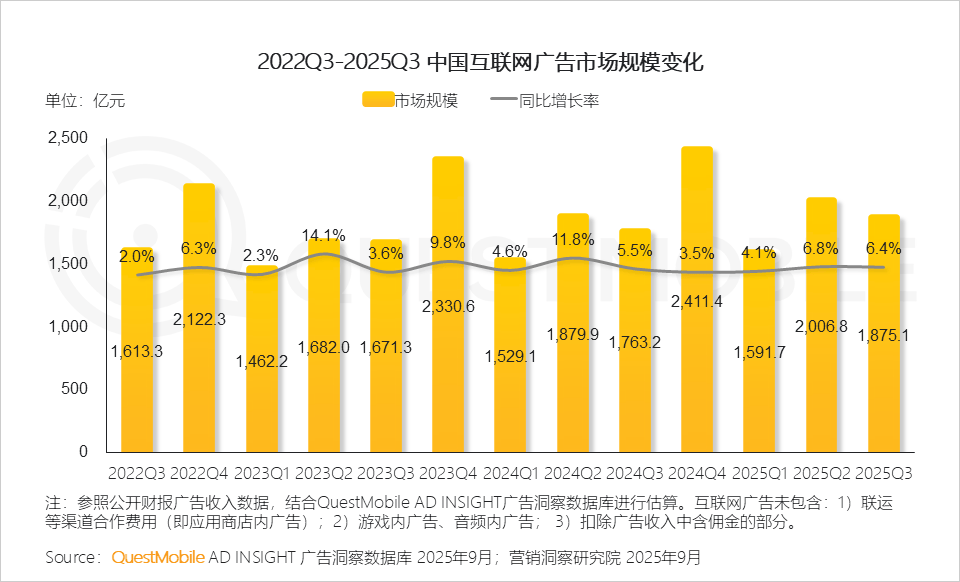
Core Insights - The report by QuestMobile indicates that as of September 2025, the total number of internet users in China reached 1.269 billion, marking a 2% year-on-year increase, with average monthly usage time per user at 178.2 hours, up 8.2%, the highest growth rate in nearly a year [1] - The mobile internet industry is entering a phase of high-quality development, reflected in the rapid growth of the internet advertising market, which reached 187.51 billion yuan in Q3 2025, a 6.4% year-on-year increase [1] Group 1: User Demographics and Trends - The user structure of China's mobile internet is evolving towards a healthier demographic, with first-tier city users accounting for 11.2% of the total, a 0.8% increase year-on-year [3] - Users with online consumption capabilities between 1,000 to 2,999 yuan represent 63% of the total, up 0.9% year-on-year, while users aged 46 and above make up 37.7%, an increase of 1.1% [3][5] Group 2: Advertising Market Dynamics - The soft advertising market is becoming a battleground for various industries, driven by lower costs and more direct conversion effects, aligning with the current shift towards a "trust economy" [3][5] - Marketing strategies are focusing on quickly attracting traffic and achieving conversion loops, with brands leveraging IP collaborations and celebrity endorsements to enhance conversion rates [5] Group 3: Seasonal Marketing Trends - Marketing activities are increasingly aligned with seasonal events, with significant peaks during occasions like Qixi Festival and Mid-Autumn Festival, which serve as key marketing opportunities [7] Group 4: Hard Advertising Strategies - Hard advertising is stabilizing but is becoming more precise and aggressive in response to intensified competition and innovation within the industry [8] - Key players in hard advertising include beauty, personal care, luxury goods, and healthcare sectors, with basic consumer goods also showing strong growth [9] Group 5: E-commerce and Competitive Landscape - The competition among e-commerce platforms is intensifying, with advertising strategies closely tied to business layouts and subsidy plans, emphasizing precision and aggressiveness [11] - Major platforms like Taobao and Douyin are seeing significant budget allocations due to their high transaction proximity and user engagement [13]

南极电商:不存在未披露重大风险事项
Sou Hu Cai Jing· 2025-10-31 09:03
Core Viewpoint - The company, Nanji E-commerce, is addressing investor concerns regarding its declining stock price and the stability of its main revenue source, the mobile internet media advertising business, which has a low gross margin of around 5% [1] Group 1: Business Performance - The mobile internet media advertising business has maintained a low gross margin of approximately 5%, raising questions about its profitability stability [1] - The company is actively optimizing traditional business lines and restructuring to reduce costs and improve efficiency [1] Group 2: Future Strategy - The company plans to deepen penetration in vertical industries while expanding into emerging industry opportunities, focusing on providing precise and effective advertising services to clients [1] - The company has outlined a strategy to gradually open up domestic and international market opportunities through its Apple business line by 2025 [1] Group 3: Risk Disclosure - The company has confirmed that it complies with legal disclosure requirements and does not have any undisclosed significant risks that could impact its operations, such as large goodwill impairments or termination of important partnerships [1]
宝宝巴士擦边广告背后,隐形的第三方广告联盟正在失控?
Guan Cha Zhe Wang· 2025-10-29 10:13
Core Viewpoint - The company "宝宝巴士" is facing significant challenges regarding the control of advertising content on its platforms, particularly after inappropriate ads were displayed on its children's app, raising public concern about the safety and appropriateness of content for children [1][9]. Revenue Model - "宝宝巴士" generates revenue through four main channels: programmatic advertising via its apps, licensing audio and video products, sales of educational merchandise, and user subscriptions [1]. - In 2020, the app cooperation promotion revenue was the primary source of income, amounting to 498 million yuan, which constituted 76.76% of total revenue, while audio and video licensing revenue was only 130 million yuan, accounting for 20.04% [1][6]. Advertising Dependency and Transition - The company has recognized its heavy reliance on advertising and is actively pursuing a business model transformation, with advertising now accounting for less than 10% of total revenue [2][7]. - Despite the reduced reliance on advertising, the company still faces challenges in managing ad content and preventing infringement issues within its app promotion partnerships [2][7]. Public Response and Remediation - Following the incident involving inappropriate ads, "宝宝巴士" issued an apology and announced immediate actions to rectify the situation, including the removal of problematic ads and a comprehensive internal review [3]. - The company has committed to enhancing its advertising review processes and has initiated the development of a mandatory ad interception feature to prevent similar issues in the future [3][12]. Market Position and User Engagement - "宝宝巴士" is a leading provider of digital content for children's education, with a significant user base and high engagement metrics, including being ranked first in monthly play counts for children's songs on major platforms [3]. - The company emphasizes its commitment to maintaining its core values and encourages user oversight to improve its services for children's educational content [4]. Quality Control Issues - In addition to advertising concerns, "宝宝巴士" has faced complaints regarding the quality of its products, such as the "点读笔" (reading pen), with customers expressing dissatisfaction over warranty claims and perceived poor service [5]. Regulatory Challenges - The company has been reported multiple times for software violations, including inadequate disclosure of app information, highlighting ongoing regulatory challenges in the digital content space [6][11]. - The broader issue of advertising content control reflects systemic problems within the internet advertising ecosystem, where third-party ad networks and SDKs complicate content management and regulatory compliance [9][12].
