
大气污染治理

Search documents
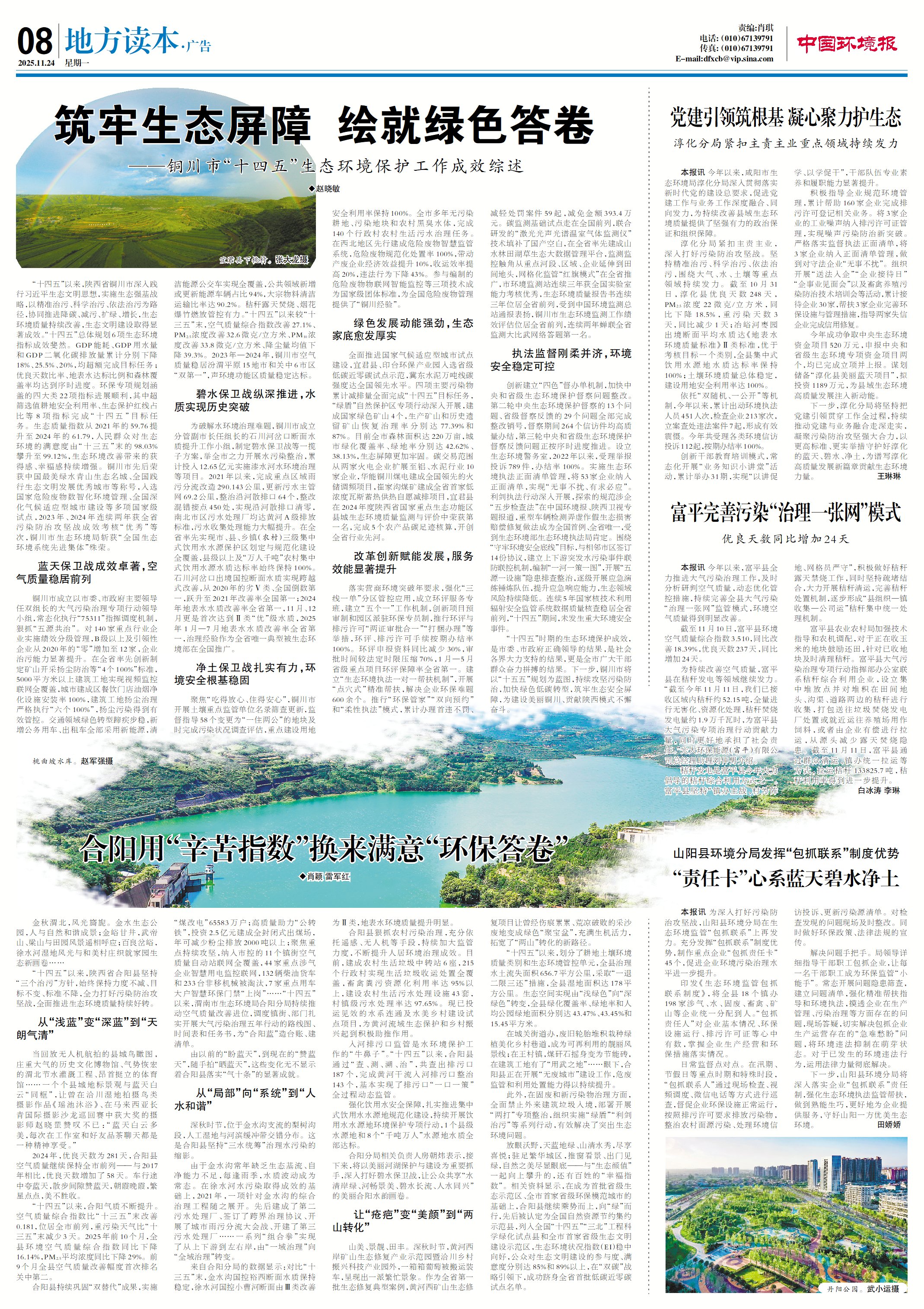
铜川│筑牢生态屏障 绘就绿色答卷
Zhong Guo Huan Jing Bao· 2025-11-24 00:46
Core Viewpoint - The ecological environment protection efforts in Tongchuan City during the "14th Five-Year Plan" period have yielded significant results, with continuous improvement in ecological quality and various environmental indicators exceeding targets [1][13]. Group 1: Ecological Environment Improvement - The city has achieved a 100% safety utilization rate of arable land, with no pollution in farmland and rural black and odorous water bodies [1][16]. - Key ecological indicators show a decrease in GDP energy consumption, water usage, and carbon dioxide emissions by 18%, 25.5%, and 20% respectively, all exceeding targets [1][13]. - The ecological quality index improved from 59.76 in 2021 to 61.79 in 2024, and public satisfaction with the ecological environment rose from 98.03% to 99.12% [1][13]. Group 2: Air Quality Improvement - The air quality index improved by 27.1% since the end of the "13th Five-Year Plan," with PM2.5 and PM10 concentrations decreasing by 32.6 µg/m³ and 33.8 µg/m³ respectively [2][14]. - The city has implemented a "75311" command and dispatch mechanism for air pollution control, leading to a significant increase in the number of enterprises with improved pollution control capabilities [2][14]. Group 3: Water Quality Management - A total investment of 12.65 billion yuan has been made for water environment governance, with significant improvements in water quality, including the transformation of the Shichuan River from a poor quality to a national leading improvement rate [3][15]. - The city achieved a 100% compliance rate for drinking water source protection areas, ensuring safe drinking water for the population [3][15]. Group 4: Soil and Waste Management - The city has established a hazardous waste smart supervision system, achieving a 100% standardized disposal rate for hazardous waste, which has improved economic efficiency for waste-producing enterprises by 10% [4][16]. - The city has completed rural sewage treatment tasks in 140 administrative villages, ensuring no polluted farmland or black and odorous water bodies [4][16]. Group 5: Green Development Initiatives - The city has made strides in green development, with significant reductions in four major pollutants and the establishment of four national green mines [5][17]. - The forest area has reached 2.2 million acres, with urban greening coverage rates of 42.62% and green space rates of 38.13% [5][17]. Group 6: Reform and Innovation in Environmental Services - The city has implemented a series of reforms to enhance environmental service efficiency, achieving a 100% on-time completion rate for environmental assessments and permits [6][18]. - The approval time for environmental assessments has been reduced by 70%, and the city has established a one-on-one assistance mechanism for environmental law enforcement [6][18]. Group 7: Future Plans - The city aims to continue its efforts in pollution prevention and green low-carbon transformation, laying a solid ecological safety foundation for future development [20].

“全运蓝”背后的广东密码:精准治污守护湾区蓝天
Zhong Guo Huan Jing Bao· 2025-11-24 00:46
Core Points - The successful air quality management during the opening ceremony of the 15th National Games in Guangdong is attributed to systematic strategies and advanced technologies implemented by the provincial government [1][2][3][4][5][6] Group 1: Air Quality Management Strategies - Guangdong's air quality management for the National Games was initiated with the "Beautiful National Games" concept proposed in April 2024, establishing high standards for environmental quality [2] - A comprehensive plan was developed, guiding 21 cities to create localized strategies for air quality management, utilizing a differentiated control list for 16,700 pollution sources [2] - A series of measures, including ultra-low emission renovations and the elimination of old vehicles, were implemented to ensure air quality during the event [2] Group 2: Technological Innovations - The air quality management system in Guangdong transitioned to a "digital intelligence" phase, utilizing big data, AI, and IoT technologies for real-time monitoring and rapid response [3] - High-precision monitoring equipment enabled the identification of pollution sources down to individual vehicles, allowing for immediate detection of abnormal emissions [3] - Advanced technologies such as hyperspectral scanning and AI recognition were employed to monitor and trace particulate matter and other pollutants in real-time [3] Group 3: Collaborative Efforts - Guangdong coordinated with neighboring provinces to enhance regional air quality monitoring and control, establishing a collaborative defense against external pollution [4][5] - A daily command and dispatch system was set up, involving multiple environmental monitoring agencies to ensure effective air quality forecasting and response [5] - Expert consultations were held prior to the opening ceremony to assess pollution risks and ensure effective management strategies were in place [5][6] Group 4: Ongoing Commitment - The air quality management efforts continue throughout the National Games, with daily assessments and support teams deployed to maintain air quality standards [6] - The successful experience from the opening ceremony serves as a model for ongoing air quality management during the events [6]
凯龙高科:11月21日召开董事会会议
Mei Ri Jing Ji Xin Wen· 2025-11-21 11:05
Group 1 - The core point of the article is that Kailong High-Tech (SZ 300912) held a temporary board meeting on November 21, 2025, to review proposals related to external investments and related transactions [1] - For the fiscal year 2024, the revenue composition of Kailong High-Tech is reported to be 99.93% from air pollution control and 0.07% from other sources [1] - As of the report date, the market capitalization of Kailong High-Tech is valued at 1.9 billion yuan [1]
同兴科技:欧盟通过环保法案对公司未来经营具有一定的积极影响
Zheng Quan Ri Bao Zhi Sheng· 2025-11-12 08:41
Core Viewpoint - The European Union's new environmental legislation aligns with the company's "one body, two wings" strategic layout, positively impacting its future operations [1] Group 1: Air Pollution Control - The company has achieved international leading standards in low-temperature SCR denitration catalyst technology, applicable across over 20 industries including steel, coking, and building materials [1] - The company's self-developed Tx-1 carbon capture absorbent exhibits 20-300 times higher antioxidant capacity compared to competitors [1] Group 2: Carbon Capture Utilization and Storage (CCUS) - The innovative TXio carbon capture process enhances carbon capture efficiency to over 90%, with energy consumption reduced to 2.0-2.2 GJ/tCO2, successfully applied in a 10,000-ton marine installation [1] Group 3: Sodium-Ion Battery - The company's sodium-ion batteries maintain nearly 90% capacity at -40°C, suitable for European household energy storage applications [1] - The production of sodium-ion batteries requires no cobalt and minimal nickel, leveraging abundant and easily extractable sodium resources, offering significant low-carbon advantages over lithium-ion batteries [1] - Due to their low cost and high safety, sodium-ion batteries are ideal for large-scale energy storage systems, effectively storing intermittent energy sources like wind and solar, thus greatly promoting decarbonization of the power system [1] Group 4: Future Outlook - The company will continue to monitor EU environmental policy developments, leveraging its technological advantages and market positioning to actively seize policy benefits and expand related business [1]

同兴科技:公司钠离子电池在-40℃环境下保持近90%容量,适配欧洲户用储能等应用场
Mei Ri Jing Ji Xin Wen· 2025-11-12 01:18
Core Viewpoint - The EU's environmental legislation is expected to have a positive impact on the company's operations, aligning with its "one body, two wings" strategic layout [2]. Group 1: Environmental Legislation Impact - The EU's focus on carbon reduction, pollution control, and sustainable development aligns with the company's strategic goals [2]. - The company plans to leverage its technological advantages and market positioning to capitalize on policy benefits [2]. Group 2: Core Business Areas - In air pollution control, the company’s low-temperature SCR denitration catalyst technology is at an internationally leading level, applicable in over 20 industries including steel, coking, and building materials [2]. - In the CCUS field, the company has developed a long-life Tx-1 carbon capture absorbent, with antioxidant capabilities improved by 20-300 times compared to competitors [2]. - The company’s innovative TXio carbon capture process achieves over 90% carbon capture efficiency, with energy consumption reduced to 2.0-2.2 GJ/tCO2, successfully applied in large-scale marine installations [2]. Group 3: Sodium-Ion Battery Development - The company’s sodium-ion batteries maintain nearly 90% capacity at -40°C, suitable for European residential energy storage applications [2]. - The production of sodium-ion batteries requires no cobalt and minimal nickel, utilizing abundant and easily extractable sodium resources, offering significant low-carbon advantages over lithium-ion batteries [2]. - Sodium-ion batteries are considered ideal for large-scale energy storage systems due to their low cost and high safety, effectively storing intermittent energy sources like wind and solar, thus promoting decarbonization of the power system [2].
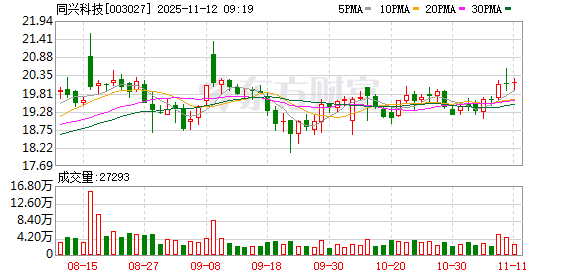
同兴科技:11月4日召开董事会会议
Mei Ri Jing Ji Xin Wen· 2025-11-04 09:48
Company Summary - Tongxing Technology (SZ 003027) announced the convening of its fifth board meeting on November 4, 2025, to discuss the appointment of a new CFO and other related documents [1] - For the first half of 2025, Tongxing Technology's revenue composition was 99.7% from the air pollution control industry and 0.3% from other businesses [1] - As of the report date, Tongxing Technology's market capitalization was 2.5 billion yuan [1] Industry Summary - A significant increase in overseas orders for the industry, with a reported growth of 246%, covering over 50 countries and regions [1] - Industry entrepreneurs have raised concerns about some companies selling products at a loss, warning of potential vicious competition expanding into overseas markets [1]
将PM10和NO2削减任务纳入计划 成都启动秋冬季大气污染防治攻坚战
Si Chuan Ri Bao· 2025-10-31 06:37
Core Viewpoint - Chengdu has launched a comprehensive air pollution prevention campaign for the autumn and winter seasons, focusing on reducing PM10 and NO2 emissions as part of its "14th Five-Year Plan" for air quality improvement [1][2] Group 1: Air Quality Improvement Goals - As of October 28, Chengdu recorded 251 days of good air quality this year, an increase of 15 days year-on-year [1] - The concentrations of major pollutants PM2.5 and PM10 were 28 and 44 micrograms per cubic meter, showing year-on-year decreases of 6.7% and 6.4% respectively; however, NO2 concentration increased by 9.1% to 24 micrograms per cubic meter [1] Group 2: Governance Strategies - The campaign will focus on three main areas: governance thinking, governance methods, and governance structure [1] - Governance thinking emphasizes source prevention, including control of mobile sources, industrial sources, and dust sources [2] - In mobile source control, a phased and regional approach will be taken to limit the use of older vehicles, promoting the use of new energy construction waste transport vehicles and concrete transport vehicles within certain areas [1][2] Group 3: Technological and Community Engagement - The campaign will enhance smart and precise governance by installing power monitoring devices in key industries to prevent illegal emissions [2] - A comprehensive monitoring network will be established using advanced technologies such as satellite remote sensing to trace pollution sources accurately [2] - Community engagement will be deepened by integrating air pollution prevention efforts with the construction of beautiful communities, ensuring accountability at the smallest social units [2]
清新环境:公司将持续发挥在火电烟气治理领域长期积累的技术优势与品牌影响力
Zheng Quan Ri Bao Wang· 2025-10-30 08:09
Core Viewpoint - The company aims to leverage its long-standing technical advantages and brand influence in the thermal power flue gas treatment sector while actively seizing development opportunities presented by the construction of a new power system in the country [1] Group 1: Business Strategy - The company is actively laying out plans in the renewable energy sector and closely monitoring the development trends of cutting-edge energy technologies [1] - The company is steadily advancing the optimization of its business structure and strategic transformation [1] Group 2: Project Implementation - The company's wholly-owned subsidiary, Guorun Water, has successfully implemented pilot "water + photovoltaic" power generation projects in multiple locations in Sichuan Province, achieving significant results [1]

亚洲清洁空气中心发布《大气中国2025 | 中国大气污染防治最佳实践》——记录大气污染防治典型,分享减污降碳领先经验
Zhong Guo Neng Yuan Wang· 2025-10-24 11:56
Core Viewpoint - The report "Air Quality in China 2025: Best Practices for Air Pollution Prevention and Control" highlights significant achievements in air pollution control in China over the past decade, emphasizing the role of cities and regions in improving air quality through collaborative governance and innovative practices [1][3]. Group 1: Achievements in Air Quality Improvement - Since the implementation of the Clean Air Action in 2013, China's overall air quality has steadily improved, with PM2.5 annual average concentrations in 339 cities decreasing by 59% compared to 2013, and heavy pollution days reduced by over 90% [3][4]. - The report showcases exemplary practices from key cities and regions, aiming to provide replicable experiences for broader air quality improvement efforts [1][4]. Group 2: Innovative Practices and Case Studies - The report includes notable case studies such as the collaborative air pollution control in the Beijing-Tianjin-Hebei region, which has evolved into a representative model for regional governance [6][4]. - Shanghai's approach to VOCs (Volatile Organic Compounds) management has transitioned from individualized solutions to standardized management, enhancing regulatory efficiency [7][8]. - Chengdu's "near-zero carbon construction site" pilot project focuses on reducing emissions from construction activities, showcasing innovative practices in the construction industry [9][10]. Group 3: Future Challenges and Directions - As air pollution characteristics and demands evolve, the report indicates that China is entering a new phase of deepening and upgrading air pollution control efforts, necessitating enhanced regional cooperation and governance capabilities [4][11]. - Experts emphasize the need for improved forecasting capabilities and regulatory effectiveness to address ongoing challenges in air quality management [11][13].
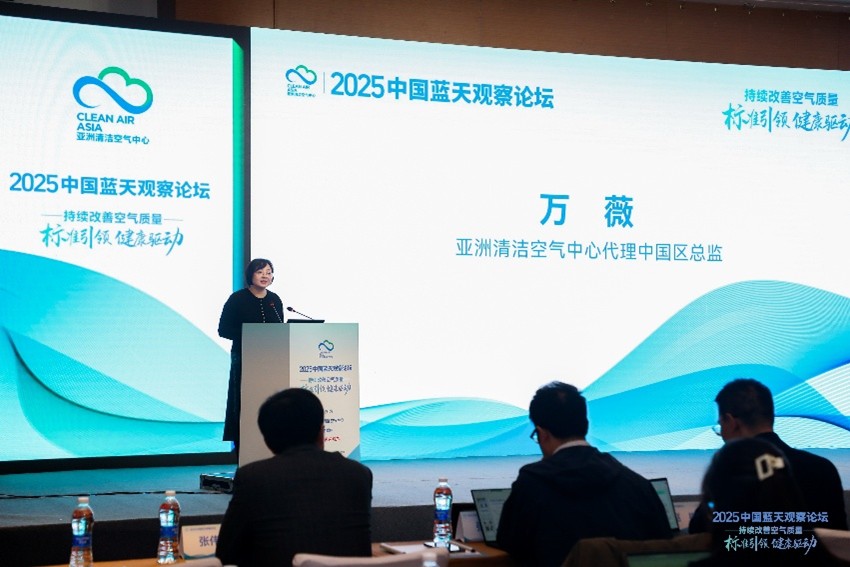
专家建议加严空气质量标准,驱动产业结构优化升级
Di Yi Cai Jing· 2025-10-24 11:49
Core Viewpoint - The article emphasizes the need for stricter air quality standards in China to drive industrial restructuring and improve public health, especially as the country transitions from the 14th Five-Year Plan to the 15th [1][4]. Group 1: Air Quality Improvement - Since the implementation of the Clean Air Action in 2013, China has seen a significant reduction in PM2.5 levels, with an overall annual average concentration decrease of 59% by 2024 compared to 2013 [3]. - The annual report highlights successful local practices in air pollution control, such as the collaborative efforts in the Beijing-Tianjin-Hebei region and Shanghai's VOCs management [2][3]. Group 2: Policy and Management Innovations - Shanghai has pioneered industrial VOCs governance since 2007, evolving from individualized solutions to standardized management approaches, enhancing regulatory efficiency [2][3]. - The establishment of a comprehensive data management system in Shanghai has improved real-time monitoring of vehicle emissions, addressing traditional regulatory challenges [3]. Group 3: Future Challenges and Recommendations - Experts indicate that as pollution characteristics evolve, there is a need for enhanced forecasting capabilities and improved regulatory effectiveness to tackle persistent pollution issues [4][5]. - Recommendations include focusing on structural adjustments in energy, industry, and transportation sectors to meet new standards and maximize health benefits while ensuring high-quality economic development [6].