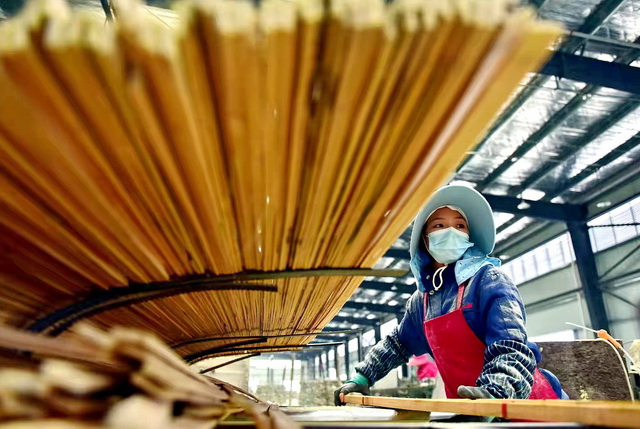
竹制品加工

Search documents
从矿坑重生到竹业价值再造,安吉实践解码可持续发展“两条路径”
Zhong Guo Zheng Quan Bao· 2025-09-04 15:06
Core Insights - The transformation of a former mining site in Anji County into a popular ecological tourism destination demonstrates the successful implementation of sustainable development practices [1][2][8] - The "Deep Blue Project" employs a three-step approach for ecological restoration, economic development, and community profit-sharing [2][3] - The bamboo industry in Anji County showcases the potential for carbon trading and the creation of high-value products, contributing to local economic growth [4][5][6] Group 1: Ecological Transformation - The former mining site has been converted into a scenic area with a café that sells over 8,000 cups of coffee daily, achieving annual revenue comparable to past mining operations [2] - The three-step method includes ecological restoration, micro-transformations for economic benefits, and a profit-sharing model that ensures community involvement [2][3] - The project has generated sales of 50 million yuan in two years and increased collective income by over 6 million yuan [2] Group 2: Bamboo Industry Development - Anji County's bamboo forests have a carbon sequestration capacity 1.5 times greater than that of equivalent forest areas, with an annual carbon sink increase of 120,000 tons [4][5] - The establishment of a carbon trading platform has allowed local villagers to earn an average of 85,000 yuan annually from bamboo carbon credits [4] - The bamboo industry has expanded from basic products to high-value items, including bamboo toothbrushes and bamboo-based construction materials, contributing significantly to local employment and income [5][6] Group 3: Green Manufacturing and High-Quality Development - Companies in Anji County are adopting green production practices, with a focus on reducing carbon emissions and enhancing energy efficiency [7] - Henglin Co., a listed company, has implemented solar energy solutions that generate approximately 18 million kWh annually, reducing CO2 emissions by over 28,000 tons [7] - The integration of intelligent manufacturing and green production is seen as essential for companies aiming to compete on the international stage [7][8]
重庆忠县竹制品走俏马来西亚
Ren Min Ri Bao· 2025-08-11 22:01
Core Insights - Chongqing's Zhongxian County has significantly increased exports of bamboo fiber eco-friendly tableware to Malaysia, capturing 15% of the local biodegradable tableware market [1] - The county has developed over 100,000 acres of bamboo material bases and processes 300 million sets of bamboo fiber products annually, with over 60% of these products exported [1] Group 1 - Zhongxian County's bamboo fiber eco-friendly tableware includes various products such as plates, forks, chopsticks, spoons, and cups [1] - The products have successfully entered 23 local chain supermarkets in major Malaysian cities like Kuala Lumpur and Johor Bahru [1] - The county is recognized as an important production area for global bamboo fiber eco-friendly products [1] Group 2 - The development strategy focuses on replacing plastic with bamboo, promoting high-quality industrial growth [1] - The bamboo industry in Zhongxian has seen significant advancements in resource cultivation, deep processing, and product design and manufacturing [1] - The county's bamboo fiber product exports contribute to its status as a key player in the eco-friendly product market [1]
山水间颜色更亮,百姓日子焕然一新!解码“生态美”滋养“百姓富”转化密码
Yang Shi Wang· 2025-08-11 08:05
Group 1 - The concept of "Lucid waters and lush mountains are invaluable assets" has been guiding China's ecological and developmental transformation for 20 years, leading to a harmonious coexistence of ecology and development [1][3][19] - Anji County has transitioned from pollution and mining to green development, achieving a per capita income of 74,000 yuan in 2024, showcasing the benefits of ecological restoration [3][4][19] - The local economy has diversified with bamboo forests generating income through carbon trading and sustainable practices, leading to increased earnings for villagers [11][13] Group 2 - Anji County has seen a significant rise in tourism, with over 300 coffee shops established, transforming former mining sites into popular attractions [15][17] - The ecological environment in Yichun, Heilongjiang, has also improved, with the number of farmhouses in the scenic area increasing from 1 to 42 since 2016, driven by tourism [22][24] - Yichun's forest coverage rate is 83.8%, significantly above the national average, contributing to an estimated ecological product value of 4.24 trillion yuan annually from 2021 to 2023 [31][33]

经济聚焦丨山城怀化何以成功打造国际陆港
Ren Min Ri Bao· 2025-07-30 05:12
Core Insights - Hunan Huaihua is integrating into the Western Land-Sea New Corridor, focusing on developing an international land port and enhancing open platforms to promote local industries such as bags and bamboo products [1][2][3] Trade Growth - In 2024, Huaihua's trade with ASEAN increased by 28.9%, marking three consecutive years of leading foreign trade growth in Hunan Province [1] - From 2022 to 2024, Huaihua's import and export volume with RCEP countries grew at an average annual rate of 87.23% [1] Logistics and Transportation - Huaihua International Land Port saw a 31% year-on-year increase in train shipments, with 601 trains dispatched in the first half of the year [1] - The cost of transporting a 40-foot container of agricultural machinery has decreased from 32,000 yuan to approximately 17,000 yuan due to optimized rail services [4] Industrial Development - The bag manufacturing industry in Huaihua has rapidly developed, with 37 bag companies established in two years, achieving an annual output value exceeding 1.7 billion yuan [6][7] - Huaihua's bag export value reached 260 million yuan in the first half of the year, reflecting an 80.2% year-on-year increase [7] Policy and Infrastructure - The implementation of a tax refund policy for export enterprises has significantly reduced the refund period by 5 to 10 days [10] - A multi-modal transport center at Huaihua International Land Port is set to enhance logistics efficiency, with a capacity of 100,000 TEUs annually [10][11] Future Goals - Huaihua aims to achieve a target of 1,000 train services, 1,000 tons of cargo throughput, and a total output value of 100 billion yuan by 2026 [8]
山城怀化何以成功打造国际陆港
Sou Hu Cai Jing· 2025-07-30 00:11
Core Insights - Hunan Huaihua is leveraging the construction of the Western Land-Sea New Corridor to enhance its international land port, driving high-quality development through the growth of port-related industries such as luggage and bamboo products [1][8] Trade Growth - In 2024, Huaihua's trade with ASEAN is expected to grow by 28.9% year-on-year, marking three consecutive years of leading foreign trade growth in Hunan Province [1] - From 2022 to 2024, Huaihua's import and export volume with other RCEP member countries is projected to grow at an annual rate of 87.23% [1] Logistics and Transportation - Huaihua International Land Port has seen a 31% year-on-year increase in the number of trains dispatched, totaling 601 in the first half of the year [1] - The cost of transporting a 40-foot container of agricultural machinery has decreased from 32,000 yuan to approximately 17,000 yuan due to the establishment of regular train services [4] - A new "scatter to gather" rail transport method has improved transport efficiency by 50% and reduced logistics costs by 30% for chemical products shipped to Vietnam [4] Industrial Development - Huaihua has attracted 172 enterprises in the luggage industry, achieving a production value exceeding 4 billion yuan within two years [7] - The luggage export value reached 260 million yuan in the first half of the year, reflecting an 80.2% year-on-year increase [7] Policy and Infrastructure - The implementation of a tax refund policy for exports has significantly shortened the refund period by 5-10 days, enhancing operational efficiency for local businesses [9] - The Huaihua International Land Port Multi-Modal Transport Center, with a capacity of 100,000 TEUs annually, is set to open in October [10] - New measures from Changsha Customs aim to promote seamless connections between various transport modes, supporting the development of Huaihua as an ASEAN cargo hub [10]
山城怀化何以成功打造国际陆港(经济聚焦)
Ren Min Ri Bao· 2025-07-29 22:42
Core Viewpoint - Hunan Huaihua is leveraging the construction of the Western Land-Sea New Corridor to enhance its international land port, optimize its institutional environment, and promote the development of port-related industries such as luggage and bamboo products, achieving high-quality economic growth [1][5]. Group 1: Trade Growth and Economic Impact - In 2024, Huaihua's trade with ASEAN increased by 28.9% year-on-year, marking three consecutive years of leading foreign trade growth in Hunan Province [1]. - From 2022 to 2024, Huaihua's import and export volume with other RCEP member countries grew at an average annual rate of 87.23% [1]. - In the first half of this year, Huaihua International Land Port dispatched 601 trains, a year-on-year increase of 31% [1]. Group 2: Logistics and Transportation Efficiency - The new logistics model allows for faster and cheaper transportation of goods, with the cost of transporting a 40-foot container dropping from 32,000 yuan to approximately 17,000 yuan [4]. - The Huaihua International Land Port has established a regular train service to Vientiane, significantly reducing transportation time from 25 days to as little as 5 days [4]. - A recent collaboration improved cross-border transport efficiency by 50% and reduced logistics costs by 30% for chemical products transported from Northwest China to Vietnam [4]. Group 3: Industrial Development and Investment - Huaihua has attracted 172 enterprises in the luggage industry, achieving a production value exceeding 4 billion yuan within two years [7]. - The local government has facilitated the establishment of a luggage manufacturing project with an investment of 500 million yuan, aiming for an annual production capacity of 6 million pieces [6]. - The bamboo industry in Huaihua has also seen significant growth, with exports projected to reach over 20 million yuan in 2024 [8]. Group 4: Policy and Infrastructure Enhancements - New policies such as immediate tax refunds for export enterprises have been implemented, reducing the refund cycle by 5 to 10 days [9]. - The Huaihua International Land Port's multi-modal transport center, set to open in October, will enhance logistics capabilities with a capacity of 100,000 TEUs annually [10]. - The establishment of a legal service area and cold chain logistics center aims to fill service gaps in the outward-oriented economy [10].

深度对接国家战略推动港产城一体化发展 山城怀化何以成功打造国际陆港(经济聚焦)
Ren Min Ri Bao· 2025-07-29 21:55
Core Viewpoint - Hunan Huaihua is leveraging the construction of the Western Land-Sea New Corridor to enhance its international land port, optimize its institutional environment, and promote the development of port-related industries such as luggage and bamboo products, achieving high-quality economic growth [1][5]. Trade Growth and Economic Data - In 2024, Huaihua's trade with ASEAN is expected to grow by 28.9% year-on-year, with foreign trade import and export growth rates leading Hunan Province for three consecutive years [1]. - From 2022 to 2024, Huaihua's import and export volume with other RCEP member countries is projected to grow at an annual rate of 87.23% [1]. - In the first half of this year, Huaihua International Land Port dispatched 601 trains, marking a 31% increase year-on-year [1]. Logistics and Transportation Efficiency - The shift in logistics from traditional routes to Huaihua has improved efficiency and reduced costs, with transportation time for agricultural machinery reduced from 25 days to 5 days [4]. - The cost of transporting a 40-foot container has decreased from 32,000 yuan to approximately 17,000 yuan [4]. - A new "scatter to gather" cross-border transport method has improved transport efficiency by 50% and reduced logistics costs by 30% [4]. Industrial Development and Investment - Huaihua has attracted 172 enterprises in the luggage industry, achieving a production value exceeding 4 billion yuan within two years [7]. - The local government has facilitated the establishment of a luggage manufacturing project with an investment of 500 million yuan, producing 6 million pieces annually [6][7]. - The bamboo industry is also thriving, with exports expected to reach over 20 million yuan in 2024 due to successful international certifications [8]. Policy and Infrastructure Enhancements - New policies such as immediate tax refunds for export enterprises have been implemented, significantly reducing the tax refund cycle by 5 to 10 days [9]. - The Huaihua International Land Port's multi-modal transport center is set to enhance logistics capabilities with a capacity of 100,000 TEUs annually [10]. - The establishment of a legal service area and cold chain logistics center aims to fill service gaps in the outward-oriented economy [10].
湖南靖州:竹产业项目加速推进 打通出海“快车道”
Yang Shi Wang· 2025-07-28 02:06
Group 1: Company Overview - Hunan Linggao New Materials Co., Ltd. has established a bamboo fiber technology product production line in Jingzhou, with a total investment of 1.25 billion yuan, covering an area of 167 acres [1] - The project is divided into two phases: Phase 1 involves an investment of 400 million yuan for an annual production capacity of 30,000 tons of bamboo fiber products, while Phase 2 involves an investment of 850 million yuan for an annual production capacity of 120,000 tons of bamboo fiber and 130,000 tons of organic fertilizer [1] - The company has signed contracts with over 10 domestic and international clients, with an expected transaction amount of 350 million yuan [1] Group 2: Production and Efficiency - The production line is capable of mass production, requiring only six processes from bamboo strips to finished products, with energy consumption reduced by 15% compared to traditional methods [2] - The first batch of orders primarily consists of bamboo fiber molded products, with a target shipping date set for August 15 [2] - Hunan Yiyou New Materials Technology Co., Ltd. has also established operations in Jingzhou, completing its project within eight months and producing 60,000 cubic meters of bamboo truck flooring annually [2] Group 3: Industry Growth and Impact - Jingzhou has attracted over 40 bamboo processing enterprises, including six large-scale companies and two provincial leading enterprises, due to its abundant bamboo resources and favorable business environment [3] - The county's bamboo processing capacity is projected to reach 600,000 tons in 2024, with a comprehensive industry output value of 3.06 billion yuan [3] - The bamboo industry is expected to create over 500 jobs and generate tax revenue exceeding 50 million yuan [1]
“以竹代塑”产业潜力大
Jing Ji Ri Bao· 2025-07-21 22:07
Core Viewpoint - The "bamboo instead of plastic" industry in China is rapidly developing as a sustainable alternative to traditional plastic, driven by environmental concerns and government initiatives [1][2][3]. Industry Development - The global plastic waste production is approximately 400 million tons annually, with only 9% being recycled, leading to significant environmental pollution [1]. - China is the largest plastic producer, accounting for about 30% of global production, and is facing increasing pressure to find sustainable alternatives [1]. - Bamboo is identified as an ideal substitute for plastic due to its rapid growth, mechanical properties, and carbon sequestration capabilities [1]. Government Initiatives - The "14th Five-Year Plan for Plastic Pollution Control" promotes the scientific and steady introduction of plastic alternatives, with "bamboo instead of plastic" included in international dialogues [2]. - A global action plan for "bamboo instead of plastic" was launched for 2023-2030, aiming to establish a robust industry framework by 2025 [2]. - The National Development and Reform Commission and other agencies have set goals for increasing the comprehensive added value of bamboo products by over 20% by 2025 [2]. Market Potential - China possesses a rich bamboo resource base, with 39 genera and 837 species, representing 51% of the world's bamboo varieties [3]. - The bamboo industry is projected to exceed 500 billion yuan in value by 2024, with bamboo product exports reaching 2.3 billion USD [3]. - Innovations in bamboo products include bamboo fiber containers, straws, and durable goods, which have successfully entered the market [3]. Challenges and Shortcomings - Despite the advantages, bamboo utilization rates remain low, with only about 20% of bamboo resources being effectively used [6]. - The bamboo processing sector is primarily composed of small and medium-sized enterprises, lacking advanced mechanization and automation [6]. - There is a need for improved research and development capabilities within the bamboo industry to enhance product quality and market competitiveness [8]. Future Directions - The focus should be on scaling up production and creating industrial clusters for "bamboo instead of plastic" to achieve efficient resource utilization [8]. - Emphasis on technological innovation and the development of high-quality products is essential for the industry's sustainable growth [8]. - Collaboration between government and enterprises is crucial to enhance market competitiveness and control costs [8].
加速释放市场潜力,4大类25种“以竹代塑”产品名录敲定
Di Yi Cai Jing· 2025-07-08 03:23
Core Insights - The "Bamboo Substitute for Plastic" initiative is gaining momentum in China, with the release of the "2025 Product Catalog" aimed at expanding application areas and enhancing plastic pollution management [1][2]. Group 1: Market Potential and Growth - China's bamboo industry is projected to exceed 1 trillion yuan in total output value by 2035, with bamboo processing enterprises exceeding 10,000 and industry output growing from 82 billion yuan in 2010 to 415.3 billion yuan in 2022, averaging over 30% annual growth [4][5]. - The "Bamboo Substitute for Plastic" industry aims to establish a preliminary industrial system by 2025, with a target of increasing the comprehensive added value of key products by over 20% compared to 2022 and improving bamboo utilization rates by 20 percentage points [2]. Group 2: Product Applications and Innovations - The new product catalog includes bamboo-based alternatives for various sectors, such as sports equipment (golf tees, skateboards), safety gear (helmets, barriers), and agricultural materials (seedling trays, bags) [5][6]. - Bamboo is recognized as a green, low-carbon, and biodegradable material, suitable for replacing non-biodegradable plastics in packaging, construction, and industrial applications [4][5]. Group 3: Challenges and Development Needs - The bamboo industry faces challenges such as low levels of large-scale development, insufficient intensive management, and a lack of high-quality products and sales channels, necessitating deeper product research and the cultivation of leading enterprises [6].