通用机械

Search documents
看好燃气轮机、人形机器人和核聚变 | 投研报告
Zhong Guo Neng Yuan Wang· 2025-12-01 03:05
Market Performance - The SW Machinery Equipment Index increased by 3.91% during the trading days from November 24 to November 28, 2025, ranking 7th among 31 primary industry categories [1] - Year-to-date performance shows the SW Machinery Equipment Index up by 30.48%, ranking 6th among the same categories, while the CSI 300 Index rose by 15.04% [1] Core Insights - The demand for gas turbines is expected to rise due to AI, with significant growth in power consumption from data centers in the U.S., projected to increase from 8.9 GW to 111.3 GW between 2025 and 2028 [2] - The turbine blades, being core components of gas turbines, face a global supply shortage, with 应流股份 positioned as a leading domestic supplier, already supplying blades for Siemens Energy and developing blades for H-class gas turbines [2] - 应流股份 has strengthened its collaboration with Baker Hughes, securing future orders for multiple gas turbine blades, indicating a robust outlook for export orders [2] Company Developments - 优必选 has secured two significant contracts totaling 4.07 billion yuan for humanoid robot projects, with the Walker series orders reaching 1.3 billion yuan for 2025 [3] - The company is expected to see a pivotal year in 2025 for humanoid robot deliveries and commercialization, coinciding with the IPO of 宇树科技 and Tesla's production ramp-up [3] - The 合肥 BEST fusion project has seen over 2 billion yuan in tenders in November alone, indicating an acceleration in fusion project bidding as construction progresses [3] Industry Trends - General machinery is under continuous pressure, while engineering machinery is accelerating upward [3] - The shipbuilding sector is experiencing a slowdown, oil service equipment is stabilizing at the bottom, railway equipment is steadily increasing, and gas turbines are showing stable growth [3]


看好燃气轮机、农机和人形机器人
SINOLINK SECURITIES· 2025-11-23 13:31
Investment Rating - The report does not explicitly state an investment rating for the industry [3]. Core Insights - Siemens Energy has raised its gas turbine production target, indicating strong demand for gas turbines, which benefits leading turbine blade manufacturer Yingliu. Siemens aims for a production capacity of 17GW in FY24, increasing to 22GW from 2025 to 2027, and exceeding 30GW from 2028 to 2030 [5][24]. - The tractor market showed stable data in October, with corn prices returning to positive year-on-year growth, suggesting a recovery in agricultural machinery demand [5][24]. - The robotics sector is approaching a pivotal moment with upcoming mass production from leading companies, highlighting the potential for domestic suppliers to break through [5][24]. - The general machinery sector remains under pressure, while engineering machinery is accelerating upward, and gas turbines are showing steady growth [5][24]. Summary by Sections Market Review - The SW Machinery Equipment Index fell by 4.78% in the week of November 17-21, 2025, ranking 13th among 31 primary industry categories. Year-to-date, the index has risen by 25.58%, ranking 6th [3][15]. Key Data Tracking - General Machinery: Continues to face pressure with a PMI of 49.0% in October, indicating contraction [23]. - Engineering Machinery: Sales of excavators reached 18,096 units in October, up 7.8% year-on-year, indicating a recovery [31]. - Railway Equipment: Steady growth with fixed asset investment maintaining around 6% [43]. - Gas Turbines: GEV's new gas turbine orders grew by 39% year-on-year in the first three quarters of 2025, reflecting strong industry demand [55][56]. Industry Dynamics - The report highlights significant developments in various sectors, including the acquisition of Mitsubishi Electric's motor business by Ebara and advancements in 3D printing technology by INTAMSYS [59][60].


韩称半数主力出口产业竞争力被中国赶超
Ke Ji Ri Bao· 2025-11-19 00:05
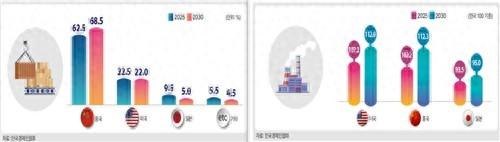
Core Insights - The report from the Korea Economic Association indicates that half of South Korea's top ten export industries have been surpassed by China in terms of competitiveness, with a prediction that all ten industries may fall behind China in five years [1][2] - A survey of 200 major companies in these industries revealed that 62.5% view China as their biggest competitor, with this figure expected to rise to 68.5% by 2030 [1] - The competitiveness index set by the surveyed companies ranks South Korea at 100, while China and the US are projected to surpass South Korea by 2030, with indices of 112.3 and 112.9 respectively [1] Industry Competitiveness - In specific sectors, Chinese companies lead in steel (112.7), general machinery (108.5), secondary batteries (108.4), displays (106.4), and automotive parts (102.4) [2] - South Korean companies still maintain an edge in semiconductors (99.3), electronics and electrical machinery (99), shipbuilding (96.7), petrochemicals and petroleum products (96.5), and biopharmaceuticals (89.2) [2] - The report highlights that China holds advantages in price competitiveness, production capacity, and government support, while South Korea only leads in brand competitiveness, which is expected to be overtaken in five years [2]
江西聚利通用机械有限公司成立 注册资本50万人民币
Sou Hu Cai Jing· 2025-11-18 03:22
Group 1 - The establishment of Jiangxi Julitong General Machinery Co., Ltd. has been recently registered with a legal representative named Zhang Xiaomei and a registered capital of 500,000 RMB [1] - The company's business scope includes manufacturing and wholesale of electronic (gas) physical equipment, electronic components, electronic vacuum devices, and other related electronic devices [1] - The company also engages in technical services, development, consulting, exchange, transfer, promotion, and digital technology services, operating independently under its business license [1]
最新报告:中国猛追,5年内韩国十大产业全线失守
Guan Cha Zhe Wang· 2025-11-18 00:34
Core Insights - The report from the Korea Economic Association indicates that half of South Korea's top ten export industries have been surpassed by China in terms of competitiveness, with a prediction that all ten industries may lose their competitive edge within five years [1][2]. Industry Competitiveness - A survey of 200 South Korean companies revealed that 62.5% identified China as their biggest competitor, significantly higher than the 22.5% who chose the United States and 9.5% who chose Japan. This perception is expected to increase, with 68.5% anticipating China as the main competitor by 2030 [1][2]. - The competitiveness levels, with South Korean companies using a standard of 100, are perceived as follows: the United States at 107.2, China at 102.2, and Japan at 93.5. By 2030, these levels are projected to be 112.9 for the U.S., 112.3 for China, and 95 for Japan, indicating a significant shift in competitiveness [2][4]. Sector Analysis - In specific sectors, South Korean companies believe that Chinese firms lead in steel (112.7), general machinery (108.5), batteries (108.4), displays (106.4), and automotive parts (102.4). However, South Korea still maintains an edge in semiconductors (99.3), electronics and electrical machinery (99), shipbuilding (96.7), petrochemicals (96.5), and biopharmaceuticals (89.2) [2][4]. - The report highlights that China has advantages in price competitiveness, production capacity, and government support, while the U.S. excels in branding, skilled talent, and core technologies. Currently, South Korea only leads in brand competitiveness, which is expected to be overtaken in five years [4][6].

42页深度 | 隆鑫通用:老牌摩托车及通机企业,无极等自主品牌加速全球拓展【国信汽车】
车中旭霞· 2025-11-16 09:29
Core Viewpoint - Longxin General is transitioning from OEM to developing its own brands, focusing on the motorcycle and general machinery sectors, with a strong emphasis on global expansion and product quality improvement through partnerships, particularly with BMW [14][15][16]. Group 1: Business Overview - Longxin General has diversified its product lines, including motorcycles, engines, ATVs, and general machinery, with a focus on the "motorcycle + general machinery" business model [3][20]. - The company aims for its motorcycle and general machinery business revenues to account for 75% and 21% of total revenue, respectively, by 2024 [3][22]. - The company has undergone a significant ownership change, with the new major shareholder being Zongshen New Manufacturing, which is expected to resolve industry competition issues [20][28]. Group 2: Market Expansion - The company is aggressively expanding its high-end motorcycle brand, Wujing, into European and South American markets, where it has already established brand recognition, particularly in Spain with a market share exceeding 5% [5][42]. - The global market for ATVs is projected to reach $15 billion by 2028, with Longxin General aiming to enhance its market share by leveraging its engine advantages [6][7]. - The company has seen a rise in motorcycle engine exports, supported by the increasing demand for Chinese motorcycles in international markets [9][43]. Group 3: Financial Performance - Longxin General's revenue has shown a compound annual growth rate (CAGR) of 10.2% from 2015 to 2024, with a significant recovery expected in 2024, driven by motorcycle exports and the recovery of general machinery business [34]. - The company's net profit is projected to increase by 92.3% in 2024, primarily due to reduced impairment losses and growth in high-end motorcycle sales [34][35]. - The gross margin is expected to improve to 17.6% in 2024, reflecting a recovery in profitability as the company reduces impairment losses and increases the share of high-margin products [35][40]. Group 4: Product Development - Longxin General has developed a comprehensive product matrix, including various types of motorcycles, engines, and general machinery, with a focus on high-performance and cost-effective products [25][31]. - The company has established stable partnerships with leading global manufacturers, enhancing its product quality and supply chain management capabilities [15][31]. - The product offerings include a wide range of motorcycles, from high-end models to ATVs, with a focus on meeting diverse market demands [25][26]. Group 5: Competitive Landscape - The global motorcycle market is dominated by Japanese and Indian brands, with Longxin General aiming to increase its market share through strategic international expansion [44][46]. - The company is positioned to benefit from the growing demand for motorcycles in emerging markets, particularly in South America and Southeast Asia, where it has identified significant growth opportunities [67][70]. - Longxin General's strategy includes a "1+N" market approach, focusing on deepening its presence in one market before expanding to similar markets, which is expected to enhance its competitive position [5][42].


鑫磊股份:11月12日召开董事会会议
Mei Ri Jing Ji Xin Wen· 2025-11-12 10:05
Group 1 - The company Xinlei Co., Ltd. (SZ 301317) held its 23rd meeting of the second session of the third board of directors on November 12, 2025, to review the proposal regarding the confirmation of the audit committee members and the convener [1] - For the year 2024, the company's revenue composition is entirely from the general machinery industry, accounting for 100.0% [1] - As of the report date, Xinlei Co., Ltd. has a market capitalization of 5.1 billion yuan [1]
宗申动力(001696) - 001696宗申动力投资者关系管理信息20251110
2025-11-10 09:18
Group 1: Company Overview and Strategic Direction - The company is focused on developing its aviation power business and has established a comprehensive layout in the aviation power sector, including piston, hybrid, and turbine power systems [3]. - The company has successfully built two major product systems in the new energy sector: electric drive systems and energy storage, covering various applications such as portable storage and hydrogen energy systems [3]. - The establishment of Chongqing Chenyu Technology Co., Ltd. aims to deepen the company's layout in the aviation power business and enhance its market influence [5]. Group 2: IPO and Financing Plans - The subsidiary Zongshen Aviation has terminated its IPO due to strategic development needs and changes in the capital market environment [2]. - The company plans to continue consolidating and expanding its business in the aviation power sector while seizing opportunities in the low-altitude economy [2]. - There are no disclosed plans for future IPOs or financing arrangements for Zongshen Aviation at this time [14]. Group 3: Market Performance and Investor Relations - The company has maintained a focus on its core business, aiming for steady growth and economic efficiency, while enhancing shareholder returns through high cash dividends [4]. - The company acknowledges the impact of macroeconomic factors, industry policies, and market sentiment on stock price fluctuations [11]. - The company is committed to improving information disclosure and engaging with institutional investors to enhance understanding of its operations [4]. Group 4: Product Development and Innovation - The company has launched a smart lawn mower product and plans to further develop its product layout based on market demand [9]. - The company is actively pursuing high-end, intelligent, and electric product transformations in its robotics sector [8]. - The company has made significant advancements in its industrial robotics sector, with a focus on automation and efficiency improvements [9]. Group 5: Future Growth and Market Strategy - The company aims to create a second growth curve through increased investment in new energy and aviation power sectors [3]. - The company is focused on enhancing its core competitiveness and market influence in the aviation power field [5]. - The company is exploring opportunities in the low-altitude economy and is committed to adapting to the evolving market landscape [2].

10月进出口点评:出口转跌非趋势,资本品出口潜力仍在
Orient Securities· 2025-11-10 08:21
Export Performance - October exports saw a significant decline, with a year-on-year growth rate dropping to -1.1%, down from 8.3% in September[5] - The decline was attributed to factors such as the Mid-Autumn Festival holiday misalignment and market expectations regarding the year-on-year base effect[5] - Despite the drop, the two-year compound growth rates for September and October exports remained stable at 5.3% and 5.5% respectively[5] Trade with the United States - Exports to the U.S. in October experienced a year-on-year decline of 25.2%, an improvement from the 33.1% drop in August[5] - Traditional consumer goods, including bags, shoes, and clothing, saw declines exceeding 10% in October[5] - The "overdraft effect" from previous U.S. import demand is expected to take time to fully dissipate, keeping short-term export figures low[5] Regional Trade Dynamics - Exports to ASEAN, Latin America, and India showed varying degrees of decline, but two-year compound growth rates indicated a recovery similar to that of U.S. exports, with increases of 2.9% to 3.4%[5] - The indirect trade channels between China and the U.S. remain significant, contributing to export stability[5] High-Tech and Capital Goods - Exports of high-tech products and capital goods, particularly in semiconductors, ships, and automobiles, showed strong performance in October, with year-on-year growth rates of 26.9%, 68.4%, and 34% respectively[5] - The growth in high-tech exports is largely driven by demand from countries involved in the Belt and Road Initiative[5] European Market Challenges - Exports to the EU faced significant pressure, with a decline that exceeded what could be explained by base effects, indicating weakening demand[5] - The EU's retail inventory levels have returned to historical averages, reducing the impetus for import demand[5] Future Outlook - The export outlook for the fourth quarter is expected to stabilize around 0%, influenced by the ongoing "overdraft effect" and potential impacts from U.S. trade policies[5] - The resilience of capital goods and high-tech exports remains a key factor for overall export performance moving forward[5]
数据点评 | 出口骤降的“隐藏线索”?(申万宏观·赵伟团队)
赵伟宏观探索· 2025-11-08 00:00
Core Viewpoint - The decline in October exports is not primarily due to weakened external demand but rather short-term supply disruptions, which are now dissipating [3][10][65]. Export Analysis - October exports fell significantly, with a year-on-year decrease of 1.1%, down from a previous value of 8.3%, and a forecast of 3.2%. The month-on-month decline was 7.1%, which is worse than the seasonal average of 3.2% [2][9][10]. - The drop in exports is influenced by a high base effect, but the decline in exports to emerging economies, such as ASEAN and Africa, indicates a more complex situation. For instance, exports to ASEAN decreased by 4.7 percentage points to 11%, and to Africa by 46.1 percentage points to 10.5% [3][10][11]. - The reduction in working days in October, which was three days fewer than the previous month, exacerbated supply constraints. The "production rush" phenomenon observed in September ended, leading to a significant drop in exports of goods that had previously surged [3][18][27]. Import Analysis - October imports also saw a decline, with a year-on-year decrease of 6.4% to 1%. This decline was particularly notable in processing trade imports, which fell from 12% in September to 4.6% in October [4][23][66]. - The import of mechanical and electrical products decreased significantly, with a drop of 7.6% to 2.5%. The largest declines were seen in automatic data processing equipment and integrated circuits [4][54][66]. Future Outlook - With the easing of trade tensions between China and the U.S., and the dissipation of supply disruptions, it is expected that export growth may recover in November. The export performance to developed economies is showing divergence, with exports to the U.S. improving while those to Europe and the UK are declining [5][67]. - The ongoing industrialization and urbanization in emerging markets are expected to drive demand for imported production materials, which may support China's exports of intermediate and capital goods [5][67]. Regular Tracking - In October, both exports and imports experienced declines. The export of consumer electronics fell sharply by 11.1 percentage points to -1.7%, with mobile phones seeing a significant drop of 14.7 percentage points to -16.6% [6][68]. - Capital goods exports showed mixed results, with general machinery exports declining by 33.9 percentage points to -9.1%, while shipbuilding exports increased by 25.7 percentage points to 68.4% [6][42][68].