
Banking

Search documents
HELOC and home equity loan rates Sunday, March 15, 2026: Tap your home's liquidity at low rates
Yahoo Finance· 2026-03-15 10:00
Core Insights - Home equity lines of credit (HELOC) and home equity loans are currently available at historically low rates, providing homeowners with liquidity options [1] Interest Rates Overview - The average HELOC rate is 7.20%, a decrease of three basis points from the previous month, while the average home equity loan rate is 7.47%, an increase of three basis points [2] - The lowest recorded HELOC rate in the past year was 7.19% in mid-January, and the lowest home equity loan rate was 7.38% in early December 2025 [2] Market Conditions - With primary mortgage rates near 6%, homeowners with low primary mortgage rates may find it challenging to access their home's increasing value [3] - HELOCs and home equity loans are viable solutions for homeowners who wish to retain their low primary mortgage rates while accessing home equity [3] Rate Structure - Home equity interest rates differ from primary mortgage rates, typically based on an index rate plus a margin, with the current prime rate at 6.75% [4] - Lenders have flexibility in pricing second mortgage products, making it essential for borrowers to shop around for the best rates [5] Loan Characteristics - HELOCs often feature variable interest rates, while home equity loans generally have fixed rates, providing stability over the loan's duration [6][9] - The best HELOC lenders offer low fees, fixed-rate options, and generous credit lines, allowing homeowners to utilize their equity as needed [7] Current Offers - LendingTree is currently offering a HELOC APR as low as 6.13% for a credit line of $150,000, although borrowers should be aware of the variable nature of HELOC rates [8] Payment Considerations - For a $50,000 HELOC at a 7.25% interest rate, the monthly payment during the 10-year draw period would be approximately $302, but payments may increase during the repayment period due to the variable rate [13]
Warren Buffett returned 6,000,000% plus for investors over 60 years. Here are his 5 biggest wins and what to learn
Yahoo Finance· 2026-03-15 09:45
Core Insights - The article discusses Warren Buffett's investment philosophy and highlights key successful investments that shaped his career, emphasizing the importance of understanding businesses and holding them long-term for compounding returns [4][26]. Investment Philosophy - Buffett transitioned from "cigar butt" investing, which focused on undervalued companies, to acquiring businesses with strong pricing power and brand loyalty, exemplified by his purchase of See's Candies for $25 million [6][5]. - The principle of buying wonderful businesses at fair prices, rather than fair businesses at wonderful prices, was a significant shift in Buffett's investment strategy [7]. Key Investments - **See's Candies**: This investment provided substantial cash flow, enabling Buffett to reinvest in larger opportunities, yielding over $2 billion in pretax income from an initial $25 million investment [6]. - **Bank of America**: Buffett's $5 billion investment in preferred shares during a crisis generated guaranteed income and significant paper profits, demonstrating the value of having capital during desperate times [8][10]. - **Coca-Cola**: Buffett's long-term hold since 1988 has resulted in a current value of approximately $31 billion from an initial investment of $1.3 billion, showcasing the power of compounding dividends [14][15]. - **American Express**: After a scandal in the 1960s, Buffett recognized the brand's resilience and invested $1.3 billion, which has since grown to a value between $46 and $56 billion [20][21]. - **Apple**: Buffett's late-career investment of around $36 billion in Apple has yielded over $120 billion in total gains, highlighting the importance of understanding consumer brands over technology [22][24]. Lessons Learned - The article emphasizes that successful investing requires patience, understanding of the business, and the ability to capitalize on market panic [26][27]. - Buffett's approach illustrates that time and compounding are critical to wealth accumulation, with significant growth occurring after decades of consistent investment [25][27].




What We’re Reading (Week Ending 15 March 2026) : The Good Investors %
The Good Investors· 2026-03-15 01:00
Group 1: Investment Strategies - The article discusses an investment strategy where the investor commits to never selling stocks, which leads to a deeper understanding and trust in the businesses held in the portfolio [3][5] - Emotional selling decisions often lead to regret, as illustrated by the example of Netflix shares, which significantly appreciated over time [4][5] - The focus should be on the dividend stream rather than stock price fluctuations, promoting a long-term investment mindset [5] Group 2: Ergodicity in Investing - The concept of ergodicity is introduced, emphasizing that individual investment outcomes differ from average outcomes across a group [6][7] - Investors should prioritize survival over performance, avoiding strategies that could lead to permanent losses [10] - The article advocates for an antifragile approach to investing, where exposure to volatility is beneficial rather than harmful [11] Group 3: AI and Software Industry - AI is expected to enhance the software industry rather than destroy it, as it will expand capabilities and market opportunities for software companies [12][13] - Competitive advantages in software will evolve, with factors like switching costs and network effects remaining crucial [13][14] - The emergence of new business models driven by AI will create opportunities for startups to challenge incumbents, leading to a split in the software market [15][16] Group 4: NDFI Loans and Banking Risks - Non-Depository Financial Institutions (NDFIs) represent a rapidly growing loan category, with U.S. banks holding $1.14 trillion in outstanding NDFI loans as of Q1 2025 [20][21] - NDFI lending has grown at approximately 26% annually since 2012, significantly outpacing traditional bank loan growth [21] - The potential total exposure of banks to NDFIs exceeds $2 trillion, raising concerns about the risks associated with shadow banking [20][21] Group 5: Job Displacement and AI - Historical job displacement due to technology is noted, with examples illustrating how roles have evolved over time [28][30] - While AI integration may lead to job losses in certain sectors, it is also expected to create new opportunities and enhance productivity in various roles [30][31]



Treasury Yields Jump, 10-Year to 4.28%, 30-Year to 4.90%, Mortgage Rates Spike to 6.41%, on Inflation & Deficit Fears
Wolfstreet· 2026-03-15 00:13
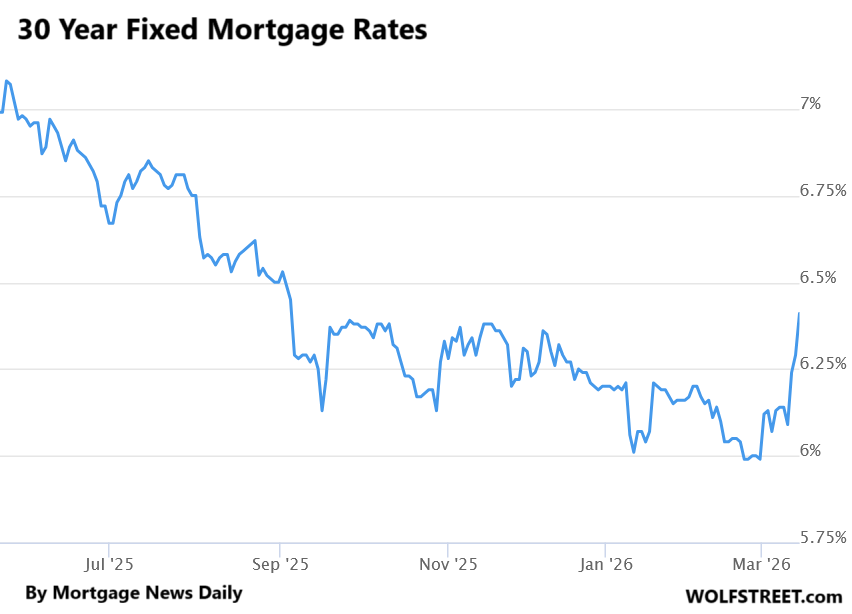
Core Viewpoint - The U.S. Treasury market experienced significant selling pressure, with the government selling $651 billion in Treasury securities amid rising yields and inflation concerns, particularly driven by surging gasoline prices and disappointing inflation data [1][4]. Treasury Market Activity - The U.S. government sold $651 billion of Treasury securities this week across nine auctions, including $532 billion in Treasury bills and $119 billion in Treasury notes and bonds [4][5]. - The 1-year Treasury yield surpassed the Effective Federal Funds Rate (EFFR) for the first time since November 2023, indicating that the bond market has largely dismissed rate cut expectations for the year [2][4]. - All Treasury yields across the yield curve are now at or above the EFFR, suggesting that rate cuts are not anticipated in the current market scenario [4]. Yield Trends - The 3-year Treasury yield rose significantly, closing at 3.74% after a 16 basis point increase since its auction, marking a total spike of 36 basis points over two weeks [7][8]. - The 10-year Treasury yield increased to 4.28%, the highest since early February, reflecting a 13 basis point rise during the week [12]. - The 30-year Treasury yield reached 4.90%, the highest level since earlier this year, indicating growing concerns about long-term inflation and interest rates [14][16]. Mortgage Market Impact - Mortgage rates surged to 6.41%, the highest since early September, with a notable increase of 42 basis points over the past two weeks [18]. - The relationship between mortgage rates and long-term Treasury yields remains significant, with mortgage rates typically tracking the 10-year Treasury yield but at higher levels [19]. - Announced buybacks of mortgage-backed securities (MBS) by Fannie Mae and Freddie Mac are intended to reduce the spread between mortgage rates and Treasury yields, although they may increase concerns in the bond market [20].
Goldman Sachs Executive Says Some Clients Are 'Glad' Iran War Shifted Focus Away From Software Exposure, Private Credit Woes: Report
Yahoo Finance· 2026-03-14 17:31
Core Insights - Goldman Sachs' private capital clients are finding relief from concerns over software exposure due to the ongoing Iran war, which has shifted focus away from these issues [1][2] Group 1: Market Reactions - The Iran war has caused significant volatility in public markets, affecting energy, bond, and stock prices, which has particularly impacted hedge funds [4] - Some clients of Goldman Sachs have previously managed similar market volatility, but those in the region are currently facing heightened risks [4] Group 2: Private Credit Market - The private credit market, valued at $1.8 trillion, is experiencing a historic sell-off due to declining valuations and increasing defaults, leading to a loss of confidence [5] - Redemption limits and bankruptcies are contributing to the challenges faced in the private credit market, as highlighted by Ark Invest CEO Cathie Wood [5] Group 3: Software Sector Concerns - SaaS and data-provider stocks have seen significant declines recently, driven by fears that artificial intelligence may reduce the sector's relevance [7] - Top private equity CEOs are addressing investor concerns regarding the so-called "SaaS apocalypse," with Apollo CEO Marc Rowan describing investor reactions as "extreme" [7] - Ares CEO Michael Arougheti stated that the firm is well-prepared to manage risks associated with the market and software [7]

‘Get Your Shopping Lists Ready’: Morgan Stanley Suggests 2 Stocks to Buy as Market Weakness Could Create Opportunity
Yahoo Finance· 2026-03-14 11:02
Company Overview - Flywire acquired Sertifi, a cloud-based electronic signature platform, for $330 million, generating $14.2 million in revenue during 4Q25 [1] - Flywire serves over 4,900 global clients across more than 240 countries and territories, handling over 140 currencies [2] - The company has provided online digital payment solutions for over 15 years, focusing on education, travel, and healthcare sectors [3] Financial Performance - In 4Q25, Flywire reported a total payment volume increase of 35.6% year-over-year, rising from $6.9 billion in 4Q24 to $9.3 billion [8] - Flywire's revenue for 4Q25 reached $157.5 million, a 34% year-over-year increase, exceeding estimates by $7.74 million [9] - The company's GAAP EPS for the quarter was $0.00, beating forecasts by a penny, and it paid down $15 million of debt from the Sertifi acquisition [9] Analyst Insights - Morgan Stanley analyst Michael Infante views Flywire positively, noting its credibility in public markets with four consecutive quarters of beats in revenue and earnings [10] - Infante rates Flywire shares as Overweight (Buy) with a price target of $17, indicating a potential upside of 36% [10] - The consensus rating for Flywire is Moderate Buy, with 7 Buys, 4 Holds, and 1 Sell, and the stock is currently priced at $12.49 with an average target price of $16.60, suggesting a 33% upside [10]


PTY: I'd Still Be Overpaying Even At $12
Seeking Alpha· 2026-03-13 20:30
Core Insights - The article discusses the expertise of Sensor Unlimited, who has a PhD in financial economics and specializes in the mortgage market, commercial market, and banking industry [2] Group 1: Company Overview - Sensor Unlimited is a quantitative modeler with a decade of experience in covering various financial sectors, including asset allocation and ETFs related to the overall market, bonds, banking, and housing markets [2] Group 2: Services Offered - The investing group Envision Early Retirement, led by Sensor Unlimited, provides solutions aimed at generating high income and growth with isolated risks through dynamic asset allocation [2] - Features of the service include two model portfolios: one for short-term survival/withdrawal and another for aggressive long-term growth, along with direct access for discussions, monthly updates, tax discussions, and ticker critiques by request [2]

'Rich Dad Poor Dad' author sends blunt message on 'New Depression' warning
Yahoo Finance· 2026-03-13 20:03
Group 1 - The author Robert Kiyosaki warns of a potential market crash, citing panic among private credit funds, large banks, and financial institutions due to investor withdrawals [2] - Kiyosaki emphasizes the importance of investing in alternative assets such as oil, silver, gold, Bitcoin, and Ethereum to avoid becoming poorer during economic turmoil [6][8] - The current rise in oil prices, with West Texas Intermediate (WTI) trading at $96.83 per barrel and Brent oil at $101.59 per barrel, indicates a potential opportunity for investors [8] Group 2 - Kiyosaki advises followers to track where money is being redirected during bank runs, suggesting that understanding these movements can lead to investment opportunities [7] - The concept of "smart money" becoming richer while "stupid money" exits the market highlights the contrasting strategies investors may adopt during market fluctuations [8] - The ongoing conflict between the U.S.-Israel and Iran is contributing to market instability, reinforcing Kiyosaki's warnings about economic challenges ahead [2][3]
Dream Chasers Responds to Carver Attempt to Block Bank Turnaround Expert Moishe Gubin
Businesswire· 2026-03-13 19:53
Core Viewpoint - Dream Chasers Capital Group (DCCG) is responding to Carver Bancorp's Board blocking the nomination of Moishe Gubin and Greg Lewis, highlighting concerns over corporate governance and potential dilution of shareholder value [1][1][1] Group 1: Company Actions and Responses - DCCG, the leading shareholder of Carver Bancorp, criticizes the Board for using corporate mechanisms to disenfranchise shareholders, including a strategic delisting of shares to OTC markets [1][1][1] - The Board's actions are seen as detrimental to shareholders, particularly in blocking Gubin, who has a proven track record in banking turnaround [1][1][1] Group 2: Moishe Gubin's Achievements - Gubin successfully grew OptimumBank's assets from $100 million to over $1.11 billion while maintaining a 49.59% efficiency ratio, significantly better than the industry average of 67.3% [1][1][1] - Under Gubin's leadership, OptimumBank transformed from a loss-making entity to a profitable institution, achieving a net income of $16.65 million in 2025, representing a 600% growth in core earnings since 2021 [1][1][1] - Gubin also cleared a decade-long regulatory consent order by enhancing capital levels to "well-capitalized" status [1][1][1] Group 3: Timeline of Events - On March 5, 2026, the Board informed DCCG of "numerous deficiencies" and plans to block independent nominees just before the SEC deadline [1][1][1] - DCCG submitted nominations for Gubin and Lewis on February 20, 2026, but faced immediate resistance from the Board [1][1][1] - Carver announced a delisting on November 18, 2025, leading to a 50% drop in stock price [1][1][1] Group 4: Shareholder Support and Concerns - DCCG is monitoring Barry Mann's emergence as a 10% filer, suspecting it may be a tactic to dilute the 70% retail shareholder mandate opposing current Board policies [1][1][1] - DCCG emphasizes the importance of the 70% retail shareholder support and urges vigilance against any anti-takeover or dilutive actions as the May 21, 2026, Annual Meeting approaches [1][1][1] - The company remains committed to removing the current Board and restoring Carver's value, advocating for competitive bidding on any new stock issuance [1][1][1]


Why Stock Indexes Ended This Week in the Red
Yahoo Finance· 2026-03-13 18:22
Market Overview - The stock market experienced a rough week, with leading indexes initially rising due to expectations of a quick resolution to the conflict in Iran, but later faced declines as the situation escalated, particularly with an Iranian blockade affecting oil shipments through the Strait of Hormuz, resulting in soaring oil prices [1][2]. Energy Sector Impact - The energy sector, while seeing significant gains from companies with limited operations in the Persian Gulf, only accounts for 3.4% of the S&P 500's total market value, indicating that it cannot single-handedly support the overall market [5][6]. - Chevron is the only energy stock in the Dow Jones Industrial Average, with a share price just below $200, contributing a mere 2.4% weight to the index, suggesting that even substantial movements in Chevron's stock would have minimal impact on the Dow [7]. Technology and Consumer Goods - The Iranian crisis has negatively impacted tech stocks, banks, and consumer goods companies, with the only beneficiaries being energy producers and utility services [2]. - The "Magnificent 7" stocks, which include major tech companies, collectively lost over $100 billion in market value, with Amazon experiencing the largest drop of $120 billion, directly linked to rising power costs associated with its $200 billion investment in AI-processing data centers [8][9]. Market Sentiment - The ongoing Iranian conflict is expected to continue influencing market sentiment until it is resolved, although the current market downturn does not qualify as a bear market, as the top three indexes remain less than 7% below their all-time highs, with total weekly drops under 2% [10].
