Food Delivery

Search documents
刘强东直播炒菜,调侃贾国龙和罗永浩,谈到“外卖大战”:想和王兴见面聊聊
Mei Ri Jing Ji Xin Wen· 2025-09-16 14:54
Core Viewpoint - JD Group's founder Liu Qiangdong reinitiated the "User Meeting" after nearly 20 years, emphasizing user engagement and showcasing local cuisine during a live-streamed event [1][11] Group 1: User Engagement and Brand Promotion - The "User Meeting" featured a live cooking demonstration of the local dish "Huang Gou Zhutou Rou," highlighting the importance of regional flavors and memories associated with food [2][3] - Liu Qiangdong expressed his personal connection to cooking, stating he cooks for his family regularly, which adds a personal touch to the brand's image [2][3] Group 2: Competitive Landscape and Business Strategy - Liu Qiangdong discussed the competitive dynamics with Meituan, advocating for a respectful and strategic approach to competition rather than personal conflicts [5] - He emphasized the need for innovation in the food delivery and hospitality sectors to ensure fair profit distribution among stakeholders [6][7] Group 3: Future Plans and Market Positioning - JD Group is set to launch a new hotel development plan in the coming weeks, aiming to avoid price wars that could harm the industry ecosystem [6] - The company has already made significant strides in the hospitality sector, with the launch of travel services including hotels and tickets, indicating a broader market strategy [6][7]



Is DoorDash Stock Outperforming the Nasdaq?
Yahoo Finance· 2025-09-15 15:44
Company Overview - DoorDash, Inc. (DASH) has a market cap of $110.2 billion and operates marketplaces like DoorDash and Wolt, providing services such as food delivery, order fulfillment, merchant tools, and customer support [1] - The company is classified as a "large-cap" stock, with membership programs like DashPass and Wolt+, and offers white-label delivery solutions through DoorDash Drive and Wolt Drive [2] Stock Performance - Shares of DoorDash have declined 6.9% from their 52-week high of $278.15, but have increased 18.3% over the past three months, outperforming the Nasdaq Composite's 14.9% return [3] - Year-to-date, DoorDash shares have climbed 54.4%, significantly surpassing the Nasdaq's 15.5% gain, and have surged 97.2% over the past 52 weeks compared to the Nasdaq's over 26% return [4] Q2 2025 Results - Following Q2 2025 results, DoorDash shares jumped 5% after reporting EPS of $0.65, beating estimates, and revenue rose 24.9% year-over-year to $3.3 billion, exceeding consensus [5] - Marketplace Gross Order Value (GOV) surged 23% to $24.2 billion, with total orders up 20% to 761 million, and guidance for Q3 GMV is projected between $24.2 billion and $24.7 billion, indicating strong demand [5] Analyst Sentiment - Compared to rival Coupang, Inc. (CPNG), which has seen a YTD increase of 50.9%, DoorDash's stock has a consensus rating of "Moderate Buy" from 38 analysts, with a mean price target of $294.38, representing a 13.5% premium to current levels [6]

Intouch Insight Study: C-Stores Narrow the Gap with Restaurants for Key Metrics in Third-Party Delivery Study
Prnewswire· 2025-09-15 12:00
Core Insights - Intouch Insight has released the second edition of its Third-Party Delivery Study, indicating that the food delivery industry continues to evolve [1] Industry Summary - The study highlights ongoing changes in the food delivery sector, reflecting trends and consumer preferences [1]

Billionaire Bill Ackman's Billion-Dollar Bet on Amazon Isn't His Largest Position -- This One Is
Yahoo Finance· 2025-09-15 11:45
Core Insights - Billionaire investor Bill Ackman, founder of Pershing Square, is known for high-conviction, concentrated investments, often holding fewer than a dozen stocks in his portfolio, which has historically yielded outsized returns [1][2] Investment Strategy - Ackman recently acquired a significant stake in Amazon, purchasing 5.82 million shares valued at approximately $1.3 billion, representing about 9% of his U.S. equity portfolio, but this is not his largest position [4][5] - Uber Technologies is Ackman's largest holding, comprising about 21% of his fund at $2.8 billion, indicating a strong preference for this stock [4][6] Company Analysis - Ackman views Uber as one of the best-managed and highest-quality businesses globally, available at a substantial discount to its intrinsic value, which he describes as a rare opportunity for a large-cap company [6][7] - Uber has transitioned from a cash-burning disruptor to a disciplined operator with a strong competitive advantage in mobility and delivery, serving 180 million users per quarter [7][9] Competitive Advantage - The strength of Uber's business model lies in its network effects, where the interaction between riders and drivers, as well as merchants and consumers in food delivery, creates a self-reinforcing cycle that enhances its market position [9]

Experts Are Watching These 12 Stocks
Yahoo Finance· 2025-09-14 12:42
Core Insights - The stock market is reacting to global trade tensions, interest rates, and changing consumer behaviors, with certain stocks identified as having long-term growth potential [1] Group 1: Fintech Sector - SoFi Technologies (SOFI) is positioned to benefit from high interest rates, which have pressured traditional financial institutions while creating opportunities for innovative fintech companies [3] - SoFi's diverse offerings in banking, lending, investing, and crypto are attracting a growing customer base, making it a compelling long-term investment despite expected volatility due to 70% of its lending portfolio being unsecured loans [4] Group 2: E-commerce and Grocery Delivery - Amazon (AMZN) continues to dominate e-commerce and cloud computing, with its recent launch of same-day grocery delivery posing a significant challenge to competitors like Instacart and DoorDash [5][6] - This expansion into grocery delivery is expected to create new revenue opportunities for Amazon, leveraging its ownership of Whole Foods and enhancing its control over the grocery chain [6] Group 3: Artificial Intelligence Sector - The demand for AI is driving growth across various industries, with global spending on AI projected to exceed $632 billion by 2028 [7] - Companies such as Nvidia, ASML Holding, and Palantir Technologies are expected to experience rapid growth in the AI sector, despite challenges posed by the China-U.S. trade war and issues in the semiconductor industry [8]
How China's retail market is evolving amid Alibaba and Meituan's instant commerce war
Yahoo Finance· 2025-09-13 09:30
Core Insights - JD.com and Meituan are intensifying their competition in the instant commerce sector by establishing thousands of central kitchens to enhance the efficiency of online food order fulfillment [1] - Instant commerce in China is rapidly evolving, catering to hundreds of millions of consumers who prefer on-demand delivery for a variety of products and services [2][4] - The competition among instant commerce providers is characterized by heavy reliance on subsidies and operational efficiency rather than traditional competitive strategies [3] Company Strategies - Meituan plans to build 1,200 "Raccoon Restaurants" over three years to streamline operations for multiple restaurant chains, aiming to reduce costs and improve efficiency [10] - JD.com is investing 1 billion yuan to establish 10,000 self-operated 7Fresh kitchens, promoting a diverse menu to a nationwide audience [11] - Alibaba has integrated its food delivery platform Ele.me and travel agency Fliggy into its core e-commerce business to enhance its ecosystem [14] Market Dynamics - The instant commerce market is experiencing significant promotional activities, with daily transactions reaching hundreds of millions and costs associated with discounts and promotions in the hundreds of millions of yuan [16] - Alibaba's daily orders reached an all-time high of 120 million in August, while Meituan peaked at 150 million in July, indicating a competitive landscape [17] - Daily active users for Taobao, Meituan, and JD.com grew by 16%, 21%, and 24% respectively from January to July [18] Financial Performance - Meituan's CFO indicated expectations of substantial losses in Q3 due to strategic investments in incentives and marketing [22] - Alibaba's cash and investments were reported at 585.7 billion yuan, significantly higher than Meituan's 171.1 billion yuan, providing Alibaba with a financial advantage [23] - S&P analysts predict that all three instant commerce providers will face margin pressures for the next 12 to 24 months, with an estimated expenditure of at least 160 billion yuan to maintain market share [22] Future Projections - Morgan Stanley forecasts that Meituan will maintain a 75% market share in China's food delivery market by 2030, while its share in instant commerce may decrease to 48%, closely competing with Alibaba's expected 47% share [31] - Instant commerce order growth is expected to slow down after promotional activities diminish, although overall volumes are projected to increase by 40% this year compared to 2024 [32]
X @Bloomberg
Bloomberg· 2025-09-12 03:55
Meituan has launched a new AI agent app that aims to boost its food delivery and local services business https://t.co/8JKlzDutQD ...
UBER Vs. GRAB: Which Ride-Hailing Stock Has Better Upside Potential?
ZACKS· 2025-09-11 15:11
Core Insights - Uber Technologies (UBER) and Grab (GRAB) are both key players in the ride-hailing industry, each with unique business models and geographical focuses [1][2] - Uber operates globally while Grab is concentrated in Southeast Asia, providing a range of services including mobility, deliveries, and digital financial services [2][3] Uber's Performance and Strategy - Uber is experiencing increased demand across its ride-sharing and delivery platforms, supported by new growth initiatives and cost discipline [4] - For Q3 2025, Uber anticipates gross bookings between $48.25 billion and $49.75 billion, reflecting a year-over-year growth of 17-21% [5] - The adjusted EBITDA for the same period is projected to be between $2.19 billion and $2.29 billion, indicating a year-over-year growth of 30-36% [5] - A recent partnership with Best Buy enhances Uber Eats by allowing delivery of consumer electronics, diversifying its delivery ecosystem [6][7] - Uber is strategically entering the robotaxi market through partnerships, avoiding high R&D costs associated with autonomous systems [8] - The company announced a stock repurchase authorization of up to $20 billion, signaling confidence in its business strategy [9] Grab's Performance and Strategy - Grab expects 2025 revenues between $3.33 billion and $3.40 billion, indicating a year-over-year growth of 19-22% [12] - The company has transformed from a taxi-hailing app to an "everyday everything app," offering various services including food delivery and digital payments [13] - Grab's On-Demand Gross Merchandise Value (GMV) rose 21% year-over-year in Q2 2025, reflecting strong growth in its mobility and delivery segments [14] - A partnership with Amazon Web Services (AWS) aims to enhance operational efficiency and drive growth across Grab's services [15][16] - Grab is making a strategic equity investment in WeRide to advance the deployment of Level 4 robotaxis in Southeast Asia [17] Comparative Analysis - Uber's forward sales multiple is 3.45, while Grab's is higher at 5.6, indicating that Grab may be more expensive relative to its sales [18] - Uber's market capitalization stands at $199.05 billion, positioning it well to navigate uncertain economic conditions, while Grab's market cap is significantly smaller at $21.3 billion [19][20] - Economic pressures in Southeast Asia are impacting Grab more severely due to its narrower geographical focus and intense competition in the delivery segment [20] Conclusion - Based on the analysis, Uber appears to be a more favorable investment compared to Grab, despite both companies currently holding a Zacks Rank 3 (Hold) [21]

China's State-Driven Stocks, And Its Corporate Wars Abroad
Benzinga· 2025-09-10 13:46
Stock Market in China - The Hang Seng Index has increased by 40% and the Shanghai Composite by 36% over the last 52 weeks, while the S&P 500 and Dow Jones have only seen gains of 16% and 10% respectively [3] - The rally is driven by limited investment options for Chinese investors due to a prolonged slump in the real estate sector and low interest rates [4] - Speculation fueled by government policy is a significant factor, with investments flowing into sectors like new energy, EVs, AI, and semiconductors, based on the belief that government-favored companies are reliable investments [5] - The sustainability of this rally is questioned, as past market surges have led to crashes, and the current economic support from the government needs to translate into tangible results for the broader economy [6] Corporate Feud in Brazil - The conflict between DiDi and Meituan in Brazil highlights the aggressive competition stemming from China's domestic business culture, with DiDi allegedly pressuring restaurants not to partner with Meituan [7] - Meituan's lawsuit against DiDi for unfair competition reflects the irony of both companies employing aggressive tactics against competitors [8] - The resolution of this dispute will depend on Brazilian courts and government decisions, which face the challenge of balancing consumer benefits from price wars against the protection of local businesses [9] - The competitive behavior observed among Chinese companies contrasts with the more rational competition seen in Western firms, which typically focus on product value rather than aggressive price cutting [10] - As Chinese companies expand globally, emerging markets may adopt stricter regulations to protect local industries, influenced by the state-driven competitive environment in China [11]


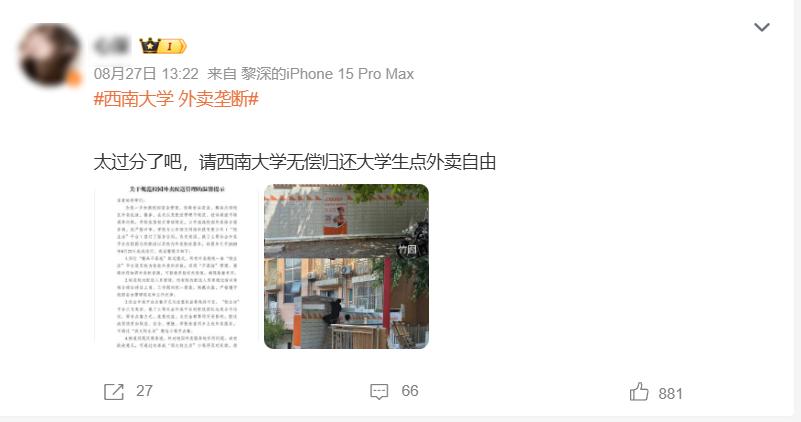
外卖大厂们花几百亿,也没能进去某些大学的门
3 6 Ke· 2025-09-08 02:45
Core Insights - The article discusses the challenges and inefficiencies of campus food delivery systems, particularly focusing on the exclusive partnership between Southwest University and a delivery platform called "Campus Life" [2][4][19] - It highlights the dissatisfaction among students regarding the quality and speed of service, as well as the emergence of various delivery methods and platforms within university campuses [7][22][41] Group 1: Campus Delivery System - The introduction of a single delivery platform for campus food has led to increased costs and slower service, causing frustration among students [2][4] - The delivery process involves multiple steps, including handoffs between social riders and campus riders, which contributes to delays [22][23] - The article notes that the campus delivery system has evolved from informal groups using WeChat to more organized platforms with dedicated apps [12][17][39] Group 2: Student Experience - Students express dissatisfaction with the current delivery system, often receiving cold food or experiencing long wait times [7][30] - The article mentions that the delivery fee is low, typically between 1-2 yuan, leading riders to accumulate orders before delivery, further delaying service [30][32] - The lack of accountability and transparency in the delivery process leaves students uncertain about the status of their orders [26][28] Group 3: Market Dynamics - Major food delivery companies like Meituan and Ele.me are beginning to enter the campus delivery market to retain student customers [21][41] - The article suggests that the current chaotic delivery environment is a temporary phase, with a shift towards more standardized services expected in the future [37][41] - The competition among various delivery platforms is intensifying, as they seek to capture the growing demand for off-campus food options among students [19][40]