ETF

Search documents
Is Invesco Large Cap Value ETF (PWV) a Strong ETF Right Now?
ZACKS· 2025-08-19 11:21
Core Insights - The Invesco Large Cap Value ETF (PWV) offers investors exposure to the Style Box - Large Cap Value category, having debuted on March 3, 2005 [1] - Smart beta ETFs, like PWV, aim to outperform traditional market cap weighted indexes by focusing on specific fundamental characteristics [3][4] - The fund is sponsored by Invesco and has assets exceeding $1.15 billion, targeting performance matching with the Dynamic Large Cap Value Intellidex Index [5] Fund Details - PWV has annual operating expenses of 0.53% and a 12-month trailing dividend yield of 2.29% [6] - The ETF's largest sector allocation is in Financials at 31.2%, followed by Energy and Healthcare [7] - Top holdings include Goldman Sachs Group Inc (3.72%), Wells Fargo & Co, and Jpmorgan Chase & Co, with the top 10 holdings comprising 35.12% of total assets [8] Performance Metrics - The ETF has a return of approximately 12.36% and has increased by about 12.92% year-to-date as of August 19, 2025 [10] - PWV has traded between $52.26 and $63.23 over the past 52 weeks, with a beta of 0.80 and a standard deviation of 14.50% for the trailing three-year period, indicating medium risk [10] Alternatives - Other ETFs in the same space include Schwab U.S. Dividend Equity ETF (SCHD) and Vanguard Value ETF (VTV), with SCHD having $70.84 billion in assets and VTV at $141.7 billion [12] - SCHD has an expense ratio of 0.06% and VTV at 0.04%, presenting lower-cost options for investors [12]


Should First Trust NASDAQ-100 Ex-Technology Sector ETF (QQXT) Be on Your Investing Radar?
ZACKS· 2025-08-19 11:21
Core Viewpoint - The First Trust NASDAQ-100 Ex-Technology Sector ETF (QQXT) provides broad exposure to the Large Cap Growth segment of the US equity market, with assets exceeding $1.11 billion, making it a significant player in this category [1]. Group 1: Large Cap Growth Characteristics - Large cap companies typically have a market capitalization above $10 billion, offering stability and more reliable cash flows compared to mid and small cap companies [2]. - Growth stocks are characterized by faster growth rates, higher valuations, and above-average sales and earnings growth rates, but they also exhibit higher volatility [3]. Group 2: Costs and Performance - The ETF has an annual operating expense ratio of 0.6%, which is relatively high compared to other products in the space, and a 12-month trailing dividend yield of 0.73% [4]. - QQXT aims to match the performance of the NASDAQ-100 Ex-Tech Sector Index, which includes non-technology companies from the NASDAQ-100 Index [7]. - The ETF has returned approximately 6.5% year-to-date and 10.6% over the past year, with a trading range between $84.34 and $101.22 in the last 52 weeks [8]. Group 3: Sector Exposure and Holdings - The ETF has the largest allocation to the Industrials sector at about 19.3%, followed by Healthcare and Consumer Discretionary [5]. - Old Dominion Freight Line, Inc. (ODFL) represents about 1.89% of total assets, with the top 10 holdings accounting for approximately 18.65% of total assets under management [6]. Group 4: Alternatives and Market Position - QQXT carries a Zacks ETF Rank of 3 (Hold), indicating it is a reasonable option for investors seeking exposure to the Large Cap Growth area [10]. - Alternatives such as the Vanguard Growth ETF (VUG) and Invesco QQQ (QQQ) have significantly larger assets, with VUG at $186.05 billion and QQQ at $369.46 billion, and lower expense ratios of 0.04% and 0.2%, respectively [11]. Group 5: Industry Trends - Passively managed ETFs are gaining popularity among both institutional and retail investors due to their low cost, transparency, flexibility, and tax efficiency, making them suitable for long-term investment strategies [12].

Should WisdomTree U.S. LargeCap Dividend ETF (DLN) Be on Your Investing Radar?
ZACKS· 2025-08-18 11:20
Core Viewpoint - The WisdomTree U.S. LargeCap Dividend ETF (DLN) provides broad exposure to the Large Cap Value segment of the US equity market, with assets exceeding $5.22 billion, making it a significant player in this category [1]. Group 1: ETF Overview - DLN is a passively managed ETF launched on June 16, 2006, sponsored by WisdomTree [1]. - The ETF targets large cap companies, defined as those with a market capitalization above $10 billion, which are typically stable with predictable cash flows [2]. Group 2: Value Stocks Characteristics - Value stocks, which DLN focuses on, are characterized by lower than average price-to-earnings and price-to-book ratios, but they also exhibit lower sales and earnings growth rates [3]. - Historically, value stocks have outperformed growth stocks in nearly all markets, although growth stocks tend to perform better in strong bull markets [3]. Group 3: Costs and Performance - The annual operating expenses for DLN are 0.28%, which is competitive within its peer group, and it has a 12-month trailing dividend yield of 1.9% [4]. - As of August 18, 2025, DLN has gained approximately 10.06% year-to-date and 14.2% over the past year, with a trading range between $70.70 and $84.97 in the last 52 weeks [7]. Group 4: Risk and Diversification - DLN has a beta of 0.81 and a standard deviation of 13.5% over the trailing three-year period, indicating it is a medium risk investment [8]. - The ETF holds about 307 different stocks, effectively diversifying company-specific risk [8]. Group 5: Alternatives - DLN holds a Zacks ETF Rank of 2 (Buy), indicating strong expected performance based on various factors [9]. - Other ETFs in the same space include Schwab U.S. Dividend Equity ETF (SCHD) with $71.11 billion in assets and Vanguard Value ETF (VTV) with $141.73 billion, both of which have lower expense ratios of 0.06% and 0.04%, respectively [10]. Group 6: Market Trends - Passively managed ETFs like DLN are gaining popularity among both institutional and retail investors due to their low cost, transparency, flexibility, and tax efficiency, making them suitable for long-term investment strategies [11].

Should Schwab Fundamental U.S. Large Company ETF (FNDX) Be on Your Investing Radar?
ZACKS· 2025-08-18 11:20
Core Insights - The Schwab Fundamental U.S. Large Company ETF (FNDX) is a passively managed ETF launched on August 13, 2013, with assets exceeding $19.39 billion, targeting the Large Cap Value segment of the U.S. equity market [1] - Large cap companies typically have market capitalizations above $10 billion, offering stability and lower risk compared to mid and small cap companies [2] - Value stocks are characterized by lower price-to-earnings and price-to-book ratios, but they also exhibit lower sales and earnings growth rates [3] Costs - The ETF has an annual operating expense ratio of 0.25%, which is competitive within its peer group, and a 12-month trailing dividend yield of 1.7% [4] Sector Exposure and Top Holdings - The ETF's largest sector allocation is to Financials at approximately 17.4%, followed by Information Technology and Healthcare [5] - Apple Inc. constitutes about 3.86% of total assets, with the top 10 holdings representing around 20.25% of total assets under management [6] Performance and Risk - FNDX aims to replicate the performance of the Russell RAFI US Large Co. Index, with a year-to-date return of approximately 7.87% and a one-year return of about 12.26% as of August 18, 2025 [7] - The ETF has a beta of 0.93 and a standard deviation of 15.15% over the trailing three-year period, indicating a medium risk profile [8] Alternatives - The Schwab U.S. Dividend Equity ETF (SCHD) and Vanguard Value ETF (VTV) are comparable options, with SCHD having $71.11 billion in assets and an expense ratio of 0.06%, while VTV has $141.73 billion in assets and charges 0.04% [11] Bottom-Line - Passively managed ETFs are gaining popularity among both institutional and retail investors due to their low cost, transparency, flexibility, and tax efficiency, making them suitable for long-term investment strategies [12]



Is Janus Henderson Small Cap Growth Alpha ETF (JSML) a Strong ETF Right Now?
ZACKS· 2025-08-18 11:20
Core Viewpoint - The Janus Henderson Small Cap Growth Alpha ETF (JSML) aims to provide investors with broad exposure to the small-cap growth segment of the market, utilizing a smart beta strategy to potentially outperform traditional market cap weighted indexes [1][5]. Fund Overview - JSML was launched on February 23, 2016, and has accumulated over $206.62 million in assets, categorizing it as an average-sized ETF within its segment [1][5]. - The fund is managed by Janus Henderson and seeks to match the performance of the Janus Small Cap Growth Alpha Index, which selects small-cap stocks based on growth, profitability, and capital efficiency [5][6]. Cost Structure - The annual operating expenses for JSML are 0.30%, which is competitive with similar products in the market [7]. - The fund offers a 12-month trailing dividend yield of 1.63% [7]. Sector Exposure and Holdings - JSML has a significant allocation in the Industrials sector, comprising approximately 21.8% of the portfolio, followed by Information Technology and Financials [8]. - The top holding, Sterling Infrastructure Inc. (STRL), represents about 2.23% of the fund's total assets, with the top 10 holdings accounting for approximately 18.94% of total assets under management [9]. Performance Metrics - As of August 18, 2025, JSML has increased by roughly 8.34% year-to-date and 15.71% over the past year [11]. - The ETF has traded between $54.00 and $73.60 in the last 52 weeks, with a beta of 1.24 and a standard deviation of 23.03% over the trailing three-year period [11]. Alternatives - Investors may consider other ETFs in the small-cap growth space, such as iShares Russell 2000 Growth ETF (IWO) and Vanguard Small-Cap Growth ETF (VBK), which have larger asset bases and lower expense ratios [12][13].

Should iShares S&P Mid-Cap 400 Growth ETF (IJK) Be on Your Investing Radar?
ZACKS· 2025-08-18 11:20
Core Viewpoint - The iShares S&P Mid-Cap 400 Growth ETF (IJK) is a significant investment vehicle in the Mid Cap Growth segment of the US equity market, with over $8.91 billion in assets, providing investors with a diversified and growth-oriented option [1]. Group 1: ETF Overview - Launched on July 24, 2000, IJK is designed to provide broad exposure to the Mid Cap Growth segment of the US equity market [1]. - The ETF is sponsored by Blackrock and has become one of the larger ETFs in its category [1]. - The fund has an annual operating expense ratio of 0.17%, which is competitive within its peer group [4]. Group 2: Investment Characteristics - Mid cap companies, with market capitalizations between $2 billion and $10 billion, are generally seen as having higher growth prospects and lower volatility compared to large and small cap companies [2]. - Growth stocks, while having higher sales and earnings growth rates, also come with higher valuations and associated risks [3]. Group 3: Sector Exposure and Holdings - The ETF has a significant allocation to the Industrials sector, comprising about 29.1% of the portfolio, followed by Financials and Consumer Discretionary [5]. - The top holding, Interactive Brokers Group Inc, accounts for approximately 1.61% of total assets, with the top 10 holdings making up about 11.43% of total assets under management [6]. Group 4: Performance Metrics - IJK aims to match the performance of the S&P MidCap 400 Growth Index, with a year-to-date return of approximately 2.76% and a one-year return of about 5.25% as of August 18, 2025 [7]. - The ETF has a beta of 1.06 and a standard deviation of 20.02% over the trailing three-year period, indicating a medium risk profile [8]. Group 5: Alternatives and Market Position - IJK holds a Zacks ETF Rank of 2 (Buy), indicating strong expected performance based on various factors [9]. - Other comparable ETFs include the Vanguard Mid-Cap Growth ETF (VOT) and the iShares Russell Mid-Cap Growth ETF (IWP), with VOT having $17.40 billion in assets and IWP with $19.98 billion [10].

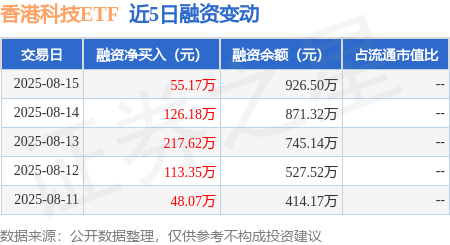
香港科技ETF:8月15日融资净买入55.17万元,连续3日累计净买入398.98万元
Sou Hu Cai Jing· 2025-08-18 02:45
Group 1 - The core point of the news is that the Hong Kong Technology ETF (513560) has seen a net financing inflow of 55.17 million yuan on August 15, 2025, with a total financing balance of 926.5 million yuan, indicating a positive market sentiment towards the ETF [1][3][4] - Over the past three trading days, the ETF has accumulated a total net inflow of 398.98 million yuan, with 13 out of the last 20 trading days showing net financing inflows [1][2] - The financing balance increased by 6.33% compared to the previous day, reflecting a strengthening bullish sentiment in the market [3][4] Group 2 - The detailed financing inflow data shows that on August 14, 2025, the net financing inflow was 126.18 million yuan, and on August 13, it was 217.62 million yuan, indicating a consistent upward trend in financing activity [2][4] - The financing balance has shown significant growth over the past few days, with increases of 16.93% on August 14, 41.25% on August 13, and 27.37% on August 12 [4] - There were no short-selling transactions reported on August 15, suggesting a focus on bullish positions in the market [2]
历史性突破!香港市场单只ETF首次突破100亿份
Zhong Guo Ji Jin Bao· 2025-08-18 00:20
Group 1 - The Hong Kong ETF market has seen significant growth, with the Southern Eastern Hong Kong Hang Seng Technology Index ETF reaching 10.219 billion shares, making it the first ETF in Hong Kong to exceed 10 billion shares issued [1][2] - The popularity of ETFs among mainland Chinese investors has increased, driven by the "Northbound capital" flow, making ETFs a favored tool for investment in the Hong Kong market [2][3] - Various ETFs and leveraged products have surpassed 1 billion shares, including the Yingfu Fund at 6.138 billion shares and the Southern Eastern Hang Seng Technology Index Daily Inverse (-2x) product at 3.541 billion shares [2] Group 2 - Hong Kong is actively introducing high-quality products from other markets, such as the Hang Seng Morgan U.S. Equity High Income Active ETF, which is the first actively managed ETF focused on U.S. stock income in Hong Kong [3] - The demand for defensive investments has increased due to economic uncertainties, prompting the launch of more diversified investment options like high-yield U.S. dollar assets [3] - Analysts predict a continued bullish trend in the Hong Kong stock market, supported by strong liquidity and potential interest rate cuts by the Federal Reserve [3][4] Group 3 - The Asia-Pacific ETF market is rapidly developing, with China expected to surpass Japan as the largest ETF market in the region by the end of the year [6] - As of mid-August 2025, the number of stock ETFs in mainland China reached 1,173, with a total scale of 3.87 trillion yuan [6] - The Hong Kong market has seen the launch of its first ETF exceeding 10 billion shares, while over 40 stock ETFs in mainland China have also surpassed this threshold [6] Group 4 - The overall market conditions are favorable for ETF growth, with domestic policies supporting capital markets and a stable economic recovery [7] - The Japanese ETF market has shown resilience and growth, with total assets under management increasing by 13.2% from the previous year [7] - In Taiwan, the active ETF market is expanding rapidly, with several issuers launching new products this year [7] Group 5 - Global ETF development is characterized by three major trends: the expansion of actively managed ETFs, the introduction of digital asset strategies, and regulatory changes encouraging ETF adoption [8] - There are currently 68 investment managers applying to launch actively managed ETFs in the U.S., indicating strong interest in this segment [8] - The Bitcoin ETF by BlackRock has attracted significant investment, with its latest scale exceeding 80 billion dollars [8]
做空、对冲、转赛道……本周,投资策略课上新!
Sou Hu Cai Jing· 2025-08-17 13:27
Group 1 - The article discusses various investment strategies including shorting oil stocks, investing in gold, and shifting focus to renewable energy, reflecting market sentiment and industry trends [1][4] - Tencent's stock has seen a significant increase in market value, growing over $180 billion this year, yet it remains approximately 21% below its historical peak, indicating potential for recovery [2] - Asian ultra-high-net-worth individuals are increasingly investing directly in gold, with Hong Kong investors doubling their allocation to gold within a year, highlighting a surge in demand for gold as a hedge against risks [3] Group 2 - Hedge funds are shifting from a long position in oil stocks to a net short position, influenced by global economic slowdown and concerns over oil supply-demand balance, while showing optimism towards solar and wind energy sectors [3][4] - VinFast's founder is pivoting the company's strategy towards Asian markets after unsuccessful attempts in the US and Europe, having invested at least $14 billion into the company despite significant losses [5][6] - The trend of launching leveraged ETFs is gaining momentum, with multiple companies submitting applications to capitalize on popular stocks, indicating a competitive landscape in the ETF market [7]
Is Nuveen ESG Large-Cap Value ETF (NULV) a Strong ETF Right Now?
ZACKS· 2025-08-15 11:20
Core Viewpoint - The Nuveen ESG Large-Cap Value ETF (NULV) is a smart beta ETF launched on December 13, 2016, providing broad exposure to the large-cap value market segment [1] Fund Overview - NULV is sponsored by Nuveen and has accumulated assets exceeding $1.78 billion, categorizing it as an average-sized ETF in the large-cap value space [5] - The fund aims to replicate the performance of the TIAA ESG USA Large-Cap Value Index, which includes equity securities from large-cap companies listed on U.S. exchanges [5] Cost Structure - NULV has an annual operating expense ratio of 0.26%, which is competitive within its peer group [6] - The fund's 12-month trailing dividend yield is reported at 1.93% [6] Sector Allocation and Holdings - The ETF has a significant allocation in the Financials sector, comprising approximately 22.2% of the portfolio, followed by Healthcare and Industrials [7] - Procter & Gamble Co (PG) represents about 2.61% of total assets, with Bank of America Corp (BAC) and International Business Machines (IBM) also among the top holdings [8] - The top 10 holdings account for roughly 22.35% of total assets under management [8] Performance Metrics - As of August 15, 2025, NULV has gained approximately 8.46% year-to-date and about 11.83% over the past year [10] - The fund has traded between $36.02 and $43.28 in the last 52 weeks, with a beta of 0.88 and a standard deviation of 14.28% over the trailing three-year period [10] Alternatives - Other ETFs in the large-cap value space include Vanguard ESG U.S. Stock ETF (ESGV) with $11.13 billion in assets and iShares ESG Aware MSCI USA ETF (ESGU) with $14.28 billion [12] - ESGV has an expense ratio of 0.09%, while ESGU charges 0.15%, presenting lower-cost options for investors [12]