Data Centers

Search documents
Mitsubishi Electric's ME Innovation Fund Invests in Lucend, U.S. Startup Driving Data Center Operational Optimization
Businesswire· 2026-01-27 03:00
Core Insights - Mitsubishi Electric Corporation has made its fourteenth investment through the ME Innovation Fund in Lucend, a U.S.-based startup focused on optimizing data center operations with an AI platform [1] Investment Details - The investment in Lucend reflects the growing trend of capital investment in data centers, driven by the rapid advancement of digitalization and the adoption of generative AI [1] - The ME Innovation Fund aims to support innovative technologies that enhance operational efficiency in data centers [1]


微软获批在威斯康星州增建15个数据中心
Ge Long Hui· 2026-01-27 02:52
Core Viewpoint - Microsoft has received local approval to expand its data center operations in Pleasant Prairie, Wisconsin, by adding 15 new data centers, which will enhance its capacity to confirm revenue from OpenAI and other clients [1] Group 1: Company Expansion - The new data centers will be located near Microsoft's existing data center expansion area [1] - Microsoft is in competition with Amazon, Google, and Oracle to build data centers equipped with NVIDIA chips for training and running generative AI models [1] Group 2: Challenges and Community Response - Finding suitable locations for these facilities is challenging due to utility companies not always providing the necessary energy [1] - Residents and officials in Pleasant Prairie generally welcome Microsoft's expansion in the village [1] - Microsoft is now able to submit final civil engineering plans and apply for building permits [1]

未知机构:TF计算机阿里千问3引爆算力需求IDC产业链再迎强催化-20260127
未知机构· 2026-01-27 02:00
【TF计算机】阿里千问3引爆算力需求,IDC产业链再迎强催化 #阿里正式发布万亿参数旗舰推理模型Qwen3-Max-Thinking,总参数量突破1T、预训练数据量达36T Tokens,成为阿 里史上规模最大、能力最强的千问模型。 模型参数与训练数据的极致扩容,直接推动算力需求爆发式增长,为IDC产业链带来确定性增量。 其原生Agent能力的大幅增强,也将加速大模型在各场景落地,进一 【TF计算机】阿里千问3引爆算力需求,IDC产业链再迎强催化 #阿里正式发布万亿参数旗舰推理模型Qwen3-Max-Thinking,总参数量突破1T、预训练数据量达36T Tokens,成为阿 里史上规模最大、能力最强的千问模型。 其原生Agent能力的大幅增强,也将加速大模型在各场景落地,进一步拉动算力产业链景气度上行。 ➡ 万亿参数大模型的训练与推理,对数据中心的单机柜功率、液冷技术及算力调度能力提出更高要求,IDC基础 设施升级迫在眉睫。 阿里算力集群的持续扩张,与"以租代买"模式的深化,让绑定其生态的IDC厂商直接受益。 1 核心IDC供应商:#数据港(阿里系收入占比超80%)、润泽科技、杭钢股份(联合阿里投建浙江云 ...

Microsoft's plans for 15 more data centers win approval at former Wisconsin Foxconn site
CNBC· 2026-01-27 01:41
Core Insights - Microsoft is expanding its data center operations by constructing 15 additional data centers in Mount Pleasant, Wisconsin, which will enhance its capacity to recognize revenue from clients like OpenAI [1][2]. Group 1: Expansion Plans - The new data centers will cover almost 9 million square feet and are expected to have a taxable value exceeding $13 billion [5]. - The Mount Pleasant village board has unanimously approved the plans for the new data centers, indicating local support for Microsoft's expansion [6]. Group 2: Community Response - While many residents in Mount Pleasant support the expansion, there has been opposition in the adjacent village of Caledonia, where residents protested against Microsoft's request to rezone land for a data center [4]. - Concerns were raised during public comments about the permanence of jobs created by the data centers, but local officials defended the long-term nature of the employment opportunities [6][7]. Group 3: Industry Context - Microsoft is competing with Amazon, Google, and Oracle in the race to build data centers equipped with Nvidia chips for generative AI applications [2]. - The construction of data centers faces challenges, including the availability of energy from utilities and local opposition from residents [2].

木头姐年度旗舰报告《Big+Ideas+2026》
Sou Hu Cai Jing· 2026-01-27 00:49
Group 1: AI Infrastructure - AI infrastructure is set to become the core of the next generation of cloud computing, driving sustained growth in data center system investments [2] - Data center system investments are projected to reach approximately $500 billion by 2025, growing to $1.4 trillion by 2026, primarily driven by AI-related workloads, creating significant market opportunities for hardware manufacturers like Nvidia and AMD [3] - The competition in the AI chip market is intensifying, with Nvidia currently leading, while competitors like AMD and Google are catching up, fostering technological innovation and cost reduction [5] - The growth of AI infrastructure extends beyond hardware to include software and networking technologies, with increasing demand for high-performance computing and storage as AI model complexity rises, leading to continuous revenue growth across the industry [7] Group 2: AI Consumer Operating Systems - AI is emerging as a new consumer operating system, transforming the economics of search, discovery, transactions, and e-commerce [8] - The rise of AI agents is expected to capture 65% of global search traffic by 2030, altering the traditional search engine market and creating new revenue streams for AI-driven search platforms and advertising businesses [9] - AI consumer operating systems will drive rapid growth in advertising and subscription revenues, projected to reach $900 billion by 2030 [11] Group 3: AI Productivity - AI is expected to significantly enhance productivity, reduce repetitive tasks, and elevate the automation level of knowledge work [12] - AI tools can dramatically improve the efficiency of knowledge workers, with the cost of AI models decreasing exponentially, exemplified by a 91% reduction in software development costs over eight months [14] - The global competitive landscape in AI shows the U.S. leading, while China is strong in the open-source model domain [12] Group 4: Bitcoin - Bitcoin is projected to continue expanding as an emerging asset class, with its market value expected to reach $16 trillion by 2030, presenting substantial opportunities for investors and financial service providers [14] - Increasing institutional participation in Bitcoin is enhancing its market acceptance, which will further stabilize prices and lay a foundation for future growth [16] - The improving regulatory environment is expected to enhance Bitcoin's legitimacy and market stability, attracting more traditional investors [16] Group 5: Tokenized Assets - The tokenized asset market is anticipated to grow from $19 billion in 2025 to $11 trillion by 2030, offering significant market opportunities for fintech companies and blockchain platforms [17] - Tokenization will encompass a variety of asset classes, providing investors with broader investment choices and driving innovation in financial markets [19] - Increased regulatory support for tokenized assets will enhance market legitimacy and stability, further promoting their adoption [19] Group 6: Decentralized Finance (DeFi) Applications - DeFi applications are becoming the core engine for digital asset growth [20] - Revenue from DeFi applications is expected to reach approximately $3.8 billion by 2025, indicating substantial market opportunities for DeFi protocol developers and operators [22] - The rise of DeFi applications will lead to more efficient and transparent financial services, fostering innovation in financial markets [22] Group 7: Multiomics - Multiomics technology is set to drive significant transformations in healthcare, from disease diagnosis to drug development [23] - The integration of AI and multiomics technology will accelerate drug development processes and reduce R&D costs, creating substantial market potential for pharmaceutical companies and AI-driven drug development platforms [25] - Multiomics technology has the potential to extend healthy lifespans, generating significant economic value and long-term growth opportunities for related enterprises and investors [25] Group 8: Reusable Rockets - Reusable rocket technology is expected to lower space exploration costs, promoting the development of satellite communications and space infrastructure [26] - SpaceX's reusable rocket technology has already significantly reduced launch costs, with future costs projected to drop to $100 per kilogram, facilitating growth in satellite communications and space tourism [27] - The satellite communication market is forecasted to reach $160 billion by 2035, providing substantial market opportunities for satellite operators and related technology providers [29] Group 9: Robotics Technology - Robotics technology is projected to create approximately $26 trillion in market opportunities, benefiting robot manufacturers and AI integrators [30] - The application of robotics will diversify across various fields, from industrial automation to home services, driving continuous innovation and development in related technologies [32] - The widespread adoption of robotics technology will expand the related industry chain, offering sustained growth opportunities for investors and enterprises [32] Group 10: Distributed Energy - The declining costs of solar energy, battery technology, and nuclear energy will drive the adoption of distributed energy systems [33] - The deployment of distributed energy systems is expected to increase significantly to meet global electricity demands, providing long-term growth opportunities for related enterprises and investors [35] - Innovations in distributed energy technology will transform energy systems, leading to continuous revenue growth for related companies [35] Group 11: Autonomous Vehicles - Autonomous vehicles are set to change transportation methods and reduce travel costs [36] - The market value of autonomous vehicles is projected to reach $34 trillion by 2030, presenting significant market opportunities for automotive manufacturers and technology suppliers [37] - The application of autonomous vehicles will diversify across various sectors, driving ongoing innovation and development in related technologies [40] Group 12: Autonomous Logistics - Autonomous logistics will lower logistics costs and improve delivery efficiency through drones and self-driving trucks [42] - The technology is expected to significantly reduce logistics costs, driving rapid market growth and providing substantial opportunities for logistics technology providers and drone manufacturers [43] - The application of autonomous logistics technology will span various fields, from last-mile delivery to long-haul transportation, fostering continuous innovation and development [44] Group 13: Blockchain Technology - Blockchain technology is poised to drive innovation in finance, supply chain, and digital identity sectors [47] - The technology will create significant market opportunities for blockchain platform developers and related service providers [48] - As blockchain technology becomes more widespread, the related industry chain will continue to expand, offering sustained growth opportunities for investors and enterprises [49]



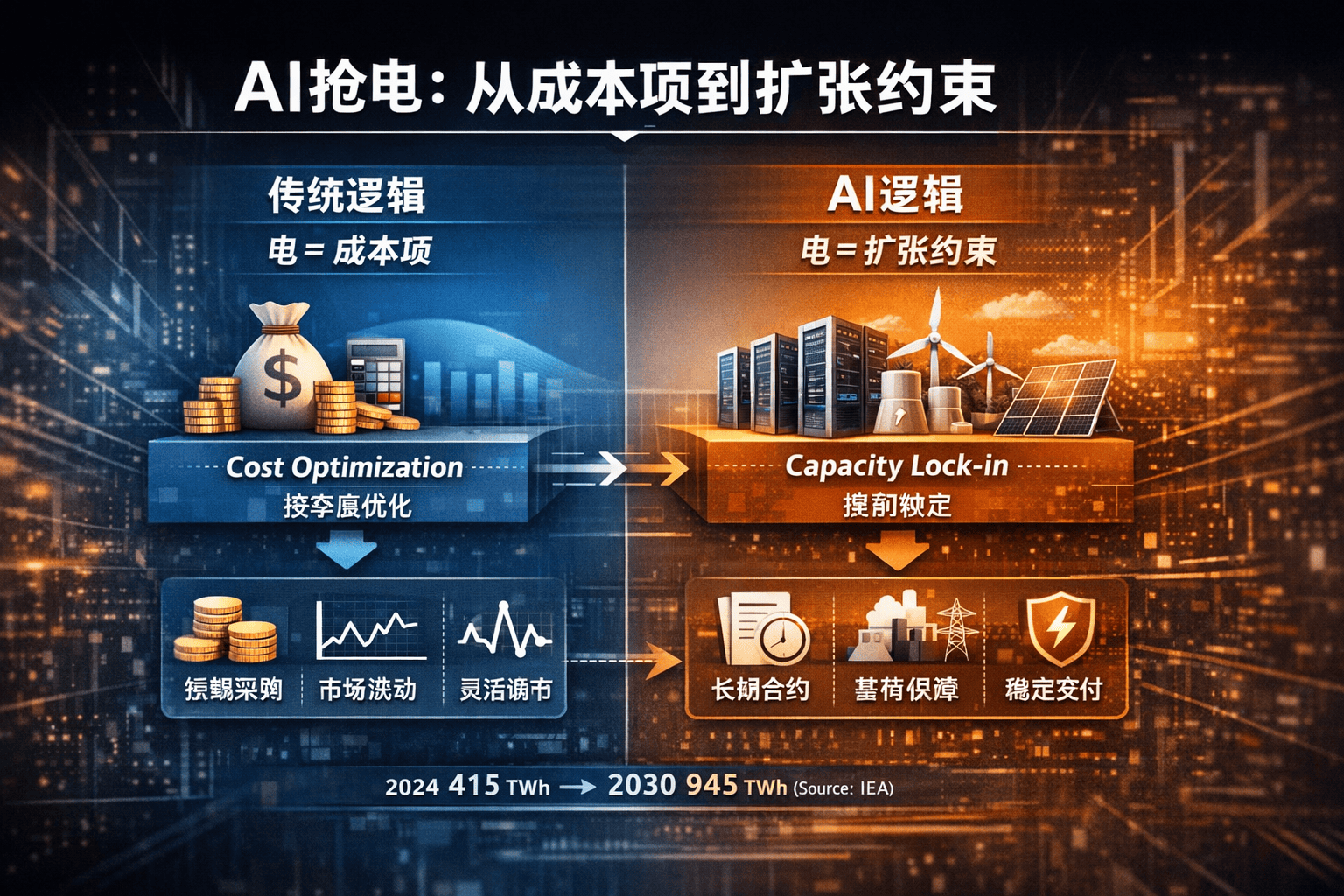
AI 抢电时代:新能源如何把电力交付变成全球竞争力
Sou Hu Cai Jing· 2026-01-27 00:16
Core Insights - The article discusses the rising importance of electricity supply in the context of AI expansion, highlighting that the focus has shifted from merely generating power to ensuring reliable delivery and capacity [1][6]. Group 1: AI Electricity Demand Surge - The demand for electricity from data centers is expected to grow significantly, with the International Energy Agency (IEA) projecting global data center electricity consumption to reach approximately 415 TWh in 2024 and potentially rise to about 945 TWh by 2030, nearly doubling [4]. - This growth is characterized by structural changes, driven by the expansion of computing infrastructure, increased power density of devices, and longer operational hours [4]. Group 2: Supply Constraints - The key issue is not a global electricity shortage but rather the concentration of demand at specific grid nodes, leading to challenges in connection and delivery [5]. - In regions like Northern Virginia, new data center loads face lengthy queue and expansion periods for grid connection, with some studies indicating that connection research could take over 10 years [5]. Group 3: Capital Strategies - Companies are shifting their approach to electricity from a cost item to a strategic limit on expansion, locking in deliverable capacity through long-term power purchase agreements (PPAs) and bundled supply arrangements [7]. - The combination of high demand growth, supply-side constraints, and capital strategies indicates that electricity has become a primary constraint for AI expansion, with structural and sustainable implications [7]. Group 4: Repricing of Electricity - The trading logic of electricity is evolving, with a focus on long-term stability and deliverable capacity rather than just price optimization [8]. - Companies like Meta and Google are entering into long-term agreements to secure stable power supplies, emphasizing the importance of reliability and predictability in electricity delivery [8][9]. Group 5: Investment Pathways in New Energy - The article outlines three main investment pathways: renewable energy and storage, stable low-carbon power sources, and the integration of energy with AI infrastructure [13][14]. - The focus is on transforming electricity from a commodity into a deliverable capability, with an emphasis on ensuring that power can be reliably accessed and delivered [13]. Group 6: Collaboration and Market Entry - Chinese renewable energy companies are encouraged to form partnerships with local entities to enhance project delivery capabilities and meet the rigid electricity demands of developed markets [15][18]. - This collaborative approach aims to leverage China's manufacturing and delivery strengths while addressing local regulatory and operational challenges [16].
WhiteFiber Announces Closing of $230.0 Million Convertible Senior Notes Offering and Zero-Strike Call Option Transaction
Prnewswire· 2026-01-26 21:05
Core Viewpoint - WhiteFiber, Inc. has successfully closed a private placement of $230 million in convertible senior notes, aimed at enhancing its AI infrastructure and high-performance computing capabilities [1][2]. Group 1: Financial Details - The notes have an initial conversion price of approximately $25.91 per share, which is a 27.5% premium over the last reported sales price on January 21, 2026 [2]. - The net proceeds from the offering amount to approximately $221.5 million after deducting discounts and estimated expenses [2]. - A zero-strike call option was negotiated to offset potential dilution from the notes, effectively increasing the conversion price to approximately $37.01 per share, resulting in a net share exposure of about 3 million shares [3]. Group 2: Use of Proceeds - Approximately $120 million of the net proceeds will be used to cover the cost of the zero-strike call, while the remaining funds will primarily support data center expansion, including property acquisition, construction, energy service agreements, and potential partnerships [4]. - The company anticipates closing a project-level debt facility for its NC-1 data center development in the first quarter of 2026, viewing this convertible financing as complementary to its non-dilutive project financing strategy [5]. Group 3: Company Overview - WhiteFiber specializes in AI infrastructure solutions, owning HPC data centers and providing cloud services designed to maximize performance and efficiency for generative AI workloads [8].

Ex-crypto stock surges after $2B Nvidia investment
Yahoo Finance· 2026-01-26 20:39
Another former crypto miner is quietly making the case that pivoting to AI may be the smartest survival move in today’s market. This time, the proof point is CoreWeave (NASDAQ: CRWV), a firm that began life as a Bitcoin mining operation and is now pulling in billions from Big Tech. Related: What is Bitcoin mining? Explained A Bitcoin miner that changed course early CoreWeave didn’t start out as an AI darling. The company was founded in 2017 under the name Atlantic Crypto, initially focused on Bitcoin ...

5 Tech Stocks Surging as Wall Street Money Floods East
Benzinga· 2026-01-26 18:16
Core Insights - Investing in Chinese stocks presents both opportunities and risks, particularly due to political tensions, but advancements in sectors like electric vehicles, AI, and renewable energy make them appealing [1][2]. Group 1: Market Overview - Chinese stocks are trading at significant discounts compared to international peers, especially those in the US, despite recent technological advancements and accommodating government policies [2]. - Investment flows are increasingly moving away from the US, with stocks in several countries outside the US experiencing faster growth [2]. Group 2: Company Highlights - **BYD Co. Ltd.**: - BYD has become the world's top electric vehicle seller with a market cap of $116 billion and over 2.2 million vehicles delivered in 2025, generating over $108 billion in revenue [4]. - The stock has recently shown bullish momentum, breaking above the 50-day simple moving average (SMA) [6]. - **Alibaba Group Holdings Ltd.**: - Alibaba is the largest e-commerce company in China with a market cap exceeding $400 billion and annual sales nearing $140 billion [7]. - The company is shifting towards higher-margin services, and analysts have a consensus Buy rating with an average price target of $173, indicating potential upside [8][10]. - **Baidu Inc.**: - Baidu holds over 70% market share in China's search engine market and is experiencing growth through its ERNIE AI chatbot and cloud business [11][12]. - The stock trades at 14 times earnings and is poised for a potential bull market, with analysts expecting $4.36 billion in quarterly revenue [15]. - **XPeng Inc.**: - XPeng has an $18 billion market cap and delivered over 116,000 vehicles in Q3 2025, marking a year-over-year growth of nearly 150% [16]. - The stock is showing signs of a breakout after a period of consolidation [19]. - **VNET Group Inc.**: - VNET, with a market cap of $2.8 billion, benefits from the AI boom and raised its full-year revenue guidance after a significant 82.7% year-over-year increase in wholesale revenue [20]. - The stock is attempting a breakout above the 50-day SMA, with bullish momentum indicated by the MACD and RSI [22].