
南方润泽科技数据中心REIT

Search documents
关注“公租房与保租房并轨”
HUAXI Securities· 2026-03-14 15:25
1. Report Industry Investment Rating - No information provided on industry investment rating. 2. Core Viewpoints of the Report - The China Securities REITs Total Return Index closed at 1023.2 points this week, down 0.43% week - on - week and 2.78% from the end of January. The trading volume remained sluggish, with the average daily turnover rate hovering around 0.36%, lower than the 60 - day average of 0.45%. As of March 13, the total market value of 79 listed REITs was 224.1 billion yuan, with a week - on - week decrease of 0.41%, and the circulating market value was 123.9 billion yuan [11]. - The "merger of public rental housing and affordable rental housing" in Shanghai may attract some public rental housing applicants to choose affordable rental housing projects, but it may also divert the applicants of original affordable rental housing projects. Attention should be paid to the competition around rental housing REITs projects [2][22]. - The rental housing REITs sector has excellent fundamentals, and high occupancy rates and rent advantages ensure the stability of cash flow at the numerator end. The sector may be more affected by the discount rate at the denominator end. The current distribution rate of the sector is about 3.12%. Attention can be paid to trading opportunities in the sector with subsequent interest rate adjustments, especially individual bonds of affordable rental housing with stronger policy attributes [3][24]. - In the secondary market this week, except for the data center sector which rose 0.73%, all other sectors declined, with the decline ranging from 0.01% to 1.06%, narrowing compared with last week. The industrial park sector declined the most, while the energy facility sector declined the least [4][26]. 3. Summary by Relevant Catalogs 3.1 "Merger of Public Rental Housing and Affordable Rental Housing", Continuously Monitor the Impact on the Supply of Affordable Rental Housing REITs - China's housing security system is divided into rental - type (public rental housing and affordable rental housing) and sales - type affordable housing. Public rental housing has relatively strict application conditions, and the rent is generally lower than that of affordable rental housing projects [2][19]. - Since March 2026, multiple batches of public rental housing in Shanghai have been unified for supply management according to the relevant policies of affordable rental housing. The rights and interests of existing tenants remain unchanged, and new tenants will be reviewed according to the standards of affordable rental housing. After the expiration of the lease contract, those who still meet the access conditions can renew the lease [2][22]. - The "merger of public rental housing and affordable rental housing" may attract some public rental housing applicants to choose affordable rental housing projects, but it may also divert the applicants of original affordable rental housing projects. Attention should be paid to the competition around rental housing REITs projects [2][22]. - The rental housing sector fell 0.62% this week. The current distribution rate of the sector is about 3.12%. Attention can be paid to trading opportunities in the sector with subsequent interest rate adjustments, especially individual bonds of affordable rental housing such as Huaxia Beijing Affordable Housing and CICC Xiamen Anju [3][24]. 3.2 Secondary Market: Data Centers Lead the Rise, Industrial Parks Lead the Fall, and Trading Sentiment is Low - This week, except for the data center sector (+0.73%), all other asset sectors declined, with the decline ranging from 0.01% to 1.06%, narrowing compared with last week. The industrial park sector declined the most (-1.06%), and the warehousing and logistics and rental housing sectors declined about 0.6%. The energy facility and municipal environmental protection sectors declined less, at -0.01% and -0.11% respectively [4][26]. - The data center sector was the only one that rose this week. However, the two individual bonds in the sector showed different performances. Runze Technology rose while Wanguo declined. The current distribution rates of Runze and Wanguo are 3.40% and 3.49% respectively, slightly higher than the reference value of 3.31% for the distribution rate of rental - type REITs projects, and there may still be an upward space of 10 - 20BP. However, the China Securities Computing Power Index in the equity market retreated 1.07% this week. Allocation can be made at an appropriate time in combination with Runze's expansion process [4][28]. - The industrial park sector declined the most this week. The current distribution rate of the park sector has increased by 5BP to 4.72%. Under the pressure on the fundamentals, attention should be paid to the marginal improvement and repair opportunities of individual bonds with poor fundamentals, large previous declines, and distribution rates as high as over 5%. It is recommended to carefully focus on park REITs with stable fundamentals, income distribution adjustment mechanisms, and leading distribution rates, such as Jinyu Zhizao Gongchang and Chuangjin Hexin Shounong [30][31]. - The energy facility sector declined the least this week. The "coordination of computing and power" was first proposed in the 2026 government work report. Attention should be paid to the stability of regional consumption, on - grid power generation, on - grid electricity prices, and changes in the demand side of the energy sector [37][41]. - The warehousing sector declined significantly this week. The recent poor performance of Harvest JD Warehousing Infrastructure may be related to the upcoming expiration of the lease of the Langfang project. It is expected that the rent reduction of the Langfang project will be similar to that of the Chongqing project, ranging from 16% to 40%. Attention can be paid to the subsequent renewal situation [5][45]. 3.3 Primary Market: Shenzhen Stock Exchange Welcomes the Second Commercial Real Estate REIT - On March 10, 2026, after Huatai Zijin Huazhu Anju Commercial Real Estate REIT, the Shenzhen Stock Exchange welcomed the second commercial real estate REIT - Hongtu Innovation Xinghe Group Closed - end Commercial Real Estate Securities Investment Fund, with Xinghe Industrial (Shenzhen) Co., Ltd. as the original equity holder [57]. - As of March 13, 2026, there were 11 projects that had received inquiries and feedback and 2 projects that had been accepted among the projects declared to the exchange [61].




REITs周度观察(20260224-20260227):二级市场价格波动下跌,特许经营权类REITs表现相对更优-20260228
EBSCN· 2026-02-28 13:06
1. Report Industry Investment Rating No information about the industry investment rating is provided in the report. 2. Core Viewpoints of the Report - From February 24 to February 27, 2026, the secondary - market prices of publicly - listed REITs in China fluctuated and declined overall. The returns of publicly - listed REITs were relatively weak compared to other mainstream asset classes. Among them, franchise - based REITs performed relatively better, and new infrastructure - based REITs had the highest increase in returns [1][11]. - In the primary market, no new REIT products were listed this week, but the project status of 12 REIT products was updated [4]. 3. Summary According to the Directory Secondary Market Price Trends - **At the major asset level**: The secondary - market prices of publicly - listed REITs in China fluctuated and declined. The returns of REITs were - 0.96%, and the returns of other major asset classes from high to low were: crude oil (5.45%) > gold (4.68%) > convertible bonds (3.44%) > A - shares (2.74%) > US stocks (0.54%) > pure bonds (- 0.14%) > REITs [11]. - **At the underlying asset level**: Both property - based and franchise - based REITs' secondary - market prices declined. The return of property - based REITs was - 1.46%, and that of franchise - based REITs was - 0.09%. Among different underlying asset types, new infrastructure - based REITs had the highest increase, with a return of 2.01%. The top three underlying asset types in terms of returns were new infrastructure, ecological and environmental protection, and transportation infrastructure, with returns of 2.01%, 0.41%, and 0.11% respectively [16][17]. - **At the single - REIT level**: Among the 79 REITs, 17 rose and 62 fell. The top three in terms of increase were Southern Runze Technology Data Center REIT (2.68%), Huatai Jiangsu Expressway REIT (2.33%), and Huaan Waigaoqiao REIT (1.7%). The top three in terms of decline were Huatai Nanjing Jianye REIT (- 6.19%), CICC Chongqing Liangjiang REIT (- 4.96%), and ICBC Mengneng Clean Energy REIT (- 3.91%) [19]. Trading Volume and Turnover Rate - **At the underlying asset level**: The trading volume of publicly - listed REITs this week was 1.72 billion yuan, and the new infrastructure - based REITs had the highest average daily turnover rate. The total trading volume of the 79 listed REITs was 1.72 billion yuan, and the average daily turnover rate was 0.44%. The top three underlying asset types in terms of trading volume were transportation infrastructure (319 million yuan), warehousing and logistics (309 million yuan), and consumer infrastructure (251 million yuan). The top three in terms of average daily turnover rate were new infrastructure (1.47%), warehousing and logistics (0.54%), and water conservancy facilities (0.45%) [22]. - **At the single - REIT level**: The trading volume and turnover rate of single REITs continued to show differentiation. The top three in terms of trading volume were Southern Wanguo Data Center REIT (190 million shares), AVIC Yishang Warehousing and Logistics REIT (190 million shares), and嘉实京东仓储基础设施 REIT (180 million shares). The top three in terms of trading value were Southern Runze Technology Data Center REIT (104 million yuan), Southern Wanguo Data Center REIT (90 million yuan), and嘉实京东仓储基础设施 REIT (65 million yuan). The top three in terms of turnover rate were Southern Wanguo Data Center REIT (8.00%),嘉实京东仓储基础设施 REIT (5.45%), and Southern Runze Technology Data Center REIT (4.79%) [25]. Main Force Net Inflow and Block Trading - **Main force net inflow situation**: The total net inflow of the main force this week was 42.87 million yuan, and the market trading enthusiasm increased compared to the previous period. At the underlying asset level, the top three in terms of net inflow were consumer infrastructure (12.21 million yuan), affordable rental housing (11.41 million yuan), and new infrastructure (10.52 million yuan). At the single - REIT level, the top three in terms of net inflow were Southern Runze Technology Data Center REIT (8.53 million yuan), Huatai Jiangsu Expressway REIT (8.40 million yuan), and Huaxia Anbo Warehousing REIT (7.75 million yuan) [28]. - **Block trading situation**: The total block trading volume this week was 216 million yuan, which was lower than the previous period. There were block trades on 3 trading days, with the highest single - day trading volume on February 27, 2026, reaching 122.87 million yuan. The top three REITs in terms of block trading volume were AVIC Yishang Warehousing and Logistics REIT (93.55 million yuan), Guotai Haitong Jinan Energy Heating REIT (51.30 million yuan), and Huaxia Jinyu Zhizao Factory REIT (48.06 million yuan), with average discount/premium rates of - 1.90%, + 0.13%, and - 1.71% respectively [30]. Primary Market Listed Projects As of February 27, 2026, there were 79 publicly - listed REIT products in China, with a total issuance scale of 205.039 billion yuan. Among them, transportation infrastructure - based REITs had the largest issuance scale, reaching 68.771 billion yuan, followed by park infrastructure - based REITs with an issuance scale of 32.933 billion yuan. No new REIT products were listed this week [36][37]. Projects to be Listed According to the project dynamics disclosed by the Shanghai and Shenzhen Stock Exchanges, there were 30 REITs in the state of being to be listed, including 28 initial - offering REITs and 2 REITs to be expanded. The project status of 12 REIT products was updated this week [40][41].
又有REITs新品申报
Zhong Guo Ji Jin Bao· 2026-02-27 14:29
Market Performance - The public REITs secondary market experienced a downward trend this week, with overall trading activity declining [1] - The CSI REITs total return index fell by 1.08% this week, underperforming the CSI 300 index [1][2] - As of February 27, the index closed at 1035.78 points, with a cumulative increase of 2.57% year-to-date [2] REITs Performance - Out of 79 listed public REITs, 17 saw an increase, with the top performers being data center, highway, consumer, and logistics REITs [2] - The best-performing REIT this week was the Southern Runze Technology Data Center REIT, which rose by 3.48% [2] - Conversely, 62 REITs declined, with 41 experiencing a drop of over 1%, the largest being Huatai Nanjing Jianye REIT, which fell by 6.34% [3] New REITs Filings - Four new public REITs were filed this week, indicating potential market expansion [4] - The Guangfa New Town Wuyue Commercial Real Estate REIT was officially filed, with a project scale of 616 million yuan [4] - The Jiashi Shoukai Commercial Real Estate REIT was also filed, aiming to revitalize existing assets and lower debt ratios [4] Additional Filings - The Guojin Jiazhe New Energy REIT was filed, focusing on wind power projects as underlying assets [5] - The Jianxin Tianjin Lingang Port REIT was filed, marking the first port real estate REIT in the country [6] - The Shanghai and Shenzhen stock exchanges issued the first round of review inquiries for five commercial real estate REIT projects this week [6]
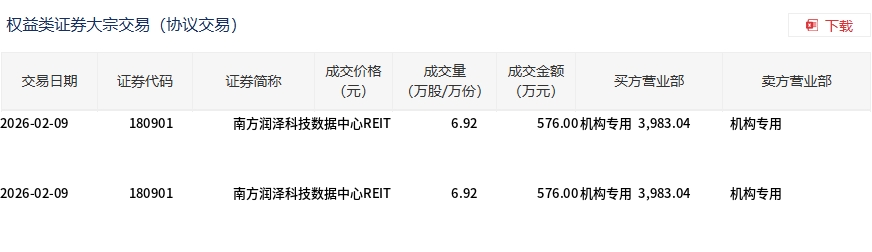
南方润泽科技数据中心REIT今日大宗交易溢价成交1152万股,成交额7966.08万元
Xin Lang Cai Jing· 2026-02-09 08:57
Group 1 - The core point of the news is that Southern Runze Technology Data Center REIT executed a block trade of 11.52 million shares on February 9, with a transaction value of 79.66 million yuan, accounting for 83.65% of the total transaction volume for that day [1] - The transaction price was 6.92 yuan, which represents a premium of 0.3% compared to the market closing price of 6.899 yuan [1] - The buyer and seller for the transaction were both institutional investors, indicating strong institutional interest in the REIT [2]


润泽科技2025年业绩预增近两倍 REITs发行激活资产价值
Zheng Quan Ri Bao Zhi Sheng· 2026-01-31 04:06
Core Viewpoint - Runze Technology Development Co., Ltd. is expected to achieve a net profit of 5 billion to 5.3 billion yuan in 2025, representing a year-on-year growth of 179.28% to 196.03%, primarily driven by the successful issuance of a public REITs project in August 2025, which contributed approximately 3.746 billion yuan in non-recurring gains [1] Group 1: Financial Performance - The company's net profit growth is significantly influenced by the REITs issuance, which provided a one-time gain of about 3.746 billion yuan [3] - Excluding the impact of the REITs, the company's net profit excluding non-recurring items is expected to grow by 5.71% to 11.33% [1] - The AIDC (Artificial Intelligence Data Center) business is also contributing to growth, with a projected increase in performance due to the rising demand for AI computing power [2][4] Group 2: Business Structure and Growth Drivers - The growth of Runze Technology is driven by two main engines: non-recurring income from REITs asset securitization and the continuous expansion of the AIDC business amid surging AI computing power demand [1][2] - The successful listing of the Southern Runze Technology Data Center REIT in August 2025 marked a significant milestone for the data center industry, providing a replicable model for other IDC companies [2] - The company has established seven AIDC infrastructure clusters across six core regions, with a total of approximately 320,000 cabinet resources, completing the framework layout for a nationwide integrated computing power center system [2] Group 3: Market Trends and Future Outlook - The explosive growth in AI computing demand is a key factor behind the company's performance, with significant increases in token consumption by leading internet and large model companies [3] - The company is well-positioned with advantages in liquid cooling technology and high-power cabinet deployment, attracting major AI clients and optimizing its customer structure [3] - Looking ahead, the company anticipates continued growth in high-performance computing supply capabilities and steady increases in intelligent computing service revenue, reinforcing its profit growth resilience [4]
润泽科技:预计2025年净利润同比增长179.28%-196.03%
Xin Lang Cai Jing· 2026-01-30 10:49
Core Viewpoint - Runze Technology expects a net profit of 5 billion to 5.3 billion yuan for the fiscal year 2025, representing a year-on-year increase of 179.28% to 196.03% [1] Financial Performance - The net profit excluding non-recurring gains and losses is projected to be between 1.88 billion to 1.98 billion yuan, with a year-on-year growth of 5.71% to 11.33% [1] - The significant increase in net profit is primarily attributed to the successful issuance of public REITs, which generated non-recurring gains [1] Market Activity - On August 8, 2025, the Southern Runze Technology Data Center REIT was successfully listed on the Shenzhen Stock Exchange, with an issuance scale of 4.5 billion yuan [1]
75%产品四季度盈利,公募REITs转向深耕底层资产
2 1 Shi Ji Jing Ji Bao Dao· 2026-01-23 13:19
Core Insights - The Chinese public REITs market faced dual shocks in Q4 2025, with both performance and market conditions deteriorating [1][2] - The market logic has shifted from previous trends of declining interest rates to a deeper exploration of the operational quality of underlying assets [2][7] Financial Performance - In Q4 2025, 77 public REITs reported a total revenue of 5.913 billion yuan, but net profit fell to 526 million yuan, marking a 42.83% decline from Q3's 920 million yuan [3] - The net profit in Q4 2025 was the lowest of the year, with earlier quarters showing higher profits of 840 million yuan and 763 million yuan in Q1 and Q2 respectively [3] - 58 out of 77 public REITs (75%) were profitable in Q4, with 26 products exceeding 10 million yuan in net profit [3] Market Trends - The overall REITs index declined by 4.37% in Q4 2025, reflecting a weak secondary market [4] - Transaction activity showed structural differentiation, with transportation infrastructure leading at 6.494 billion yuan, followed by park and consumer infrastructure [4] - New infrastructure sectors, particularly data centers, performed well, with average gains of 4.94% [4] Market Development - Over the past four years, REITs have exhibited risk-return characteristics between stocks and bonds, with overall performance surpassing major equity assets [5][7] - The market has transitioned through various phases, from exploration to value recovery, and now to normalized issuance and a bull market driven by declining interest rates [6][7] Future Outlook - The long-term potential for public REITs remains positive, supported by ongoing policy initiatives, including the introduction of commercial real estate REITs [7][8] - The market is expected to see stable growth in the number and scale of REITs, with total market value projected to increase from over 200 billion yuan to 500 billion yuan in the next five years [8] - Investment strategies should focus on high-quality assets with stable cash flows and growth potential, particularly in sectors benefiting from policy support [9]
【财经分析】2025年基础设施公募REITs市场观察:扩容、分化与韧性生长
Xin Hua Cai Jing· 2025-12-30 05:57
Core Insights - The domestic public REITs market in China is steadily progressing under favorable policies and capital interest, characterized by three distinct features: expansion, differentiation, and breaking through challenges [1] Group 1: Market Expansion - In 2025, the public REITs market in China entered a deep development phase, with 20 new projects launched, raising a total of 43.45 billion yuan (approximately 4.35 billion USD) [2] - As of December 29, 2025, the number of listed public REITs reached 78, with a cumulative issuance scale of about 201.75 billion yuan (approximately 20.17 billion USD), indicating significant growth potential [2] - The issuance pace in 2025 slowed compared to 2024, where 29 projects raised 65.52 billion yuan (approximately 6.55 billion USD), but the normalization of the expansion mechanism effectively supplemented market growth [2] Group 2: Structural Differentiation - The market has seen a breakthrough in asset types, with new fields such as digital infrastructure and urban renewal emerging, including the first data center REITs and urban renewal REITs [3] - Institutional investors dominate the market, accounting for 97.21% of the REITs market by mid-2025, an increase of 0.8 percentage points from the end of 2024, driven by the stable cash flow characteristics of REITs [3] - The trading activity varies significantly among different asset types, with new infrastructure REITs showing a daily average turnover rate of 0.92%, while transportation infrastructure leads in monthly transaction volume [4] Group 3: Market Dynamics - The primary market remains robust, with high subscription enthusiasm, exemplified by the 华夏中海商业REIT achieving a subscription multiple of 361.9 times from public investors [5] - In contrast, the secondary market faced adjustments in the second half of 2025, with the 中证REITs total return index declining by 1.44% over a week, reflecting a broader market correction of nearly 6% [6][7] - Factors contributing to the secondary market's volatility include the "stock-bond seesaw effect," fluctuations in long-term interest rates, and the release of strategic placement shares, which increased market supply [7] Group 4: Future Outlook - Despite challenges in the secondary market, the long-term outlook for the REITs market remains positive due to ongoing policy support, normalization of the expansion mechanism, and further diversification of asset types [8] - The market is expected to focus on three main paths in 2026: leveraging bond market trends, capitalizing on policy catalysts, and identifying opportunities from expansion and unlocks [8] - New asset types such as cultural tourism and elderly care are anticipated to inject growth momentum into the market, potentially leading to valuation premiums upon listing [8]
【固收】二级市场价格有所修复,周度连续下跌行情暂缓——REITs周度观察(20251222-20251226)(张旭/秦方好)
光大证券研究· 2025-12-28 00:20
Market Overview - The secondary market for publicly listed REITs in China has shown a wave-like recovery, ending a five-week decline, with the CSI REITs closing at 783.86 and the CSI REITs Total Return Index at 1014.8, yielding returns of 1.39% and 1.56% respectively during the week of December 22-26, 2025 [4] - In comparison to other major asset classes, the return rates ranked from highest to lowest are: Gold > Oil > A-shares > Convertible Bonds > REITs > US Stocks > Pure Bonds [4] - Among different project types, both property and concession REITs saw price increases, with property REITs achieving a return of 2.22% and concession REITs 1.19% [4] - The largest increase in returns came from affordable housing REITs, with the top three asset types ranked by return being affordable housing, warehousing and logistics, and industrial park REITs [4] Trading Activity - The total trading volume for public REITs was 3.14 billion yuan, with the water infrastructure REITs leading in average daily turnover rate at 0.80% [5] - The top three REITs by trading volume were: Zhongjin Hubei Keti Guanggu REIT, Huaxia Anbo Warehousing REIT, and Yinhua Shaoxing Raw Water REIT [5] - The total net inflow for the week was 94.74 million yuan, indicating increased market trading enthusiasm compared to the previous week, with the top three net inflow categories being consumer infrastructure, transportation infrastructure, and warehousing and logistics REITs [5] Block Trading - The total amount of block trading reached 264.42 million yuan, showing an increase from the previous week, with the highest single-day block trading amount on December 26, 2025, at 149.19 million yuan [6] - The top three REITs by block trading volume were: Southern Runze Technology Data Center REIT, CMB Fund Shekou Rental Housing REIT, and Southern Wanguo Data Center REIT [6] Primary Market - No new REIT products were listed during the week, but the project status of three existing REITs was updated [7]

公募新发数量创近4年新高,股基赶超债基站上“C位”
Zheng Quan Shi Bao· 2025-12-22 00:24
Core Insights - The public fund issuance market has seen a significant shift since 2025, with equity funds taking center stage, marking a departure from the previously dominant bond funds [1][4][10] - A total of 1,468 new funds were established in 2025, the highest number in nearly four years, indicating a return of market vitality and a shift towards a more refined approach in fund management [2][3][10] Fund Issuance Trends - The total fundraising scale for new funds in 2025 reached 11,637.62 billion, remaining stable compared to previous years, reflecting a more rational and detailed market issuance rather than reliance on a few blockbuster products [3][10] - The number of new equity funds reached 807, with a fundraising scale of 4,083.62 billion, accounting for 35.96% of the total new fund issuance, the highest proportion in nearly a decade [4][5] Structural Changes in Fund Types - The proportion of bond funds has significantly decreased from 70.19% in 2024 to 41.22% in 2025, indicating a clear shift in market risk appetite [6][10] - Mixed funds saw an increase in issuance to 13.66% (1,551.03 billion), but still far from the peak of 56.58% in 2021, suggesting a preference for clearer investment styles among investors [7][10] Innovation in Fund Products - The market has seen a surge in innovative products, with FOFs (Fund of Funds) growing to 81 new funds and a scale of 810.68 billion, reflecting increasing demand for professional asset allocation [8][10] - Public REITs have also expanded, with 19 new products and 10.5 billion shares issued, providing new channels for investors to participate in physical assets [9][10] - QDII funds have shown a focus on strategy diversity, with recent products covering various international markets, indicating an active global investment approach [10] Future Outlook - The public fund industry is expected to play a more critical role in supporting the transformation of the real economy and meeting the wealth management needs of residents, driven by the clarity of equity investment and the development of diverse tools like FOFs, REITs, and QDIIs [11]