
自动化设备

Search documents
博众精工跌2.00%,成交额7738.69万元,主力资金净流入292.94万元
Xin Lang Cai Jing· 2025-10-14 02:53
Core Viewpoint - Bozhong Precision Engineering's stock has experienced fluctuations, with a year-to-date increase of 26.19% but a recent decline of 10.97% over the past five trading days [1] Group 1: Company Overview - Bozhong Precision Engineering Co., Ltd. was established on September 22, 2006, and went public on May 12, 2021 [1] - The company is located in Wujiang Economic and Technological Development Zone, Jiangsu Province [1] - Main business activities include research, design, production, sales, and technical services of automation equipment, flexible production lines, key components, and tooling [1] - Revenue composition: automation equipment (86.26%), tooling and spare parts (11.96%), core components (1.66%), and others (0.12%) [1] Group 2: Financial Performance - For the first half of 2025, Bozhong Precision Engineering achieved operating revenue of 1.876 billion yuan, a year-on-year increase of 2.34% [2] - The net profit attributable to shareholders for the same period was 163 million yuan, reflecting a significant year-on-year growth of 69.69% [2] Group 3: Market Activity - As of October 14, the stock price was 32.83 yuan per share, with a market capitalization of 14.663 billion yuan [1] - The stock has seen a trading volume of 77.3869 million yuan and a turnover rate of 0.52% [1] - The number of shareholders as of September 30 was 10,300, a decrease of 2.41% from the previous period [2] Group 4: Shareholder Information - Since its A-share listing, Bozhong Precision Engineering has distributed a total of 200 million yuan in dividends [3] - As of June 30, 2025, the top ten circulating shareholders included Huaxia CSI Robot ETF, which holds 2.9999 million shares as a new shareholder [3]

瑞迪智驱10月13日获融资买入1970.05万元,融资余额2.09亿元
Xin Lang Cai Jing· 2025-10-14 01:44
Core Viewpoint - The company, Ruide Zhichui, experienced a decline in stock price and trading volume, with significant financing activities indicating a low financing balance relative to its market value [1][2]. Financing Summary - On October 13, Ruide Zhichui's financing buy-in amounted to 19.70 million yuan, with a net buy of 2.81 million yuan after repayments [1] - The total financing and margin trading balance reached 209 million yuan, accounting for 7.15% of the circulating market value, which is below the 40th percentile of the past year [1] - The company had no short selling activities on the same day, with a short selling balance of 0, indicating a high level of short selling availability compared to the past year [1] Business Performance - As of September 30, the number of shareholders decreased by 3.54% to 10,600, while the average number of circulating shares per person increased by 3.67% to 2,943 shares [2] - For the first half of 2025, Ruide Zhichui reported revenue of 317 million yuan, a year-on-year increase of 7.34%, and a net profit attributable to shareholders of 51.01 million yuan, up 1.07% year-on-year [2] Dividend and Shareholding Structure - Since its A-share listing, Ruide Zhichui has distributed a total of 61.73 million yuan in dividends [3] - As of June 30, 2025, the top ten circulating shareholders included notable funds, with significant reductions in holdings by some institutional investors [3]
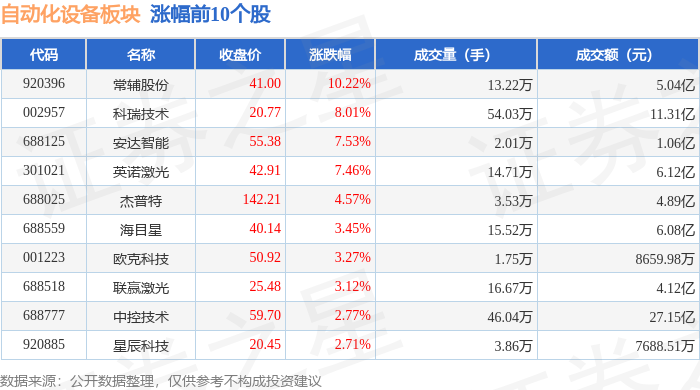
自动化设备板块10月13日跌2.1%,瑞晟智能领跌,主力资金净流出12.25亿元
Zheng Xing Xing Ye Ri Bao· 2025-10-13 12:45
Market Overview - The automation equipment sector experienced a decline of 2.1% on October 13, with Ruisheng Intelligent leading the drop [1] - The Shanghai Composite Index closed at 3889.5, down 0.19%, while the Shenzhen Component Index closed at 13231.47, down 0.93% [1] Stock Performance - Notable gainers in the automation equipment sector included: - Changfu Co., Ltd. (Code: 920396) with a closing price of 41.00, up 10.22% [1] - Keri Technology (Code: 002957) with a closing price of 20.77, up 8.01% [1] - Anda Intelligent (Code: 688125) with a closing price of 55.38, up 7.53% [1] - Conversely, significant decliners included: - Ruisheng Intelligent (Code: 688215) with a closing price of 82.43, down 8.23% [2] - Weichuang Electric (Code: 688698) with a closing price of 84.01, down 7.15% [2] - Buke Co., Ltd. (Code: 688160) with a closing price of 89.50, down 6.10% [2] Capital Flow - The automation equipment sector saw a net outflow of 1.225 billion yuan from institutional investors, while retail investors experienced a net inflow of 1.289 billion yuan [2][3] - Key stocks with notable capital flows included: - Keri Technology (Code: 002957) with a net inflow of 1.54 million yuan from institutional investors [3] - Zhongkong Technology (Code: 688777) with a net inflow of 99.67 million yuan from institutional investors [3] - Ruisheng Intelligent (Code: 688215) with a net outflow of 11.37 million yuan from retail investors [3]




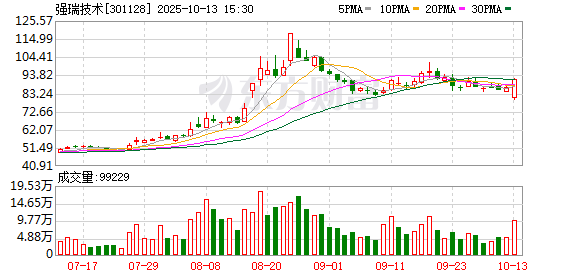
强瑞技术:三烨科技扩产厂房已于7月开始陆续投产
Mei Ri Jing Ji Xin Wen· 2025-10-13 09:09
Group 1 - The company’s subsidiary, Sanyue Technology, has expanded its production facility by 12,000 square meters, which began production in July 2023 [2] - Investors inquired about the production timeline of the new facility, indicating interest in the company's growth and operational updates [2] - Strong瑞 Technology (301128.SZ) confirmed the commencement of production for the expanded facility on October 13, 2023 [2]

智立方10月10日获融资买入1661.11万元,融资余额1.92亿元
Xin Lang Cai Jing· 2025-10-13 01:31
Core Viewpoint - The company, Zhili Fang, experienced a decline in stock price and trading volume on October 10, with significant financing activity indicating high leverage levels in the market [1][2]. Group 1: Stock Performance - On October 10, Zhili Fang's stock price fell by 4.16%, with a trading volume of 144 million yuan [1]. - The financing buy-in amount for Zhili Fang on the same day was 16.61 million yuan, while the financing repayment was 20.10 million yuan, resulting in a net financing outflow of 3.49 million yuan [1]. - As of October 10, the total financing and securities lending balance for Zhili Fang was 192 million yuan, which represents 3.15% of its market capitalization [1]. Group 2: Financial Performance - For the first half of 2025, Zhili Fang reported a revenue of 317 million yuan, reflecting a year-on-year growth of 32.61% [2]. - The net profit attributable to the parent company for the same period was 42.89 million yuan, showing a significant increase of 101.44% year-on-year [2]. Group 3: Shareholder Information - As of September 30, the number of shareholders for Zhili Fang was 14,600, a decrease of 2.87% from the previous period [2]. - The average number of circulating shares per shareholder increased by 2.95% to 4,148 shares [2]. - Zhili Fang has distributed a total of 108 million yuan in dividends since its A-share listing [3].
向新向智向绿活力释放 广交会彰显外贸韧性
Zhong Guo Zheng Quan Bao· 2025-10-12 22:12
Core Insights - The 138th China Import and Export Fair (Canton Fair) is set to open on October 15, showcasing a record number of 74,600 booths and over 32,000 participating companies, with 207,000 registered buyers, reflecting a 14.1% increase compared to previous events [1] Group 1: Trade Growth and Innovation - The Canton Fair serves as a "barometer" and "weather vane" for China's foreign trade, indicating a resilient growth trend in exports [1] - A significant increase in high-tech and specialized enterprises is noted, with over 10,000 quality companies participating, marking a historical high [2] - The fair is expected to feature over 1 million new products developed in the past year, with nearly 1.1 million products holding independent intellectual property rights [2] Group 2: Smart Technology Development - The fair highlights the acceleration of smart technology in foreign trade, with 175 product zones, including 18 dedicated to smart products, showcasing over 350,000 intelligent items [5] - The introduction of a smart medical area at the fair features 47 companies presenting advanced medical technologies, including surgical robots and wearable devices [5] - The trend towards smart manufacturing is reshaping export competitiveness, pushing products towards higher-end markets and enhancing the overall quality and technology of exports [5] Group 3: Green Transformation - The fair emphasizes the green transformation of foreign trade, with 305 participating companies in the renewable energy sector, a 3% increase from the previous event [6] - Approximately 38.4% of participating companies reported using green production technologies, showcasing a commitment to sustainable practices [6] - A total of 1.083 million green and low-carbon products will be displayed, reflecting the industry's shift towards environmentally friendly solutions [6] Group 4: Future Outlook - The overall foreign trade landscape is expected to maintain resilience in the fourth quarter, with recommendations to accelerate the development of digital, service, and green trade [7] - There is a call for expanded policy support for foreign trade enterprises, including enhancing export credit insurance and improving logistics and customs efficiency [7]
向新向智向绿活力释放广交会彰显外贸韧性
Zhong Guo Zheng Quan Bao· 2025-10-12 20:53
Group 1 - The 138th China Import and Export Fair (Canton Fair) will open on October 15, showcasing a record 74,600 booths and over 32,000 participating companies, with 207,000 registered buyers from 217 export markets, reflecting a 14.1% month-on-month increase [1] - The fair serves as a "barometer" and "weather vane" for China's foreign trade, indicating a resilient growth trend in the sector [1] - A significant number of high-tech and specialized enterprises are participating, with over 10,000 companies recognized as "specialized and innovative" [2] Group 2 - The fair will feature over 1 million new products developed in the past year and nearly 1.1 million products with independent intellectual property rights [2] - The export of electromechanical products has maintained a strong growth momentum, accounting for over 60% of total exports, with high-tech products like integrated circuits and industrial robots showing significant growth [2] - The fair includes 175 product zones, with 18 dedicated to smart products, showcasing over 350,000 intelligent items [3] Group 3 - The trend towards smart technology is evident, with companies like Wuhan Furili Automation Equipment Co., Ltd. reporting over 20% of their orders coming from overseas [3] - The introduction of a smart medical area at the fair highlights advancements in medical technology, featuring 47 companies showcasing surgical robots and wearable devices [3] - The shift towards intelligent manufacturing is reshaping export competitiveness and driving the transition of export goods towards higher-end products [3] Group 4 - The fair emphasizes green transformation, with companies like Juzi Hezhong Technology Co., Ltd. preparing to launch hydrogen-powered vehicles, reflecting a commitment to sustainable development [4] - A total of 305 companies in the renewable energy sector are participating, a 3% increase from the previous fair, with 38.4% of exhibitors adopting green production technologies [4] - The fair aims to enhance cooperation and communication between domestic and international enterprises, promoting high-quality development in foreign trade [5] Group 5 - Experts anticipate that the foreign trade landscape will remain resilient in the fourth quarter, despite increasing uncertainties [5] - Recommendations include accelerating the development of digital, service, and green trade, as well as expanding policy support for foreign trade enterprises [5] - The fair is positioned as a crucial platform for showcasing China's dynamic foreign trade, focusing on innovation, intelligence, and sustainability [5]
10月10日晚间重要公告一览
Xi Niu Cai Jing· 2025-10-10 10:17
Group 1 - Jieqiang Equipment has completed the acquisition of 51% stake in Shandong Carbon Seeking, which will now be included in the company's consolidated financial statements [1] - Tonghua Dongbao's insulin injection product has received marketing approval in Myanmar for diabetes treatment [1] - New Light Optoelectronics' actual controller plans to increase shareholding by 5 to 10 million yuan within six months [2] Group 2 - Far East Holdings received contracts worth 1.769 billion yuan in September [3] - Poly Developments reported a 1.84% decrease in signed sales amount in September, totaling 20.531 billion yuan [4] - ST Nuotai expects a net profit increase of 5.62% to 13.74% for Q3 2025 [7] Group 3 - Chongqing Port's controlling shareholder plans to merge with another entity, changing the controlling shareholder to Chongqing Logistics Group [9] - New Energy Company reported a 28.21% increase in cumulative power generation from January to September [11] - Dashiang Co. announced the resignation of its chairman due to personal reasons [12] Group 4 - Liao Port Co. announced the resignation of a non-executive director due to work changes [13] - Zhongzai Resources received a government subsidy of 5.33 million yuan, accounting for 23.72% of its audited net profit for 2024 [14] - Xiaoming Co. reported a sales revenue of 66.15 million yuan from chicken products in September [15] Group 5 - Tianyi Co. signed a framework contract worth 23.50 million yuan for e-business network terminal production [16] - Jingu Co. signed a strategic cooperation agreement with Ninebot Technology for lightweight materials [18] - Tianbang Foods reported a sales revenue of 634 million yuan from commodity pigs in September [20] Group 6 - Shaanxi Energy's subsidiary received an administrative penalty for safety violations, resulting in a fine of 940,000 yuan [22] - North Bay Port reported a 9% increase in cargo throughput in September [23] - Tangrenshen reported a sales revenue of 639 million yuan from pig sales in September [24] Group 7 - Dabeinong reported a sales revenue of 541 million yuan from pig sales in September [25] - Jiukang Bio obtained four medical device registration certificates [26] - Canan Co. invested 90 million yuan in structured deposits with a bank [27] Group 8 - Zhuhai Port reported a 5.44% decrease in cargo throughput in Q3 [28] - Jinli Yongmag expects a net profit increase of 157% to 179% for the first three quarters [29] - Huamao Logistics' controlling shareholder plans to increase shareholding by 64.5 to 129 million yuan [30] Group 9 - Dongjie Intelligent signed a 50 million yuan contract for intelligent warehousing in the steel industry [31] - Sais Technology signed a cooperation framework agreement with Volcano Engine for intelligent robotics [32] - Huadong Pharmaceutical's subsidiary received approval for clinical trials of a new drug targeting advanced solid tumors [34] Group 10 - TCL Technology completed the acquisition of 80% and 100% stakes in LG Display's subsidiaries for 11.088 billion yuan [34] - Shuangliang Energy won a 419 million yuan EPC project for cooling systems [36] - Ruina Intelligent announced plans for shareholders to reduce their stakes by up to 1.18% [38] Group 11 - Baodi Mining announced plans for shareholders to reduce their stakes by up to 5.45% [40] - Xinyi Technology's shareholders set the transfer price for shares at 328 yuan each [42] - Sunshine Power submitted an application for H-share listing on the Hong Kong Stock Exchange [44] Group 12 - Qisheng Technology's controlling shareholder plans to reduce their stake by up to 3.09% [46] - Wu Ming Kangde sold 30.3 million shares of Wu Ming He Lian through block trading [48] - Qiaoyin Co. announced plans for shareholders to reduce their stakes by up to 6% [49] Group 13 - Muyuan Foods reported a sales revenue of 9.066 billion yuan from commodity pigs in September [51] - Huawang Technology's shareholders plan to reduce their stakes by up to 1.1% [53] - Huaxin Xinchuang received a project notification from Lantu Automotive for display components [54] Group 14 - China Merchants Shekou reported a signed sales amount of 16.698 billion yuan in September [55] - Shao Neng Co. received approval for an antitrust review regarding a share acquisition [57] - Pengding Holdings reported a 6.21% increase in consolidated revenue in September [58] Group 15 - Ganfeng Lithium is advancing its solid-state battery commercialization and strategic investment in the energy storage sector [59]




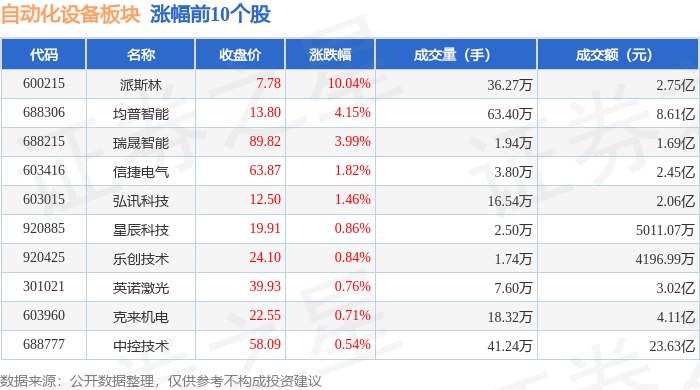
自动化设备板块10月10日跌3.07%,海目星领跌,主力资金净流出26.07亿元
Zheng Xing Xing Ye Ri Bao· 2025-10-10 08:51
从资金流向上来看,当日自动化设备板块主力资金净流出26.07亿元,游资资金净流入14.19亿元,散户资 金净流入11.88亿元。自动化设备板块个股资金流向见下表: 证券之星消息,10月10日自动化设备板块较上一交易日下跌3.07%,海目星领跌。当日上证指数报收于 3897.03,下跌0.94%。深证成指报收于13355.42,下跌2.7%。自动化设备板块个股涨跌见下表: | 代码 | 名称 | 收盘价 | 涨跌幅 | 成交量(手) | 成交额(元) | | | --- | --- | --- | --- | --- | --- | --- | | 600215 | 派斯林 | 7.78 | 10.04% | 36.27万 | | 2.75 Z | | 688306 | 均音智能 | 13.80 | 4.15% | 63.40万 | | 8.61亿 | | 688215 | 瑞晟智能 | 89.82 | 3.99% | 1.94万 | | 1.69 Z | | 603416 | 信捷电气 | 63.87 | 1.82% | - 3.80万 | | 2.45亿 | | 603015 | 弘讯科技 | 12.50 ...

正业科技股价跌5.16%,广发基金旗下1只基金重仓,持有4.39万股浮亏损失2.33万元
Xin Lang Cai Jing· 2025-10-10 02:09
Group 1 - The core point of the news is that Zhengye Technology's stock price has dropped by 5.16%, currently trading at 9.75 CNY per share, with a total market capitalization of 3.579 billion CNY [1] - Zhengye Technology, established on November 14, 1997, and listed on December 31, 2014, specializes in the research, production, and sales of automation equipment and auxiliary materials for PCB precision processing and testing, as well as LCD module automation assembly and testing [1] - The company's main business revenue composition includes: high-end new materials (32.01%), flat panel display module automation (30.48%), X-ray detection automation (23.66%), PCB detection automation (12.17%), and others (1.68%) [1] Group 2 - From the perspective of fund holdings, one fund under GF Fund has a significant position in Zhengye Technology, with the GF CSI 2000 ETF holding 43,900 shares, accounting for 0.62% of the fund's net value [2] - The GF CSI 2000 ETF was established on September 8, 2023, with a latest scale of 53.7022 million CNY, and has achieved a year-to-date return of 37.41% [2] - The fund's performance ranks 1508 out of 4220 in its category this year, and it has a one-year return of 52.39%, ranking 707 out of 3852 [2]
