自动化设备

Search documents
Allient (ALNT) - 2025 Q4 - Earnings Call Transcript
2026-03-06 16:02
Financial Data and Key Metrics Changes - Fourth quarter revenue increased 17% year-over-year to $143.4 million, with 15% organic growth on a constant currency basis [10] - Gross margin expanded 90 basis points year-over-year to 32.4%, driven by higher volumes, favorable mix, and operational efficiencies [14] - Operating income increased 76% in the fourth quarter to $11.4 million, with a full-year increase of 46% to $44 million [16][17] - Net income for the quarter more than doubled to $6.4 million, or $0.38 per diluted share, with adjusted net income at $9.3 million or $0.55 per share [17] Business Line Data and Key Metrics Changes - Industrial revenue increased 24% in the quarter, driven by strengthening automation demand and power quality solutions [10] - Vehicle revenue increased 35%, primarily due to increased commercial automotive shipments [10] - Medical revenue increased 9%, while aerospace and defense declined 5% due to program timing dynamics [11] Market Data and Key Metrics Changes - 50% of revenue was generated in the U.S., with the remainder from Europe, Canada, and Asia Pacific, reflecting a diversified footprint [10] - The backlog ended the year at approximately $233 million, with most expected to convert within 3 to 9 months [21] Company Strategy and Development Direction - The company aims to expand structural margins, strengthen the balance sheet, and position the portfolio around durable secular growth drivers [4] - The "Simplify to Accelerate NOW" program focuses on reducing complexity, improving throughput, and strengthening margins sustainably [7] - The company is aligning its portfolio around higher value motion controls and power solutions, serving long-term drivers of electrification, automation, and digital infrastructure [23] Management's Comments on Operating Environment and Future Outlook - Management noted improving industrial demand and a return to normalized ordering patterns after a destocking cycle [5] - The macro environment remains uneven across certain end markets, with ongoing monitoring of policy and tariff considerations [22] - Confidence is derived from control over cost structure, working capital discipline, and capital allocation [23] Other Important Information - Record operating cash flow of $56.7 million for the year, up 35% from the prior year, with improved inventory turns to 3.2 times [18][19] - Total debt declined to $180.4 million, with net debt down to $139.7 million, improving the leverage ratio significantly [20] Q&A Session Summary Question: What are the expected contributors to growth and margin expansions in 2026? - Management indicated that both external tailwinds and internal initiatives will contribute, with a focus on long-term drivers like data center infrastructure and defense spending [28][32] Question: What drove the better-than-expected seasonality in Q4? - Management acknowledged unusual pull-ins in demand, particularly in commercial vehicles, but expects a return to normal demand patterns in Q1 [50][52] Question: What is the status of the data center facility expansion? - The facility expansion is on track for completion by late Q2 or early Q3, which is expected to capitalize on increasing market demands [59] Question: How is the company addressing supply chain challenges related to the NDAA? - Management confirmed ongoing efforts to comply with NDAA requirements, focusing on regionalizing supply chains and solidifying sources for critical materials [78][80]

Allient (ALNT) - 2025 Q4 - Earnings Call Transcript
2026-03-06 16:00
Financial Data and Key Metrics Changes - Fourth quarter revenue increased 17% year-over-year to $143.4 million, with 15% organic growth on a constant currency basis [9] - Gross margin expanded 90 basis points year-over-year to 32.4%, driven by higher volumes, favorable mix, and operational efficiencies [12] - Operating income for the fourth quarter increased 76% to $11.4 million, representing 7.9% of revenue [14] - Net income for the quarter more than doubled to $6.4 million, or $0.38 per diluted share [14][15] - Record operating cash flow of $56.7 million for the year, up 35% from the prior year [16] - Total debt declined to $180.4 million, with net debt down to $139.7 million, a reduction of $48.4 million year-over-year [18] Business Line Data and Key Metrics Changes - Industrial revenue increased 24% in the quarter, driven by strengthening automation demand and power quality solutions [9] - Vehicle revenue increased 35%, primarily due to increased commercial automotive shipments [9] - Medical revenue increased 9%, supported by steady demand for surgical instruments [10] - Aerospace and defense revenue declined 5%, reflecting program timing dynamics and the cancellation of the M10 Booker tank program [10] Market Data and Key Metrics Changes - 50% of revenue was generated in the U.S., with the remainder from Europe, Canada, and Asia Pacific [9] - The industrial sector remains the largest vertical, increasingly anchored by higher value applications [11] - European markets, particularly Germany, are expected to remain soft, with no growth predicted for 2026 [38] Company Strategy and Development Direction - The company aims to expand structural margins, strengthen the balance sheet, and position the portfolio around durable secular growth drivers [4] - The "Simplify to Accelerate NOW" program focuses on reducing complexity, improving throughput, and strengthening margins sustainably [6] - The company is aligning its portfolio around higher value motion controls and power solutions, serving long-term drivers of electrification, automation, and digital infrastructure [23] Management's Comments on Operating Environment and Future Outlook - Management noted improving industrial demand and a return to normalized ordering patterns after a destocking cycle [5] - The macro environment remains uneven across certain end markets, with ongoing monitoring of customer capital spending and policy considerations [22] - Confidence is derived from control over cost structure, working capital discipline, and capital allocation [23] Other Important Information - The company expects capital expenditures in the range of $10 million-$12 million for 2026, primarily supporting customer programs and growth initiatives [17] - The backlog at the end of the year was approximately $233 million, with most expected to convert within 3 to 9 months [21] Q&A Session Summary Question: What will drive growth and margin expansion in 2026? - Management indicated that both external tailwinds and internal initiatives will contribute, with a focus on long-term drivers like data center infrastructure and defense spending [28][39] Question: What are the trends seen in Q1? - Management noted that Q4's unusual growth was due to pull-ins and that some areas may see lower demand in Q1 as a result [50][52] Question: What is the status of the data center facility expansion? - The facility is on track to be fully operational by late Q2 or early Q3, which aligns well with increasing market demand [59] Question: How is the company addressing supply chain challenges related to the NDAA? - Management acknowledged ongoing work to comply with the NDAA, particularly regarding rare earth materials, and emphasized proactive steps taken to regionalize the supply chain [78][81]
劲拓股份(300400) - 2026年3月5日投资者关系活动记录表
2026-03-06 00:42
Company Overview - Shenzhen Jintuo Automation Equipment Co., Ltd. was established in 1997 and listed on the Shenzhen Stock Exchange in 2014 (stock code 300400) [2] - The company is a leading manufacturer in the electronic thermal equipment industry, providing R&D, production, sales, and services [2] - Products are widely used in various fields including consumer electronics, automotive electronics, and aerospace electronics [2] Business Operations - In the first three quarters of 2025, the company achieved total revenue of CNY 595.61 million, a year-on-year increase of 6.84% [3] - Net profit attributable to shareholders was CNY 86.16 million, up 42.80% year-on-year [3] - Net cash flow from operating activities reached CNY 138.81 million, an increase of 81.84% year-on-year [3] - The company maintains a strong market position with a global market share in reflow soldering equipment [3] Competitive Advantages - Jintuo has served nearly 7,000 customers across over 150 regions globally, establishing a strong market reputation [3] - The company has transitioned its core strategy from "business-oriented" to "technology-oriented," investing over CNY 100 million in R&D focused on AI and smart equipment [3] - Jintuo is a pioneer in addressing the three major intelligent needs in thermal equipment, accumulating significant physical data during the development process [3] Future Development Directions - The company will continue to focus on core thermal equipment, increasing R&D investment to promote product intelligence and high-end upgrades [4] - Jintuo is expanding its overseas market presence, particularly in Malaysia, where it is enhancing service capabilities [4] R&D and Innovation - The company is building a multidisciplinary R&D team to tackle key challenges in large-size chip soldering technology [5] - Jintuo has developed multiple iterations of its specialized reflow soldering equipment for large integrated circuits, with ongoing testing and validation [5] - The company is leveraging innovative self-developed testing equipment to improve accuracy in prototype testing [5]

Ranpak (PACK) - 2025 Q4 - Earnings Call Transcript
2026-03-05 14:32
Financial Data and Key Metrics Changes - Consolidated net revenue increased by 2.2% year-over-year on a constant currency basis for Q4, or 4.4% excluding the impact of warrants, driven by solid e-commerce volume growth in North America and increased automation sales [16] - For the full year, net revenue increased by 4.7% on a constant currency basis or 6.1% excluding the $5 million headwind associated with warrants [16] - Adjusted EBITDA declined by 10.3% for Q4 on a constant currency basis, or down 1.2% excluding the impact of warrants, bringing the full year's results to down 8.5% on a constant currency basis or down 2.4% excluding the non-cash impact of warrants [21][13] Business Line Data and Key Metrics Changes - Automation achieved nearly 40% growth on a constant currency basis in Q4, with full-year revenue exceeding $40 million, resulting in almost 35% growth [6][10] - North America saw a volume growth of 5.5% in Q4 and 14% for the year, driven by more than 20% growth in void fill and 91.7% growth in automation excluding warrants [10][18] - In Europe and Asia Pacific, combined revenue decreased by 1.4% on a constant currency basis in Q4, primarily due to higher rebate activity and competitive pressures [17] Market Data and Key Metrics Changes - North America was the engine driving top-line performance, with sales up 5.8% for Q4 and 14% for the year [10][18] - Europe experienced a revenue decrease of 1.5% year-over-year on a constant currency basis, with the environment improving from previous tariff impacts [11][12] - The input cost environment remained stable, with energy market volatility being a concern for Europe [12][13] Company Strategy and Development Direction - The company aims to leverage its relationships with large e-commerce players to drive substantial growth, expecting over $1 billion in cumulative revenue from these partnerships over the next 8-10 years [8][24] - Automation is positioned as a hedge against labor shortages and rising costs, with expectations of significant growth in this segment [25][29] - The company is focusing on enhancing its technology stack and operational efficiencies to improve margins and cash generation [20][29] Management's Comments on Operating Environment and Future Outlook - The management noted that the operating environment in North America is more stable than in 2025, with an encouraging outlook despite potential challenges from geopolitical events [26][27] - Inflation is moderating, and real wage growth has turned positive, contributing to a more favorable economic outlook [27] - The company anticipates low to high single-digit volume growth in PPS for 2026, with a focus on automation driving significant revenue growth [29][32] Other Important Information - The company completed 2025 with a strong liquidity position, holding a cash balance of $63 million and no drawings on its revolving credit facility [22] - CapEx for the year was $30.3 million, reflecting a disciplined approach to capital spending [22][23] - The company expects net revenue growth of 5%-12.7% and Adjusted EBITDA growth of 5.4%-19.9% for 2026 [30][31] Q&A Session Summary Question: What is the PPS volume outlook for 2026? - Management expects meaningful growth in North America, potentially high single-digit to double-digit growth, while Europe remains uncertain due to geopolitical factors [36][38] Question: What percentage of PPS growth is driven by customer initiatives with Walmart and Amazon? - Both accounts are expected to drive double-digit growth, particularly as automation equipment is deployed [40] Question: What is the backlog for automation growth in 2026? - The company enters 2026 with its best backlog ever, expecting to surpass $60 million in automation revenue [42][44] Question: How does the company plan to unlock shareholder value? - The company believes it can double its top line and drive significant EBITDA growth through strategic relationships and automation initiatives [60][62]

Ranpak (PACK) - 2025 Q4 - Earnings Call Transcript
2026-03-05 14:30
Financial Data and Key Metrics Changes - Consolidated net revenue increased by 2.2% year-over-year on a constant currency basis for Q4, or 4.4% excluding the impact of warrants, driven by solid e-commerce volume growth in North America and increased automation sales [15][10] - For the full year, net revenue increased by 4.7% on a constant currency basis or 6.1% excluding the $5 million headwind associated with warrants [16] - Adjusted EBITDA declined by 10.3% for Q4 on a constant currency basis, or down 1.2% excluding the impact of warrants, bringing the full year's results to down 8.5% on a constant currency basis or down 2.4% excluding the non-cash impact of warrants [21][13] Business Line Data and Key Metrics Changes - Automation achieved nearly 40% growth on a constant currency basis in Q4 and 34.4% growth for the full year, with revenue exceeding $40 million [6][10] - North America saw a 5.5% volume growth in Q4 and 14% for the full year, driven by over 20% growth in void fill and 91.7% growth in automation excluding warrants [10][18] - In Europe and Asia Pacific, combined revenue decreased by 1.4% on a constant currency basis for Q4, primarily due to higher rebate activity and a challenging competitive environment [17] Market Data and Key Metrics Changes - North America experienced a robust e-commerce-led holiday season, particularly in December, contributing to a volume growth of 5.5% in Q4 and 14.3% for the year [5] - Europe showed signs of improvement after a challenging year, with economic fundamentals stabilizing despite ongoing geopolitical uncertainties [12][27] - The input cost environment remained stable, with energy market volatility being a key concern moving forward [12][28] Company Strategy and Development Direction - The company aims to leverage its partnerships with major e-commerce players to drive substantial growth, expecting over $1 billion in cumulative revenue from these relationships over the next 8-10 years [7][23] - Automation is positioned as a hedge against labor shortages and rising costs, with expectations of significant growth in this segment [24][29] - The company is focusing on enhancing its technology stack and operational efficiencies to improve margins and cash generation [20][29] Management's Comments on Operating Environment and Future Outlook - Management expressed optimism about the structural forces shaping the packaging and fulfillment landscape, indicating a stable operating environment in North America and an improving outlook in Europe [26][27] - The geopolitical situation, particularly the conflict in the Middle East, poses uncertainties that could impact demand and pricing [28][56] - The company anticipates net revenue growth of 5%-12.7% and Adjusted EBITDA growth of 5.4%-19.9% for 2026, with a focus on driving top-line growth and improving margins [29][30] Other Important Information - The company completed 2025 with a strong liquidity position, holding a cash balance of $63 million and no drawings on its revolving credit facility [22] - CapEx for the year was $30.3 million, reflecting a disciplined approach to capital expenditures [22] Q&A Session Summary Question: What is the PPS volume outlook for 2026 by region? - Management expects meaningful growth in the U.S., potentially high single-digit to double-digit growth, while Europe remains uncertain due to geopolitical factors [35][36] Question: What percentage of PPS growth is driven by customer initiatives with Walmart and Amazon? - Both accounts are expected to drive double-digit growth, with automation equipment playing a significant role in the growth of consumables [40] Question: What is the backlog visibility for the targeted 30%-50% growth in automation for 2026? - The company enters 2026 with its best backlog ever, driven by strong activity in the U.S. and Europe, and confidence in surpassing the lower end of the growth target [42][43] Question: How does the company plan to unlock shareholder value? - Management believes that doubling the top line and driving significant EBITDA growth through strategic relationships and automation will unlock shareholder value [62][64]
制造业智能化转型加快,重点行业存结构差异
Di Yi Cai Jing· 2026-02-26 12:50
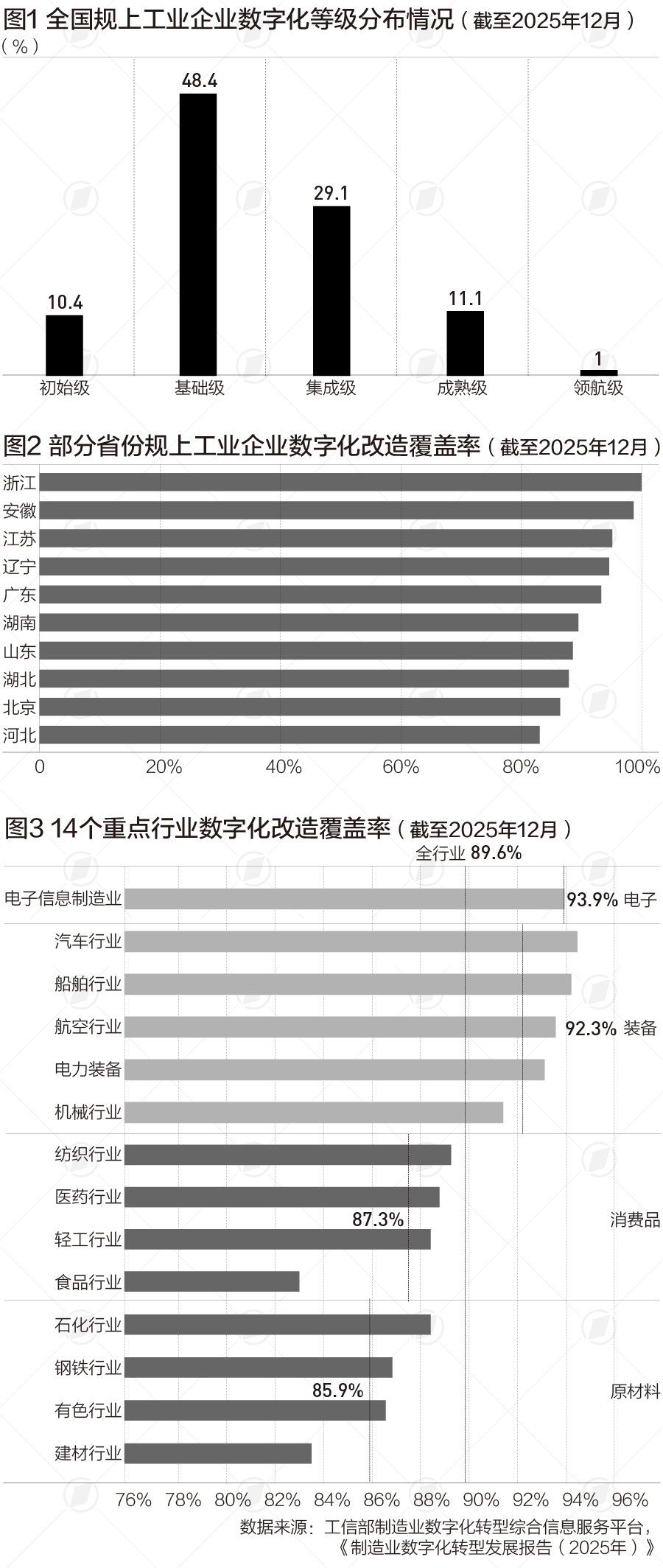
Core Viewpoint - By 2030, China aims to complete a round of digital transformation for industrial enterprises, amidst pressures from global industrial restructuring and the need for intelligent transformation in manufacturing [1][2]. Group 1: Digital Transformation Goals - The report outlines that by 2027, major industrial provinces and key parks will achieve full coverage of digital transformation for industrial enterprises, with a target for all industrial enterprises to complete digital transformation by 2030 [2]. - As of December 2025, the Ministry of Industry and Information Technology (MIIT) plans to issue digital transformation implementation plans for 14 key industries, setting clear transformation goals [2]. Group 2: Current Status and Growth - According to data from the National Taxation Administration, the procurement of automation and digital equipment by manufacturing enterprises is expected to grow by 11.3% and 10% year-on-year, respectively, by 2025 [3]. - The proportion of industrial enterprises engaged in digital transformation is projected to reach 89.6% by the end of 2025, with a digital production equipment penetration rate of 57.7% [3]. Group 3: Regional and Industry Disparities - Different provinces show varying levels of digital transformation, with Zhejiang, Anhui, and Guangdong nearing or exceeding 90% coverage among industrial enterprises [3][10]. - The automotive, shipbuilding, and electronic information manufacturing sectors have the highest rates of digital transformation, with 94.4%, 94.2%, and 93.9% of enterprises engaged in such efforts, respectively [10]. Group 4: Challenges and Recommendations - The report identifies challenges such as weak transformation foundations, insufficient technological products, and inadequate resource support for digital transformation [14]. - Recommendations include establishing unified industrial data interfaces, promoting data sharing among industry players, and leveraging central financial resources to support digital transformation projects [15].

税收大数据显示:2025年我国科技创新与产业创新融合发展加快
Xin Lang Cai Jing· 2026-02-23 16:33
Group 1 - The core viewpoint of the articles highlights the accelerated integration of technology and industry in China, with significant growth in strategic emerging industries and improved efficiency in technology transfer by 2025 [1][2] Group 2 - Strategic emerging industries are experiencing robust growth, with high-tech industry sales revenue expected to increase by 13.9% year-on-year in 2025, driven by high-tech manufacturing and services growing by 10.1% and 16.6% respectively [1] - Notable sectors such as lithium battery manufacturing, service robots, industrial robots, and biopharmaceuticals are showing impressive sales growth, with increases of 25.1%, 60.7%, 17.4%, and 7.7% respectively [1] - The conversion of scientific and technological achievements is being enhanced, with sales revenue from research and technical services projected to rise by 20.4% year-on-year, and revenue from patent-intensive industries increasing by 10.7% [1] - The digital economy's core industries are expected to see a sales revenue growth of 9.4% in 2025, with digital product manufacturing and digital technology application sectors growing by 9.4% and 13.8% respectively [2] - Traditional industries are accelerating their transformation, particularly in automation, with significant increases in procurement of automation equipment in sectors like petrochemicals, steelmaking, and ironmaking, showing growth rates of 17.3%, 11.7%, and 12.7% respectively [2] - The data reflects a solid achievement in China's technological self-reliance and the cultivation of new productive forces, indicating a strong and sustainable internal momentum for high-quality development [2]
鸿富瀚(301086)深度报告:精密制造平台化延展 液冷与自动化驱动全新成长极
Xin Lang Cai Jing· 2026-02-09 14:40
Group 1: Core Business and Market Trends - The company focuses on precision manufacturing in consumer electronics, building a comprehensive product platform covering thermal management, optics, insulation, shielding, and structural components [1] - The recovery in smartphone demand, accelerated penetration of AI PCs, and upgrades in wearables and new energy vehicles are driving a resurgence in functional components, which are evolving from simple material parts to integrated solutions [1] - The company's engineering capabilities in high-clean manufacturing, defect control, and online inspection support its growth within a robust customer base, backed by industry trends and customer structure [1] Group 2: Liquid Cooling Technology - The increasing power density in AI servers and high-speed switching devices is driving the shift towards liquid cooling, which is transitioning from limited introduction to large-scale application [2] - The Direct-to-Chip approach is establishing advantages in engineering replicability and system efficiency, leading to increased penetration and higher single-unit value, making the liquid cooling market significantly elastic [2] - The company is expanding beyond single cold plate processing to modular products like cold plate modules, manifolds, and connectors, leveraging its precision functional components and multi-process manufacturing capabilities [2] Group 3: Automation Business Development - The automation equipment business has evolved from internal support for major consumer electronics clients to an independent revenue-generating unit, driven by a deep understanding of processes [3] - The shift in manufacturing demand from "replacing labor" to "empowering processes" is leading to the application of micro-level precision assembly and inspection capabilities in new energy lithium battery production [3] - This business model emphasizes process understanding and engineering delivery, positioning the automation segment for mid-term growth potential as it transitions from a cost-reduction tool to an external profit unit [3] Group 4: Financial Projections and Valuation - Revenue projections for 2025-2027 are estimated at 1.03 billion, 3.04 billion, and 4.37 billion yuan, with year-on-year growth rates of 25.79%, 195.22%, and 43.78% respectively [4] - Corresponding net profits for the same years are forecasted to be 134 million, 425 million, and 689 million yuan, with current market valuations reflecting PE ratios of 85.30, 26.91, and 16.60 times [4] - The company is rated as a "buy" based on these financial metrics [4]
经济日报:透过税收看制造强国建设
Xin Lang Cai Jing· 2026-02-04 12:20
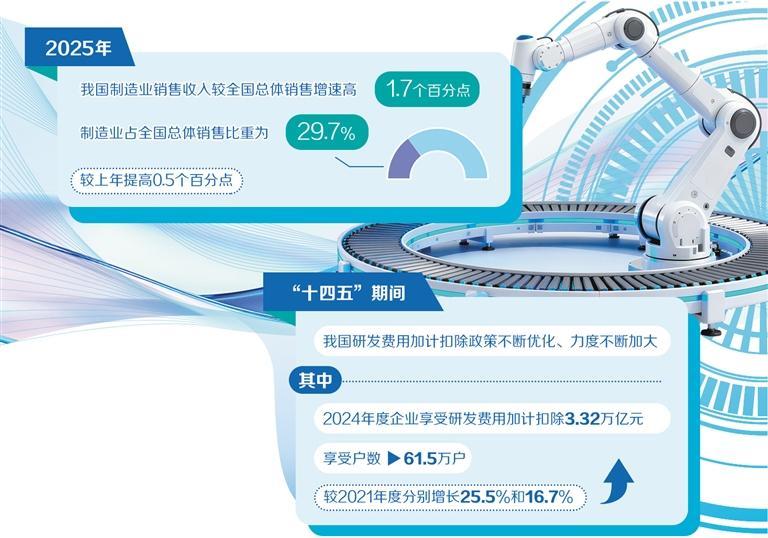
Core Insights - The manufacturing sector in China is projected to grow faster than the overall national sales growth by 1.7 percentage points by 2025, with its share of total sales reaching 29.7%, an increase of 0.5 percentage points from the previous year, highlighting its role as an economic stabilizer [2][14]. Intelligent Upgrading - By 2025, the procurement of automation and digital equipment by manufacturing enterprises is expected to increase by 11.3% and 10% year-on-year, respectively, indicating a rapid transformation towards intelligent manufacturing [4][16]. - The sales revenue of the intelligent equipment manufacturing sector is anticipated to grow by 28.1% year-on-year, with industrial robots and special operation robots seeing increases of 17.4% and 42.1%, respectively [4][16]. - Tax policies are being tailored to support the intelligent, green, and integrated development of the manufacturing sector, encouraging technological innovation and reducing R&D costs [4][16]. Green Development - The sales revenue of the new energy vehicle manufacturing sector is expected to grow by 14.3% year-on-year by 2025, while the clean energy generation sector is projected to see a 17.3% increase, with its share of total electricity production revenue rising to 38.5%, up 6.9 percentage points from 2021 [7][19]. - The government is focusing on establishing effective communication mechanisms between departments and enterprises to facilitate the accurate enjoyment of tax benefits related to green development [7][19]. Digital Integration - The sales revenue of the digital product manufacturing sector is projected to grow by 9.4% year-on-year by 2025, with manufacturing enterprises' procurement of digital technologies increasing by 10.4%, reflecting a deepening integration of the digital economy with the real economy [10][22]. - The automotive industry is set to enhance its digital transformation capabilities significantly by 2027, with a goal of achieving a high level of digital development by 2030 [10][22]. - Local tax authorities are enhancing their digital capabilities to improve tax services and compliance, thereby supporting the manufacturing sector's transition towards intelligent, green, and integrated development [10][22]. Tax Incentives and Support - During the "14th Five-Year Plan" period, tax incentives have been implemented to support technological innovation and manufacturing development, resulting in significant tax reductions for businesses [5][17]. - The R&D expense deduction policy has been optimized, with an expected deduction of 3.32 trillion yuan for 2024, benefiting 615,000 enterprises, marking increases of 25.5% and 16.7% from 2021 [5][17]. - Local tax departments are actively engaging with enterprises to ensure they can access these tax benefits effectively, including personalized support for R&D expense deductions [5][17][18].
透过税收看制造强国建设丨财金纵横
Xin Lang Cai Jing· 2026-02-04 05:06
Core Insights - The manufacturing sector in China is expected to see a sales revenue growth rate that exceeds the national average by 1.7 percentage points by 2025, with its share of total sales rising to 29.7% [3] - The transition towards intelligent, green, and integrated manufacturing is accelerating, highlighting the sector's role as an economic stabilizer [3] Intelligent Upgrade - By 2025, the procurement of automation and digital equipment by manufacturing enterprises is projected to increase by 11.3% and 10% year-on-year, respectively [3] - The sales revenue of the intelligent equipment manufacturing sector is expected to grow by 28.1%, with industrial robots and special operation robots seeing year-on-year growth of 17.4% and 42.1% [3] Tax Incentives and Support - Tax policies are being tailored to support the intelligent, green, and integrated development of the manufacturing sector, focusing on technological innovation and reducing R&D costs [4] - The R&D expense deduction policy is being optimized, with an expected deduction of 3.32 trillion yuan for 2024, benefiting 615,000 enterprises, marking increases of 25.5% and 16.7% from 2021 [5] Green Development - The sales revenue of the new energy vehicle industry is projected to grow at an annual rate of 49.5%, while clean energy generation is expected to grow by 13.9% annually during the 14th Five-Year Plan period [6] - By 2025, the new energy vehicle manufacturing sector is anticipated to grow by 14.3%, and the clean energy generation sector's revenue is expected to increase by 17.3%, accounting for 38.5% of total electricity production revenue [6] Digital Integration - The sales revenue of the digital product manufacturing sector is expected to grow by 9.4% year-on-year, with manufacturing enterprises' procurement of digital technologies increasing by 10.4% [9] - The automotive industry is set to enhance its digital transformation, with policies aiming for significant improvements in smart manufacturing capabilities by 2027 and overall digital development by 2030 [9] Local Tax Administration Initiatives - Local tax authorities are implementing tailored services to support green and low-carbon initiatives, including customized tax incentive packages for enterprises [7] - Collaborative platforms between tax and environmental departments are being established to enhance compliance and streamline tax reporting processes [8] Future Directions - Continued focus on intelligent, green, and integrated manufacturing is essential, with a need for targeted support based on regional industrial characteristics [10] - The integration of compliance guidance and risk prevention into tax services is crucial for enhancing the competitiveness of manufacturing enterprises [10]