地面兵装

Search documents
英大证券晨会纪要-20260330
British Securities· 2026-03-30 03:05
Core Views - The A-share market is showing signs of recovery, with the Shanghai Composite Index successfully reclaiming the 3900-point mark, indicating a reduction in the marginal impact of overseas market fluctuations and a shift towards self-driven recovery momentum [1][15][17] - The recent market adjustment is primarily attributed to ongoing geopolitical conflicts rather than a deterioration in domestic macroeconomic fundamentals, suggesting that such declines typically do not alter the long-term market trajectory [1][15][17] - Investors are advised to focus on "double insurance" stocks that have been unjustly punished but can validate their growth logic through upcoming quarterly performance reports, especially in the current environment of macroeconomic data verification and external uncertainties [1][15][17] Market Overview - Last week, the A-share market experienced a rebound after a period of decline, with the Shanghai Composite Index, Shenzhen Component Index, and ChiNext Index all showing positive movements [4][6] - The market saw significant activity in sectors such as pharmaceuticals, lithium mining, and agricultural chemicals, while defensive sectors like electricity and banking faced declines [4][5][6] - The overall market sentiment improved, with a notable increase in the number of rising stocks, although trading volumes remained a concern, indicating potential limitations on the sustainability of the rebound [2][5][6] Sector Analysis - The pharmaceutical and biotechnology sector is expected to continue its upward trajectory, driven by an aging population and increasing healthcare demands, making it a valuable area for investment [8] - The new energy sector, particularly lithium mining and energy metals, remains active, supported by government initiatives aimed at standardizing and promoting advancements in electric vehicle technologies and energy storage [9] - The coal sector has shown resilience, benefiting from rising oil and gas prices that encourage a shift towards coal as an alternative energy source [10] - The military industry, particularly ground equipment, is experiencing growth due to geopolitical tensions and the increasing importance of self-sufficiency in defense technologies [11] - The electricity sector, especially in relation to "computing and electricity synergy," is gaining traction as it becomes a national strategic focus, promising long-term growth opportunities [12] - The non-ferrous metals sector is rebounding, supported by ongoing economic recovery expectations and government policies aimed at stabilizing growth [12] Investment Strategy - Investors are encouraged to adopt a cautious approach, focusing on sectors with strong fundamentals and growth potential while being mindful of the overall market volatility and external risks [2][16] - The report emphasizes the importance of monitoring trading volumes to gauge the sustainability of market rebounds, as insufficient volume could limit upward movement [2][16] - A long-term bullish outlook remains intact, with expectations of a gradual recovery in the A-share market, supported by structural changes in the economy and policy stability [2][16]
市场分析:汽车光伏行业领涨,A股震荡上行
Zhongyuan Securities· 2026-03-06 09:14
Investment Rating - The industry is rated as "outperforming the market," indicating an expected increase of over 10% in the industry index relative to the CSI 300 index over the next six months [16]. Core Insights - The A-share market experienced a low opening followed by a slight upward trend, with significant performance in sectors such as photovoltaic equipment, automotive parts, chemical raw materials, and software development [3][4]. - The average price-to-earnings ratios for the Shanghai Composite Index and the ChiNext Index are 16.94 times and 51.73 times, respectively, which are above the median levels of the past three years, suggesting a favorable environment for medium to long-term investments [4][15]. - The total trading volume on the two exchanges reached 22,194 billion, which is above the median trading volume of the past three years, indicating strong market activity [4][15]. - The market is expected to focus on cyclical and technological sectors, especially with the upcoming "Two Sessions" and the clarification of the "14th Five-Year Plan" [4][15]. Summary by Sections A-share Market Overview - On March 6, the A-share market opened low but rose slightly, with the Shanghai Composite Index facing resistance around 4,129 points. The market showed a general upward trend throughout the day, with the Shanghai Composite closing at 4,124.19 points, up 0.38% [8][9]. - Over 80% of stocks in the two markets rose, with notable gains in agriculture, chemical raw materials, and software development sectors, while industries like oil services and energy metals lagged [8][10]. Future Market Outlook and Investment Recommendations - The market is anticipated to maintain a slight upward trend, with investors advised to pay close attention to macroeconomic data, changes in overseas liquidity, and policy developments [4][15]. - Short-term investment opportunities are recommended in sectors such as grid equipment, automotive parts, photovoltaic equipment, and chemical raw materials [4][15].
军工行业双周报:美以联合袭击伊朗,地缘政治风险加剧
Zhong Guo Yin He Zheng Quan· 2026-03-01 14:24
Investment Rating - The report maintains a recommendation for the defense and military industry [4] Core Insights - The geopolitical risks have escalated following the US and Israel's joint attack on Iran, which is expected to strengthen the growth expectations for military spending [6][15] - The Chinese military trade is anticipated to experience structural expansion opportunities due to the high cost-performance ratio and the absence of political conditions attached to Chinese military equipment [16][18] - The report highlights a significant calendar effect observed in the military industry index before and after the National People's Congress meetings [21][24] - The defense budget in China is projected to grow steadily by 7%-7.5% in 2026, driven by geopolitical tensions [21][24] Summary by Sections Section 1: Geopolitical Risks - The US and Israel launched a coordinated attack on Iran on February 28, 2026, leading to a significant military response from Iran [8][15] - The escalation of geopolitical risks is expected to enhance military spending growth expectations, with a focus on main battle equipment and new domains [15] Section 2: National Congress Outlook - The military industry index typically outperforms the Shanghai Composite Index before the National Congress meetings, with a notable increase of 4.4% one month prior and 1.7% one week prior [21][22] - The focus of the upcoming National Congress is expected to be on domestic innovation and emerging sectors within the military industry [24][25] Section 3: Military Trade Opportunities - Chinese military equipment is positioned as a core alternative for Middle Eastern countries, with expectations for military trade to increase from the current 3.82% to 10%-15% [16][18] - The report suggests focusing on key players in military trade, including 中航沈飞 (AVIC Shenyang Aircraft Corporation) and 中航成飞 (AVIC Chengfei), among others [18][47] Section 4: Investment Recommendations - Short-term opportunities are identified in commercial aerospace and military trade, with significant growth expected in the next five years [45] - Long-term prospects remain strong, with defense spending expected to maintain a growth rate of around 7% leading up to the centenary of the military [45]


军工行业双周报:美以联合袭击伊朗,地缘政治风险加剧-20260301
Yin He Zheng Quan· 2026-03-01 12:59
Investment Rating - The report maintains a recommendation for the defense and military industry [4] Core Insights - The geopolitical risks have escalated due to the US and Israel's joint attack on Iran, which is expected to strengthen military spending growth expectations [6][15] - China's military trade is anticipated to experience structural expansion opportunities, with domestic military equipment becoming a core choice for Middle Eastern countries [16][18] - The report highlights a significant calendar effect on the military industry index before and after the National People's Congress meetings [21][24] - The defense budget in China is projected to grow steadily by 7%-7.5% in 2026, focusing on new combat capabilities and network information system construction [21][24] - The report outlines two main lines of focus for the upcoming meetings: domestic substitution of high-end equipment and the cultivation of future industries and new combat capabilities [24][25] Summary by Sections Geopolitical Risks - The US and Israel launched a coordinated attack on Iran on February 28, 2026, leading to significant retaliatory actions from Iran [6][8] - The escalation of geopolitical risks is expected to enhance military procurement certainty, with a focus on main battle equipment and new combat capabilities [15] Military Trade Opportunities - China's military equipment is characterized by high cost-effectiveness and independence from political conditions, making it an attractive option for Middle Eastern countries [16][18] - The proportion of military trade in domestic major manufacturers is expected to increase from 3.82% to 10%-15%, indicating significant growth potential [18] Calendar Effect and Market Performance - The military industry index showed a notable increase of 4.4% in the month leading up to the National People's Congress, outperforming the Shanghai Composite Index [21][22] - Historical data indicates that the military index typically outperforms the Shanghai Composite before the meetings and underperforms afterward [21][23] Investment Recommendations - Focus on commercial aerospace, military trade, and intelligent equipment opportunities, with a strong demand forecast for the next five years [45] - Key companies to watch include those in the commercial aerospace sector, military trade, and the two-engine industry chain [47]
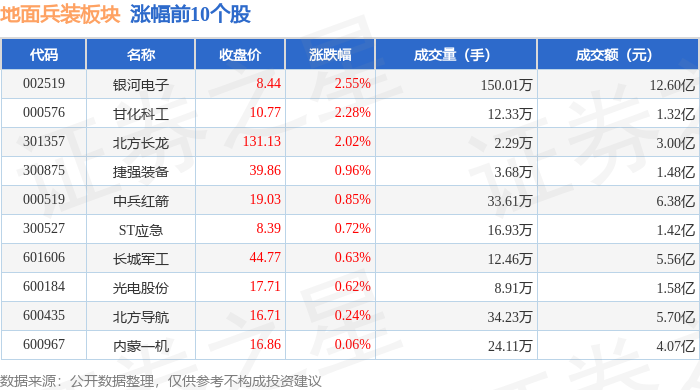
地面兵装板块2月4日涨0.6%,银河电子领涨,主力资金净流出7740.85万元
Zheng Xing Xing Ye Ri Bao· 2026-02-04 08:57
Market Overview - The ground armament sector increased by 0.6% compared to the previous trading day, with Galaxy Electronics leading the gains [1] - The Shanghai Composite Index closed at 4102.2, up by 0.85%, while the Shenzhen Component Index closed at 14156.27, up by 0.21% [1] Stock Performance - Galaxy Electronics (002519) closed at 8.44, with a rise of 2.55% and a trading volume of 1.5 million shares, amounting to a transaction value of 1.26 billion [1] - Other notable performers include: - GanHua Science and Technology (000576) at 10.77, up by 2.28% [1] - North Long Dragon (301357) at 131.13, up by 2.02% [1] - ST Emergency (300527) at 8.39, up by 0.72% [1] Capital Flow - The ground armament sector experienced a net outflow of 77.41 million from institutional investors, while retail investors saw a net inflow of 5.40 million [2] - The capital flow for key stocks includes: - Galaxy Electronics had a net inflow of 35.17 million from institutional investors [3] - North Long Dragon saw a net inflow of 14.05 million from institutional investors [3] - ST Emergency had a net inflow of 1.29 million from retail investors [3]





地面兵装板块2月3日涨2.41%,银河电子领涨,主力资金净流出2491.81万元
Zheng Xing Xing Ye Ri Bao· 2026-02-03 09:10
Market Performance - The ground equipment sector increased by 2.41% compared to the previous trading day, with Galaxy Electronics leading the gains [1] - The Shanghai Composite Index closed at 4067.74, up 1.29%, while the Shenzhen Component Index closed at 14127.1, up 2.19% [1] Stock Performance - Key stocks in the ground equipment sector showed the following closing prices and percentage changes: - Galaxy Electronics (002519) closed at 8.23, up 4.84% with a trading volume of 1.348 million shares and a turnover of 1.094 billion [1] - North Navigation (600435) closed at 16.67, up 3.09% with a trading volume of 364,000 shares and a turnover of 601 million [1] - Tianzuo Equipment (300922) closed at 22.96, up 2.96% with a trading volume of less than 30,200 shares and a turnover of 16.895 million [1] - Other notable stocks include Guodian (688543) at 65.68, up 2.24%, and Zhongbing Hongjian (000519) at 18.87, up 2.78% [1] Capital Flow - The ground equipment sector experienced a net outflow of 24.918 million from institutional investors, while retail investors saw a net inflow of 14.6 million [1] - Detailed capital flow for key stocks indicates: - Galaxy Electronics had a net inflow of 55.239 million from institutional investors but a net outflow of 14.471 million from retail investors [2] - North Navigation saw a net outflow of 2.409 million from institutional investors but a net inflow of 11.973 million from retail investors [2] - Tianzuo Equipment had a net inflow of 4.195 million from institutional investors and a net outflow of 1.430 million from retail investors [2]


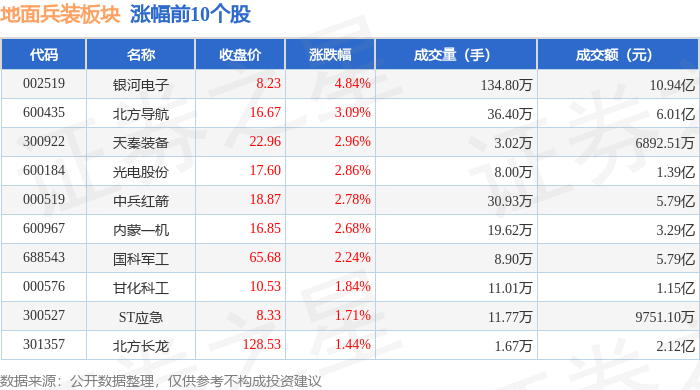
地面兵装板块2月2日跌2.78%,捷强装备领跌,主力资金净流出4.95亿元
Zheng Xing Xing Ye Ri Bao· 2026-02-02 09:15
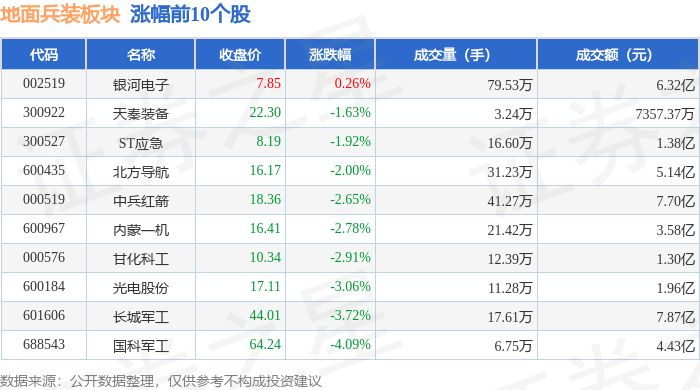
Market Overview - The ground equipment sector experienced a decline of 2.78% on February 2, with Jieqiang Equipment leading the drop [1] - The Shanghai Composite Index closed at 4015.75, down 2.48%, while the Shenzhen Component Index closed at 13824.35, down 2.69% [1] Stock Performance - Notable stock performances in the ground equipment sector included: - Galaxy Electronics (002519) closed at 7.85, up 0.26% with a trading volume of 795,300 shares and a turnover of 632 million yuan [1] - Jieqiang Equipment (300875) closed at 39.21, down 5.01% with a trading volume of 43,700 shares and a turnover of 173 million yuan [2] - Changcheng Military Industry (601606) closed at 44.01, down 3.72% with a trading volume of 176,100 shares and a turnover of 787 million yuan [2] Capital Flow - The ground equipment sector saw a net outflow of 495 million yuan from institutional investors, while retail investors experienced a net inflow of 382 million yuan [2] - The capital flow for individual stocks showed: - Changcheng Military Industry had a net outflow of 170 million yuan from institutional investors [3] - Jieqiang Equipment had a net outflow of 17 million yuan from institutional investors [3] - Galaxy Electronics had a net outflow of 23 million yuan from institutional investors [3]


中上游企业25年业绩恢复性高增长
HTSC· 2026-02-02 07:09
Investment Rating - The report maintains an "Overweight" rating for the aerospace and defense sector [8] Core Insights - The aerospace and defense industry is expected to experience significant recovery and growth in 2025, with 30 out of 75 listed companies forecasting positive earnings growth compared to the previous year [11][12] - The report highlights structural opportunities in military equipment demand during the "14th Five-Year Plan" period, focusing on new domains, unmanned systems, advanced weaponry, and low-cost equipment [14][16] Summary by Sections Industry Performance - As of January 31, 2025, 75 out of 120 listed companies in the defense sector have disclosed earnings forecasts, with 30 companies expecting positive growth, 7 expecting positive but declining growth, 17 expecting losses but reduced compared to the previous year, and 21 expecting increased losses [11][12] Key Companies to Watch - Recommended companies include: - AVIC Shenyang Aircraft Corporation (600760 CH) - Guorui Technology (600562 CH) - Steel Research (300797 CH) - Guotai Group (603977 CH) - West Superconductor (688122 CH) - Ruichuang Micro-Nano (688002 CH) - Beifang Navigation (600435 CH) - Gaode Infrared (002414 CH) - Aerospace Intelligence (300446 CH) - Aerospace Rainbow (002389 CH) [3][8][9] Earnings Forecasts - Notable companies with significant earnings growth forecasts include: - Beimo High-Tech: 1169% growth due to product delivery and cost reduction [12] - Hailanxin: 509% growth from increased self-produced products [12] - *ST Chengchang: 452% growth driven by industry recovery [12] - Zhimin Da: 414% growth from increased demand in previously established product lines [12] - Aileda: 351% growth from increased military and civilian product demand [12] Long-term Outlook - The report emphasizes the importance of new equipment construction cycles and suggests focusing on new products and markets during the "14th Five-Year Plan" [14][16] - The military trade market is expected to grow, with China aiming to increase its market share in global military trade [17] Market Trends - The report notes a decline in the defense sector index by 7.69% over the past week, underperforming the broader market [28] - The current PE (TTM) for the defense sector is 95.23, indicating a high valuation compared to historical levels [36] Investment Opportunities - The report suggests that companies involved in unmanned systems, low-cost munitions, and military AI are likely to see significant growth opportunities [16][18] - The commercial aerospace sector is also highlighted as a growing area, with advancements in satellite internet and low-altitude economy [18][25]



2025年业绩预告有哪些线索值得关注?
Yin He Zheng Quan· 2026-02-02 06:21
Core Insights - The report highlights that as of January 31, 2025, 2,956 A-share listed companies have disclosed their annual performance forecasts, with a disclosure rate of 54% and a positive forecast rate of 37% [2][4][7] - The report indicates that the technology manufacturing sector shows a high positive forecast rate, reflecting an upward trend in its economic outlook [29] - Certain cyclical industries are benefiting from price increases and product structure improvements, while overseas business expansion is opening new growth avenues [29] Disclosure and Positive Forecast Rates - Among the disclosed companies, 1,092 have positive forecasts, categorized into "turning profitable," "continuing profit," "slight increase," and "expected increase" types [4][10] - The disclosure rates vary by sector, with the ChiNext board having a high positive forecast rate of 39%, followed by the main board at 37%, the Sci-Tech Innovation board at 36%, and the North Exchange at 33% [7][10] - The non-bank financial, non-ferrous metals, automotive, beauty care, and public utilities sectors have positive forecast rates exceeding 50%, while coal, real estate, light manufacturing, and food and beverage sectors have rates below 25% [11][12] Profit Growth Rates - The median growth rate of net profit attributable to shareholders for the 2,956 A-shares is 17.95%, an increase of 12.42 percentage points from the third quarter of 2025 [17][20] - The main board's median net profit growth rate is 14.46%, while the ChiNext board leads with 25.34% and the Sci-Tech Innovation board follows at 21.83% [20][22] - In terms of industry performance, non-ferrous metals and non-bank financial sectors show median net profit growth rates above 40%, while sectors like commercial retail and food and beverage show significantly negative growth rates [22][23] Investment Outlook - The report suggests focusing on sectors with high net profit growth rates and low price-to-earnings ratios, such as personal care, marine equipment, gas, and securities [29] - Technology manufacturing sectors like electric motors, ground weaponry, and wind power equipment are expected to benefit from trends in renewable energy and AI, despite higher valuations [29] - Policy support for key areas such as artificial intelligence and aerospace is anticipated to catalyze growth in related industries [29]
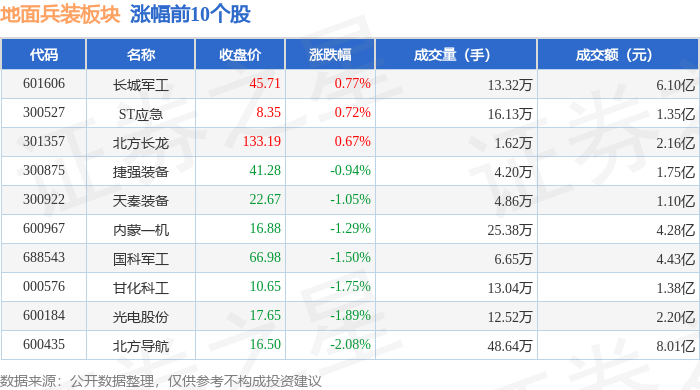
地面兵装板块1月30日跌1.4%,中兵红箭领跌,主力资金净流出4.05亿元
Zheng Xing Xing Ye Ri Bao· 2026-01-30 09:00
Market Overview - The ground armament sector declined by 1.4% on January 30, with Zhongbing Hongjian leading the drop [1] - The Shanghai Composite Index closed at 4117.95, down 0.96%, while the Shenzhen Component Index closed at 14205.89, down 0.66% [1] Stock Performance - Notable stock performances include: - Changcheng Military Industry (601606) closed at 45.71, up 0.77% with a trading volume of 133,200 shares and a turnover of 610 million yuan [1] - Zhongbing Hongjian (000519) closed at 18.86, down 3.68% with a trading volume of 611,500 shares and a turnover of 1.151 billion yuan [2] - Beifang Navigation (600435) closed at 16.50, down 2.08% with a trading volume of 486,400 shares and a turnover of 801 million yuan [2] Capital Flow - The ground armament sector experienced a net outflow of 405 million yuan from institutional investors, while retail investors saw a net inflow of 436 million yuan [2][3] - Specific stock capital flows include: - Beifang Navigation had a net outflow of 6.5665 million yuan from institutional investors and a net inflow of 121 million yuan from retail investors [3] - Zhongbing Hongjian saw a net outflow of 11.2832 million yuan from institutional investors and a net inflow of 115 million yuan from retail investors [3]