Smartphones

Search documents
传音非洲智能手机份额51%居首,小米连续9季度增长
Xin Lang Ke Ji· 2025-08-22 06:27
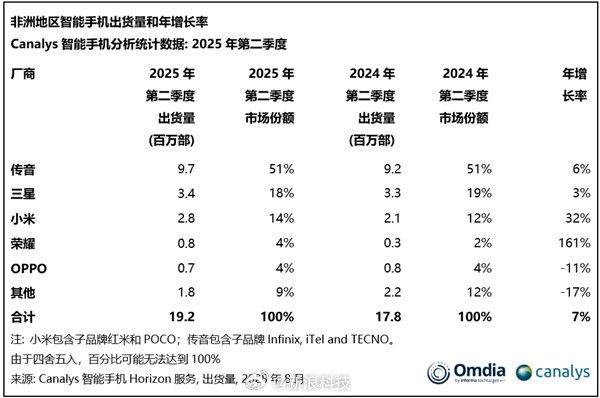
Core Insights - The African smartphone market saw a year-on-year increase of 7% in Q2 2025, with a total shipment of 19.2 million units, making it one of the best-performing regions globally [1][2] - Demand for ultra-low-cost smartphones under $100 surged by 38% in Q2 2025, contributing to a decrease in average selling prices since 2023 [1] Company Performance - Transsion maintained its leading position with a 6% growth, holding a 51% market share, significantly ahead of competitors [1][2] - Samsung ranked second with an 18% market share, showing a slight increase from the previous year [2] - Xiaomi achieved a remarkable 32% growth, securing a 14% market share and marking its ninth consecutive quarter of growth [1][2] - Honor experienced a substantial growth rate of 161%, while OPPO and Realme faced declines of 11% and 17%, respectively [2] Market Strategy - Xiaomi is focusing on expanding its presence in Africa, having established operations in 16 countries, including Egypt, South Africa, Nigeria, Morocco, Algeria, and Kenya [1]



机构:非洲智能手机市场100美元以下机型在第二季度激增38% 小米持续增长、荣耀增幅最大
Xin Lang Cai Jing· 2025-08-22 03:16
Group 1 - The demand for ultra-low-cost smartphones is reshaping the African market, with models priced below $100 surging by 38% in Q2, continuing to lower the average selling price since 2023 [1] - Transsion maintains the top position with a 6% growth, facing challenges in moving up the value chain despite TECNO's efforts in the mid-range market [1] - Samsung has extended its market reach from South Africa to Egypt and Nigeria through localized distribution, retail expansion, and the launch of affordable models like A06, achieving a 3% year-on-year growth [1] Group 2 - Xiaomi has experienced a 32% year-on-year growth, capturing a 14% market share, driven by strong performance in Nigeria and Egypt, active channel expansion, and deeper local investments [1] - Honor has strengthened its momentum with popular entry-level and mid-range models like X7c and 400 Lite, along with partnerships with carriers, with South Africa contributing 64% to Honor's regional business [1]
折叠屏手机火热 荣耀推出Magic V Flip2
2 1 Shi Ji Jing Ji Bao Dao· 2025-08-21 14:04
Core Viewpoint - The launch of the new foldable smartphone Honor Magic V Flip2 at a starting price of 5499 yuan signifies the ongoing competition in the foldable smartphone market, with major players like Honor and potential entrants like Apple driving innovation and consumer interest [1] Group 1: Product Features - The Honor Magic V Flip2 features a vertical fold design, measuring 6.9mm in thickness when opened and 15.5mm when folded, weighing approximately 204g [1] - The device is equipped with a 200 million pixel ultra-clear main camera and a 50 million pixel 120° ultra-clear wide-angle lens [1] Group 2: Market Trends - Leading smartphone manufacturers, including Honor, are increasingly investing in the foldable smartphone segment, with Apple expected to launch its own foldable device next year [1] - TrendForce predicts that if Apple enters the market, consumer interest and acceptance of foldable products among high-end users will likely increase rapidly, injecting innovation into the smartphone industry [1] Group 3: Market Projections - TrendForce estimates that global foldable smartphone shipments will reach 19.8 million units by 2025, maintaining a penetration rate of approximately 1.6%, consistent with 2024 figures [1]
Google's Pixel 10 launch wasn't about the phones but the strategic AI play
CNBC· 2025-08-21 12:34
Group 1 - Google introduced its Pixel 10 series of smartphones, emphasizing the strategic importance of software features to compete with AI players like OpenAI and Perplexity [1][2] - The new devices showcase various AI features powered by Gemini AI models, including "Magic Cue" for information retrieval, "Camera Coach" for photography tips, and live translation for phone calls [2] - The development of "agentic AI" is a key focus for tech giants, as they aim to create advanced AI assistants capable of performing complex tasks, amid concerns over user retention and revenue from Google's core search product [3] Group 2 - Google has a significant opportunity with Android, the operating system installed on over three billion devices worldwide, many of which are smartphones [4]


小米集团-W(1810.HK):25Q2经营创新高 汽车规模效应加速释放
Ge Long Hui· 2025-08-21 10:40
Core Insights - The company reported a significant increase in total revenue and adjusted net profit for the first half of 2025, with total revenue reaching 227.2 billion yuan, up 38.2% year-on-year, and adjusted net profit at 21.5 billion yuan, up 69.8% [1] Automotive Sector - The automotive segment experienced accelerated growth, with revenue from smart electric and innovative businesses reaching 21.3 billion yuan, a year-on-year increase of 234% and a quarter-on-quarter increase of 14%, driven by continuous delivery growth and an increase in average selling price (ASP) [2] - The company delivered 81,000 vehicles in Q2, marking a year-on-year increase of 198% and a quarter-on-quarter increase of 7%, with an ASP of 254,000 yuan, up 11% year-on-year, primarily due to the increased delivery of the high-priced SU7 Ultra [2] - The automotive business gross margin improved to 26.4%, up 11 percentage points year-on-year and 3 percentage points quarter-on-quarter, benefiting from robust orders and capacity ramp-up [2] - The company anticipates that the launch of the YU7 model in June will further enhance quarterly deliveries and potentially lead to profitability within the year [2] Smartphone Sector - In Q2 2025, the smartphone business generated revenue of 45.5 billion yuan with a shipment volume of 42.4 million units, achieving year-on-year growth for eight consecutive quarters and maintaining a top-three position globally for five years [2] - The company achieved significant market share in the high-end segment, with a 24.7% market share in the 4,000-5,000 yuan price range, ranking first, and a 15.4% market share in the 5,000-6,000 yuan range, an increase of 6.5 percentage points year-on-year [2] - The successful launch and mass production of the self-developed 3nm flagship SoC, the Xuanjie O1, provide the company with a long-term competitive advantage [2] IoT Sector - The IoT and lifestyle consumer products segment achieved record revenue of 38.7 billion yuan in Q2, a year-on-year increase of 45%, with a gross margin of 22.5%, up 3 percentage points [3] - The smart home appliance category showed strong performance, with revenue growth of 66% year-on-year, air conditioner shipments exceeding 5.4 million units (up over 60% year-on-year), refrigerator shipments exceeding 790,000 units (up over 25% year-on-year), and washing machine shipments exceeding 600,000 units (up over 45% year-on-year) [3] - The company launched the Xiaomi AI glasses in June, featuring a 12-megapixel ultra-transparent optical lens, which is expected to further expand the IoT business space [3] Financial Forecast - The company projects revenues of 474.4 billion yuan, 588.7 billion yuan, and 696.4 billion yuan for 2025-2027, representing year-on-year growth rates of 30%, 24%, and 18% respectively; net profit attributable to shareholders is expected to be 43.7 billion yuan, 56.7 billion yuan, and 71.4 billion yuan, with corresponding year-on-year growth rates of 85%, 30%, and 26% [3]
Google announces its AI-powered Pixel 10 smartphone series
CNBC· 2025-08-20 16:00
Core Insights - Google has launched its new Pixel smartphone series, including the Pixel 10 Pro, emphasizing AI and durability features as key selling points [1][3] - The Pixel 10 family utilizes Google's AI capabilities for smart tasks, enhancing user experience [2][5] - The Pixel 10 series includes multiple models with varying price points, starting from $799 for the baseline model to $1,799 for the Pixel 10 Pro Fold [3][4] Product Features - The Pixel 10 series incorporates advanced AI and camera features, with the baseline model starting at $799 and the Pixel 10 Pro at $999 [3] - The "Magic Cue" feature anticipates user needs by surfacing relevant information during calls, enhancing the personalized experience [7] - Google's Gemini assistant is positioned as a more advanced AI compared to Apple's Siri, potentially attracting AI-focused consumers [5][6] Market Context - The launch of the Pixel phones precedes Apple's announcement of new iPhone models, highlighting the competitive landscape in the smartphone market [4] - Despite having a smaller market share compared to competitors like Samsung and Apple, the Pixel line allows Google to showcase its Android software capabilities [4] - Apple's delay in updating Siri until 2026 creates an opportunity for Google to capture AI-driven customers with its Gemini assistant [6]

Capture, create and connect: Google Pixel 10 series now available at Verizon
Globenewswire· 2025-08-20 16:00
Core Points - Verizon has launched preorders for the new Google Pixel 10 series, which includes Pixel 10, Pixel 10 Pro, Pixel 10 Pro XL, and Pixel 10 Pro Fold, on its 5G network [2] - The company offers a three-year price lock guarantee on its myPlan and myHome network plans, ensuring no price hikes for customers [3][7] - The Pixel 10 series features advanced AI capabilities, enhanced camera technology, and improved durability, aiming to redefine the smartphone experience [5][6] Pricing and Offers - Pixel 10 Pro XL starts at $33.33 per month for 36 months ($1,199.99 retail), Pixel 10 Pro at $27.77 per month ($999.99 retail), Pixel 10 at $22.22 per month ($799.99 retail), and Pixel 10 Pro Fold at $49.99 per month ($1,799.99 retail) [8] - Customers can receive significant discounts, such as $1,000 off a Pixel 10 Pro Fold with a trade-in of qualified devices [9] - The Pixel Watch 4 is available starting at $12.49 per month for 36 months ($449.99 retail) [8] Customer Experience and Benefits - Verizon enhances customer experience with exclusive mobile and home discounts, rewards, and events accessible via the My Verizon app [4] - The company provides seamless service and a variety of plans tailored to customer needs, including a special offer for business customers [11][12] - Customers purchasing a Pixel 10 series smartphone can enjoy six months of Google AI Pro for free [10]


CBN丨Pop Mart worths over HKD400 billion on stunning H1 performance
2 1 Shi Ji Jing Ji Bao Dao· 2025-08-20 12:26
Company Overview - Pop Mart, a Chinese toymaker, reported a near-400% surge in net profit, driven by global demand for its LABUBU dolls [1][11] - The company’s adjusted net profit reached CNY4.71 billion, with revenue at CNY13.88 billion, marking a year-on-year increase of 204.4% [3] Financial Performance - In the first half of 2025, Pop Mart's revenue from China was CNY8.28 billion, up 135.2%, while revenue from Asia-Pacific (excluding China) was CNY2.85 billion, rising 257.8% [4] - Revenue from the Americas surged to CNY2.26 billion, up 1,142.3%, and revenue from Europe and other regions rose 729.2% to CNY480 million [4] Product and Market Expansion - LABUBU generated revenue exceeding CNY4.8 billion, becoming one of the world's most popular IPs in the first half of 2025 [5] - The company plans to launch a miniature LABUBU that can be clipped onto phones [6] Strategic Initiatives - Pop Mart established four regional headquarters in April to enhance its globalization strategy [7] - The company opened its first stores in landmark locations such as Cambridge in the UK and Bali in Indonesia, with plans to expand into markets including the Middle East, South Asia, Central and South America, and Russia [8] Market Position - Pop Mart's market cap surpassed HKD400 billion, with shares rising more than 200% in the last year, making it worth more than Mattel, Hasbro, and Sanrio combined [2]
固定收益部市场日报-20250820
Zhao Yin Guo Ji· 2025-08-20 08:29
Report Summary 1. Report Industry Investment Rating No information provided. 2. Core View of the Report The report provides a comprehensive update on the fixed - income market, including bond price movements, macro - news, and company - specific financial and operational information. It also highlights potential investment opportunities, such as the recommendation to buy INCLEN 4.5 04/18/27 in the RNW complex [15]. 3. Summary by Relevant Catalogs Trading Desk Comments - Yesterday, the new DBS 3.989 28 was 3bps tighter from RO at par. In Asia IG, HYUELE 2.375 31s was 1bp tighter. SK Hynix repaid KRW3.4tn (cUSD2.5bn) [2]. - In financials, there was selling in STANLNs due to USD9.6bn unlawful transactions allegations. STANLN Perps were down 0.1pt. Yankee AT1s were weaker [2]. - In lifers, JP DAIL 6.2 Perps/MYLIFE 5.8 54s/NIPLIF 6.5 55s were down 0.4pt. KR TYANLI 35 was 1bp tighter. Tongyang Life announced the redemption of USD300mn TYANLI 5.25 Perp on 22 Sep'25 [2]. - In Chinese AMCs, CFAMCI 25/29s were 0.1 - 0.2pt higher. China CITIC FAMC expects its 1H25 net profit to increase 12.5 - 16.3% yoy to RMB6 - 6.2bn [2]. - In HK Corp, there was selling in HYSAN/CPREIT/CKHH/MTRC for profit - taking. HYSAN 4.85/7.2 Perps was 0.4 - 1.1pts lower. MTRC 55 was 1bp wider and MTRC Perps were 0.1 - 0.2pt lower [2]. - In Chinese HY, HONGQI 28s were 1bp tighter. China Hongqiao announced the buy - back of 10.2mn shares for cHKD234mn. GWFOOD 30 was 1.1pts lower. WESCHI 26 was 0.1pt higher [2]. - In Chinese properties, FTLNHD 25 - 26 were 0.2pt higher, FUTLAN 28 was unchanged. Seazen obtained approval for up to RMB1.1bn (cUSD147.5mn) onshore ABS offering and announced a profit warning for 1H25 results [2]. - In SEA, PTTGCs were 0.2 - 1.4pts higher (1 - 4bps tighter). PTT Global Chemical eyes THB30bn (cUSD923mn) from non - core assets monetization. PERTIJs were 1 - 2bps tighter. VLLPM 27 - 29 were down 0.1 - 1.5pts [2]. - This morning, the new ALVGR 6.55 Perp was up 0.5pt from RO at par. China and KR IGs were 1 - 3bps wider. There was profit - taking from BNKEAs/NANYANs. BBLTB subs were 2bps wider. SHIKON 35 was 1bp tighter [3]. - INCLEN 27s/INGPHL 27s/RPVIN27 - 28s were 0.1 - 0.4pt higher after results announcement. CTFSHK 29 was 0.4pt lower this morning [3]. - In the LGFV space, flows were mixed. Higher - yielding (8%+) papers were sought after by HF and RM, while there was profit - taking on 5% - 7% yielding papers. TSIVMG 1.55 29 was up 0.7pt [4]. Macro News Recap On Tuesday, S&P was down 0.59%, Dow was up 0.02%, and Nasdaq was down 1.46%. UST yield was lower, with 2/5/10/30 yields at 3.75%/3.82%/4.30%/4.90% [7]. Desk Analyst Comments - INCLEN's module and cell manufacturing drove 1QFY26 revenue and adj. EBITDA growth [8]. - ReNew Energy (RNW) reported a 71% yoy increase in 1QFY26 revenue to INR39.0bn, with adj. EBITDA rising 43% yoy to INR27.2bn. The manufacturing segment contributed significantly [8]. - In May'25, RNW secured INR8.7bn (cUSD100mn) from Marquee Investment for a 10% stake in its solar manufacturing subsidiary. The investment will expand manufacturing capacity [9]. - RNW's total operational capacity reached 11.1GW in 1QFY26, up 16% yoy. The PLF for wind assets improved to 32.8%, while solar PLF declined to 24.6% [10]. - RNW reiterates its FY26 guidance for adj. EBITDA at INR87 - 93bn and maintains CFe guidance at INR14 - 17bn. 1QFY26 adj. EBITDA represents 29 - 31% of the full - year target [11]. - As of Jun'25, cash and bank balance was INR76.1bn, 6% lower than in Mar'25. 1QFY26 capex was INR5.1bn, down 86% yoy [12]. - RNW's net debt/LTM adj. EBITDA was down to 7.5x in Jun'25 from 8.3x in Dec'24 [13]. - On 2 Jul'25, RNW received a final non - binding offer to be taken private at USD8 per share, a 13.2% increase from the previous proposal [14]. - The analyst maintains a buy on INCLEN 4.5 04/18/27 in the RNW complex [15]. Offshore Asia New Issues - Priced: Ganzhou Urban Investment Holding issued USD250mn, 3 - year bonds at a 4.8% coupon. Tongling State - owned Capital Operation Holding Group issued USD200mn, 3 - year bonds at a 4.65% coupon [20]. - Pipeline: No new issues pipeline today [20]. News and Market Color - Yesterday, 118 credit bonds were issued onshore with an amount of RMB114bn. Month - to - date, 1,319 credit bonds were issued, raising RMB1,183bn, a 3.7% yoy increase [22]. - The US government is exploring ways to get stakes in companies like Taiwan Semiconductor Manufacturing, Micron, and Samsung [22]. - BHP plans to cut annual capex to USD10bn in FY28 - 30 from USD11bn in FY26 - 27 and will sell Carajas copper assets in Brazil for up to USD465mn [22]. - Media reported CK Asset was approached for short - term financing or equity investment opportunities [22]. - Seazen expects 1H25 profit to fall by up to 48% yoy to RMB500 - 700mn (cUSD69.6 - 97.5mn) [22]. - HPCL - Mittal Energy will purchase USD56.39mn of HMELIN 5.45 10/22/26 and USD85.55mn of HMELIN 5.25 04/28/27 in tender offers [22]. - LG Electronics aims to expand in the Indian home electronics market [22]. - Powerlong 1H25 loss will widen to up to RMB2.9bn (cUSD403mn) [22]. - West China Cement will hold fixed income investor meetings from 26 Aug'25 [22]. - Xiaomi 1H25 revenue rose 38.2% yoy to RMB227.3bn (cUSD31.6bn) and plans to enter the European EV market by 2027 [22].

字节跳动回应“豆包手机”传闻:无自研计划 聚焦AI能力开放合作
Huan Qiu Wang Zi Xun· 2025-08-20 03:23
Group 1 - ByteDance has denied rumors regarding the development of its own smartphone, "Doubao," stating that there are no plans to launch a proprietary mobile product [1][3] - The company is focused on opening its AI capabilities to various hardware manufacturers, including smartphone makers, and will collaborate on complete solutions without developing its own mobile devices [1][3] - In 2019, ByteDance acquired partial patent rights from Smartisan Technology, which led to speculation about entering the smartphone market; however, the internal team responsible for hardware has since shifted focus to educational hardware [3] Group 2 - In 2021, the "New Stone Laboratory," which was exploring smartphone development, was merged into an education hardware team, ceasing the development of unrelated products like the Smartisan phone [3] - Similar rumors have surfaced multiple times in 2023, including claims of partnerships with Nubia for AI phones and the recruitment of former Honor CEO Zhao Ming, both of which were denied by ByteDance [3] - The Doubao large model, an important AI product of ByteDance, has over 160 million cumulative users as of 2024, with an average of 800,000 new downloads daily in November and nearly 9 million daily active users [3]