
互联网医疗

Search documents
创新药企业扭亏节点或加速到来,港股通医疗ETF工银(159167)将于2月12日在深交所上市交易
Sou Hu Cai Jing· 2026-02-11 01:20
近期,随着创新药企业陆续披露2025年报及业绩预告,多家企业展现出良好的经营改善态势,在报告期 内实现亏损收窄甚至业绩转正,释放出积极信号。在此背景下,创新药及相关板块再引关注。公告显 示,工银瑞信中证港股通医疗主题交易型开放式指数证券投资基金(简称:港股通医疗ETF工银;代 码:159167)将于2026年2月12日起在深交所上市交易。 公开资料显示,港股通医疗ETF工银(159167)紧密跟踪中证港股通医疗主题指数(代码: 932069.CSI),该指数锚定医疗创新,全面覆盖港股"CXO +互联网医疗+医疗器械+创新药"等医药各领 域核心龙头,并囊括脑机接口、AI医疗、高端医疗器械等热门主题;该指数弹性足,估值具有吸引 力。Wind数据显示,截至2026年2月10日,中证港股通医疗主题指数目前市盈率(TTM)为32.85倍, 处于发布以来48.16%分位,指数当前或未被高估,或仍具有吸引力。 国金证券指出,2025年中国新药License-out交易数量达158笔、总规模1357亿美元,创近十年新高;出 海BD繁荣不仅显著提振短期业绩预期,更推动国产新药国际化开发进程与远期价值提升。申万宏源研 究研报观点 ...
平安好医生(01833.HK):2月10日南向资金增持159.24万股
Sou Hu Cai Jing· 2026-02-10 19:27
Group 1 - The core viewpoint of the article highlights that southbound funds have increased their holdings in Ping An Good Doctor (01833.HK) by 1.59 million shares on February 10, with a total net increase of 5.49 million shares over the last five trading days [1] - Over the past 20 trading days, southbound funds have increased their holdings on 11 occasions, resulting in a cumulative net increase of 3.91 million shares [1] - As of now, southbound funds hold 479 million shares of Ping An Good Doctor, accounting for 22.14% of the company's total issued ordinary shares [1] Group 2 - Ping An Health Medical Technology Co., Ltd. operates through mobile platforms and offline resources to provide medical and health services [1] - The company conducts its business through two segments: the medical services segment, which focuses on online consultations, referrals, appointment scheduling, hospitalization arrangements, disease diagnosis, and related sales of pharmaceuticals and medical devices [1] - The health services segment offers a variety of standardized health service packages that integrate medical health institution services to meet users' health-related needs, covering categories such as physical examinations, elderly care, dental services, anti-aging, and general health [1]


互联网医院系统是一种新型医疗服务模式
Sou Hu Cai Jing· 2026-02-10 12:31
Core Insights - The internet hospital system is a new medical service model that integrates digital technology with healthcare, enhancing efficiency and accessibility while transforming traditional medical systems towards intelligent, precise, and human-centered care [1] Group 1: Technical Architecture - The internet hospital system is built on a microservices architecture, utilizing distributed storage and computing technologies to ensure high availability and elastic scalability [3] - It incorporates a network security protection system that meets national standards, ensuring patient privacy and medical data security through encryption, access control, and audit tracking [3] - The system supports multi-terminal access, including PC, mobile apps, and mini-programs, catering to diverse user habits [3] Group 2: Service Model Innovation - The system breaks traditional medical time and space barriers through an "online + offline" service model, allowing patients to complete appointments, video consultations, report inquiries, and online payments, thus reducing waiting times [4] - It enables doctors to provide consultations during fragmented time, improving diagnostic efficiency, and supports chronic disease management and health consultations, especially benefiting remote and mobility-impaired patients [4] - AI-assisted diagnostic tools are integrated into the system, utilizing natural language processing and medical image recognition to enhance diagnostic accuracy [4] Group 3: Optimization of Medical Resources - The internet hospital system promotes the implementation of hierarchical diagnosis and treatment by creating a regional medical collaboration platform, allowing grassroots medical institutions to request remote consultations from higher-level hospitals [5] - It facilitates the sharing of electronic medical records and mutual recognition of test results within medical alliances, reducing redundant examinations and lowering patient burdens [5] - The system can quickly deploy functions for epidemic monitoring and health education in public health emergency management, providing digital support for epidemic prevention [5] Group 4: Data-Driven Decision Making - The system collects multidimensional medical data to create patient health profiles, providing data support for clinical decision-making [5] - It includes a medical quality monitoring module that analyzes treatment behaviors, medication rationality, and patient satisfaction in real-time, assisting hospital managers in optimizing service processes [5] - Big data analysis can uncover disease occurrence patterns and predict medical needs, offering scientific basis for health policy formulation and discipline construction [5] Group 5: Challenges and Future Outlook - Despite significant progress, the internet hospital system faces challenges such as lack of standardization, insufficient insurance coverage, and limited depth of online doctor-patient interactions [5] - With the maturation of technologies like 5G and digital twins, the system is expected to evolve towards intelligent and personalized healthcare [5] - Future innovations may include virtual clinics and metaverse consultation rooms, real-time monitoring of vital signs through wearable devices, and data interoperability with commercial insurance and health management institutions, creating a comprehensive health service ecosystem [5]
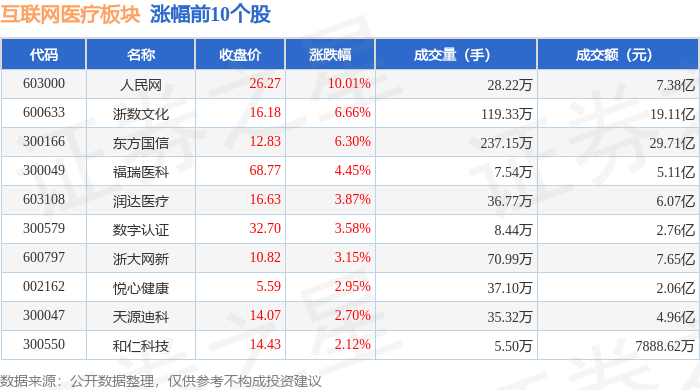
互联网医疗板块2月10日涨0.64%,人民网领涨,主力资金净流入6.39亿元
Sou Hu Cai Jing· 2026-02-10 09:01
Market Performance - The internet healthcare sector increased by 0.64% compared to the previous trading day, with People's Daily leading the gains [1] - The Shanghai Composite Index closed at 4128.37, up 0.13%, while the Shenzhen Component Index closed at 14210.63, up 0.02% [1] Stock Performance - People's Daily (603000) closed at 26.27, up 10.01% with a trading volume of 282,200 shares and a transaction value of 738 million [1] - Zhejiang Shuzhi Culture (600633) closed at 16.18, up 6.66% with a trading volume of 1,193,300 shares and a transaction value of 1.911 billion [1] - Dongfang Guoxin (300166) closed at 12.83, up 6.30% with a trading volume of 2,371,500 shares and a transaction value of 2.971 billion [1] - Other notable stocks include Furu Medical (300049) up 4.45% and Run Da Medical (603108) up 3.87% [1] Capital Flow - The internet healthcare sector saw a net inflow of 639 million from main funds, while retail funds experienced a net outflow of 414 million [2][3] - Main funds showed significant net inflows in People's Daily (3.85 billion) and Meian Health (1.90 billion), while retail funds had notable outflows in the same stocks [3] Individual Stock Capital Flow - People's Daily had a main fund net inflow of 3.85 billion, accounting for 52.16% of total inflows, while retail funds saw a net outflow of 2.00 billion [3] - Other stocks like Meian Health and Keda Xunfei also experienced varying levels of net inflows and outflows from main and retail funds [3]


港股创新药概念股早盘爆发!港股通医疗ETF富国(159506)涨超3%,脑机接口、AI影像等前沿方向催化不断
Mei Ri Jing Ji Xin Wen· 2026-02-10 03:15
Core Viewpoint - The Hong Kong stock market showed strong performance in the healthcare sector, particularly in innovative drugs and medical companies, with significant gains observed in various stocks [1] Group 1: Market Performance - The Hong Kong stock market experienced fluctuations but ultimately strengthened, with notable performances in the innovative drug and medical sectors [1] - Stocks such as CSPC Pharmaceutical Group and Innovent Biologics rose over 6%, while others like Zai Lab and WuXi Biologics increased by more than 5% [1] - The Hong Kong Stock Connect Medical ETF (159506) saw a rise of over 3% during trading [1] Group 2: Industry Insights - At the J.P. Morgan Healthcare Conference held in January, global pharmaceutical companies disclosed advanced research pipelines and significant business development transactions, creating clear order expectations for the CXO industry [1] - The penetration of AI in healthcare is accelerating, with applications expanding from smart consultations to chronic disease management, leading to a reevaluation of the value of internet healthcare platforms like Alibaba Health and JD Health [1] - Analysts suggest that the current healthcare sector presents multiple investment opportunities, with the CXO industry benefiting from a recovery in overseas orders and domestic capacity clearance [1] - The medical device sector is supported by domestic equipment upgrade policies and overseas market expansion, with cutting-edge areas like brain-computer interfaces and AI imaging continuously catalyzing growth [1] - Internet healthcare is optimizing operational efficiency against the backdrop of deepening medical insurance payment reforms, leading to a clearer profitability growth trajectory [1] Group 3: ETF Information - The Hong Kong Stock Connect Medical ETF (159506) closely tracks the Hang Seng Hong Kong Stock Connect Innovative Drug and Healthcare Index (HSSCHI) [2] - The index composition emphasizes companies with high R&D expenditure and innovative drug business, ensuring that companies with the lowest average R&D to revenue ratio over the past two years are excluded [2] - This innovative focus aids investors in accurately capturing investment opportunities within the Hong Kong pharmaceutical sector [2]
疾控部门研判称我国尚未发现尼帕病毒病例 京东互联网医院医生解读科学防护
Sou Hu Wang· 2026-02-10 03:08
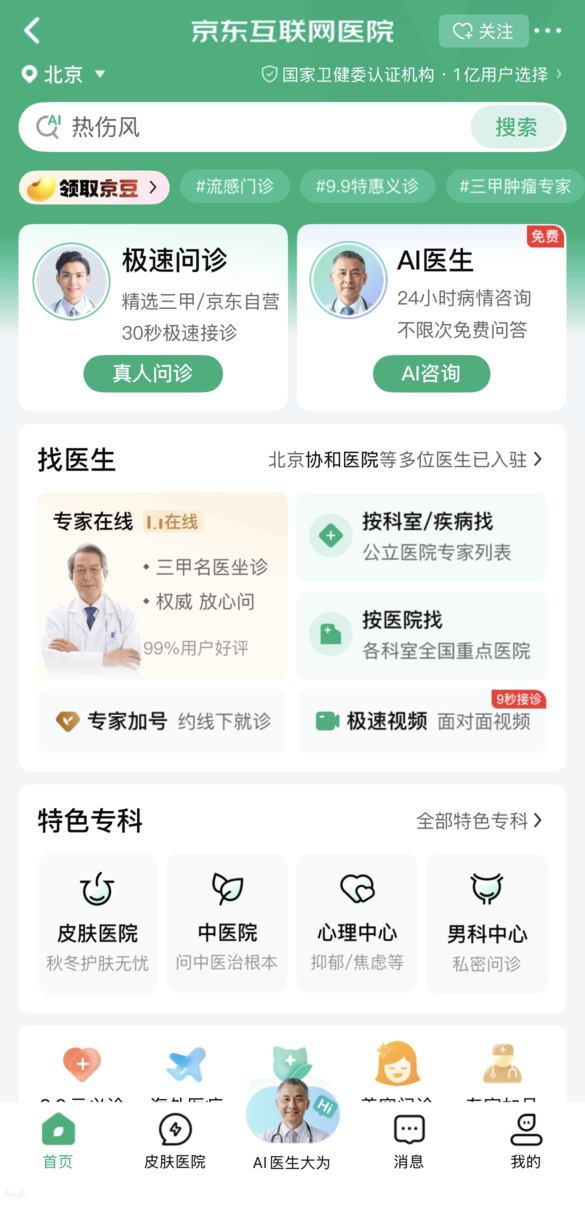
近日,印度部分地区报告的尼帕病毒病例引发国际关注。我国国家疾控局发布研判指出,经综合评估, 此次疫情对我国造成的影响相对较小。目前,我国尚未发现尼帕病毒病病例,但也存在一定境外输入风 险,公众需提高防范意识,采取科学防护措施。 京东互联网医院 C7关注 ♀ 北京 ▼ ▽国家卫健委认证机构 · 1亿用户选择 > C 热伤风 搜索 #流感门诊 | #9.9特惠义诊 | #三甲肿瘤专家 领取京豆 > 免费 极速问诊 Al医生 24小时病情咨询 精选三甲/京东自营 不限次免费问答 30秒极速接诊 Al咨询 真人问诊 找医生 北京协和医院等多位医生已入驻 > 按科室/疾病找 专家在线 III在线 公立医院专家列表 · 三甲名医坐诊 · 权威 放心问 按医院找 99%用户好评 各科室全国重点医院 9秒接诊 专家加号 约线下就诊 | 极速视频 面对面视频 特色专科 全部特色专科 > 5 B 9 中医院 皮肤医院 心理中心 男科中心 问中医治根本 抑郁/焦虑等 秋冬护肤无忧 私密问诊 我的 皮肤医院 AI 医生大为 消息 首页 目前,京东互联网医院可提供24小时在线问诊服务,全国三甲医院医生在线接诊,平均响应时间约30 秒。 ...
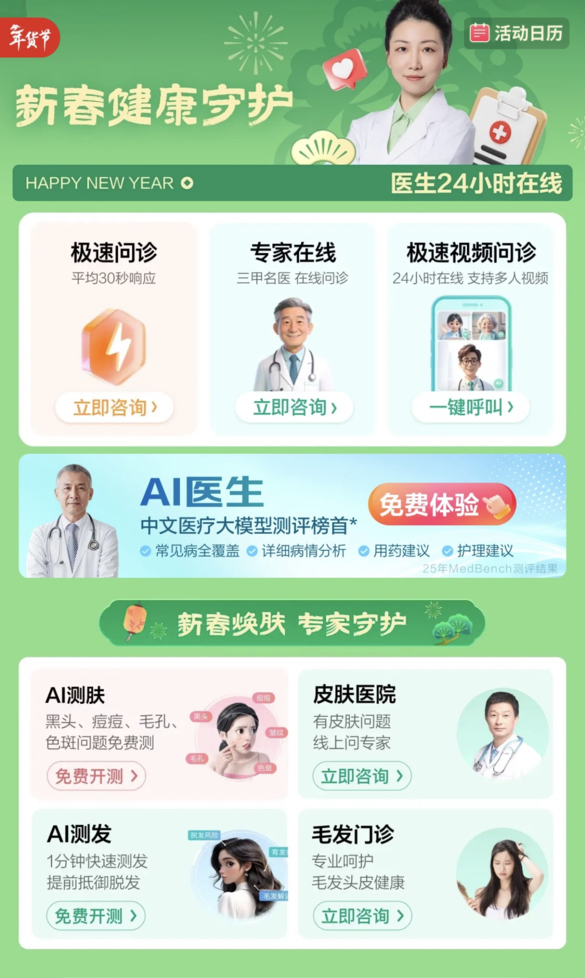
全国三甲医生24小时在线 京东互联网医院开展“新春健康守护”活动
Sou Hu Wang· 2026-02-10 03:08
Core Viewpoint - JD Internet Hospital is launching the "New Year Health Guard" initiative to provide 24-hour online consultation services, integrating resources from top-tier hospitals to address health needs during the Spring Festival [1] Group 1: Service Overview - The initiative aims to alleviate healthcare access issues during the holiday season, ensuring timely and professional medical support for users [1] - Users can access the service through the JD APP by searching for "New Year Health Guard" or "Ask a Doctor," allowing for quick entry into the consultation channel [1] Group 2: User Experience - Previous experiences highlight the effectiveness of JD Internet Hospital's online consultation, such as a case where a user abroad received timely advice for a burn injury through video consultation with a top-tier hospital [3] - Another case involved a 71-year-old user who received a diagnosis and treatment plan for severe skin itching, demonstrating the platform's ability to provide effective medical guidance [3] Group 3: AI Integration - JD Health's AI doctor, "Dai Wei," operates around the clock, utilizing a self-developed medical model and comprehensive medical knowledge base to offer multi-round symptom collection, analysis, and recommendations [4] - The AI doctor integrates authoritative clinical guidelines and medical literature, providing evidence-based suggestions to enhance the quality of health services [4] Group 4: Strategic Goals - JD Health aims to leverage its internet medical service advantages and robust pharmaceutical supply chain capabilities to ensure quality medical resources are accessible regardless of users' locations [4] - The initiative seeks to provide peace of mind and health support for families during the reunion moments of the Spring Festival [4]
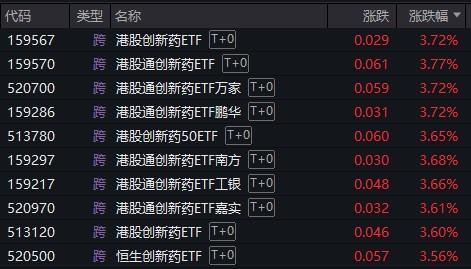
港股创新药概念股走强,港股创新药相关ETF涨超3%
Mei Ri Jing Ji Xin Wen· 2026-02-10 03:08
| 4-685 | ਕੇ ਕਿ 名称 | 涨跌 | 涨跌幅 | | --- | --- | --- | --- | | 159567 | 跨 港股创新药ETF T+0 | 0.029 | 3.72% | | 159570 | 跨 港股通创新药ETF T+0 | 0.061 | 3.77% | | 520700 | 跨 港股通创新药ETF万家 T+0 | 0.059 | 3.72% | | 159286 | 時 港股通创新药ETF鹏华 T+0 | 0.031 | 3.72% | | 513780 | 跨 港股创新药50ETF T+0 | 0.060 | 3.65% | | 159297 | 跨 港股通创新药ETF南方 T+0 | 0.030 | 3.68% | | 159217 | 陪 港股通创新药ETF工银 T+0 | 0.048 | 3.66% | | 520970 | 0 1 1 6 4 | 0.032 | 3.61% | | 513120 | 跨 港股创新药ETF T+0 | 0.046 | 3.60% | | 520500 | 跨 恒生创新药ETF T+0 | 0.057 | 3.56% | 有分析指 ...
阿里健康(00241.HK):2月9日南向资金增持1166.2万股
Sou Hu Cai Jing· 2026-02-09 20:31
Group 1 - The core point of the article highlights that southbound funds increased their holdings in Alibaba Health (00241.HK) by 11.662 million shares on February 9 [1] - Over the past five trading days, there were two days of net reductions in holdings by southbound funds, totaling a net decrease of 15.941 million shares [1] - In the last 20 trading days, there were 13 days of net increases in holdings by southbound funds, with a total net increase of 191 million shares [1] Group 2 - As of now, southbound funds hold 1.957 billion shares of Alibaba Health (00241.HK), accounting for 12.08% of the company's total issued ordinary shares [1] - Alibaba Health Information Technology Co., Ltd. is a holding company providing industrial internet solutions for the medical and pharmaceutical industry, serving as Alibaba Group's flagship platform in the health sector [1] - The company primarily engages in the sales of pharmaceutical health products, operates a pharmaceutical e-commerce platform, and offers consumer healthcare services, utilizing technologies such as cloud computing and big data for traceability and digital healthcare [1]

股票行情快报:朗玛信息(300288)2月9日主力资金净卖出17.24万元
Sou Hu Cai Jing· 2026-02-09 14:02
证券之星消息,截至2026年2月9日收盘,朗玛信息(300288)报收于14.62元,上涨3.76%,换手率 3.36%,成交量8.63万手,成交额1.25亿元。 2月9日的资金流向数据方面,主力资金净流出17.24万元,占总成交额0.14%,游资资金净流出517.1万 元,占总成交额4.13%,散户资金净流入534.34万元,占总成交额4.27%。 资金流向名词解释:指通过价格变化反推资金流向。股价处于上升状态时主动性买单形成的成交额是推 动股价上涨的力量,这部分成交额被定义为资金流入,股价处于下跌状态时主动性卖单产生的的成交额 是推动股价下跌的力量,这部分成交额被定义为资金流出。当天两者的差额即是当天两种力量相抵之后 剩下的推动股价上升的净力。通过逐笔交易单成交金额计算主力资金流向、游资资金流向和散户资金流 向。 注:主力资金为特大单成交,游资为大单成交,散户为中小单成交 以上内容为证券之星据公开信息整理,由AI算法生成(网信算备310104345710301240019号),不构成 投资建议。 该股主要指标及行业内排名如下: 朗玛信息2025年三季报显示,前三季度公司主营收入2.24亿元,同比下降24. ...
