
可穿戴设备

Search documents
路透社:阿里巴巴发布搭载千问的夸克AI眼镜,进军全球可穿戴设备市场
Ge Long Hui· 2025-11-27 11:10
Core Insights - Alibaba has officially entered the AI wearable device market with the launch of its first AI glasses, Quark AI Glasses, marking a significant move in a sector dominated by Meta [1] - The starting price for the Quark AI Glasses is 1,899 yuan, and they resemble ordinary glasses, differentiating them from other head-mounted devices [1] - The Quark AI Glasses are deeply integrated with Alibaba's ecosystem products such as Taobao, Alipay, and Gaode, allowing users to perform tasks like real-time translation and product comparison [1] - In early November, Alibaba upgraded its Qianwen AI assistant and launched the Qianwen app, indicating a more aggressive strategy in the consumer AI market [1] - The competition in the AI wearable device sector is intensifying, with major tech companies like Meta, Apple, and Samsung actively participating [1] Company Developments - The Quark AI Glasses represent Alibaba's first foray into the AI wearable device market, showcasing its commitment to innovation in this space [1] - The integration of the glasses with Alibaba's existing services enhances their functionality and user experience, positioning them as a competitive product [1] - The recent upgrade of the Qianwen AI assistant and the launch of the Qianwen app reflect Alibaba's strategic focus on consumer-level AI solutions [1] Industry Context - The AI wearable device market is currently dominated by Meta, which holds approximately 80% market share in the VR headset segment [1] - Other competitors include Apple, which has introduced the Apple Vision Pro headset, and Samsung, which launched the Galaxy XR headset in October, indicating a rapidly evolving competitive landscape [1]

机构:2025年智能戒指出货量预计将突破400万台
Zheng Quan Shi Bao Wang· 2025-11-25 01:15
Core Insights - The global smart ring market is experiencing rapid growth, with 2025 projected to be a significant year for the industry [1] Market Overview - In 2023, smart ring shipments exceeded 850,000 units, with an expected increase to 1.8 million units in 2024 [1] - By the first half of 2025, shipments are anticipated to reach 1.6 million units, with total annual shipments projected to surpass 4 million units [1] Market Share - Oura remains the market leader, holding a 74% market share in the first half of 2025 [1] - Other competitors include Ultrahuman and Samsung, each with a 9% market share, and RingConn with 5% [1] - The remaining market share is distributed among companies such as Circular, Noise, boAt, and Zepp [1]
Nature全新子刊上线首篇论文,来自华人团队,AI加持的可穿戴传感器,突破手势识别最后难关
生物世界· 2025-11-18 04:05
Core Insights - The article discusses a new research paper published in Nature Sensors, which presents a noise-tolerant human-machine interface based on deep learning-enhanced wearable sensors, capable of accurate gesture recognition and robotic arm control even in dynamic environments [3][22]. Group 1: Motion Interference Challenges - Wearable inertial measurement units (IMUs) show great potential in various fields but often face challenges from motion artifacts during real-world applications, which can obscure gesture signals [6][7]. - Motion artifacts can arise from activities like walking, running, or riding in vehicles, and may vary significantly between individuals [7]. Group 2: Innovative Solutions - The research team developed a sensor system that integrates a six-channel IMU, electromyography (EMG) module, Bluetooth microcontroller, and a stretchable battery, capable of wireless gesture signal capture and transmission [9]. - The sensor features a four-layer design, measuring 1.8×4.5 cm² and 2 mm thick, with over 20% stretchability, ensuring durability and performance even after multiple charge cycles [9]. Group 3: Deep Learning Algorithms - The study collected 19 types of forearm gesture signals and various motion interference signals to create a composite dataset, training three deep learning networks, with the LeNet-5 convolutional neural network (CNN) achieving the best performance metrics [12]. - The CNN demonstrated a recall rate greater than 0.92, precision greater than 0.93, and an F1 score exceeding 0.94, confirming its effectiveness in gesture recognition [12]. Group 4: Transfer Learning for Personalization - To enhance model generalization, the research team applied parameter-based transfer learning, allowing for significant improvements in gesture recognition accuracy with minimal sample data [14]. - The recognition accuracy for 19 gestures improved from 51% to over 92% with just two samples per gesture, significantly reducing data collection time [14]. Group 5: Real-time Gesture Recognition and Robotic Control - The team implemented a sliding window mechanism for continuous gesture recognition, achieving a response time of approximately 275 milliseconds for robotic arm actions based on gesture signals [16]. - The system maintained accurate control of the robotic arm even in the presence of motion interference, demonstrating its robustness [18]. Group 6: Underwater Applications - The human-machine interface has potential applications for divers controlling underwater robots, with the system effectively managing motion artifacts caused by ocean dynamics [20]. - After training on a dataset simulating various wave conditions, the model maintained high accuracy in generating commands for robotic arm actions, showcasing its adaptability in challenging environments [20][22].


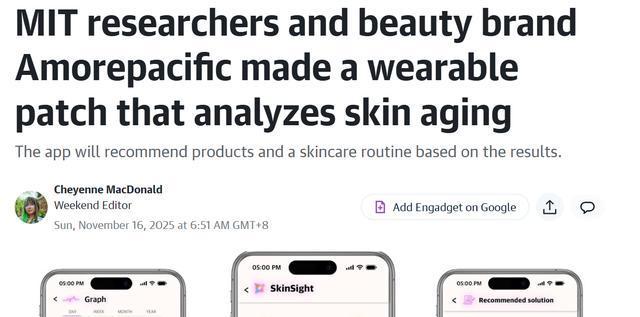
CES 2026:MIT研发可穿戴“电子皮肤”,可监测皮肤老化情况并提供护肤建议
Huan Qiu Wang Zi Xun· 2025-11-17 09:20
Core Insights - MIT researchers collaborated with Amorepacific to develop a wearable "electronic skin" called Skinsight, designed to analyze skin aging and recommend products and skincare routines based on the analysis. The product is set to debut at CES 2026 [1][3] Group 1: Product Features - Skinsight can monitor skin aging in real-time and provide personalized skincare recommendations [3] - The product is a Bluetooth-enabled sensor patch that adheres to the skin and operates via a mobile app, tracking skin firmness, UV exposure, temperature, and humidity [3] - The patch features a breathable and sweat-resistant design, allowing for long-term wear [3] Group 2: Market Positioning - The app estimates how various factors affect skin aging and suggests suitable products based on the detected results [3] - The launch date and pricing for Skinsight have not yet been disclosed [3]
中国银河证券:算力板块依然处于业绩兑现阶段
Xin Lang Cai Jing· 2025-11-12 00:41
Group 1 - The computing power sector is still in the performance realization stage and has a relatively moderate valuation level, with continued optimism for computing-related PCB, domestic computing, IP licensing, and chip inductors [1] - The year 2026 may be a key year for the recovery of the foldable screen market, with rumored foldable products from Apple expected to stimulate overall category discussions and potentially bring new insights in software interaction and hardware design, further activating market demand [1] - Newly launched wearable devices this year are also expected to drive market recovery [1] Group 2 - AR glasses manufacturers are pushing AR glasses from being "niche geek toys" to "mainstream smart terminals" through technological breakthroughs, ecosystem integration, and market penetration, with the maturity of AI and AR technologies suggesting that smart glasses could become the next mainstream computing terminal after smartphones [1]

向小米说“不”的华米 是迷因还是黑马?
BambooWorks· 2025-11-10 13:54
Core Viewpoint - Huami Technology has shown significant revenue growth in the third quarter, with a 78.5% increase year-over-year, but is expected to see a slowdown to approximately 40% growth in the upcoming quarter [1][6]. Group 1: Financial Performance - In the three months ending in September, Huami recorded strong revenue growth for the second consecutive quarter, achieving operational breakeven on an adjusted basis [2]. - The company reported a revenue increase from $42.5 million to $75.8 million year-over-year, marking a 78.5% growth [6]. - The gross margin improved to 38.2% in the third quarter, up 2 percentage points from the previous quarter, although it remains below the 40.6% from the same period last year [7]. - The company expects revenue growth to slow to about 40% in the fourth quarter, projecting revenue between $82 million and $86 million [6]. Group 2: Market Position and Strategy - Huami has transitioned from being a manufacturer for Xiaomi to developing its own brand, Amazfit, reducing its reliance on Xiaomi to about 5% of total sales [6]. - The Amazfit T-Rex 3 Pro, priced at approximately $300, has received positive reviews, positioning Huami competitively against Garmin's products, which are priced significantly higher [5]. - Despite the recent stock price volatility, Huami's current price-to-sales ratio is 3.98, which is significantly lower than Garmin's 7.39, indicating that Huami may have been undervalued [3]. Group 3: Future Outlook - The company is approaching profitability, with the operational loss narrowing to $1.6 million from $13.3 million year-over-year [8]. - Huami aims to enhance its product design and brand image to move up the value chain and sell more mid-to-high-end wearable devices, which would help improve profit margins [8].


估值36亿美元的可穿戴设备Whoop,在AI时代展示了哪些新价值?
3 6 Ke· 2025-11-07 10:14
Core Insights - Whoop, an AI wearable device company founded in 2012, initially focused on sleep and recovery for professional athletes, achieving a valuation of $3.6 billion as a unicorn in the sports wearable sector [1][4] - The company has integrated generative AI technology into its devices, enhancing accuracy and expanding its potential applications [1][6] - Whoop completed a $200 million Series F funding round in August 2021, led by SoftBank Vision Fund 2, with participation from various investors including notable athletes [1][2] Company Overview - Whoop was co-founded by Will Ahmed, John Capodilupo, and Aurelian Nicolae, who met at Harvard [2] - The initial idea stemmed from Ahmed's desire to monitor training, recovery, and sleep data as a Harvard athlete [4] Product Development - The release of Whoop 4.0 in September 2023 introduced the Whoop Coach, an AI health assistant that provides personalized fitness guidance based on user data and the latest sports science [6][9] - Whoop 5.0 features upgraded sensors, a redesigned processor for improved efficiency, and a 14-day battery life, while the new Whoop MG series includes medical-grade ECG sensors [7][11] Health Functionality - Whoop focuses on three core pillars: sleep, recovery, and consumption, generating daily recovery scores to assess user readiness [9][10] - The device tracks various metrics, including heart rate variability (HRV), resting heart rate, and sleep performance, to provide insights into user health [10][12] Targeted Features - Whoop 5.0 includes a menstrual cycle tracking feature for women, offering insights into hormonal changes and their effects on health [10] - The Whoop MG can perform on-demand ECG readings and estimate blood pressure, although the latter is still in testing [11] Business Model - Whoop operates on a subscription-based model, where hardware costs are included in the membership fee, with the highest tier (Whoop MG) priced at $359 annually [12] - The company aims to provide ongoing value to users, addressing challenges faced by previous fitness tech products that struggled with user retention and perceived value [13][14] Industry Outlook - The success of AI-native wearable devices hinges on their ability to deliver high-value health insights and maintain user engagement over time [15] - The market for AI-driven health wearables is expected to grow, with investments in early-stage companies indicating strong interest in this sector [15][16]

华米科技20251106
2025-11-07 01:28
Summary of Huami Technology Conference Call Company Overview - **Company**: Huami Technology - **Industry**: Wearable Devices and Smartwatches Key Financial Performance - **Q3 Revenue**: $76 million, close to guidance upper limit, with a year-over-year growth of nearly 80% [2][3] - **Q4 Revenue Guidance**: Expected between $82 million and $86 million, representing a year-over-year growth of 38% to 45% [2][3] - **Gross Margin**: Q3 gross margin was 38.2%, adjusted to 39.4% excluding tariffs [3] - **Operating Cash Flow**: Transitioned from outflow to inflow, indicating improved financial health [2][3] Product Development and Market Strategy - **New Product Launches**: Introduction of T3 Pro, Balance R2, and Halo Stripe, which have received positive market feedback [2][5] - **Future Product Plans**: New products including a small tablet version of T3P are set to launch in Q4 2025 and 2026, with a focus on maintaining a growth rate of approximately 40% year-over-year [2][6][13] - **Market Positioning**: Aiming to enhance profit margins by focusing on mid to high-end products, with T3P priced at $400 and expected to generate $20 million in profit from 100,000 units sold [4][26] Competitive Landscape - **Competitors**: Direct competition with Garmin, particularly with products like T3 Pro against Garmin's PHOENIX 8 Pro [5][27] - **Market Share Goals**: Targeting to achieve a market share that is a fraction of Garmin's, aiming for 1/5 or 1/10 of Garmin's scale [27] Market Trends and Consumer Demand - **Wearable Device Market Growth**: The market for wearables, especially smartwatches, is growing at over 20%, indicating strong consumer demand [7][8] - **Sales Strategy**: Plans to promote entry-level products during discount seasons to drive sales, while maintaining focus on high-margin products [20][22] Cost Management and Supply Chain - **Chip and Storage Costs**: Storage chip costs have nearly doubled, but their impact on overall costs is limited (less than 5% for low-end and 5-10% for high-end products) [15][16] - **Supply Chain Strategy**: Strategic procurement and bulk purchasing to mitigate supply chain issues, ensuring long-term supply security [15][16] Long-term Growth Strategy - **Sustainable Growth Focus**: Emphasis on steady growth over several quarters rather than short-term spikes, with a goal to align revenue with Garmin's levels [10][28] - **Profitability Goals**: Aiming for consistent profitability growth through improved gross margins and controlled expenses [10][28] Market Reactions and Investor Guidance - **Market Sentiment**: Initial market reactions to financial results were seen as emotionally driven rather than based on fundamentals [4] - **Investor Communication**: Advising investors to rely on official guidance rather than third-party data, which may not accurately reflect company performance [11] Conclusion - **Outlook for 2026**: Anticipating a growth rate of at least 40% year-over-year, with a focus on product innovation and market expansion [13][26]
砍掉屏幕,年费上千:这款「极简」手环凭什么估值200亿?|产品观察
36氪· 2025-11-05 00:10
Core Viewpoint - The article discusses the rising trend of "screenless wearables" in the fitness industry, highlighting the shift from data collection to providing actionable insights for users, with WHOOP leading this market segment [6][10][23]. Market Overview - The global shipment of wearable devices is projected to decline by 1.4% in 2024, influenced by economic instability and market saturation in regions like the US and India [7]. - WHOOP's valuation has surged from $1.2 billion in 2020 to approximately $26.5 billion by 2025, with annual revenue exceeding $260 million and users in 56 countries [7][8]. User Demand Shift - There is a notable shift in user demand from merely obtaining data to seeking professional advice on health and fitness [9][11]. - New entrants like Huami and Polar are entering the screenless wearable market, indicating a growing interest in this segment [9][10]. Product Differentiation - WHOOP differentiates itself by focusing on three core physiological metrics: sleep, strain, and recovery, while traditional devices often overload users with features [16][19]. - The ability to translate complex physiological signals into actionable insights is a key value proposition for screenless wearables [22][23]. Business Model Evolution - WHOOP has pioneered a subscription-based model, eliminating hardware costs and requiring users to subscribe for full functionality, with annual fees ranging from $199 to $359 [26][27]. - In contrast, Polar maintains a traditional hardware sales model, pricing its Polar Loop at $199 without a subscription [30]. Marketing Strategies - WHOOP has established partnerships with top sports organizations and athletes, enhancing its credibility and market presence [32][33]. - The marketing approach of WHOOP emphasizes professional endorsements and deep product testing, while competitors like Huami leverage collaborations with fitness events [32][33]. Competitive Landscape - WHOOP's first-mover advantage and high user engagement present challenges for new entrants like Huami and Polar, although the latter's traditional model may appeal to users wary of subscription fees [31][33]. - The success of WHOOP and the emergence of competitors suggest a trend towards niche markets in the hardware startup space, focusing on personalized and specialized products [33].

2025年智慧养老产业发展白皮书
Tou Bao Yan Jiu Yuan· 2025-11-04 12:04
Investment Rating - The report does not explicitly state an investment rating for the smart elderly care industry Core Insights - The smart elderly care industry in China is rapidly evolving through technological integration and innovative models to address the challenges posed by an aging population, which is expected to reach 30% by 2050, significantly higher than the global average [5][18] - The industry is focusing on creating a comprehensive health management ecosystem that covers the entire life cycle of elderly care, showcasing significant breakthroughs from technology application to system construction [5] Summary by Sections Overview of the Smart Elderly Care Industry - The aging population in China is accelerating, with the proportion of individuals aged 65 and above expected to reach 30% by 2050, indicating a severe challenge for social and economic development [18][20] - The report highlights the structural challenges in the current elderly care service supply system, including insufficient total supply, uneven resource distribution, and a shortage of professional caregivers [6] Demand Environment - The acceptance of smart products among the elderly is steadily increasing, with 43.08% of users spending 1-3 hours daily using these products [6][39] - The demand for personalized leisure and entertainment services is significantly higher among elderly individuals living with family compared to those living alone, indicating a strong expectation for functionality in multi-generational households [6] Supply Situation - Smart elderly care products are evolving from single-function devices to comprehensive solutions, with wearable devices forming a health management loop covering prevention, diagnosis, and rehabilitation [7] - The report emphasizes the need for a smart transformation in elderly care services to enhance sustainability and meet the growing demand [6] Policy Environment - The report outlines a systematic approach to policy development in the smart elderly care sector, emphasizing the integration of technology and the enhancement of service quality to improve the well-being of the elderly [33] Economic Environment - Investment strategies in the elderly care sector are shifting from quantity to quality, focusing on high-quality projects in areas such as artificial intelligence, robotics, and digital platforms [35] - The report notes significant investment activity in the elderly care robot sector, with a notable increase in funding for companies developing companion and rehabilitation robots [37] Technological Environment - The health IoT is driving the development of automated and intelligent health services, with technologies such as blockchain enhancing data security and sharing [45][47] - The integration of various technologies is crucial for creating a seamless health management ecosystem that meets the needs of the elderly [47] Industry Chain Analysis - The smart elderly care industry chain consists of upstream technology support, midstream product and service integration, and downstream application scenarios, forming a collaborative ecosystem [51][53] - The report highlights the importance of integrating resources from various sectors to create a comprehensive elderly care solution that includes home care, community support, and institutional care [52]