生态环境监测

Search documents
环保设施开放里的治理之道(人民时评)
Ren Min Ri Bao· 2025-08-06 22:11
Core Viewpoint - The opening of environmental facilities to the public serves as a window to observe the effectiveness of building a beautiful China and as a tool to strengthen ecological environment protection and governance [1][3]. Group 1: Public Engagement and Awareness - The initiative to open environmental facilities allows the public to experience firsthand the role of technology in pollution reduction and carbon neutrality, enhancing ecological awareness among citizens [1][2]. - Currently, there are 2,512 environmental facilities open to the public across all prefecture-level cities in China, covering both traditional and new categories of environmental management [1][2]. - Engaging the public through facility visits helps to build consensus on ecological civilization and promotes environmental knowledge dissemination [1][2]. Group 2: Trust and Participation - Public access to environmental facilities is an effective way to ensure the public's right to know and supervise environmental governance, reducing misunderstandings and increasing trust between the government, enterprises, and the public [2][3]. - Initiatives like inviting local residents to observe operations in the petrochemical industry help to change negative perceptions and encourage public participation in environmental oversight [2]. Group 3: Innovative Approaches to Governance - The methods of opening environmental facilities have evolved from traditional in-person visits to include online live streaming, allowing real-time access to operational data and enhancing public supervision [3]. - The shift towards proactive governance in environmental management is supported by the increased visibility and accessibility of environmental facilities, fostering a culture of accountability among enterprises [3].
上半年我国环境空气质量和地表水环境质量总体持续改善
Zhong Guo Chan Ye Jing Ji Xin Xi Wang· 2025-08-03 21:47
Core Insights - The overall air quality and surface water quality in China have shown continuous improvement in the first half of this year, with 83.8% of days classified as good air quality, a 1 percentage point increase year-on-year [1] - The proportion of surface water quality classified as good (Class I to III) stands at 89% across 3,641 national monitoring sections [1] Air Quality Summary - In key regions, the average PM2.5 concentration in the Beijing-Tianjin-Hebei region's "2+36" cities is 40.8 micrograms per cubic meter, a decrease of 15.4% year-on-year [1] - The average PM2.5 concentration in the Yangtze River Delta's 31 cities is 37.4 micrograms per cubic meter, down 4.3% year-on-year [1] - The average PM2.5 concentration in the Fenwei Plain's 13 cities is 38.3 micrograms per cubic meter, a reduction of 13.7% year-on-year [1] Surface Water Quality Summary - The proportion of good water quality (Class I to III) in major river basins, including the Yangtze, Yellow, Pearl, Songhua, Huai, Hai, and Liao rivers, is 90.4%, an increase of 0.1 percentage points year-on-year [1] - The proportion of sections classified as poor quality (Class V and below) is 0.8%, an increase of 0.3 percentage points year-on-year [1] - Among 209 monitored key lakes and reservoirs, 78% are classified as good quality (Class I to III), a decrease of 1.5 percentage points year-on-year, while 3.8% are classified as poor quality, a decrease of 0.5 percentage points year-on-year [1]
内蒙古加快生态环境监测向数智化转型
Zhong Guo Chan Ye Jing Ji Xin Xi Wang· 2025-08-03 21:35
Core Viewpoint - Inner Mongolia has significantly enhanced its ecological environment monitoring network, focusing on automation and digital transformation, achieving comprehensive coverage of environmental quality monitoring [1] Group 1: Monitoring Network Development - Inner Mongolia has established 349 air quality monitoring stations, 133 noise environment quality monitoring points, and 59 water environment quality monitoring stations for automatic monitoring [1] - The total number of ecological environment quality monitoring points in Inner Mongolia has reached 8,391, ensuring full coverage of environmental quality, ecological quality, and key pollution source monitoring [1] Group 2: Digital Transformation and Innovation - The region has strengthened its digital regulatory applications by creating the "Inner Mongolia Autonomous Region Ecological Protection Red Line Supervision Platform," which has been selected as a national smart monitoring innovation application pilot [1] - Three air monitoring stations have been selected for digital transformation, achieving automatic diagnostic maintenance, automatic quality control calibration, remote intelligent control, and interference intelligent identification, resulting in a reduction of on-site workload by over 70% and an abnormal handling rate of over 99% [1]
从“人工采样”到“天地一体”,陕西生态环境监测事业50年发展带来哪些启示?
Zhong Guo Huan Jing Bao· 2025-07-21 00:09
Core Insights - The article highlights the 50-year development of the Shaanxi Provincial Environmental Monitoring Station, emphasizing the establishment of a comprehensive "sky-ground integrated" monitoring network covering 205,600 square kilometers, which supports the construction of a beautiful Shaanxi [1] Group 1: Historical Development - The ecological environment monitoring in Shaanxi has undergone three significant phases: the initial phase (1975-1978), the growth phase (1979-2012), and the leap phase (2012-present), showcasing the evolution of modern ecological governance [1] - The monitoring system has expanded from focusing on single pollutants to multi-factor and compound pollution monitoring [1] Group 2: Political Leadership - The monitoring system has been guided by the Party's innovative theories, particularly since the 18th National Congress, integrating ecological monitoring into provincial development plans [2] - The establishment of party organizations in monitoring stations has played a crucial role in major ecological protection efforts [2] Group 3: Network Construction - A comprehensive monitoring network includes 813 air monitoring stations, 277 manual monitoring sections, and 143 automatic monitoring stations, forming a robust environmental quality monitoring system [3] - The monitoring capabilities for the "three major ecological barriers" have seen breakthroughs, including targeted monitoring of endangered species and real-time risk warnings for water quality [3] Group 4: Emergency Monitoring - The emergency monitoring capacity has been enhanced with the addition of mobile monitoring platforms and advanced equipment, improving the ability to respond to environmental risks [4] Group 5: Innovation-Driven Approach - The Shaanxi ecological monitoring system emphasizes technological innovation as a primary driver, establishing key laboratories for high-precision analysis and early warning of trace pollutants [5] Group 6: Data Quality Assurance - The system maintains strict data quality standards through legislation and institutional frameworks, ensuring the integrity of monitoring data [8] - Continuous efforts are made to prevent data falsification and promote public awareness of data quality [8] Group 7: Talent Development - The development of the monitoring system has been supported by a strong talent pool, including experts and skilled personnel, facilitated by training and collaboration with educational institutions [7] - Initiatives such as technical competitions and mentorship programs have fostered a culture of excellence among monitoring staff [7]
环境监测五十载 美丽陕西有我在 ——陕西生态环境监测50年发展纪实
Zhong Guo Huan Jing Bao· 2025-07-17 01:36
Core Viewpoint - The development of ecological environment monitoring in Shaanxi Province over the past 50 years has transformed from basic manual methods to a sophisticated, integrated monitoring network that utilizes advanced technology and data analysis to ensure environmental protection and improvement [5][9][27]. Group 1: Historical Development - The Shaanxi Provincial Environmental Protection Monitoring Station was established in 1975, starting with over 40 personnel and basic equipment, evolving into a comprehensive monitoring network covering the entire province [5][9]. - By 2024, the province has developed a three-tiered ecological environment monitoring system with 116 monitoring institutions and a workforce of 2,254, equipped with 11,100 advanced instruments [9][12]. Group 2: Technological Advancements - The monitoring capabilities have expanded from basic parameters like pH and dissolved oxygen to 1,320 parameters across 11 categories, including water, air, soil, and noise [9][17]. - The establishment of a "super station" in 2017 equipped with over 30 advanced monitoring devices has strengthened the data foundation for air quality monitoring [16][14]. Group 3: Environmental Achievements - As of 2024, all 46 national control sections of water quality in the Yangtze River Basin within Shaanxi meet Class II standards, with 8 sections achieving Class I [18]. - The PM2.5 concentration in Shaanxi decreased from 51 µg/m³ in 2016 to 35 µg/m³ in 2024, a reduction of 31.3%, with the number of good air quality days increasing from 270.5 to 294.6 [25][26]. Group 4: Future Outlook - By 2035, Shaanxi aims to establish an "Ecological Environment Monitoring Brain" for intelligent pollution tracing, risk warning, and assessment [30]. - The province plans to leverage new technologies such as artificial intelligence and blockchain to enhance ecological monitoring capabilities [27].

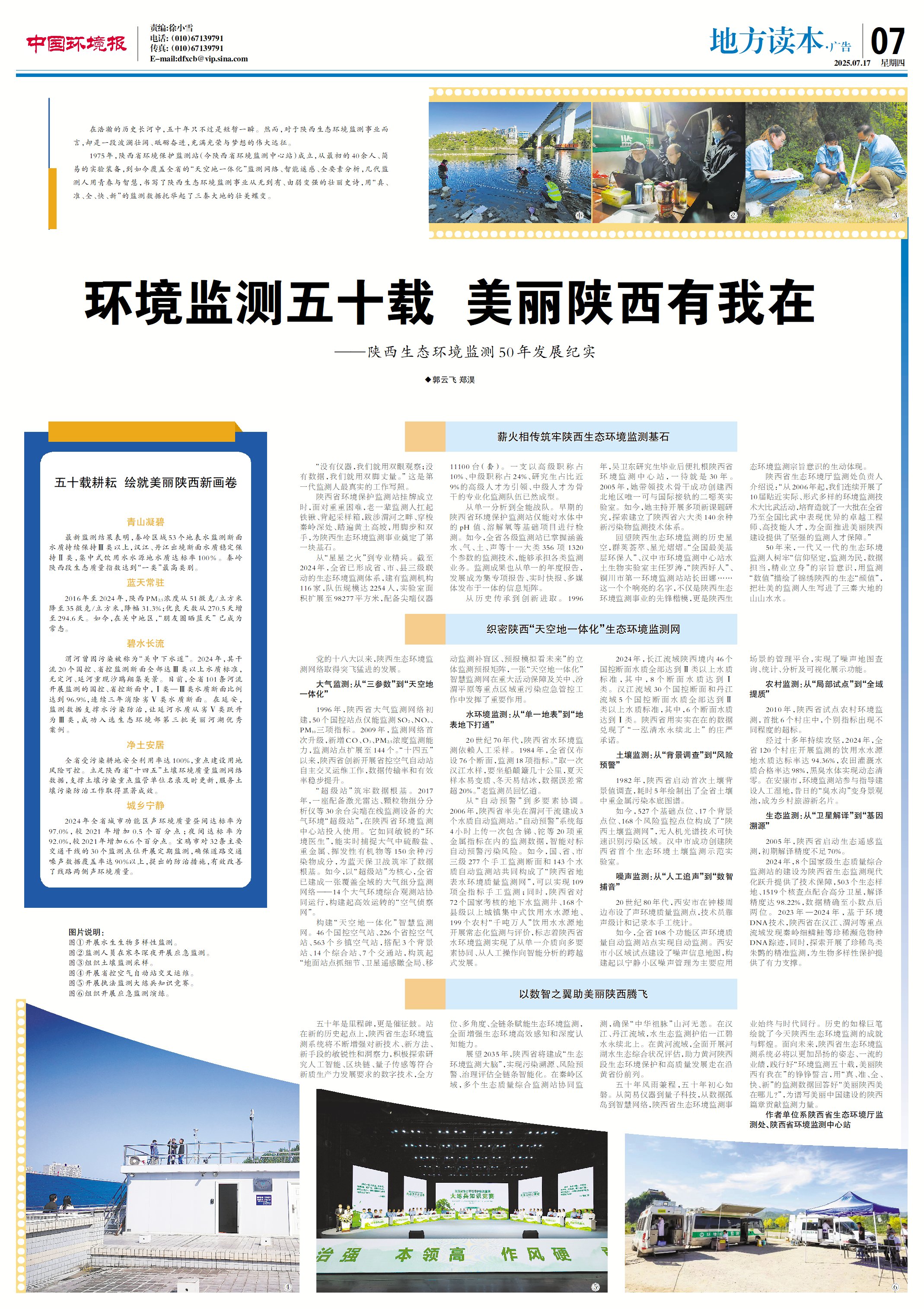
全国先进工作者丨沈秀娥:监测数据是民生幸福的晴雨表
Zhong Guo Huan Jing Bao· 2025-07-14 00:53
Core Viewpoint - The article highlights the significant advancements made by the Beijing Ecological Environment Monitoring Center in air quality monitoring and pollution management, emphasizing the importance of data-driven approaches in environmental protection [6][7][11]. Group 1: Technological Advancements - The center developed the first domestic PM2.5 organic tracing monitoring method, which can analyze over 50 organic tracers within one hour, improving efficiency by nearly ten times compared to traditional methods [7]. - By 2021, Beijing achieved an annual average PM2.5 concentration of 33 micrograms per cubic meter, a significant reduction from 89.5 micrograms per cubic meter in 2013, meeting national secondary standards for the first time [7]. - The establishment of a "1+N" air quality monitoring platform marked a digital transformation in air quality management, enabling real-time monitoring and data-driven decision-making [8]. Group 2: Operational Excellence - The center implemented a closed-loop scheduling system that captures over 20 types of environmental issues, ensuring a feedback loop of "2 hours for feedback, 4 hours for resolution" [8]. - The monitoring network has transitioned from manual operations to automated systems, allowing for remote real-time monitoring and automatic alerts for data anomalies [8]. - During the 2022 Winter Olympics, the team successfully maintained PM2.5 levels within standards, achieving a 65.2% year-on-year reduction in concentration during the event [9][10]. Group 3: Commitment to Environmental Protection - The center's leadership emphasizes the critical role of frontline monitoring in understanding and addressing air pollution, with a focus on continuous improvement and innovation in monitoring techniques [9][10]. - The dedication of the team is evident in their proactive approach during high pollution events, ensuring that monitoring efforts are robust and responsive to real-time data [10][11].
服务筑基、智驱革新,江西监测中心攻坚三大方向护航高质量发展
Zhong Guo Huan Jing Bao· 2025-06-19 03:09
Group 1 - The core viewpoint emphasizes the proactive role of the Jiangxi Provincial Ecological Environment Monitoring Center in promoting green transformation and high-quality ecological development through effective project assessments and technical support [1][2][3] Group 2 - The center has completed over 80 project assessments this year, focusing on solid waste evaluation capabilities, deepening service mechanisms, and leveraging technology for innovation [1] - A "three-in-one" technical support model has been established, enhancing solid waste evaluation capabilities through front-end guidance, process control, and back-end assessment [1] - The center actively engages with enterprises and communities, providing professional solutions for ecological environmental issues and enhancing grassroots technical capabilities [2] Group 3 - Technological empowerment is highlighted through the development of AI-based environmental impact assessment technologies, improving efficiency in project evaluations [3] - The center has revised five management systems and produced over ten research reports to ensure effective operations [3] - The center is involved in significant research initiatives, including the global environmental fund project and the establishment of local hazardous waste standards, contributing to innovation in solid waste management [3]
应对自动监测数据造假,有挑战更有对策
Zhong Guo Huan Jing Bao· 2025-06-16 00:09
Core Viewpoint - The article discusses the serious issue of data falsification in automatic environmental monitoring, highlighting the challenges faced by regulatory authorities in detecting and addressing these fraudulent activities [1][2][3][4]. Group 1: Challenges in Detection and Evidence Collection - Automatic monitoring data falsification involves diverse and covert methods, making timely detection difficult. Techniques include obstructing sampling ports, diluting samples, exploiting software vulnerabilities, and simulating data outputs [2][3]. - Collecting and securing evidence during on-site inspections is challenging due to potential obstruction from companies and the risk of evidence destruction before authorities arrive. Electronic evidence, which is crucial for these cases, is particularly difficult to obtain and preserve [3][4]. Group 2: Responsibility and Accountability - Determining responsibility for data falsification is complex, as multiple departments within a company may be involved. It is challenging to ascertain the degree of responsibility among individuals directly involved in the falsification versus those who may have condoned it [4]. - In cases of joint falsification by companies and third-party service providers, establishing shared responsibility and the extent of each party's liability is often contentious [4]. Group 3: Strategies for Improvement - Enhancing technical oversight by developing more robust automatic monitoring devices with better self-diagnostic and alert features is essential. A unified ecological data monitoring platform should be established for real-time data collection and analysis [5]. - Improving evidence collection mechanisms by training enforcement personnel in electronic evidence gathering and collaborating with law enforcement agencies to ensure the legality and effectiveness of evidence [6]. - Establishing clear responsibility recognition and accountability mechanisms, including strict penalties for violations and integrating environmental violation records into credit systems to promote compliance [6][7]. - Strengthening public oversight and media engagement to create a culture of accountability and transparency in environmental monitoring practices [7].
变化大!生态环境监测机构市场准入将迎来新规.....
仪器信息网· 2025-06-10 08:17
Core Viewpoint - The article discusses the recent revision of the "Supplementary Requirements for the Assessment of Ecological Environment Monitoring Institutions" by the National Market Supervision Administration and the Ministry of Ecology and Environment, highlighting the need for stricter technical capabilities and regulatory measures in the rapidly growing ecological environment monitoring industry [1][2]. Summary by Sections Overall Requirements - The revised supplementary requirements aim to address the definitions, legal responsibilities, personnel qualifications, equipment configurations, and data authenticity guarantees for ecological environment monitoring institutions [6]. Personnel Requirements - Specific requirements for monitoring personnel include a minimum of 15 staff members, with at least 25% holding intermediate or higher technical titles. Technical leaders and authorized signatories must have relevant professional backgrounds and significant work experience [11][12][13]. Venue Environment Requirements - The requirements specify conditions for fixed, temporary, and special venues used for monitoring, including safety measures and environmental controls [14][15]. Instrument and Equipment Requirements - Monitoring institutions must have the necessary types and quantities of equipment, ensuring that devices can prevent data tampering and that electronic data is preserved according to regulations [15]. Management System Requirements - The management system must cover all monitoring activities, including sample collection, testing, data management, and reporting. Institutions must maintain comprehensive records and ensure quality control throughout the monitoring process [16][17][18]. Basic Testing Capability Requirements - Institutions applying for monitoring qualifications in any of the 13 specified categories must demonstrate foundational testing capabilities as outlined in the supplementary requirements [22][23].

超1.2亿共1032台/套,辽宁省发布多项生态环境监测仪器采购意向
仪器信息网· 2025-06-10 08:17
Core Viewpoint - The Liaoning Provincial Ecological Environment Monitoring Center has announced multiple government procurement intentions for the "Ecological Environment Monitoring Instrument and Equipment Filling and Supplementing Project," with a total budget exceeding 120 million yuan, involving 1,032 sets of instruments and equipment [1][2]. Summary by Sections Project Overview - The project consists of 12 sub-projects, with a total budget of over 120 million yuan, and the procurement is expected to take place in June [2][3]. Detailed Project Breakdown - **Project One**: Budget of 7.6583 million yuan, involving 42 types of equipment, totaling 294 units, including portable centrifuges, measuring instruments, and various water quality sampling devices [3]. - **Project Two**: Budget of 14.3386 million yuan, involving 20 types of equipment, totaling 109 units, including portable X-ray fluorescence spectrometers and various gas analyzers [4]. - **Project Three**: Budget of 5.0684 million yuan, involving 6 types of equipment, totaling 108 units, including automatic air monitoring instruments and particulate matter samplers [5]. - **Project Four**: Budget of 7.654 million yuan, involving 17 types of equipment, totaling 124 units, including smoke and gas sampling devices [6]. - **Project Five**: Budget of 8.44 million yuan, involving 5 types of equipment, totaling 18 units, including automatic mercury analyzers and atomic absorption spectrophotometers [7]. - **Project Six**: Budget of 7.165 million yuan, involving 16 types of equipment, totaling 60 units, including various analytical instruments and sample storage devices [8]. - **Project Seven**: Budget of 7.7 million yuan, involving 5 types of equipment, totaling 29 units, including automatic analysis instruments for various environmental parameters [8]. - **Project Eight**: Budget of 5.09 million yuan, involving 4 types of equipment, totaling 16 units, including gas chromatography systems [8]. - **Project Nine**: Budget of 25 million yuan, involving 5 types of equipment, totaling 19 units, including liquid chromatography and mass spectrometry systems [8]. - **Project Ten**: Budget of 10.4968 million yuan, involving 25 types of equipment, totaling 123 units, including various laboratory instruments [8]. - **Project Eleven**: Budget of 14.467 million yuan, involving 20 types of equipment, totaling 89 units, including automatic sampling and extraction devices [8]. - **Project Twelve**: Budget of 10.8005 million yuan, involving 34 types of equipment, totaling 43 units, including various analytical and sampling instruments [8]. Total Summary - The total budget for all projects amounts to approximately 123.879 million yuan, with a total of 1,032 units of equipment planned for procurement [8].