通信技术

Search documents
量子计算商用破冰!2025 十大科技突破重塑未来
Sou Hu Cai Jing· 2025-12-28 17:13
Core Insights - The year 2025 is designated as the "International Year of Quantum Science and Technology," marking a paradigm shift in the tech sector with ten breakthroughs redefining human understanding of the world [1] Quantum Computing - Quantinuum launched the third-generation universal quantum computer Helios, featuring 98 physical qubits and a single-qubit gate fidelity of 99.9975%, achieving the highest precision in commercial computing globally [1] - Helios combines 48 logical qubits with the Guppy programming language, enabling quantum computing to address real-world business problems for the first time [1] - The Nobel Prize in Physics recognized superconducting quantum circuit technology, laying the groundwork for macroscopic quantum control and advancing quantum computing from theory to application [1] Brain-Computer Interfaces and Communication Technologies - Columbia University developed the BISC chip, integrating 65,536 electrodes into a 3mm³ flexible chip, with a thickness of 50µm, capable of sliding into the brain cortex, supporting epilepsy monitoring and neural prosthetics with a data transmission rate of 100Mbps [1] - A new type of hollow-core optical fiber, supported by Microsoft, achieved a record low loss of 0.091dB/km and a bandwidth window of 66THz, opening new avenues for long-distance communication [1] Energy and Material Science - China's "artificial sun" EAST achieved a steady-state operation at 100 million degrees Celsius for 1066 seconds, representing a significant advancement in fusion energy research [1] - Breakthroughs in the fabrication of emi-level two-dimensional metals push the limits of material science, creating opportunities in energy, healthcare, and electronics sectors, potentially generating trillion-dollar markets [1]

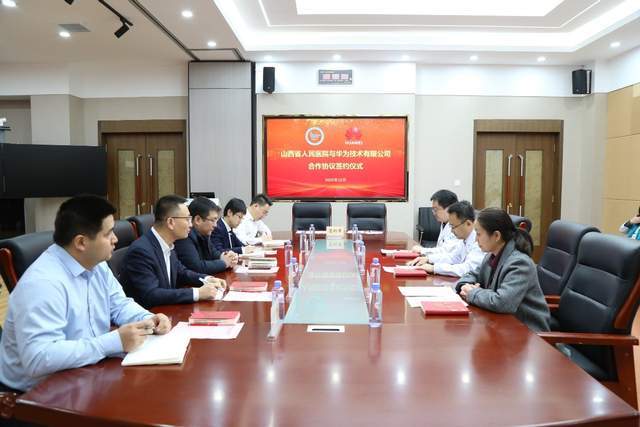
山西省人民医院与华为技术有限公司签署合作协议
Sou Hu Cai Jing· 2025-12-26 12:52
Group 1 - The strategic cooperation between Shanxi Provincial People's Hospital and Huawei aims to integrate resources and advance the application of "technology + scenarios" in healthcare [2][4] - The collaboration will focus on developing replicable and promotable smart medical solutions tailored to the province's needs, establishing a leading smart hospital demonstration project in China [4][11] - Huawei will leverage its technological advantages in artificial intelligence and experience in digital transformation to support the hospital's transition, setting a benchmark for high-quality development in public hospitals in Shanxi and North China [6][9] Group 2 - The partnership will emphasize areas such as medical AI, health big data, research platforms, digital infrastructure, and a unified digital platform for multiple hospital zones, accelerating the innovative application of AI and big data in healthcare [9][11] - The signing of the cooperation agreement marks a new strategic phase driven by technological innovation in medical transformation, aiming to enhance efficiency and service optimization through shared technological advancements [11]
国家科学中心里的“学霸工厂”
21世纪经济报道· 2025-12-26 11:05
Core Insights - The article highlights the increasing trend of international education in China, particularly in regions with newly established national science centers, as families seek quality education for their children amidst a complex study abroad landscape [2][12]. Group 1: Emerging International Schools - New international schools are being established in regions like the Greater Bay Area, Hefei, Xi'an, and Beijing Huairou, driven by local government initiatives and the demand for international education [3][11]. - Qinglan Mountain School in Dongguan, funded by Huawei, has achieved notable success with students receiving offers from prestigious universities like Stanford and Johns Hopkins [2][9]. - Hefei Ansheng School has also gained recognition, receiving offers from top universities such as Washington University in St. Louis and Duke University, reflecting the growing quality of education in the region [2][5]. Group 2: Concentration of Offers - A significant concentration of early admission offers from top U.S. universities is observed among a limited number of high schools, with only about 50 high schools in China having students admitted to Ivy League schools over the past decade [5][6]. - The majority of offers are concentrated in first-tier cities like Beijing, Shanghai, Guangzhou, and Shenzhen, with emerging schools in non-first-tier cities also achieving impressive results [6][7]. - Qinglan Mountain School reported receiving 425 offers from top global universities for its 2025 graduating class, showcasing the effectiveness of its educational model [6]. Group 3: Changing Demographics of Parents - There is a notable increase in the proportion of "returnee" parents with overseas education backgrounds among families seeking international education for their children, reflecting a broader trend across various regions [12][14]. - Research indicates that over 50% of parents in preparatory study abroad families hold at least a bachelor's degree, with 25% having studied abroad themselves, influencing their preference for international education [12][14].

“5G无用论”等质疑声不断 5G遇冷了吗
Jing Ji Ri Bao· 2025-12-26 03:31
在民生和社会领域,5G创造了更多可能。在医疗行业,5G+远程手术打破地域限制,让一线城市专家 实时指导偏远地区医院开展高难度手术;在教育行业,5G+全息课堂打破城乡教育资源壁垒,实现更多 教育公平;在交通行业,5G支撑的车路协同系统,为自动驾驶提供毫秒级路况信息;在农业领域, 5G+物联网实现了对农田作物生长状况的精准监测。5G持续织密民生保障网,让数字化转型红利惠及 千家万户。 更重要的是,5G不只是一项独立技术,还是其他前沿技术的"铺路石"。从人工智能的边缘计算到 AR/VR的沉浸式体验,都需要5G提供高速率、大带宽、低时延的网络支撑。5G的技术积累也为6G研发 奠定了基础。没有5G对网络架构、频谱资源等的探索,6G的"空天地一体化"网络建设也无从谈起。 回顾通信技术的演进史,类似的"无用论"并非首次出现。4G商用初期,也曾被质疑"只是比3G快一 点",直到移动支付、短视频等应用爆发,才真正改变了社会生活。5G的发展逻辑与4G不同,4G的价 值爆发在消费端,5G的价值沉淀在产业端,而产业数字化转型是一个长期过程,不可能一蹴而就。 所谓遇冷,恰恰是5G从建设热潮转向应用深耕的理性回归。一方面,产业链上下游持 ...
5G遇冷了吗?
Jing Ji Wang· 2025-12-26 02:04
Core Insights - The core viewpoint of the articles emphasizes the ongoing expansion of 5G user base in China, reaching 1.193 billion users by the end of November, which constitutes 65.3% of mobile phone users, despite ongoing skepticism regarding its utility and value [1][2]. Group 1: User Growth and Skepticism - As of November, the number of 5G mobile phone users reached 1.193 billion, with a net increase of 179 million users compared to the end of the previous year [1]. - Skepticism surrounding 5G arises from two main factors: pricing and user perception. The higher costs of 5G devices and plans compared to 4G, along with the perception that 5G offers no significant advantage for everyday applications, contribute to reluctance among existing 4G users to upgrade [1][2]. Group 2: Industrial and Societal Impact - In the industrial sector, 5G is transforming production models, enhancing efficiency and resource utilization, with data showing that 5G-enabled factories have seen a 25% increase in average capacity, a 21% improvement in product quality, and a 19% reduction in operational costs [3]. - 5G is also creating new possibilities in various sectors such as healthcare, education, transportation, and agriculture, facilitating remote surgeries, equitable education access, and precise agricultural monitoring [3]. Group 3: 5G as a Foundation for Future Technologies - 5G serves as a foundational technology for other advanced technologies, such as AI and AR/VR, requiring its high-speed, low-latency capabilities [4]. - The evolution of communication technologies has historically faced skepticism, similar to the initial doubts about 4G, which only gained recognition after the emergence of transformative applications [4]. - The transition from a construction boom to a focus on application development in 5G signifies a rational shift, with ongoing efforts to optimize network coverage and enhance user experience [4].
【中国制造新观察】5G遇冷了吗
Jing Ji Ri Bao· 2025-12-26 00:03
Core Insights - The scale of 5G users continues to expand, reaching 1.193 billion by the end of November, with a net increase of 179 million users compared to the end of the previous year, accounting for 65.3% of mobile phone users [2] - Despite the growth in user numbers, skepticism about 5G persists, with concerns primarily centered around cost and user perception [3] Cost Factors - The hardware costs for 5G terminals are higher than those for 4G, leading to reluctance among existing 4G users to upgrade their devices [2] - Although 5G package prices have been reduced, the cost-performance ratio compared to 4G remains unclear, and some users perceive that 5G packages consume data more quickly, reducing their willingness to upgrade [2] Perception Factors - Most users' communication needs are met by 4G, making it difficult for them to perceive the advantages of 5G, such as high bandwidth and low latency [3] - The lack of transformative applications similar to those seen during the 4G era contributes to a dominant consumer mindset of "good enough" regarding their current 4G services [3] Industrial Impact - 5G is reshaping production models in the manufacturing sector, enhancing efficiency and resource utilization through features like low latency and wide connectivity [4] - In various sectors such as healthcare, education, transportation, and agriculture, 5G is enabling new possibilities and improving service delivery [4] Technological Foundation - 5G serves as a foundational technology for other advanced technologies, including AI and AR/VR, requiring its high-speed, high-bandwidth, and low-latency capabilities [5] - The development of 6G relies on the groundwork laid by 5G in network architecture and spectrum resources [5] Long-term Perspective - The skepticism surrounding 5G mirrors past doubts about 4G, which were dispelled as transformative applications emerged [5] - The transition from a construction boom to a focus on application development represents a rational shift in the 5G landscape, with ongoing efforts to optimize network coverage and enhance user experience [5]

5G遇冷了吗
Jing Ji Ri Bao· 2025-12-25 22:05
Core Viewpoint - The expansion of 5G user base continues, with 1.79 billion net new users added in the past year, reaching a total of 1.193 billion users by the end of November, representing 65.3% of mobile phone users. Despite this growth, skepticism about 5G's utility persists, primarily due to cost and perception issues [1][2]. Cost Factors - The hardware costs for 5G devices are higher than those for 4G, leading to reluctance among existing 4G users to upgrade. Although 5G plans have seen price reductions, the value proposition compared to 4G remains unclear, with some users perceiving faster data consumption on 5G plans as a drawback [1][2]. Perception Factors - Many users find that their daily communication needs are adequately met by 4G, making it difficult to perceive the advantages of 5G, such as high bandwidth and low latency. The lack of breakthrough applications similar to those seen in the 4G era contributes to a dominant mindset of "good enough" among existing 4G users [2][3]. Industrial Impact - In the industrial sector, 5G is transforming production models, enhancing efficiency and resource utilization. For instance, 5G-enabled smart factories have reported a 25% increase in average production capacity, a 21% improvement in product quality, and a 19% reduction in operational costs [3]. Societal Benefits - 5G is creating new possibilities in various sectors, including healthcare, education, transportation, and agriculture. Applications such as remote surgeries, holographic classrooms, and precision monitoring of crops are examples of how 5G is enhancing social welfare and digital transformation [3][4]. Technological Foundation - 5G serves as a foundational technology for other advanced technologies, such as AI and AR/VR, requiring its high-speed, high-bandwidth, and low-latency capabilities. The groundwork laid by 5G is also essential for the development of 6G networks [4]. Long-term Perspective - The skepticism surrounding 5G mirrors past doubts about 4G, which were dispelled by the emergence of transformative applications. The value of 5G is expected to materialize over time, particularly as industries continue to optimize network coverage and application scenarios, leading to a more collaborative effort between consumer and industrial sectors [4].
上海:大力推动6G技术研发、标准研制、技术试验、中试熟化、场景应用与国际合作
Zheng Quan Shi Bao Wang· 2025-12-25 06:16
Group 1 - The article discusses the Shanghai Municipal Government's issuance of measures to support the construction of the Yangtze River Delta G60 Science and Technology Innovation Corridor [1] - The measures aim to cultivate future industrial clusters and establish a national 6G comprehensive testing local base [1] - There will be significant promotion of 6G technology research and development, standard formulation, technical testing, pilot maturation, scenario applications, and international cooperation [1] Group 2 - Financial support will be provided in phases, covering up to 30% of total investment, with a maximum of 30 million yuan [1]
利亚德:LiFi光通信是一种利用可见光、红外线或紫外线进行高速无线数据传输的技术
Zheng Quan Ri Bao Zhi Sheng· 2025-12-24 12:46
(编辑 丛可心 王雪儿) 证券日报网讯 12月24日,利亚德在互动平台回答投资者提问时表示,LiFi光通信是一种利用可见光、红 外线或紫外线进行高速无线数据传输的技术。与其他无线技术相比,LiFi光通信具有安全性高、保密性 好、抗电磁干扰能力强、通信速率高、无电磁污染等诸多优势。LiFi光通信过程分为发射、自由空间光 传输及接收三个部分。发射端将原始数据信号编码调制、处理放大后实现信号的电光转换,并通过自由 空间信道将光信号传输给接收端;接收端接收光信号,进行光信号的光电转换,恢复为原始数据信号, 从而实现光无线通信。 ...

翱捷科技:公司尚未获悉阿里网络存在新的减持计划
Zheng Quan Ri Bao· 2025-12-24 12:42
证券日报网12月24日讯 ,翱捷科技在接受投资者提问时表示,截至2025年12月18日,阿里网络所持公 司3%股份的减持计划已全部实施完毕。本次减持完成后,阿里网络仍持有公司12.43%的股份,为公司 重要股东。阿里网络系公司早期股东,自2017年起已参与公司多轮融资。本次减持是其基于自身商业安 排作出的决策,并非不看好公司未来发展。截至目前,公司尚未获悉阿里网络存在新的减持计划。 (文章来源:证券日报) ...