
消费金融

Search documents
21家消费金融公司发布半年报 招联、蚂蚁、马上净利稳居前三
Shen Zhen Shang Bao· 2025-09-10 23:14
"从已披露的半年业绩来看,消费金融行业正从规模扩张转向精细化运营和差异化竞争的发展新阶 段。"博通咨询首席分析师王蓬博在接受记者采访时表示。 【又讯】在上半年持牌消金机构业绩大多向好之际,行业马太效应十分明显,呈现中部机构崛起的态 势。 【深圳商报讯】(首席记者 谢惠茜)9月消费金融公司迎来半年报披露季。截至目前,已有蚂蚁消金、 招联、马上消金、中原消金等21家持牌消费金融机构披露了半年报。整体来看,绝大多数机构实现了营 收净利双增长,行业业绩整体回暖。 从资产规模来看,2025年上半年,已披露半年报消费金融公司合计总资产达1.247万亿元,其中蚂蚁消 金的资产规模达3064.7亿元,是唯一的"3000亿俱乐部"成员。招联资产规模达到1577.22亿元,位居第二 位。其次到中银消金、兴业消金与中邮消金,资产规模分别为817.03亿元、815.39亿元、723.51亿元。 从净利润来看,招联、蚂蚁消金、马上消金依然稳居前三位,分别为15.04亿元、14.6亿元、11.55亿 元。值得关注的是,多家机构的净利润增速惊人。其中,兴业消金净利润为8.68亿元,同比增长 213.36%,摘得消金2025年上半年增速之冠 ...
不止“换帅”这么简单!消费金融“人事风云”藏着哪些新动向
Bei Jing Shang Bao· 2025-09-10 13:13
Core Viewpoint - The frequent personnel changes in the consumer finance sector are driven by regulatory policies, intensified market competition, and evolving consumer demand scenarios, impacting 20 institutions and involving key management positions [1][3][4]. Personnel Changes - As of September 10, 2023, 20 consumer finance companies have undergone significant personnel changes, including positions such as chairman, general manager, and chief risk officer [3][4]. - Recent changes include the approval of four new directors at JD Consumer Finance, with a total of seven directors now approved [3]. - Mongolian Merchant Consumer Finance and Bank of China Consumer Finance have seen particularly frequent changes, with multiple approvals for key positions throughout the year [4]. Strategic Drivers - The personnel adjustments are primarily driven by company strategies aimed at long-term stability and growth, with a focus on enhancing technology and digital capabilities [4][5]. - New executives often come from backgrounds in large commercial banks or the internet sector, bringing valuable experience in risk control and user operations [5][6]. Business Expansion - Alongside personnel changes, consumer finance companies are actively pursuing business expansion, including capital increases and new business lines such as fixed-income securities and asset-backed securities [7][8]. - The increase in capital is driven by stricter regulatory requirements and the need for business expansion, which helps solidify the capital base and enhance lending capabilities [7][8]. Industry Challenges - The consumer finance industry is facing challenges such as high customer acquisition costs, product homogenization, and pressure on asset quality, necessitating a shift towards refined and specialized operations [11]. - The upcoming implementation of new regulations on internet lending is expected to impact the scale of loans issued through third-party platforms, prompting companies to adapt their pricing strategies and product offerings [10][11].


马上消费发布全国消费金融公司首个金融区块链管理平台
Sou Hu Cai Jing· 2025-09-10 09:15
Core Insights - The 2025 World Intelligent Industry Expo commenced on September 5, 2025, featuring the Digital Industry Ecosystem Conference hosted by Mashang Consumer, gathering industry leaders to explore AI-driven industrial ecosystem transformation [1] - Mashang Consumer launched the first financial blockchain management platform for national consumer finance companies and successfully issued the first credit asset-backed securities (ABS) based on blockchain and digital RMB [1][4] Group 1: Financial Blockchain Management Platform - The financial blockchain management platform is a significant achievement developed by Mashang Consumer, serving as a national, industry-level infrastructure that deeply supports the entire consumer finance ecosystem [3] - The platform utilizes blockchain's distributed, immutable, traceable, and transparent technology advantages, ensuring data security through encryption and consensus mechanisms [3] - Data is stored in an encrypted, distributed manner across multiple nodes, accessible only by authorized parties, ensuring the authenticity and consistency of information [3] Group 2: Impact and Future Prospects - The platform achieved a "release and landing" breakthrough by issuing the "Anyi Hua 2025 Third Phase Personal Consumer Loan Asset-Backed Securities" on September 4, marking the first application of blockchain technology in credit ABS by a national consumer finance company [4] - The introduction of blockchain technology in the ABS and financial bond sectors addresses traditional market issues such as information asymmetry and data falsification, enhancing trust among participants [4] - The platform's innovative file interaction model replaces traditional email methods, significantly reducing time and labor costs while improving project application and issuance efficiency [4] Group 3: Industry Implications - Looking ahead, Mashang Consumer aims to deepen the penetration of blockchain technology in the consumer finance sector, exploring innovative business models and financial products to enhance market efficiency and transparency [5] - The platform aligns with national financial technology development strategies, supporting the enhancement of financial services for the real economy and promoting economic transformation [5] - As the platform's application deepens, it is expected to inject new momentum into the consumer finance industry, facilitating the achievement of inclusive finance goals and providing better services to various social strata [5]

中邮消费金融半年报发布:ESG实践引领高质量发展
Zhong Guo Jing Ji Wang· 2025-09-10 06:21
Core Insights - 中邮消费金融 reported a significant increase in net profit by 165.97% year-on-year, achieving a net profit of 633 million yuan and operating revenue of 3.972 billion yuan in the first half of 2025 [1] - The company actively promotes inclusive finance, digital finance, and green finance, contributing to high-quality industry development through its ESG governance framework [1] Group 1: Financial Performance - The company issued 103.8 billion yuan in inclusive loans, providing financial support to 25,300 customers through various relief measures [2] - The comprehensive loan pricing decreased by 21 basis points compared to the end of the previous year [2] Group 2: Technological Innovation - 中邮消费金融 has developed the "邮远见" AI model and "邮小宝" digital assistant to enhance customer service, risk management, and operational efficiency [3] - The company holds 104 authorized patents and 121 software copyrights, with over 90% of its application systems being self-developed, significantly improving loan approval efficiency [2] Group 3: ESG Initiatives - The company integrates green concepts into its operations and consumer finance, promoting green consumption and supporting national carbon reduction goals [3] - Initiatives like the "广东家电以旧换新叠优惠" campaign and the "邮邮森林" feature incentivize users to engage in environmentally friendly behaviors [3] Group 4: Operational Efficiency - 中邮消费金融 is transitioning to a paperless operation model, with over 89% of its loan balance being online by the end of 2024 [4] - The company promotes low-carbon practices in daily operations, including the use of a paperless office system and recycling office supplies [4]
人工智能驱动产业跃迁:2025智博会数字产业生态大会在渝召开
2 1 Shi Ji Jing Ji Bao Dao· 2025-09-06 11:54
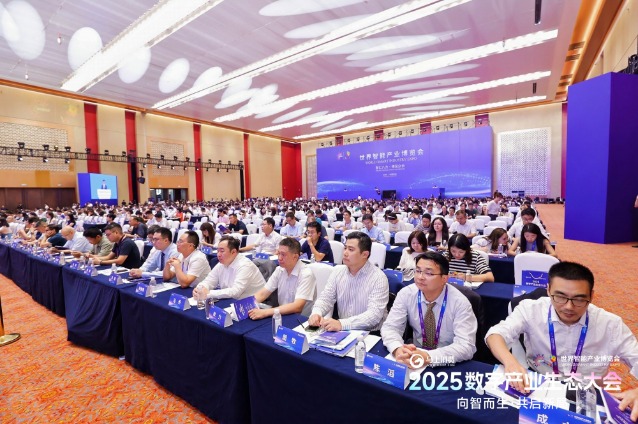
Core Insights - The 2025 World Intelligent Industry Expo (智博会) opened in Chongqing, focusing on "Artificial Intelligence+" and "Intelligent Connected New Energy Vehicles" as its main themes, showcasing global advancements in intelligent technology [1][19] - The "2025 Digital Industry Ecosystem Conference," hosted by Mashang Consumer Finance, attracted over 1,500 industry elites and experts to discuss opportunities in the digital industry ecosystem and its collaborative development [1][2] Group 1: Event Overview - The conference featured a rich agenda with "2+9+4+1" format, including two keynote speeches, nine high-level presentations, four major results announcements, and one parallel meeting, aimed at providing insights and practical wisdom for the digital industry [2] - Notable speakers included government officials, academicians, and industry leaders, discussing key issues such as the integration of digital economy and real economy [2][12] Group 2: Technological Innovations - Mashang Consumer Finance launched the first financial blockchain management platform for national consumer finance companies and completed the first credit asset-backed securities (ABS) based on blockchain and digital RMB [6][8] - The establishment of the "Chongqing Key Laboratory of Quantum Computing and Quantum Artificial Intelligence" aims to advance key technologies in finance, including quantum acceleration and real-time risk control [9][10] Group 3: Strategic Collaborations - A strategic cooperation framework was signed between Mashang Consumer Finance and Southwest University of Finance and Economics to enhance collaboration in research, talent cultivation, and results transformation [11][13] - The conference highlighted the importance of deep integration between academia and industry, showcasing the role of Mashang Consumer as a leader in digital finance innovation [5][11] Group 4: Industry Trends and Insights - Experts emphasized the accelerating integration of digital and real economies, with Chongqing recognized as a benchmark for this integration in the western region [12] - The conference underscored the shift in global industrial competition towards innovation capability and ecosystem dominance, with a focus on the importance of digital economy governance [15][16] Group 5: Future Outlook - The "智博效应" (Intelligent Expo Effect) is expected to attract high-end talent and advanced technologies to Chongqing, reshaping the industrial landscape in the western region [19][21] - The conference is seen as a catalyst for transforming technological achievements into productive forces, contributing to the high-quality development of the digital economy in China [20][21]
2025智博会聚焦金融安全新生态 多方倡议合力共治金融黑灰产
Sou Hu Cai Jing· 2025-09-06 10:03
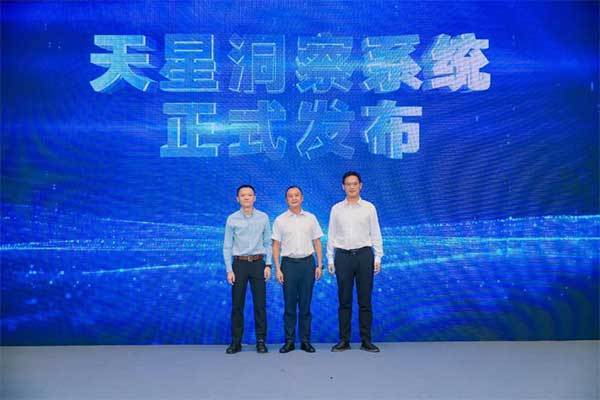
Core Viewpoint - The 2025 Smart Expo highlighted the launch of the Tianxing Insight System, aimed at combating financial black and gray industries through a comprehensive risk prevention network [1][5]. Group 1: Tianxing Insight System - The Tianxing Insight System utilizes technologies such as image forgery detection, sentiment analysis, and complaint mining to enhance the automatic interception and risk warning of black and gray industry information [3]. - The system establishes a full-chain linkage mechanism covering pre-warning, interception, and post-disposal stages, potentially forming a multidimensional risk prevention network [1][3]. Group 2: AIF Alliance Initiatives - The AIF Alliance, a pioneering organization for financial black and gray industry governance, has over 161 members and aims to create a collaborative governance model [5][7]. - The alliance's platform, Aima, has integrated over 170,000 pieces of black and gray industry data and assisted law enforcement in handling 757 illegal agency rights protection cases [5][7]. Group 3: Financial Black and Gray Industry Challenges - The financial black and gray industry market size surpassed 280 billion yuan in Q1 2025, reflecting a 40% increase from 2023, with an estimated workforce exceeding 8 million in 2024 [8][12]. - The complexity and hidden nature of financial black and gray industries pose significant challenges to the financial sector, necessitating a multi-faceted governance approach [8][10]. Group 4: Collaborative Governance and Technology - The conference emphasized the need for a comprehensive governance system involving multiple stakeholders, including internet platforms, financial institutions, and law enforcement [10][12]. - Companies like Tencent and Meituan are leveraging AI and big data to enhance fraud prevention and risk management, creating a collaborative ecosystem for combating financial crimes [14][16]. Group 5: Future Initiatives - The AIF Alliance plans to establish group standards for identifying online financial black and gray industries and develop a "Financial Safety Experience Hall" using VR technology to raise public awareness [7][8]. - The industry is moving towards a governance model that prioritizes information and awareness over traditional regulatory approaches, aiming for a long-term solution to financial crime [12].
全国消费金融首个区块链管理平台重磅发布 首单区块链数字人民币信贷ABS落地重庆
Sou Hu Cai Jing· 2025-09-06 09:20
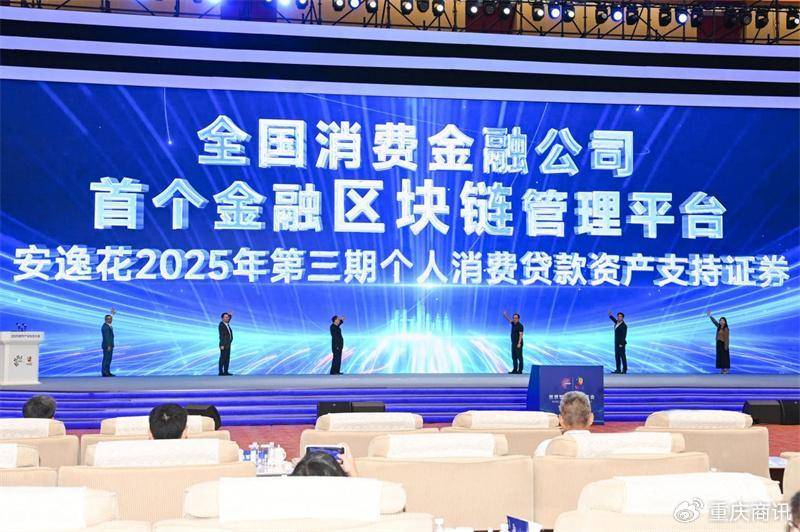
Group 1 - The core viewpoint of the article highlights the launch of China's first financial blockchain management platform by a consumer finance company, showcasing advancements in the digital economy and blockchain technology in the financial sector [1][3] - The platform is designed as a national, industry-level infrastructure that leverages blockchain's distributed, immutable, traceable, and transparent characteristics to enhance the consumer finance ecosystem [3][4] - The first issuance of asset-backed securities (ABS) utilizing this blockchain technology occurred on September 4, marking a significant milestone in the application of blockchain in consumer finance [3][4] Group 2 - The introduction of blockchain technology in the ABS and financial bond sectors addresses key industry pain points, such as information asymmetry and data integrity issues, by enabling real-time asset information tracking [4][5] - The platform's innovative file interaction model replaces traditional email methods, significantly reducing time and labor costs for participating institutions and improving project application and issuance efficiency [4][5] - The initiative aligns with national financial technology development strategies, aiming to enhance financial services for the real economy and support economic transformation [4][5]


首单区块链数字人民币信贷ABS落地重庆
Sou Hu Cai Jing· 2025-09-06 07:15
Core Viewpoint - The launch of a national blockchain management platform for consumer finance by Ma Shang Consumer Finance represents a significant advancement in the integration of blockchain technology within the financial sector, particularly in the context of asset-backed securities (ABS) and digital currency applications [1][3][4]. Group 1: Platform Features and Innovations - The blockchain management platform is designed as a national, industry-level infrastructure that enhances the consumer finance ecosystem through its public and open characteristics [3]. - It utilizes blockchain's distributed, immutable, traceable, and transparent features, ensuring data security through encryption and consensus mechanisms, which fundamentally addresses the authenticity and consistency of information [3][4]. - The platform allows for real-time on-chain asset information and project management data, effectively solving issues related to information asymmetry and data integrity in the traditional ABS market [4]. Group 2: Impact on the Financial Sector - The introduction of blockchain technology in ABS and financial bonds not only enriches policy implementation scenarios but also addresses critical industry pain points, enhancing trust among participants [4]. - The platform's innovative file interaction model replaces traditional email methods, significantly reducing time and labor costs while improving project application and issuance efficiency [4][5]. - The initiative aligns with national financial technology development strategies, supporting the enhancement of financial services to the real economy and promoting economic transformation [4][5]. Group 3: Future Prospects - The platform is expected to inject new momentum into the consumer finance industry, facilitating the achievement of inclusive finance goals by providing better financial services to various social strata [5]. - The company aims to deepen the penetration of blockchain technology in consumer finance, exploring innovative business models and financial products to enhance the efficiency, transparency, and inclusivity of the asset securitization market [5].
马上消费举办数字产业生态大会,为消费金融行业数字化转型注入科技动力
Sou Hu Cai Jing· 2025-09-06 04:14
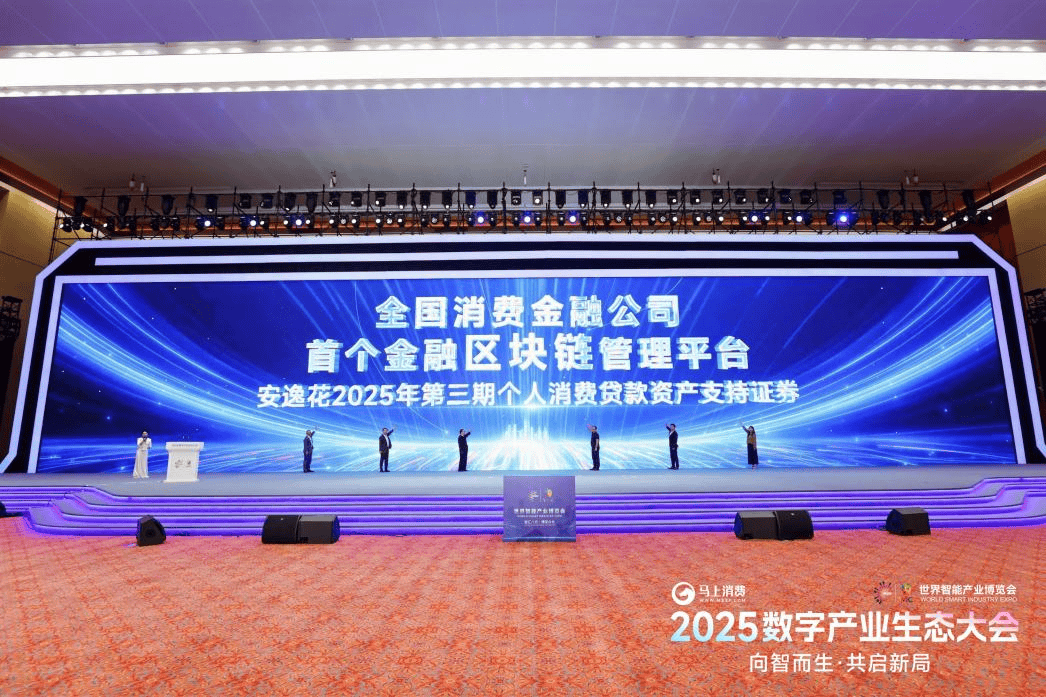
Group 1 - The 2025 World Intelligent Industry Expo focuses on "Artificial Intelligence+" and "Intelligent Connected New Energy Vehicles," showcasing global cutting-edge achievements in the smart industry [1] - Chongqing, as a host city, is a significant hub for digital economy with an industry scale exceeding one trillion, playing a strategic role in the digital transformation of the western region [2] - The "2025 Digital Industry Ecosystem Conference," held in conjunction with the expo, attracted over 1,500 industry elites and aimed to discuss new opportunities in the digital industry ecosystem driven by technological revolutions [2] Group 2 - At the conference, the company launched the first financial blockchain management platform for consumer finance in China and successfully issued the first credit asset-backed securities (ABS) based on blockchain and digital RMB [3][5] - The blockchain management platform is designed as a national, industry-level infrastructure that enhances the consumer finance ecosystem by ensuring data security and transparency through distributed storage and encryption [5][6] - The platform addresses traditional ABS market issues such as information asymmetry and data falsification by providing real-time asset information on the blockchain, thereby enhancing trust among participants [6] Group 3 - The company signed a framework agreement with Southwest University of Finance and Economics to foster collaboration in research, talent development, and innovation, aiming to build a deep integration of industry and academia [7][10] - The partnership will focus on the application of artificial intelligence in consumer finance, optimizing intelligent risk control models, and developing customized courses to cultivate talent that combines financial theory with cutting-edge technology [10] - This strategic cooperation is a key step for the company to enhance its core technological innovation capabilities and improve product and service experiences in a competitive market [10]
消费金融“三国杀”:平安普惠,如何在巨头环伺中突围求生?
Sou Hu Cai Jing· 2025-09-05 14:03
Core Viewpoint - Ping An Puhui, a leading player in China's consumer finance and small and micro enterprise loan sector, has achieved rapid expansion through a high-risk, high-interest business model, but faces significant challenges related to compliance and public perception [3][4][5] Group 1: Business Performance and Market Position - Ping An Puhui has expanded its operations to over 300 cities in China, serving more than 11 million customers and facilitating loan disbursements exceeding 100 billion yuan [3] - The company has been criticized for its aggressive collection practices and high fees, leading to a significant number of complaints on platforms like Black Cat Complaints, with a total of 45,862 complaints as of September 3, 2025 [4][5] - The average annual interest rate for customers has reportedly reached as high as 35.89%, exceeding legal limits due to additional fees [4] Group 2: Competitive Landscape - The consumer finance market is increasingly competitive, with banks, licensed consumer finance companies, and technology platforms vying for market share, creating a "three-way battle" [6] - Traditional banks are leveraging low-cost funding and advanced technology to capture market share, exemplified by WeBank's loan and advance total of 435.976 billion yuan in 2024, a 5.18% increase year-on-year [6] - Companies like Mashang Consumer Finance are gaining traction with strong revenue growth, reporting 8.734 billion yuan in revenue for the first half of 2025, a 12.96% increase [7] Group 3: Regulatory Environment - The regulatory environment for consumer finance is tightening, with seven licensed institutions fined a total of 8.327 million yuan in 2025 for violations, indicating a zero-tolerance approach to non-compliance [9] - Ping An Puhui must adapt to this new regulatory landscape, where even minor violations could have severe consequences [10] Group 4: Strategic Recommendations - The company needs to focus on compliance and technology as essential survival strategies, optimizing risk control models and improving operational efficiency [10][11] - A shift towards quality and efficiency over sheer scale is necessary, with a focus on serving clients with stable cash flows and good credit histories [12] - Emphasizing technology in risk management, such as AI for fraud detection and customer service improvements, is crucial for future success [13]
