Retail

Search documents
JPMorgan says investors looking for safety should shift into this unloved corner of the stock market
Business Insider· 2026-02-16 10:30
Group 1 - JPMorgan Asset Management recommends focusing on the quality factor in the stock market as AI disrupts various industries, defining quality stocks as those with strong cash flow, consistent earnings, experienced management, and competitive advantages [1][3] - The quality factor has underperformed the broader market over the past year, with quality stocks lagging behind by almost 5% in 2025, marking one of the worst stretches in nearly two decades [2][4] - Historical trends suggest that periods of quality underperformance can lead to sharp reversals, with quality stocks often outperforming during market downturns [3][4] Group 2 - The period from 2003 to 2008 exemplifies this trend, where higher-quality companies lagged for four years before outperforming by 7 percentage points in 2007 and 2008 as the economy entered recession [4] - Over the last 30 years, developed market stocks have experienced nine drawdowns of 10% or more, during which quality stocks outperformed 78% of the time, with a median excess return of 3.4 percentage points [4] - Examples of quality factor funds include the iShares MSCI Global Quality Factor ETF (AQLT) and the Vanguard US Quality Factor ETF (VFQY) [4] Group 3 - Investors leaning into quality stocks should be cautious of those with high exposure to AI stocks, as this theme could trigger the next market drawdown [5] - The Invesco S&P 500 Quality ETF (SPHQ) is highlighted as a quality fund with limited exposure to AI hyperscalers and software stocks, featuring top holdings such as Costco, Visa, and Apple [5]


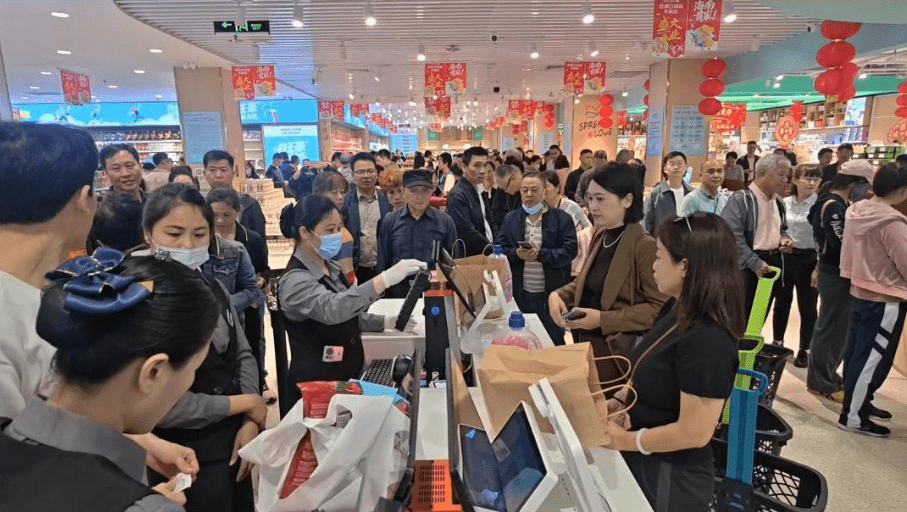
特写|日用消费品免税店内外的两条长队
Sou Hu Cai Jing· 2026-02-16 00:46
Core Viewpoint - The opening of the Haikou Wanghao Duty-Free Store has attracted significant consumer interest, with long queues both outside and inside the store, indicating strong demand for duty-free shopping in the region [2][4][6]. Group 1: Consumer Behavior - A large crowd gathered outside the store, with people arriving as early as 8:30 AM to secure their place in line, demonstrating high anticipation for the store's offerings [2][5]. - Inside the store, customers formed long lines at the checkout, with multiple shopping carts filled with a variety of products, indicating a busy shopping environment [4][5]. Group 2: Product Offering - The store features over 50,000 items across more than 40 categories, including snacks, fruits, household goods, and baby products, catering to diverse consumer preferences [5]. - Popular items include imported snacks and fruits, such as durian, which are particularly sought after during the festive season [5]. Group 3: Operational Insights - The store's staff efficiently managed the checkout process, with quick transactions and a high volume of sales, reflecting effective operational management [4][5]. - The store's opening coincided with the Southern Little New Year, enhancing the festive shopping atmosphere and encouraging consumers to purchase holiday goods [6].
5 major ASX shares to watch as reporting season tests investor nerves
Rask Media· 2026-02-16 00:05
Earnings Season Overview - ASX 200 companies are reporting this week, with heightened volatility expected as earnings expectations are tested [1] - Recent market sentiment shifted quickly, exemplified by AMP Ltd's 30% drop following its update [1] BHP Group - BHP Group is viewed as a proxy for global commodity demand, with investors focusing on production volumes, cost control, and commentary on iron ore and copper markets [3] - The company's outlook is significant for sentiment beyond the mining sector, especially with China's economic situation and energy transition metals in demand [3] - Capital allocation decisions, including dividends and project spending, will be closely scrutinized during periods of softer commodity prices [3] Telstra Group - As Australia's largest telecommunications company, Telstra's performance will be evaluated based on mobile subscriber growth, average revenue per user, and cost discipline [4] - Updates on network investment and the competitive landscape are anticipated, with a focus on maintaining margins in a higher cost environment [4] Goodman Group - Goodman Group operates at the intersection of property and global logistics, benefiting from trends like e-commerce growth and data center demand [5] - Insights into development pipelines, asset valuations, and funding conditions are expected from their results [5] Wesfarmers - Wesfarmers, a diversified retail and industrial company, will attract attention for same-store sales growth, margins, and inventory management [7] - The evolving consumer behavior, including potential trading down by households, will be a key focus area [7] Mineral Resources - Mineral Resources has faced pressure due to softening lithium prices and balance sheet concerns, making this reporting period pivotal [8] - Investors will concentrate on production guidance, debt levels, and progress in lithium and iron ore projects [9] - Commentary on long-term demand assumptions and capital discipline will likely influence market reactions [9] General Reporting Insights - Earnings season is not solely about profit changes but also about how results align with expectations and future outlooks [10] - Management communication under pressure, comparison against prior guidance, and assessment of balance sheet strength are critical for understanding company performance [12]

X @Forbes
Forbes· 2026-02-15 22:30
From running track at the University of Oregon to running the shoe retail giant Nike, Phil Knight revolutionized the shoe industry with his former coach. He's stepped into seventh place on the #Forbes250 list, featuring America’s greatest living innovators.Get the full list: https://t.co/kszvRsR2NBPhoto: Michael Hickey via Getty Images ...

XLP vs. FTXG: The Clash of Consumer Staple ETFs
Yahoo Finance· 2026-02-15 21:45
Core Insights - The comparison between State Street Consumer Staples Select Sector SPDR ETF (XLP) and First Trust Nasdaq Food & Beverage ETF (FTXG) highlights differences in cost, returns, risk, liquidity, and portfolio construction for investors to consider Cost & Size - XLP has a significantly lower expense ratio of 0.08% compared to FTXG's 0.60% [2][3] - As of February 14, 2026, XLP's one-year return is 11.12%, while FTXG's is 6.87% [2] - XLP offers a dividend yield of 2.14%, slightly lower than FTXG's 2.60% [2] - XLP has assets under management (AUM) of $17.24 billion, significantly higher than FTXG's $20.1 million [2] Performance & Risk Comparison - Over five years, XLP has a maximum drawdown of (16.31%), while FTXG's is (21.71%) [4] - A $1,000 investment in XLP would grow to $1,332 over five years, compared to $925 for FTXG [4] Portfolio Composition - FTXG tracks a smart beta index with 31 holdings, including major companies like PepsiCo, Archer-Daniels-Midland, and Mondelez International [5] - XLP, launched in 1998, has 39 holdings and includes top companies like Walmart, Costco, and Procter & Gamble [6] Investment Implications - XLP's lower expense ratio, higher returns, and established market presence make it a more competitive option compared to FTXG [7] - FTXG, being a younger fund, may have potential for scalability as it continues to develop its portfolio [7] - The focus of XLP on retail stores contrasts with FTXG's emphasis on food and beverage products, which may appeal to different investor preferences [8] Market Stability - Both funds provide stability during market volatility, as consumer defensive assets are essential regardless of economic conditions [9]
AI Disruption Fear, FOMC Minutes and Other Key Things to Watch this Week
Yahoo Finance· 2026-02-15 18:00
Group 1: AI Disruption and Market Impact - The rapid spread of AI disruption is affecting various sectors, including software, wealth management, commercial real estate, and logistics, indicating a significant shift in market psychology regarding AI's economic impact [1][2] - Wealth management selloffs are driven by fears that AI advisors and robo-platforms may disintermediate traditional financial advisory relationships [1] - Concerns about AI-driven property management automation and reduced office space needs are contributing to weakness in commercial real estate [1] - Logistics companies are under pressure due to worries about AI optimizing supply chains, potentially reducing human intervention and compressing margins [1] Group 2: Economic Data and Market Reactions - An unprecedented convergence of economic data is expected on Friday, including Q4 GDP revision, Core PCE Price Index, Manufacturing and Services PMI, and new home sales, which will provide a comprehensive economic picture [3] - The GDP revision will focus on consumer spending contributions and business investment patterns, crucial for assessing year-end economic health [3] - The Core PCE reading is essential for evaluating inflation pressures, while PMI releases will offer insights into future business activity [3] Group 3: Federal Reserve Insights - The FOMC meeting minutes will provide insights into Federal Reserve policy deliberations before leadership transition, focusing on inflation persistence and labor market assessments [4] - Any disagreements among Fed officials regarding recent rate cuts or financial stability concerns could influence market expectations about future policy adjustments [4] - The minutes may also address how policymakers are weighing AI's productivity impacts against near-term inflation pressures [4] Group 4: Consumer Spending and Retail Insights - Walmart's earnings will serve as a key indicator of consumer health, providing insights into household spending patterns and retailer inventory management [5] - The performance metrics such as same-store sales growth and e-commerce performance will help assess consumer spending resilience [5] - Commentary on traffic patterns and consumer behavior will be crucial for establishing expectations about future spending trajectories [5] Group 5: Commodity and Materials Sector Assessment - Vale's earnings will provide insights into iron ore demand and industrial commodity pricing, serving as leading indicators for global infrastructure spending [7] - Commentary on Chinese demand and commodity price expectations will help assess the sustainability of recent strength in materials sectors [7] - The convergence of materials earnings with comprehensive economic data could lead to significant sector rotation based on conflicting stories about global demand strength [7]
Walmart earnings, spending data, and more AI disruptions: What to watch this week
Yahoo Finance· 2026-02-15 12:57
Market Overview - AI turbulence has significantly impacted various sectors, including software, real estate, financial services, and logistics, leading to selling pressure on stocks due to concerns over AI-related disruptions [1] - The Nasdaq Composite fell by 0.2% on Friday, concluding the week with a total loss of 2.1%, while the S&P 500 saw a minor gain of less than 0.1% but ended the week down 1.4%. The Dow Jones Industrial Average increased by 0.1% on Friday but recorded a weekly decline of 1.2% [2] Sector-Specific Insights - The market experienced sharp movements beneath the surface, with investors closely monitoring whether the disruptions caused by AI will persist in the upcoming week [3] - A notable sell-off began in early February, affecting software companies like Salesforce and ServiceNow, and has since spread to financial services and logistics sectors, with stocks declining on any indication that AI tools may disrupt their core operations [7] Upcoming Economic Data - The Personal Consumption Expenditures (PCE) report, scheduled for release on Friday, will provide insights into consumer spending during December and inflation trends, following last week's Consumer Price Index (CPI) data that indicated a greater-than-expected slowdown in inflation [4] - The University of Michigan's market sentiment reading, also due on Friday, will gauge consumer attitudes against actual spending data, with the measure recently reaching its highest level since August but still lower than the previous year [5] Corporate Earnings Focus - Attention will be on Walmart's fourth-quarter earnings release on Thursday, which is expected to be a strong indicator of consumer spending and will mark the first report under new CEO John Furner [5] - Other significant earnings reports include those from DoorDash and Molson Coors, as well as energy companies like Constellation Energy, Energy Transfer, and Southern Company, which will provide insights into how AI is influencing power demand in the energy sector [6] AI Impact on Logistics - A recent press release from a karaoke machine maker about an AI-powered logistics platform that claims to increase freight volumes by 300% to 400% without a proportional rise in operational headcount led to significant stock declines for CH Robinson Worldwide and Universal Logistics, which fell by 12% and 10% respectively for the week [8]
X @The Economist
The Economist· 2026-02-14 22:20
Erewhon has emerged as the grocer of choice for celebrities from Hailey Bieber to the Kardashians. The retailer has been carefully cultivating a sense of exclusivity https://t.co/nQVTW1htqO ...
Walmart Stock: Defensive Compounder With Omnichannel Margin Upside (NASDAQ:WMT)
Seeking Alpha· 2026-02-14 09:17
Core Viewpoint - The article raises the question of whether Walmart Inc. has reached its peak following the announcement of CEO Doug McMillon's departure and the appointment of his successor, John [1] Company Analysis - Walmart Inc. is experiencing a leadership change with CEO Doug McMillon stepping down and John taking over [1] - The article suggests a potential stagnation in Walmart's growth after decades of loyal customer support [1] Market Context - The discussion implies that the retail sector, particularly for large companies like Walmart, may be facing challenges that could affect future performance [1]


换新补贴+年味盛宴 兴安盟多场活动迎春接福
Xin Lang Cai Jing· 2026-02-14 09:16
Group 1 - The core theme of the consumption promotion in Xing'an League is "Warm Spring on the Ridge, Beneficial Purchase in Xing'an," featuring enhanced policy subsidies and integration of commerce, culture, and tourism [1] - A total of 8.5 million yuan in consumption vouchers will be distributed across the region, with trade-in subsidies for automobiles and home appliances reaching up to 20,000 yuan [1] - The new trade-in policy, effective from January 1, 2026, will cover 12 categories of home appliances and digital products, offering a 15% subsidy on the selling price for energy-efficient appliances and digital products [1] Group 2 - The new spring lantern festival at the Guiliuhe Ecological Park in Keyou Qianqi will run until March 4, featuring over 40 unique lantern displays and a variety of cultural performances [3] - The second annual New Year goods festival in Xing'an League, which started on February 4, attracted over 150 merchants and showcased more than 1,000 specialty products, achieving sales of 500,000 yuan on the first day [3] - Online live-streaming sales through platforms like Douyin and JD.com are promoting local agricultural products nationwide as part of the "Xing'an Cloud New Year Goods Festival" [3]