
人工智能医疗

Search documents
北京率先打造医疗中试基地
Bei Jing Shang Bao· 2025-09-14 16:57
Core Insights - The article highlights the establishment of a national AI application pilot base in the medical field, which aims to enhance the integration of AI in healthcare services and improve patient outcomes [1][6][11] Group 1: AI Application in Healthcare - The AI pilot base serves as a large "incubation factory" where hospitals and enterprises can access services covering the entire process from diagnosis to drug development [1][6] - During the 2025 China International Service Trade Fair, the pilot base showcased 31 AI medical interactive products, including a system for early warning of eye diseases and chronic conditions, which attracted significant public interest [1][3] - The AI eye disease and chronic disease warning system can automatically capture images and generate analysis reports within three minutes, identifying over 30 eye diseases and 10 systemic risks [3][4] Group 2: Infrastructure and Services - The pilot base aims to create a unified support platform for common capabilities, facilitating the standardized and scalable application of AI in healthcare [6][8] - It focuses on two main areas: precision diagnosis and biopharmaceutical manufacturing, providing a comprehensive service system that includes product development and application promotion [7][8] - The base is supported by the Beijing Municipal Development and Reform Commission and the Beijing Municipal Health Commission, with operations managed by a dedicated company [6][7] Group 3: Data Challenges and Solutions - Data challenges, including ownership ambiguity and compliance requirements, are identified as significant obstacles in the development of AI applications in healthcare [9][10] - The pilot base is working on creating a trusted data space to facilitate the safe and efficient use of healthcare data, integrating various medical data resources [9][10] - A medical big model and application evaluation system is being developed to provide authoritative assessments of AI models in real clinical scenarios, ensuring quality and safety in AI applications [10][11] Group 4: Future Vision - The ultimate goal of the pilot base is to leverage AI to enhance healthcare delivery, allowing for early detection of health risks and timely interventions [11] - By connecting medical institutions and enterprises, the base aims to realize the vision of "letting data do the work, reducing patient illness" [11]


AI“分身”下沉,蚂蚁AQ的医疗普惠新路径
硬AI· 2025-09-12 14:25
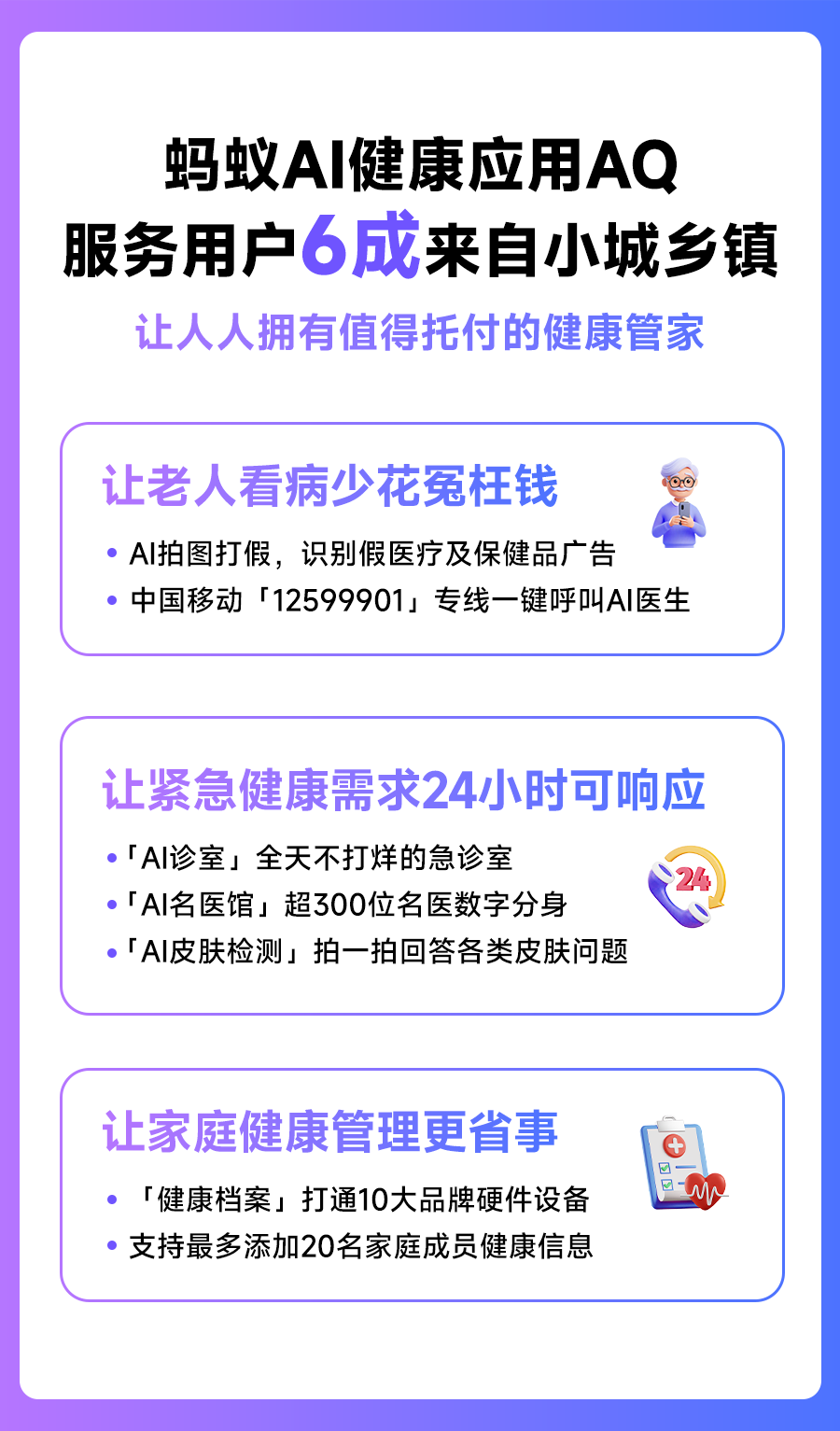
Core Viewpoint - The article discusses the integration of AI in healthcare, highlighting the launch of Ant Group's AI health application AQ, which aims to enhance medical services and accessibility for patients, particularly in underserved areas [3][5]. Group 1: AI Health Application Launch - On September 12, Ant Group launched the AI health application AQ at the 2025 Inclusion Bund Conference, introducing a smart body open platform designed to assist doctors and medical institutions in developing personalized AI assistants [3][5]. - The platform aims to address the limited supply of medical services in China, where top-tier hospitals are concentrated in eastern provinces, with only 5% located in western provinces [3][5]. Group 2: Enhancing Doctor's Service Capacity - AQ's platform connects nearly one million doctors and integrates over 200,000 online consultation services, enabling the creation of "AI avatars" for more than 300 renowned doctors, providing 24/7 medical services [5]. - A specific case from Shanghai's Huangpu District demonstrates the effectiveness of the "digital family doctor" AI avatar, which serves 400,000 residents and helps alleviate the service pressure on family doctors [5]. Group 3: User-Centric Product Development - Since its beta launch, AQ has served over 140 million users, with nearly 60% from third-tier cities and below, indicating a strong demand for accessible AI health services in these regions [7]. - New features like the "health record" function and the "AI anti-fraud hotline" have been introduced to address specific user needs, particularly for elderly individuals [7]. Group 4: Challenges in AI Healthcare - The application of AI in healthcare requires careful consideration of issues such as high-quality data accumulation, model hallucination suppression, and ethical technology development [9]. - Ant Group's CEO emphasized that AI should serve as a supportive tool for doctors, enhancing their efficiency and service reach rather than replacing them [11].

AQ发布智能体开放平台:打造医生AI助手
Yang Guang Wang· 2025-09-12 06:42
Core Insights - Ant Group's AI health application AQ launched new features focusing on family health management and fraud prevention for the elderly, including a "Health Record" and an "AI Fraud Prevention Hotline" in collaboration with China Mobile [1][2] - Since its beta launch in September last year, AQ has served over 140 million users, with nearly 60% from third-tier cities and below [1] Group 1: Product Features - The upgraded "Health Record" integrates medical history, medication records, and lifestyle information, supporting data from ten major brands of smartphones and wearable devices [2] - AQ's "AI Skin Detection" can identify over 50 skin diseases, and users can assess their health through tongue, hair, and facial scans for personalized health advice [2] - The "AI Fraud Prevention Hotline" allows elderly users to easily access AI doctors for immediate assistance with suspicious information or health issues [2] Group 2: Service Connectivity - AQ connects nearly one million real doctors and facilitates online consultations with over 200,000 doctors through the Good Doctor platform, providing 24/7 medical services [3] - The "Digital Family Doctor" AI assistant is already operational in over 200 family doctors' AI avatars in Shanghai's Huangpu District, serving 400,000 residents and one million professionals [3] Group 3: Future Directions - Ant Group's CEO emphasized that AI should assist doctors rather than replace them, and the company is investing in AI-enabled multidisciplinary consultations and addressing data quality and ethical issues [3]

AI医生下乡!健康管家AQ近六成用户来自小城乡镇
Jing Ji Guan Cha Wang· 2025-09-12 05:35
Core Insights - Ant Group's AI health application AQ launched new features focused on family health management and fraud prevention for the elderly, including a "Health Record" and an "AI Fraud Prevention Hotline" in collaboration with China Mobile [1][3] - Since its beta launch in September last year, AQ has served over 140 million users, with nearly 60% from lower-tier cities, aiming to enhance precision and inclusive healthcare [1][2] Product Features - The upgraded "Health Record" allows comprehensive management of medical history, medication, and lifestyle information, supporting data integration from ten major brands of smartphones and health devices [2][3] - The "AI Skin Detection" feature can identify over 50 skin diseases and provide personalized health advice based on various health assessments [2] Target Audience and Accessibility - The "AI Fraud Prevention Hotline" enables elderly users to easily access AI doctors for immediate assistance with suspicious information or health issues [3] - AQ aims to provide a "health steward" for every family in China, addressing healthcare needs across urban and rural areas [3][6] AI Integration in Healthcare - AQ launched an open platform for doctors to develop personalized AI assistants, enhancing the capabilities of both renowned and grassroots medical professionals [6][7] - The platform connects nearly one million real doctors and facilitates online consultations, aiming to improve healthcare service delivery [6] Community Impact - The "Digital Family Doctor" AI assistant is already operational in Shanghai, providing 24-hour health consultation services to local residents [7] - Ant Group emphasizes that AI should serve as a supportive tool for doctors rather than a replacement, focusing on ethical considerations and high-quality data accumulation in AI healthcare applications [7]
赛博老中医,能治药店虚火?
虎嗅APP· 2025-09-06 08:46
Core Viewpoint - The article discusses the emergence of AI in the traditional Chinese medicine (TCM) retail market, highlighting its potential to revitalize struggling pharmacies and enhance customer engagement through innovative health management solutions [2][5][10]. Group 1: AI Technology in Health Management - The AI TCM diagnostic device, known as "医葫芦" (Yihulu), allows users to receive detailed health reports based on facial scans and finger input, generating insights into various health indicators [2][3]. - Over 100,000 units of AI TCM devices have been sold across more than 20 companies, with cumulative usage exceeding 10 million individuals [2][4]. - The primary consumer demographic for these devices consists of individuals in their 30s and 40s, who are open to new technologies and willing to invest in health solutions [4][10]. Group 2: Market Dynamics and Pharmacy Challenges - The retail pharmacy industry is facing significant challenges, with a decline in growth and an increasing number of store closures, leading to predictions of a potential reduction in total pharmacy numbers to around 500,000 by 2025 [10][11]. - The introduction of AI technology is seen as a critical factor for pharmacies to attract new customers and improve revenue, with some pharmacies reporting a 10% average monthly income increase after adopting AI devices [7][10]. - The AI TCM devices are viewed as a lifeline for pharmacies struggling in a competitive and declining market, prompting some to sign exclusive agreements with AI suppliers [8][10]. Group 3: Future Prospects and Industry Transformation - The integration of AI in health management is expected to drive a transformation in the pharmaceutical industry, moving towards a model focused on preventive care and health management rather than just medication sales [11][15]. - The market for AI health management solutions is projected to reach tens of billions in scale, with significant growth potential as the industry adapts to new consumer demands and regulatory environments [11][15]. - The article emphasizes the need for pharmacies to enhance their service quality and provide comprehensive health management solutions to retain customers and compete effectively in the evolving market landscape [21][22].

AI智能医疗:数据为钥,AI开道,全球竞跑
Tai Mei Ti A P P· 2025-08-29 04:10
Core Insights - A productivity revolution driven by technology is set to reshape China's economic landscape by 2025, with AI, quantum computing, and green technology playing pivotal roles in transforming industries and business models [1] - The discussion focuses on the integration of AI in the healthcare sector, highlighting six key areas: AI drug development, surgical robotics, medical imaging, smart devices, biocomputing, and precision diagnostics [2][3] Group 1: AI in Healthcare - AI is reshaping the healthcare ecosystem, presenting both opportunities and challenges across various applications, including imaging diagnostics, drug development, chronic disease management, personalized interventions, and public health alerts [1] - The six key areas of focus in AI healthcare include AI drug development, surgical robotics, medical imaging, smart devices, biocomputing, and precision diagnostics [2] Group 2: Company Innovations - Huiyun Biotech has developed the world's first fully automated high-throughput clinical mass spectrometry detection platform for metabolomics, aiming to translate this technology into practical health solutions [2] - Jialiang Medical is pioneering brain-computer interface technology for neuromodulation, with significant clinical advancements in treating conditions like epilepsy and Parkinson's disease [3] - Yimai Medical specializes in interventional surgical robots, integrating AI to enhance surgical precision and decision-making processes [6][7] Group 3: AI Drug Development - InSilico Medicine utilizes generative AI to discover innovative drug targets and generate small molecule compounds, with a focus on treating idiopathic pulmonary fibrosis [5][6] - The company has reported a 70% annual revenue growth over the past three years, reaching $85.58 million last year, and aims to maintain this growth trajectory [6] Group 4: Clinical Trials and AI - AI is being integrated into clinical trial processes to enhance efficiency, reduce costs, and improve patient recruitment, with significant time savings reported in patient identification [17][18] - The use of AI in clinical trial design and execution is transforming traditional labor-intensive methods into more streamlined, data-driven approaches [17] Group 5: Challenges and Opportunities - The integration of AI in medical devices faces regulatory challenges due to the inherent unpredictability of AI, which complicates the approval process [20][21] - Despite the slow progress in AI applications within medical devices, there is a growing recognition of the need for standardized data and regulatory frameworks to support innovation [21][22] Group 6: International Competitiveness - China's AI healthcare sector, while starting later than its international counterparts, has the potential for rapid advancement due to its vast patient population and data resources [26][27] - The focus on data standardization and algorithm development is crucial for China to leverage its advantages in the AI drug development space [27][28]
鹰瞳科技-B(02251)发布中期业绩 期内溢利44.3万元 同比扭亏为盈
智通财经网· 2025-08-28 15:28
Financial Performance - The company reported a revenue of 83.713 million RMB for the six months ending June 30, 2025, with a gross profit of 64.103 million RMB, representing a year-on-year increase of 13.53% [1] - The net profit for the period was 0.443 million RMB, a significant turnaround from a loss of 81.488 million RMB in the same period last year [1] Product and Service Expansion - The number of active service points for the retinal detection AI products increased from 5,950 to 7,180, marking a year-on-year growth of 20.7% [1] - The company detected 3.3 million cases through SaMD and health risk assessment solutions, reflecting an 11.4% year-on-year increase [1] - The usage of myopia prevention AI products reached 2.812 million times, a substantial growth of 68.1% year-on-year [1] - The visual training AI products recorded 1.026 million training sessions, which is an 11.6% increase compared to the previous year [1] New Product Development - The company successfully developed and launched a new generation of physiological stress capacity detection product, the "Eagle Eye Stress Capacity Detector," based on wireless sensing technology and multimodal AI algorithms, which has completed product finalization and market testing [2]
在救命这件事上,AI开始做医生做不到的事了。
数字生命卡兹克· 2025-08-28 01:06
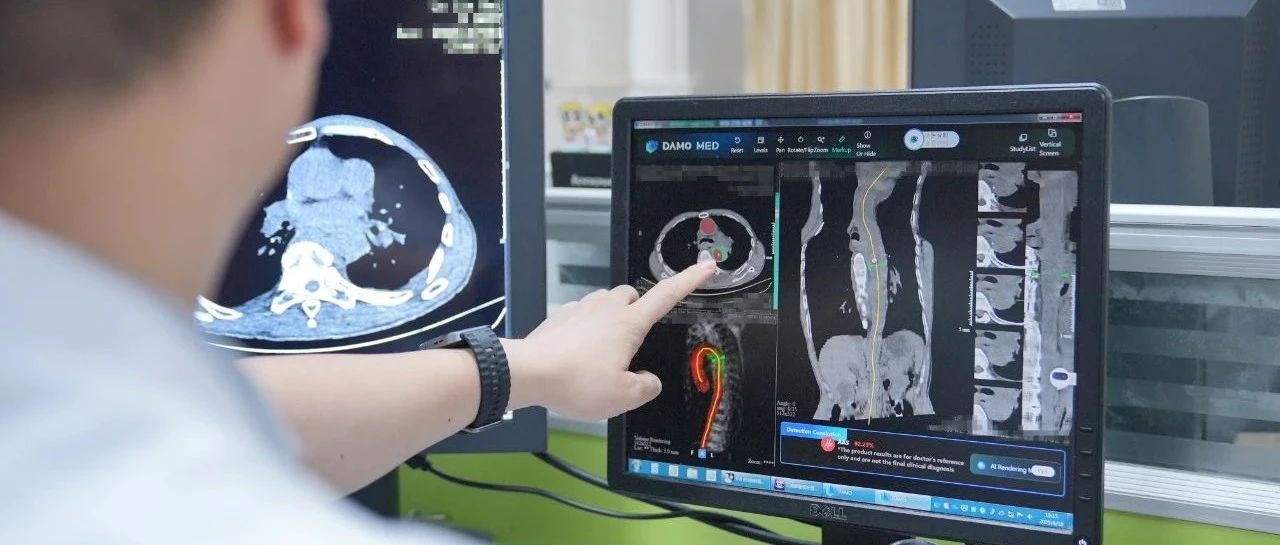
Core Viewpoint - The article highlights the advancements in AI technology for early cancer detection and diagnosis of acute aortic syndrome, emphasizing the potential of AI to save lives through faster and more accurate medical assessments [2][48][53]. Group 1: AI in Cancer Detection - The collaboration between Alibaba's DAMO Academy and Ningbo University Affiliated People's Hospital has led to the development of the PANDA model, which can detect pancreatic cancer through a standard CT scan [2][5]. - Following this, the GRAPE model was introduced for gastric cancer screening, also utilizing a regular CT scan, demonstrating the capability of AI to identify high-risk patients effectively [3][4]. - The GRAPE model showed a detection rate of 24.5% and 17.7% for gastric cancer in two regional hospitals, with significant early-stage detection rates [4]. Group 2: AI in Diagnosing Acute Aortic Syndrome - The iAorta model was developed to diagnose acute aortic syndrome (AAS) using non-contrast CT scans, achieving a sensitivity of 95.5% and specificity of 99.4% during clinical trials [48][50]. - The average time from admission to diagnosis for AAS was reduced to 1.7 hours with the use of iAorta, compared to the international average of 4.3 hours, significantly decreasing the risk of mortality [50]. - The model was able to identify AAS in a patient who was initially misdiagnosed with gallbladder stones, showcasing its potential to prevent misdiagnosis and expedite treatment [50]. Group 3: Broader Implications of AI in Healthcare - The article emphasizes the importance of timely diagnosis in critical conditions, stating that every minute counts in saving lives, particularly in cases like AAS and heart attacks [19][58]. - It advocates for the widespread deployment of AI models in hospitals and clinics across the country to ensure that patients in remote areas have access to advanced diagnostic tools [55][59]. - The narrative underscores the transformative impact of AI in healthcare, suggesting that it can bridge the gap in medical disparities and enhance early detection of life-threatening conditions [60][63].
“琶洲之星”专访:科研人员用AI大幅提升青光眼筛查效率
Nan Fang Du Shi Bao· 2025-08-26 08:53
Core Insights - The article highlights the significant advancements in AI technology for glaucoma screening and diagnosis, emphasizing its potential to improve efficiency and accuracy in the medical field [1][2][3] Group 1: AI in Glaucoma Screening - Glaucoma is the second leading cause of blindness globally, with approximately 21 million patients in China and a blindness rate of about 27% [2] - AI technology has been successfully applied to enhance the efficiency of glaucoma screening, allowing one doctor to see up to 500 patients a day compared to the previous limit of 50 [3] - The AI-assisted diagnostic system developed by the Zhongshan University Eye Center has received regulatory approval and is already in use in multiple cities [3] Group 2: Data and Research Contributions - The establishment of the iChallenge dataset, the largest publicly available ophthalmic dataset, aims to promote research in ophthalmology by providing high-quality data [5][6] - The dataset has been cited in over 1,000 research papers and has won the 2023 TOP100 Achievement Award from the Bench Council, highlighting its impact on the field [6] - The open data initiative is expected to accelerate research and product development in ophthalmology, benefiting potential patients [6] Group 3: Multidisciplinary Knowledge and AI Integration - The integration of AI across various industries necessitates professionals with multidisciplinary knowledge, as seen in the new dual-degree programs introduced by South China University of Technology [7][8] - The application of AI in medical diagnostics requires a solid understanding of medical knowledge, prompting researchers to pursue formal education in relevant fields [9] - The potential expansion of AI applications from retinal imaging to cardiovascular disease diagnosis is seen as a significant trend, with government support for such initiatives [9]
讯飞医疗(2506.HK)2025年中期业绩:营收利润双增,AI引擎驱动高增长
Ge Long Hui· 2025-08-20 09:52
Core Insights - The company reported a strong performance for the first half of 2025, achieving a revenue of 299 million yuan, a year-on-year increase of 30%, and a gross profit of 154 million yuan, with a gross margin of 51.5% [1] Group 1: R&D and Technological Advancements - The company invested 134 million yuan in R&D, accounting for 45% of its revenue, leading to significant advancements in its core product, the Xinghuo Medical Model, which topped the Medbench evaluation [2] - The Xinghuo Medical Model has been implemented in over 20 leading hospitals across China, enhancing clinical practices and demonstrating its value in real-world applications [2] Group 2: Business Matrix and Growth Drivers - The company has established a collaborative business matrix covering government (G), hospital (B), and consumer (C) sectors, with G sector solutions seeing a 52% revenue increase and B sector solutions implemented in over 500 hospitals [3] - The patient management revenue in the C sector grew by 10.1%, with the AI health assistant "Xunfei Xiaoyi" completing 140 million AI consultations [3] Group 3: Global Expansion and Market Positioning - The company accelerated its global expansion, launching the Xinghuo Medical Model V2.5 international version in Hong Kong, which serves as a strategic hub for integrating local and international medical knowledge [4] Group 4: Long-term Strategy and Policy Support - The company is committed to long-term strategies in smart healthcare, leveraging national policies that promote AI integration in healthcare, with significant support from recent government initiatives [5] - The company aims to enhance its technological breakthroughs and deepen its market presence, focusing on providing quality healthcare services and efficient diagnostic tools [6]