人工智能医疗

Search documents
康众医疗20260304
2026-03-06 02:02
Summary of Conference Call for Kangzhong Medical Company Overview - **Company**: Kangzhong Medical - **Industry**: Medical Imaging Solutions - **Transformation**: Transitioning from component supplier to imaging solution provider, with a focus on AI integration and grassroots healthcare services [2][3][4] Key Points and Arguments Strategic Transition - **Timeline**: 2026-2027 identified as critical years for transformation [2][4] - **AI X-ray Prototype**: Expected to begin mass production in 2026, aiming for a shift from component sales to system-level integration [2][3] - **Focus on Grassroots Healthcare**: Targeting a vast market by avoiding competition with top-tier hospitals, leveraging the "Kangzhong Medical Energy" platform for service fees and data monetization [2][4] Financial Projections - **Revenue Model**: Transitioning from equipment sales to per-use fees, with screening costs in Wenzhou and Shanghai set at 68 and 90 yuan respectively, yielding an annual market size of nearly 30 billion yuan [2][8] - **Incentive Goals**: Aiming for an incremental revenue of approximately 200 million yuan driven by national policies supporting grassroots AI healthcare [2][11] AI Integration and Product Development - **AI Ultrasound Accuracy**: Achieved over 90% accuracy in Wenzhou projects, significantly reducing unnecessary biopsies, which cost around 2000 yuan [2][4][19] - **Partnership with Maide Medical**: Strategic investment to enhance ultrasound AI capabilities, with regulatory approvals for thyroid and breast diagnostics expected [2][6][9] Market Strategy - **Target Markets**: Focus on county hospitals, community clinics, and village doctors, integrating AI capabilities into existing healthcare frameworks [7][8] - **Commercial Model**: Implementing a service fee model to ensure sustainable revenue generation in grassroots healthcare [8][10] Competitive Landscape - **Maide's Position**: Recognized as a leading player in ultrasound AI, with collaborations to enhance market presence in Europe [7][10] - **Regulatory Approvals**: Maide's products are positioned to meet high clinical standards, with multiple certifications expected in 2026 [13][15] Future Growth and Expansion - **Projected Market Size**: Anticipating a total of 6 billion ultrasound checks annually, with a potential market size of 30 billion yuan for AI services [16][17] - **Strategic Partnerships**: Collaborations with major tech firms (e.g., Huawei) and academic institutions to enhance product offerings and market reach [17][20] Operational Insights - **Wenzhou Project**: Currently in the operational phase, with data trends expected to stabilize in 2-3 months [18][19] - **Promotion Dynamics**: Driven by national healthcare policies, with plans to expand into 300 county-level markets by the end of 2026 [19][20] Additional Important Content - **Cash Flow Stability**: Existing detector business provides stable cash flow, with growth strategies focused on overseas markets and new product lines [20] - **AI in Diagnostics**: Emphasis on integrating AI into diagnostic processes to enhance efficiency and reduce costs for patients and healthcare systems [15][19] This summary encapsulates the strategic direction, financial outlook, and operational insights of Kangzhong Medical as discussed in the conference call, highlighting the company's commitment to transforming healthcare through AI and innovative business models.

最新!4款医疗器械进入创新通道
思宇MedTech· 2026-03-01 08:16
Core Viewpoint - The article discusses the approval of four innovative medical devices by the National Medical Products Administration of China, highlighting advancements in medical technology and the companies behind these innovations [2]. Group 1: Innovative Medical Devices - The first approved product is a CT image-assisted triage software for pancreatic lesions, developed by Alibaba DAMO Academy, which focuses on AI and medical imaging technologies [5][6]. - The second product is a neurosurgical navigation system from Beijing United Imaging Healthcare Co., which aims to enhance clinical applications in prevention, diagnosis, treatment, and rehabilitation [7]. - The third product is a thrombectomy catheter developed by Zhejiang Guichuang Medical Technology Co., specializing in neurovascular and peripheral vascular interventional medical devices [8]. - The fourth product is an OCT image-assisted diagnostic software for retinal diseases, created by TuPai (Beijing) Medical Technology Co., which focuses on high-end ophthalmic medical equipment [9][10]. Group 2: Companies Overview - Alibaba DAMO Academy was established in November 2017 and is dedicated to scientific research and technological innovation, particularly in AI and medical imaging [6]. - Beijing United Imaging Healthcare Co. is part of the United Imaging Medical Technology Group and focuses on providing innovative medical products and solutions for clinical applications [7]. - Zhejiang Guichuang Medical Technology Co. has a history dating back to 2012 and specializes in the development and manufacturing of interventional medical devices for acute ischemic stroke and other conditions [8]. - TuPai (Beijing) Medical Technology Co. was founded in 2017 and is known for its advanced ophthalmic medical devices, leveraging research from Tsinghua University [10].


全球首个医学循证推理智能体DeepRare推出
Ke Ji Ri Bao· 2026-02-24 00:42
Core Insights - Shanghai Jiao Tong University and Xinhua Hospital have launched DeepRare, the world's first intelligent rare disease diagnostic system, addressing the global challenge of high misdiagnosis rates in rare diseases [1][2] - DeepRare utilizes a "central-body" architecture, surpassing traditional medical AI by integrating vast medical literature and clinical cases, enabling a human-like reasoning process for diagnosis [1] - Clinical data shows that DeepRare's primary diagnostic accuracy for pure phenotype diagnosis is 57.18%, a 23.79 percentage point improvement over the best international models [1] Group 1 - DeepRare's system generates a complete evidence chain for each diagnosis, addressing the trust issues associated with AI in healthcare [1] - The system's accuracy improves to 70.61% when incorporating genetic sequencing data, significantly outperforming international tools [1] - The generated inference reports have achieved a 95.40% satisfaction rate among doctors, ensuring that diagnoses are well-supported [1] Group 2 - The online diagnostic platform for DeepRare was launched on July 26, 2025, attracting over 1,000 global professional users within six months [2] - The system has been deployed and tested at Xinhua Hospital, becoming part of the quality control process for rare disease diagnosis [2] - A "10,000 clinical validation plan" has been initiated, aiming to complete thousands of clinical validations through international collaboration [2]
推动创新药物从实验室到生产线,北京协和医学院携手东城打造协和创新港
Xin Lang Cai Jing· 2026-02-02 10:52
Group 1 - The "Xiehe Innovation Port" project was officially launched on February 2, with a cooperation agreement signed between the Chinese Academy of Medical Sciences Peking Union Medical College and the Dongcheng District government [2][3] - The project aims to focus on key areas such as innovative drugs, new vaccines, high-end medical devices, and artificial intelligence in healthcare, creating a benchmark innovation platform that integrates achievement transformation, industry incubation, resource docking, talent cultivation, and professional services [6] - The cooperation agreement includes five core components: provision of physical space and supporting services by Dongcheng District, special support policies, establishment of an integrated platform for technology breakthroughs and achievement transformation, creation of a talent cultivation base, and a governance model ensuring efficient operation [6][7]

博拓生物:公司战略参股了杭州皓世天辉科技有限公司
Zheng Quan Ri Bao Wang· 2026-01-23 12:25
Core Viewpoint - The company has strategically invested in Hangzhou Haoshi Tianhui Technology Co., Ltd., acquiring a 16% stake as the sole investor in its latest financing round, marking another exploration in the non-invasive brain-computer interface sector following its 2025 investment in Qingshi Yongjuan [1] Group 1: Company Overview - Haoshi Tianhui is an innovative high-tech enterprise focused on artificial intelligence in the medical field, with a founding team that has overseas entrepreneurial experience and strong industry expertise [1] - The company has developed a diverse product matrix that includes applications in mental health, cardiovascular monitoring, and imaging diagnostics [1] Group 2: Product and Technology - Haoshi Tianhui's self-developed medical-grade non-invasive brain-computer interface and mental health assessment devices can accurately evaluate emotional issues such as depression and anxiety, integrating music therapy interventions into a comprehensive service model [1] - The products are designed for various settings, including hospitals, schools, health check centers, and mental health institutions, providing objective and efficient assessments compared to traditional evaluation methods [1] Group 3: Regulatory and Market Plans - The company obtained a Class II medical device registration certificate in November 2025 for its products aimed at detecting mental health issues, with plans to promote and sell these products in the domestic market starting in 2026 [1]

幻觉率不到3%,王小川把医生版的DeepSeek免费了
机器之心· 2026-01-22 11:00
Core Viewpoint - Baichuan Intelligent has launched the Baichuan-M3 Plus model, marking a significant breakthrough in AI applications in the medical field, enhancing medical problem reasoning capabilities in real-world scenarios [1][3]. Group 1: Model Performance and Features - The M3 Plus model achieves unprecedented accuracy in medical scenarios, significantly improving reasoning efficiency and crossing critical thresholds for AI usability in healthcare [3][29]. - The model employs Fact-Aware Reinforcement Learning (Fact-Aware RL), which allows for the verification of AI-generated medical judgments against authoritative sources, thus reducing hallucination rates to the lowest globally [6][7]. - M3 Plus has a hallucination rate of only 2.6%, which is over 30% lower than GPT-5.2 and surpasses current industry benchmarks [10][18]. Group 2: Trust and Reliability in AI - Trust remains a significant barrier for AI adoption in healthcare, as many existing AI models produce seemingly professional but often incorrect information [5][16]. - Baichuan Intelligent has introduced "Evidence Anchoring" technology, ensuring that every medical conclusion generated by the AI can be traced back to specific evidence in original research or guidelines, achieving over 95% accuracy in citation matching [16][18]. Group 3: Accessibility and Cost - Baichuan has launched the "Haina Baichuan Plan," offering free access to the M3 Plus API for all service providers to medical professionals, aiming to promote the widespread adoption of AI tools in clinical settings [20][22]. - The cost of deploying M3 Plus for all clinical doctors in China is estimated to be around 100 million yuan annually, which Baichuan is willing to cover to foster ecosystem development [23]. Group 4: Engineering and Optimization - The M3 Plus model has undergone extensive engineering optimization, reducing API call costs by 70% compared to its predecessor while maintaining model performance and reliability [24]. - The Gated Eagle-3 decoding framework enhances prediction accuracy without significantly increasing computational costs, allowing for dynamic filtering of external information [24][25]. Group 5: Industry Context and Future Outlook - The year is seen as pivotal for AI in healthcare, with numerous significant developments indicating that the medical field is becoming a core application area for AI technology [30][32]. - Baichuan's strategy focuses on integrating AI directly into hospital core departments, positioning itself as a "second brain" for doctors rather than merely a health assistant [32][33].
博拓生物(688767):战略参股“皓世天辉” 脑机接口侵入/非侵入全链条布局日趋完善
Xin Lang Cai Jing· 2026-01-16 06:31
Core Insights - The investment agreement between Botao Bio's subsidiary Botai Zhito and Hangzhou Haoshi Tianhui marks a significant step in the brain-computer interface (BCI) industry, enhancing the commercial viability of the sector [1][2] Group 1: Investment and Strategic Development - Botai Zhito has completed a strategic investment in Haoshi Tianhui, becoming the sole investor in this financing round [1] - This investment complements Botao Bio's previous strategic stake in Qingshi Yongjun, establishing a dual technology path in both invasive and non-invasive BCI [2] Group 2: Company and Product Overview - Haoshi Tianhui is an innovative high-tech enterprise focused on AI in healthcare, with a strong founding team possessing overseas entrepreneurial experience and deep technical expertise [2] - The company's core AI and non-invasive BCI products aim to create a closed-loop service for various mental health issues, including depression and anxiety, through assessment, intervention, and feedback [2] Group 3: Financial Projections - Revenue forecasts for the company from 2025 to 2027 are projected at 496 million, 693 million, and 887 million yuan, reflecting a year-on-year change of -11.42%, +39.78%, and +28.11% respectively [3] - The net profit attributable to the parent company is expected to be 60 million, 158 million, and 215 million yuan for the same period, with year-on-year changes of -64.49%, +162.50%, and +35.95% respectively [3]
东城区人均预期寿命达84.59岁,居全国前列
Xin Jing Bao· 2026-01-14 10:12
Core Viewpoint - The healthcare system in Dongcheng District, Beijing, is set to achieve significant improvements by 2025, with a focus on optimizing medical resources, enhancing community healthcare services, and integrating traditional Chinese medicine into the healthcare framework [1][2] Group 1: Healthcare Improvements by 2025 - Dongcheng District aims for a per capita life expectancy of 84.59 years by 2025, ranking among the top in the country [1] - The construction of medical alliances has made progress, with the first people's hospital seeing a 7% year-on-year increase in emergency visits after relocating [1] - Nine district-level hospitals have implemented online sharing and mutual recognition of examination and testing results [1] - There has been over a 20% year-on-year increase in the transfer of patients between community medical institutions [1] - The district has been recognized as a national pilot project for the inheritance and innovation of traditional Chinese medicine [1] Group 2: Future Focus Areas for 2026 - The district will strengthen the three-tiered diagnosis and treatment system led by major hospitals and supported by community health service centers [2] - There will be an emphasis on enhancing diagnostic and treatment capabilities, particularly in traditional Chinese medicine [2] - The integration of community health and elderly care services will be prioritized, including pilot programs for home-based medical beds and care [2] - The district plans to advance smart disease control systems and establish a chronic disease management center [2] - The development of a health industry ecosystem will be promoted, focusing on the application of artificial intelligence in healthcare [2] - The establishment of a district-level internet hospital platform and a smart health big data platform will be accelerated [2]
百川开源医疗大模型 M3,王小川:今年会发布两款 ToC 产品,正在做硬件
Founder Park· 2026-01-14 05:34
Core Insights - AI in healthcare has become a significant focus this month, with major advancements from companies like OpenAI and Baichuan in developing medical AI models [2][3] - Baichuan's new model, Baichuan-M3, achieved a remarkable score of 65.1 in the HealthBench evaluation, surpassing previous models and demonstrating superior decision-making capabilities [3][4] - The model also boasts the lowest hallucination rate globally at 3.5, indicating a high level of reliability in medical reasoning [4][6] Group 1: Model Capabilities - Baichuan-M3 features an end-to-end serious inquiry capability, allowing it to conduct thorough medical questioning similar to a doctor, significantly outperforming average human doctors [4][11] - The model's training emphasizes factual consistency, which has been integrated into its training process to reduce hallucination rates effectively [6][11] - The SCAN-bench evaluation system, developed with input from over 150 frontline doctors, assesses the model's performance across the entire clinical process, demonstrating its ability to improve diagnostic accuracy [12][18] Group 2: Market Position and Strategy - Baichuan aims to address key pain points in the healthcare industry, including the shortage of qualified doctors and the imbalance in doctor-patient relationships [15][16] - The company envisions AI as a tool to empower patients, enhancing their understanding of medical conditions and treatment options, rather than replacing doctors [16][18] - Baichuan plans to launch two consumer-oriented products that will assist patients in decision-making while ensuring that the information is accessible and understandable [23][24] Group 3: Future Directions - The company is focusing on developing hardware related to sleep health, indicating a diversification of its product offerings [33] - Baichuan's strategy includes building trust and establishing a strong product identity in the market, which is crucial for user adoption [29][30] - The company recognizes the importance of integrating AI into outpatient care, aiming to shift the healthcare model towards more accessible and efficient patient interactions [20][21]

OpenAI,收购了一家AI医疗!
Xin Lang Cai Jing· 2026-01-13 11:27
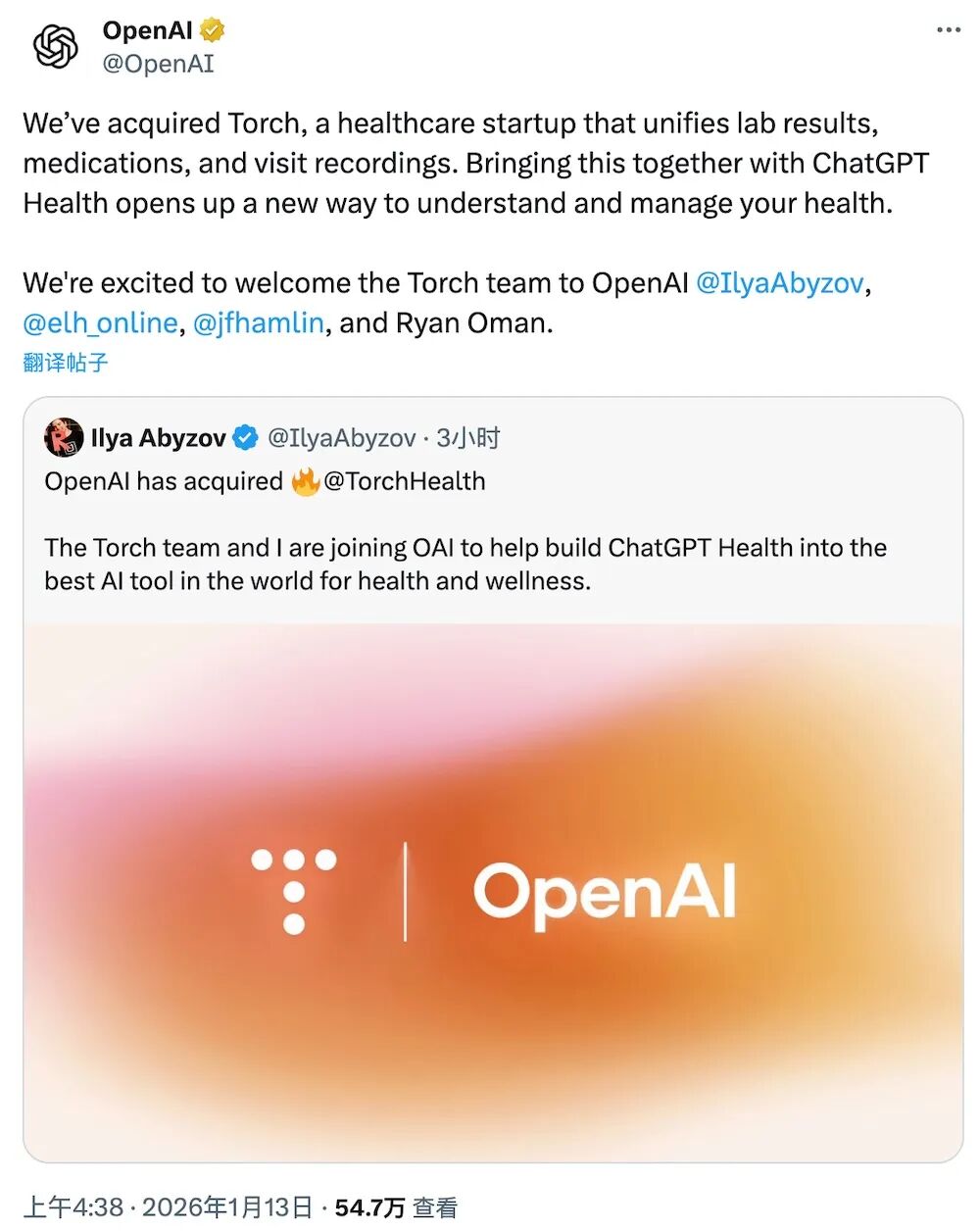
Group 1 - OpenAI has announced the acquisition of AI healthcare startup Torch for a total of $100 million, which includes $60 million in cash and $40 million in employee incentives [1][6] - The acquisition aims to enhance OpenAI's commitment to the healthcare sector, integrating Torch's platform with OpenAI's newly launched AI healthcare product, "ChatGPT Health" [4][9] - Torch, founded in January 2025, is developing a unified medical platform that aggregates patient health data from various healthcare systems, allowing users to analyze lab results, prescriptions, and medical records [4][9] Group 2 - Torch's platform distinguishes itself from traditional health apps by categorizing and organizing user-uploaded medical documents, translating medical terminology, and identifying trends in medical data to provide actionable health insights [11] - Currently, Torch is in a limited private testing phase and has not disclosed specific user numbers, but its capabilities are comparable to those of Ant Group's Aifu app, which achieved nearly 14 million downloads in December [11] - The healthcare AI sector is becoming increasingly competitive, with major players like Anthropic also entering the market shortly after OpenAI's launch of ChatGPT Health [11]