
原材料工业

Search documents
7月份全国工业生产者出厂价格环比下降0.2%
Guo Jia Tong Ji Ju· 2025-08-09 01:36
Group 1: Year-on-Year Changes in Industrial Producer Prices - In July, the producer prices for industrial goods saw a decline in production material prices by 4.3%, contributing approximately 3.20 percentage points to the overall decrease in producer prices [3] - The mining industry experienced a significant price drop of 14.0%, while raw material prices fell by 5.4% and processing industry prices decreased by 3.1% [3] - Consumer goods prices decreased by 1.6%, impacting the overall producer price level by about 0.42 percentage points, with food prices down by 1.8% and durable goods prices down by 3.5% [3] Group 2: Month-on-Month Changes in Industrial Producer Prices - In July, the producer prices for industrial goods showed a month-on-month decline in production material prices by 0.2%, affecting the overall producer price level by approximately 0.17 percentage points [7] - The mining industry prices decreased by 0.2%, raw material prices fell by 0.1%, and processing industry prices dropped by 0.3% [7] - Consumer goods prices also saw a decline of 0.2%, with food prices remaining stable and durable goods prices decreasing by 0.6% [7] Group 3: Changes in Purchase Prices of Industrial Producers - In July, the purchase prices for industrial producers indicated a notable decline in fuel and power prices by 10.8%, black metal materials by 8.0%, and chemical raw materials by 6.5% [6] - Agricultural and sideline product prices decreased by 4.6%, while construction materials and non-metallic materials fell by 3.8% [6] - Conversely, prices for non-ferrous metal materials and wires increased by 2.8% [6]

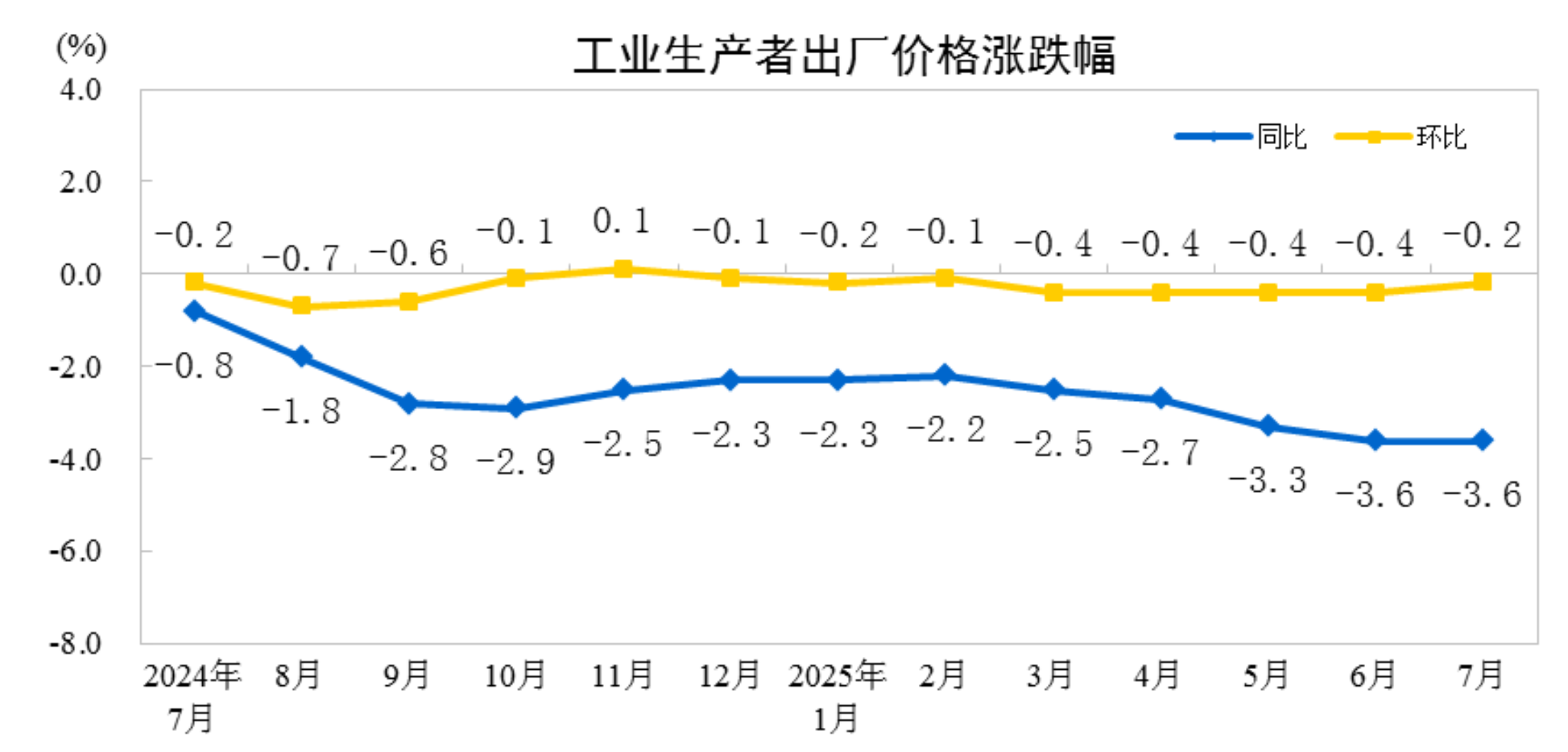
2025年7月份工业生产者出厂价格 环比降幅收窄
Guo Jia Tong Ji Ju· 2025-08-09 01:31
Industrial Producer Price Changes - In July, the industrial producer's ex-factory prices saw a year-on-year decline of 3.6%, with production material prices dropping by 4.3%, contributing approximately 3.20 percentage points to the overall decline [8][9] - The mining industry experienced a significant price drop of 14.0%, while raw material prices fell by 5.4% and processing industry prices decreased by 3.1% [8][9] - Consumer goods prices decreased by 1.6%, with food prices down by 1.8% and durable goods prices down by 3.5% [8][9] Industrial Producer Purchase Price Changes - The purchase prices for industrial producers fell by 4.5% year-on-year, with fuel and power prices decreasing by 10.8% and black metal materials down by 8.0% [10] - Chemical raw materials saw a decline of 6.5%, while agricultural products dropped by 4.6% [10] - In contrast, prices for non-ferrous metal materials and wires increased by 2.8% [10] Monthly Price Changes - Month-on-month, the industrial producer's ex-factory prices decreased by 0.2%, with production materials down by 0.2% and consumer goods prices also declining by 0.2% [7][8] - The mining sector's prices fell by 0.2%, while raw materials and processing industries saw decreases of 0.1% and 0.3%, respectively [7][8] - The purchase prices for industrial producers decreased by 0.3% month-on-month, with notable declines in building materials and non-metallic prices by 1.4% [10]
我省12家中试平台入选
Liao Ning Ri Bao· 2025-08-09 01:28
Core Viewpoint - The Ministry of Industry and Information Technology has announced the first batch of key pilot platforms for national cultivation, with 242 platforms selected, including 12 from Liaoning Province, ranking seventh nationwide [1] Group 1: Overview of Pilot Platforms - Pilot platforms are comprehensive support platforms that facilitate the transition of research results from laboratory development to large-scale industrial production, ensuring product quality and feasibility [1] - The 12 pilot platforms in Liaoning Province cover four technical fields: raw materials industry, consumer goods industry, equipment manufacturing, and emerging and future industries [1] Group 2: Regional Distribution - Among the selected platforms, 4 are located in Shenyang, 4 in Dalian, and 1 each in Anshan, Benxi, Panjin, and the Shenyang-Fushun Demonstration Zone [1] Group 3: Leading Units - Out of the 12 pilot platforms, 11 are led by enterprises, while 1 is led by a research institution [1] Group 4: Future Plans - The provincial science and technology department plans to collaborate with the provincial industrial and information technology department to seek support from the Ministry of Industry and Information Technology, aiming to have the 12 pilot platforms recognized as national-level platforms [1] - There will be efforts to enhance the construction of the pilot platforms, improving their foundational capabilities, technical support, and public service capabilities to better serve industrial development [1] - The plan includes differentiated layout construction of pilot bases based on Liaoning's industrial characteristics and organizing activities to improve the public service level of pilot bases through the Liaoning Provincial Science and Technology Achievement Transformation Comprehensive Service Platform [1]
民营企业人才需求占比近九成
Liao Ning Ri Bao· 2025-08-02 00:12
Group 1 - The core viewpoint of the articles highlights the increasing demand for talent in the private sector of Liaoning Province, with private enterprises accounting for nearly 90% of the total talent needs [1][2] - As of the end of June, 5,138 enterprises and institutions in Liaoning reported a total of 20,764 talent demand entries, indicating a robust growth in talent needs from private companies [1] - In the second quarter, 4,534 private enterprises expressed talent needs, representing 89.71% of all reporting companies, an increase of 1.08 percentage points from the first quarter [1] Group 2 - The demand for talent is concentrated in four trillion-level industrial bases and 22 key industrial clusters, with a focus on modern livestock and related industries showing rapid growth [1] - The top three industries in terms of talent demand are raw materials industry, high-end equipment manufacturing, and agriculture, collectively accounting for 35.03% of total enterprise demand [2] - Mechanical manufacturing positions continue to lead the demand rankings, with mechanical/manufacturing roles and automation majors being the most sought-after for six consecutive quarters starting from Q1 2024 [2]
【数据发布】2025年6月份工业生产者出厂价格同比下降3.6%
中汽协会数据· 2025-07-09 10:14
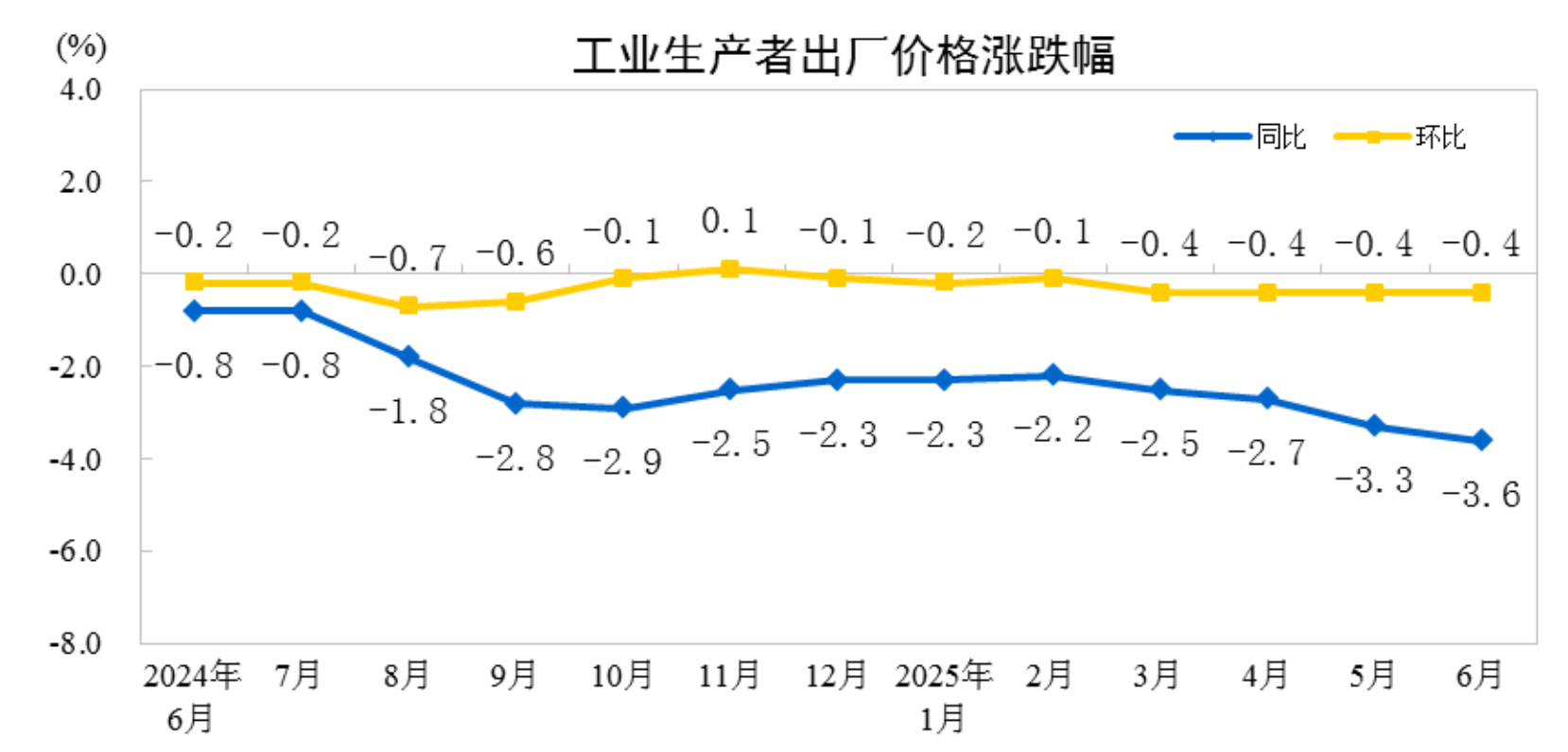
Core Viewpoint - In June 2025, the national industrial producer price index showed a year-on-year decline of 3.6% for ex-factory prices and a 0.4% month-on-month decline, indicating a continued downward trend in industrial pricing pressures [1]. Group 1: Year-on-Year Changes in Industrial Producer Prices - In June, the ex-factory prices of industrial producers saw a decline in production materials by 4.4%, contributing approximately 3.26 percentage points to the overall decrease in ex-factory prices. The mining industry experienced a significant drop of 13.2%, while raw materials and processing industries saw declines of 5.5% and 3.2%, respectively [3]. - Prices for living materials decreased by 1.4%, impacting the overall ex-factory price level by about 0.35 percentage points. Food prices fell by 2.0%, while clothing prices increased by 0.1%, and general daily goods prices rose by 0.8%. Durable consumer goods prices, however, decreased by 2.7% [3]. Group 2: Month-on-Month Changes in Industrial Producer Prices - In June, the month-on-month ex-factory prices of industrial producers showed a 0.6% decline in production materials, affecting the overall price level by approximately 0.42 percentage points. The mining industry prices decreased by 1.2%, raw materials by 0.7%, and processing industry prices by 0.5% [7]. - Living materials prices saw a slight decline of 0.1%, contributing about 0.02 percentage points to the overall price level decrease. Food prices fell by 0.3%, while clothing prices remained stable, and general daily goods prices increased by 0.1% [7]. Group 3: Changes in Industrial Producer Purchase Prices - In June, the purchase prices for industrial producers showed a significant decline in fuel and power categories by 10.4%, black metal materials by 8.0%, and chemical raw materials by 6.2%. Agricultural products also saw a decrease of 4.2%, while construction materials and non-metallic categories dropped by 2.6% [6]. - The textile raw materials category experienced a decline of 2.4%, while prices for non-ferrous metal materials and wires increased by 2.4% [6].
【宏观经济】一周要闻回顾(2025年7月2日-7月9日)
乘联分会· 2025-07-09 08:37
Group 1: Service Trade Growth - In the first five months of 2025, China's service trade grew steadily, with a total import and export value of 32,543.6 billion yuan, an increase of 7.7% year-on-year [4] - Service exports reached 14,033.7 billion yuan, growing by 15.1%, while imports were 18,509.9 billion yuan, increasing by 2.7% [4] - The service trade deficit was 4,476.2 billion yuan, a decrease of 1,352.2 billion yuan compared to the same period last year [4] Group 2: Knowledge-Intensive Services - Knowledge-intensive service trade maintained growth, with imports and exports totaling 12,492.7 billion yuan, up by 5.0% [4] - Major contributors included other business services and telecommunications, computer, and information services, with respective trade values of 5,384.1 billion yuan and 4,400.6 billion yuan, growing at 3.2% and 10.7% [4] - Knowledge-intensive service exports were 7,196.5 billion yuan, increasing by 6.6%, while imports were 5,296.2 billion yuan, up by 2.9%, resulting in a surplus of 1,900.3 billion yuan, an increase of 293 billion yuan year-on-year [4] Group 3: Travel Services - Travel services experienced the fastest growth, with total imports and exports reaching 9,200.5 billion yuan, a growth of 12.2%, making it the largest sector in service trade [5] - Travel service exports surged by 74.2%, while imports grew by 5.3% [5]

护航新型工业化网络安全行动启动
Zhong Guo Hua Gong Bao· 2025-07-09 02:13
Core Points - The Ministry of Industry and Information Technology has issued the "2025 Action Plan for Safeguarding Cybersecurity in New Industrialization" to enhance cybersecurity capabilities in the industrial sector [1][2] - The action plan focuses on upgrading protection capabilities for key enterprises, important systems, and critical products, outlining three main work objectives and eight key tasks [1] Summary by Categories Key Tasks - Establish a list of key enterprises for cybersecurity protection in the industrial sector, implementing cybersecurity standards for no less than 800 industrial enterprises and updating classification records for at least 100 vehicle networking service platforms [1] - Deepen cybersecurity assessments for industrial control systems and explore safety testing and certification for industrial control products [1] - Organize nationwide promotion of cybersecurity policies and standards, ensuring coverage of at least 20% of large-scale industrial enterprises in local areas [1] Work Objectives - The 2025 list of key enterprises will focus on industries such as raw materials, equipment, consumer goods, and electronic information manufacturing, aligning with high-quality development actions in key manufacturing industry chains [1] - Local authorities are required to prioritize new industrial cybersecurity in their planning and integrate it into the digital transformation of manufacturing [2] - Increased support through government procurement services and enterprise rewards and subsidies is emphasized to facilitate the implementation of the action plan [2]
国家统计局:6月份采掘工业价格同比下降13.2%
news flash· 2025-07-09 01:38
Group 1 - The core point of the article indicates that in June, the prices in the mining industry decreased by 13.2% year-on-year, contributing significantly to the overall decline in industrial producer prices [1] - The prices of production materials fell by 4.4%, which impacted the total level of industrial producer prices by approximately 3.26 percentage points [1] - The prices of raw materials decreased by 5.5%, while processing industry prices saw a decline of 3.2% [1] Group 2 - The prices of living materials decreased by 1.4%, affecting the total level of industrial producer prices by about 0.35 percentage points [1] - Food prices dropped by 2.0%, while clothing prices increased by 0.1% and general daily necessities rose by 0.8% [1] - Durable consumer goods prices fell by 2.7% [1]
2025年6月份工业生产者出厂价格同比下降3.6%
Guo Jia Tong Ji Ju· 2025-07-09 01:30
Core Insights - In June 2025, the national industrial producer's ex-factory prices decreased by 3.6% year-on-year and 0.4% month-on-month, while the purchase prices decreased by 4.3% year-on-year and 0.7% month-on-month [1][10]. Group 1: Year-on-Year Changes - In June, the ex-factory prices of industrial producers saw a decline in production materials by 4.4%, contributing approximately 3.26 percentage points to the overall decrease. The mining industry prices fell by 13.2%, raw materials by 5.5%, and processing industry prices by 3.2% [4]. - The prices of living materials decreased by 1.4%, impacting the overall ex-factory price by about 0.35 percentage points. Food prices dropped by 2.0%, while clothing prices increased by 0.1% and durable goods prices decreased by 2.7% [4]. - The purchase prices of industrial producers showed a significant decline in fuel and power categories by 10.4%, black metal materials by 8.0%, and chemical raw materials by 6.2% [7]. Group 2: Month-on-Month Changes - In June, the ex-factory prices of industrial producers decreased by 0.6% for production materials, contributing approximately 0.42 percentage points to the overall decline. The mining industry prices fell by 1.2%, raw materials by 0.7%, and processing industry prices by 0.5% [8]. - Living materials prices saw a slight decrease of 0.1%, with food prices down by 0.3% and durable goods prices down by 0.1% [8]. - The purchase prices of industrial producers decreased by 0.7%, with notable declines in fuel and power categories by 2.0% and black metal materials by 1.1% [9]. Group 3: Key Industry Price Changes - The coal mining and washing industry experienced a significant year-on-year price drop of 21.8%, while the oil and natural gas extraction industry saw a decrease of 12.6% [9]. - The non-metallic mining industry prices fell by 1.3%, and the agricultural and food processing industry prices decreased by 3.7% [9]. - In contrast, the prices in the non-ferrous metal mining industry increased by 12.0% year-on-year [9].
2025年护航新型工业化网络安全专项行动启动
news flash· 2025-07-02 11:07
Core Viewpoint - The Ministry of Industry and Information Technology has issued the "2025 Action Plan for Safeguarding New Industrialization Cybersecurity," focusing on enhancing cybersecurity capabilities in key enterprises and systems to support high-quality development in the manufacturing sector [1][2][3]. Overall Requirements - The plan is guided by Xi Jinping's thoughts on socialism with Chinese characteristics and aims to integrate the real economy with the digital economy, emphasizing problem-oriented, goal-oriented, and result-oriented approaches [3]. Work Objectives - Establish a list of key enterprises for cybersecurity protection, implement cybersecurity standards for at least 800 industrial enterprises, and update the classification of no less than 100 connected vehicle service platforms [4]. Key Tasks - **Focus on Key Management**: Create a list of key enterprises for cybersecurity protection, targeting industries critical to national economy and livelihood [5]. - **Enhance Protection for Key Enterprises**: Conduct cybersecurity standard compliance trials in at least 10 provinces, guiding over 60 key enterprises through a five-step process to improve their cybersecurity capabilities [6]. - **Strengthen Security for Industrial Control Systems**: Conduct cybersecurity assessments for industrial control systems and promote the certification of key industrial control products [8]. Innovative Empowerment Models - **Support Key Industry Chain Enterprises**: Provide cybersecurity services such as risk monitoring and vulnerability remediation to enhance the cybersecurity posture of key industry chains [9]. - **Promote Cybersecurity Awareness**: Organize nationwide campaigns to disseminate cybersecurity policies and standards, enhancing awareness among industrial enterprises [10]. Timeline - The action plan includes a three-phase timeline: initiation in June, implementation from July to October, and summarization in November [11]. Work Requirements - Emphasize organizational leadership and collaboration among local departments to ensure the effective implementation of the action plan [12][13].