
采掘工业

Search documents
【宏观经济】一周要闻回顾(2026年3月4日-3月10日)
乘联分会· 2026-03-10 08:44
Group 1: Manufacturing PMI Overview - In February, the Manufacturing Purchasing Managers' Index (PMI) was 49.0%, a decrease of 0.3 percentage points from the previous month, indicating a decline in manufacturing activity [3] - Large enterprises had a PMI of 51.5%, up 1.2 percentage points, while medium and small enterprises had PMIs of 47.5% and 44.8%, down 1.2 and 2.6 percentage points respectively, both below the critical point [3] - All five sub-indices of the manufacturing PMI, including production index, new orders index, raw material inventory index, employment index, and supplier delivery time index, were below the critical point [3] Group 2: Non-Manufacturing PMI Overview - The Non-Manufacturing Business Activity Index was 49.5%, an increase of 0.1 percentage points from the previous month, indicating slight improvement in non-manufacturing activity [5] - The construction industry business activity index was 48.2%, down 0.6 percentage points, while the service industry index was 49.7%, up 0.2 percentage points [5] - The new orders index for non-manufacturing was 45.2%, down 0.9 percentage points, indicating a decline in market demand [6] Group 3: Price Trends - In February, the Producer Price Index (PPI) for industrial producers decreased by 0.9% year-on-year, with a narrowing decline of 0.5 percentage points compared to the previous month [4][9] - The Consumer Price Index (CPI) rose by 1.3% year-on-year, with urban areas increasing by 1.4% and rural areas by 0.9% [14][15] - Food prices increased by 1.7%, while non-food prices rose by 1.3%, indicating inflationary pressures in consumer goods [15][16]


通胀上行继续加快
GF SECURITIES· 2026-03-09 06:28
Inflation Trends - Inflation continues to accelerate, with February CPI at 1.3%, up from 0.2% previously, and PPI at -0.9%, an improvement from -1.4%[2] - The simulated monthly deflation index for February 2026 is 0.42%, marking the first positive reading in 36 months, one month earlier than expected[2] - The monthly simulated deflation index turned negative in March 2023 at -0.58%, reaching a low of -2.16% in June 2023, before gradually recovering[2] Price Movements - CPI for February 2026 shows a month-on-month increase of 1.0%, consistent with previous years (2015, 2018, 2024) at 1.2%, 1.2%, and 1.0% respectively[2] - Key contributors to CPI increases include air travel (31.1%), travel agency fees (15.8%), and gold jewelry (6.2%)[4][3] - PPI shows a month-on-month increase of 0.4%, marking the fifth consecutive month of positive growth, with notable increases in mining (1.2%) and processing industries (0.6%)[8] Future Outlook - March inflation data is expected to remain favorable due to rising oil prices, with Brent crude increasing from $72.5 to $92.7 per barrel[10] - The South China Industrial Product Index has shown an upward trend, averaging 3902 in March compared to 3656 in February[11] - Risks include potential external economic shocks, geopolitical tensions, and fluctuations in commodity prices that could impact downstream pricing[12]
【数据发布】2026年2月份工业生产者出厂价格同比降幅收窄 环比继续上涨
中汽协会数据· 2026-03-09 03:06
Core Viewpoint - The article discusses the changes in the Producer Price Index (PPI) for industrial producers in February 2026, highlighting a year-on-year decline in both the ex-factory prices and purchase prices, while also noting month-on-month fluctuations in these prices [1][9]. Group 1: Year-on-Year Changes - In February 2026, the ex-factory prices of industrial producers decreased by 0.9% year-on-year, a reduction of 0.5 percentage points compared to the previous month [1]. - The purchase prices for industrial producers fell by 0.7% year-on-year, with a decrease of 0.7 percentage points from the previous month [1]. - For the average of January and February, the ex-factory prices dropped by 1.2% compared to the same period last year, while the purchase prices decreased by 1.1% [1]. Group 2: Month-on-Month Changes - In February, the ex-factory prices of industrial producers increased by 0.4% month-on-month, remaining unchanged from the previous month [1][6]. - The purchase prices for industrial producers rose by 0.7% month-on-month, an increase of 0.2 percentage points compared to the previous month [1][6]. - The production material prices saw a month-on-month increase of 0.5%, while the living material prices remained stable [6]. Group 3: Breakdown of Price Changes - Among the ex-factory prices, production materials saw a decline of 0.7% year-on-year, with significant drops in the mining industry (5.3%) and raw materials (1.9%), while processing industries experienced a slight increase of 0.3% [3][8]. - Living materials prices decreased by 1.6% year-on-year, with food prices down by 1.8% and clothing prices down by 1.0% [3][8]. - In the purchase prices, fuel and power prices fell by 8.4%, while prices for non-ferrous metals and wires surged by 21.3% [5][8].
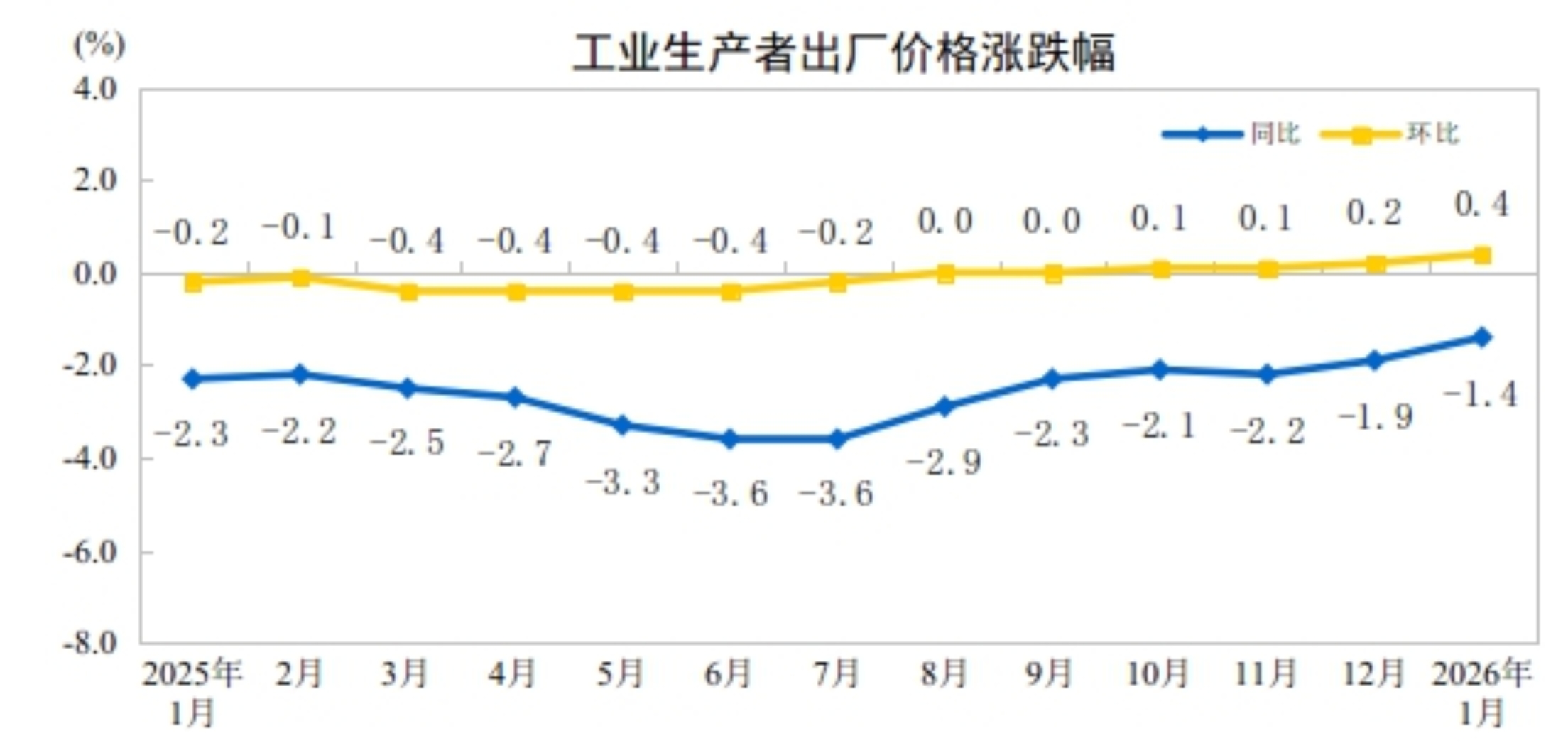
2026年1月PPI同比下降1.4% 环比上涨0.4%
Guo Jia Tong Ji Ju· 2026-02-11 03:16
Group 1 - In January 2026, the national industrial producer price index (PPI) decreased by 1.4% year-on-year, with the decline narrowing by 0.5 percentage points compared to the previous month; month-on-month, it increased by 0.4%, with the increase expanding by 0.2 percentage points from the previous month [1] - The industrial producer purchase price index also saw a year-on-year decrease of 1.4%, with the decline narrowing by 0.7 percentage points from the previous month; month-on-month, it increased by 0.5%, with the increase expanding by 0.1 percentage points from the previous month [1] Group 2 - In January, the prices of production materials decreased by 1.3%, contributing approximately 1.06 percentage points to the overall decline in industrial producer prices; within this category, mining industry prices fell by 8.1%, raw materials prices decreased by 2.0%, and processing industry prices dropped by 0.4% [2] - Prices of living materials decreased by 1.7%, contributing about 0.38 percentage points to the overall decline; food prices fell by 1.9%, clothing prices decreased by 0.7%, and prices of general daily goods and durable consumer goods both declined by 1.8% [2] - In terms of purchase prices, fuel and power prices decreased by 7.1%, chemical raw material prices fell by 5.8%, and construction materials and non-metallic prices dropped by 4.7%; however, prices of non-ferrous metals and wires increased by 16.1% [2] Group 3 - Month-on-month, production material prices increased by 0.5%, contributing approximately 0.37 percentage points to the overall increase in industrial producer prices; mining industry prices decreased by 1.7%, while raw materials prices rose by 0.7% and processing industry prices increased by 0.5% [2] - Living material prices saw a slight increase of 0.1%, contributing about 0.01 percentage points to the overall increase; food prices decreased by 0.1%, clothing prices fell by 0.3%, and general daily goods prices dropped by 0.1%, while durable consumer goods prices increased by 0.3% [2]
国家统计局:1月全国工业生产者出厂价格同比下降1.4%
Bei Jing Shang Bao· 2026-02-11 02:49
Core Insights - In January, the national industrial producer price index (PPI) decreased by 1.4% year-on-year, with the decline narrowing by 0.5 percentage points compared to the previous month [1] - Month-on-month, the PPI increased by 0.4%, with the growth rate expanding by 0.2 percentage points from the previous month [1] Group 1: Producer Prices - The industrial producer purchase price index also fell by 1.4% year-on-year, with the decline narrowing by 0.7 percentage points from the previous month [1] - Month-on-month, the purchase price index rose by 0.5%, with the increase rate expanding by 0.1 percentage points compared to the previous month [1] Group 2: Price Breakdown - In January, the prices of production materials decreased by 1.3%, contributing approximately 1.06 percentage points to the overall decline in the industrial producer price index [1] - The mining industry saw a price drop of 8.1%, while raw materials and processing industries experienced declines of 2% and 0.4%, respectively [1] - Prices of living materials fell by 1.7%, impacting the overall industrial producer price index by about 0.38 percentage points [1] - Food prices decreased by 1.9%, clothing prices by 0.7%, and prices for general daily goods and durable consumer goods both fell by 1.8% [1]
2026年1月份工业生产者出厂价格同比下降1.4%
Guo Jia Tong Ji Ju· 2026-02-11 01:43
Group 1 - In January, the producer price index (PPI) for industrial producers showed a decline in the prices of production materials by 1.3%, contributing approximately 1.06 percentage points to the overall decrease in the PPI [2][10] - The prices in the extraction industry fell by 8.1%, while raw material prices decreased by 2.0%, and processing industry prices dropped by 0.4% [2][10] - Prices for living materials decreased by 1.7%, impacting the overall PPI by about 0.38 percentage points, with food prices down by 1.9% and clothing prices down by 0.7% [2][10] Group 2 - In terms of year-on-year changes, the PPI for industrial producers decreased by 1.4%, with production materials down by 1.3% [10] - The extraction industry saw a significant year-on-year price drop of 8.1%, while raw materials and processing industries experienced declines of 2.0% and 0.4%, respectively [10] - Living materials prices also fell by 1.7%, with food and clothing prices contributing to this decline [10] Group 3 - In January, the PPI for industrial producers increased by 0.4% month-on-month, with production materials rising by 0.5%, contributing approximately 0.37 percentage points to the overall increase [7][10] - The extraction industry prices decreased by 1.7%, while raw materials and processing industries saw increases of 0.7% and 0.5%, respectively [7][10] - Living materials prices rose slightly by 0.1%, with food prices down by 0.1% and clothing prices down by 0.3% [7][10] Group 4 - The purchasing prices for industrial producers showed a month-on-month increase of 0.5%, with notable increases in the prices of non-ferrous metals and wires by 4.5% [8][10] - Fuel and power prices decreased by 0.7%, while building materials and non-metallic prices fell by 0.6% [8][10] - Year-on-year, the purchasing prices for industrial producers decreased by 1.4%, with fuel and power prices down by 7.1% [10]
2026年1月工业生产者出厂价格同比降幅收窄 环比涨幅扩大
Guo Jia Tong Ji Ju· 2026-02-11 01:39
Core Viewpoint - In January 2026, the Producer Price Index (PPI) for industrial producers in China showed a year-on-year decline of 1.4%, with a month-on-month increase of 0.4%, indicating a narrowing decline compared to the previous month [1][9]. Group 1: Year-on-Year Changes - The PPI for industrial producers decreased by 1.4% year-on-year, with the decline narrowing by 0.5 percentage points from the previous month [1][9]. - The prices of production materials fell by 1.3%, contributing approximately 1.06 percentage points to the overall decline in the PPI [3]. - The mining industry experienced a significant price drop of 8.1%, while raw material prices decreased by 2.0% and processing industry prices fell by 0.4% [3][9]. Group 2: Month-on-Month Changes - The PPI for industrial producers increased by 0.4% month-on-month, with production materials prices rising by 0.5%, contributing approximately 0.37 percentage points to the overall increase [1][8]. - The mining industry prices decreased by 1.7% month-on-month, while raw materials prices increased by 0.7% and processing industry prices rose by 0.5% [8][9]. - The prices of life materials saw a slight increase of 0.1%, with food prices decreasing by 0.1% and durable consumer goods prices increasing by 0.3% [8][9]. Group 3: Specific Price Changes - In the category of industrial producers' purchase prices, fuel and power prices fell by 7.1%, while chemical raw materials prices decreased by 5.8% [7][10]. - Prices for non-ferrous metal materials and wires increased by 16.1%, indicating a significant rise in this category [7][10]. - The prices of agricultural and sideline products rose by 0.7%, while building materials and non-metallic materials prices decreased by 0.6% [8][10].
李迅雷专栏 | PPI“失去十五年”之谜
中泰证券资管· 2026-01-21 11:32
Core Viewpoint - The Producer Price Index (PPI) in China has shown a zero increase over the past 15 years, despite a significant GDP growth of 250% during the same period, indicating a persistent weakness in producer prices and underlying demand issues [3][4][41]. Group 1: PPI Trends and Historical Context - The PPI has been in a negative growth phase since October 2021, marking 39 consecutive months of year-on-year decline by December 2025 [1]. - From 2012 to 2025, there were 111 months of negative PPI, indicating that two-thirds of this period experienced deflation in producer prices [1][4]. - The PPI index, set at 100 in December 2010, remained unchanged at 100 by December 2025, reflecting no price increase over 15 years [1][4]. Group 2: Economic Growth vs. PPI - China's GDP grew from less than 40 trillion yuan in 2010 to over 140 trillion yuan by 2025, a 2.5 times increase, while the broad money supply (M2) increased 3.68 times during the same period [4]. - Despite significant economic growth, the PPI's lack of increase raises questions about the underlying demand and pricing power within the economy [4][41]. Group 3: Factors Influencing PPI - The PPI's long-term decline is attributed to weak demand, particularly after the peak of the real estate market in 2021, which has affected both upstream and downstream price transmission [39][41]. - The relationship between real estate investment and PPI indicates that a downturn in real estate correlates with a decline in producer prices, as seen in historical data [34][41]. - The inability of upstream price changes to effectively transmit to downstream prices is exacerbated by high competition in the downstream sectors and insufficient demand [20][39]. Group 4: External Influences and Export Dynamics - Export dynamics play a crucial role in influencing midstream product prices, with a significant portion of manufacturing exports being affected by global demand fluctuations [24][26]. - The export price index has seen a notable decline, indicating that reliance on price competition to maintain export volumes may not be sustainable [26][28]. - The overall weak demand in the domestic market, particularly in the context of real estate and consumer confidence, has further constrained PPI recovery [28][39]. Group 5: Recommendations for Economic Policy - To address the persistent weakness in PPI, it is essential to adjust the supply-demand relationship by expanding effective demand, particularly through increasing the income of middle and low-income groups [41][49]. - Stabilizing the real estate market is suggested as a means to support consumer spending and alleviate overcapacity issues in various industries [41][49]. - The focus should shift towards enhancing consumer income through government policies, which may involve restructuring fiscal spending to prioritize direct transfers to households [41][49].

【数据发布】2025年12月份工业生产者出厂价格同比降幅收窄 环比涨幅扩大
中汽协会数据· 2026-01-09 10:10
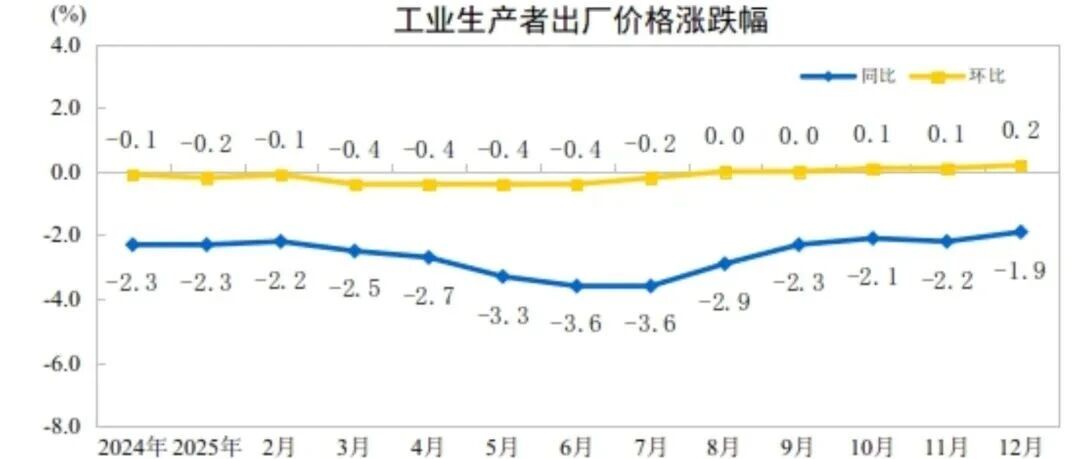
Core Viewpoint - In December 2025, the national industrial producer price index (PPI) showed a year-on-year decline of 1.9%, with a narrowing decrease of 0.3 percentage points compared to the previous month. Month-on-month, the PPI increased by 0.2%, an increase of 0.1 percentage points from the previous month. For the entire year of 2025, the PPI decreased by 2.6% [1]. Group 1: Year-on-Year Changes in Industrial Producer Prices - In December, the prices of production materials decreased by 2.1%, contributing approximately 1.53 percentage points to the overall decline in the PPI. Specifically, the mining industry saw a price drop of 4.7%, raw materials decreased by 2.6%, and processing industries fell by 1.6% [3]. - Prices of living materials decreased by 1.3%, contributing about 0.35 percentage points to the overall PPI decline. Food prices fell by 1.5%, clothing prices decreased by 0.1%, while general daily necessities increased by 1.4%, and durable consumer goods dropped by 3.5% [3]. Group 2: Month-on-Month Changes in Industrial Producer Prices - In December, the prices of production materials increased by 0.3%, contributing approximately 0.24 percentage points to the overall PPI increase. The mining industry prices rose by 0.8%, raw materials increased by 0.6%, and processing industries saw a rise of 0.2%. Prices of living materials remained stable [7]. - Within living materials, food prices decreased by 0.1%, clothing prices increased by 0.2%, general daily necessities rose by 0.5%, while durable consumer goods fell by 0.2% [7]. Group 3: Industrial Producer Purchase Prices - The purchase prices of industrial producers showed a year-on-year decline of 2.1%, with a decrease of 3.0% for the entire year of 2025. Month-on-month, the purchase prices increased by 0.4% [9]. - Notable declines in purchase prices included building materials and non-metallic products down by 6.4%, fuel and power down by 5.7%, and chemical raw materials down by 4.9%. Conversely, prices for non-ferrous metals and wires increased by 10.5% [6]. Group 4: Price Changes in Major Industries - The coal mining and washing industry experienced a month-on-month increase of 1.3% but a year-on-year decline of 8.9%. The oil and gas extraction industry saw a month-on-month decrease of 1.3% and a year-on-year decline of 11.5% [10]. - The non-ferrous metal mining industry had a month-on-month increase of 3.7% and a year-on-year increase of 24.0%, indicating strong performance compared to other sectors [10].
格林大华期货研究院专题报告:12月通胀温和回升
Ge Lin Qi Huo· 2026-01-09 08:55
1. Report Industry Investment Rating - No information provided 2. Core View of the Report - In December 2025, China's overall inflation level rebounded moderately. It is expected that the year-on-year increase of CPI in January this year will decrease compared to December last year, and the year-on-year decline of PPI in January will narrow compared to December last year [5][20] 3. Summary by Relevant Catalogs CPI Analysis - **Year-on-year data**: In December, the national consumer price (CPI) increased by 0.8% year-on-year, with a market expectation of 0.75% and a previous value of 0.7%. In 2025, the national consumer prices were flat compared to the previous year. Food prices increased by 1.1% year-on-year, non-food prices increased by 0.8% year-on-year, consumer goods prices increased by 1.0% year-on-year, and service prices increased by 0.6% year-on-year. Core CPI increased by 1.2% year-on-year [2][7] - **Month-on-month data**: In December, CPI increased by 0.2% month-on-month. Food prices increased by 0.3% month-on-month, non-food prices increased by 0.1% month-on-month, consumer goods prices increased by 0.3% month-on-month, and service prices were flat month-on-month. Core CPI increased by 0.2% month-on-month [2][8] - **Eight major categories**: In December, the price of food, tobacco and alcohol increased by 0.2% month-on-month, housing prices decreased by 0.1% month-on-month, transportation and communication prices were flat month-on-month, medical care prices increased by 0.1% month-on-month, education, culture and entertainment prices increased by 0.1% month-on-month, clothing prices were flat month-on-month, daily necessities and services prices increased by 0.4% month-on-month, and other supplies and services increased by 2.8% month-on-month [9] - **Impact factors**: The increase in the year-on-year increase of food prices in December was an important factor driving the relatively large year-on-year increase of CPI in December. The month-on-month increase of industrial consumer goods prices excluding energy by 0.6% affected the month-on-month increase of CPI by about 0.16 percentage points [2][8] - **January forecast**: The current agricultural product prices are conducive to the increase of the year-on-year CPI data in January, and have little impact on the month-on-month CPI data in January. It is speculated that refined oil prices will have a downward pull on the year-on-year CPI in January and may have a slight downward pull on the month-on-month CPI in January [11] PPI Analysis - **Year-on-year data**: In December, the ex-factory prices of industrial producers nationwide decreased by 1.9% year-on-year, with a market expectation of a 2.0% decrease and a previous value of a 2.2% decrease. In 2025, the ex-factory prices of industrial producers decreased by 2.6%. Production material prices decreased by 2.1% year-on-year, and living material prices decreased by 1.3% year-on-year [3][12] - **Month-on-month data**: In December, PPI increased by 0.2% month-on-month. Production material prices increased by 0.3% month-on-month, and living material prices were flat month-on-month [4][13] - **Industry performance**: In December, industries with a relatively large year-on-year decline in ex-factory prices included the oil and gas extraction industry, coal mining and washing industry, etc.; industries with a relatively large year-on-year increase included the non-ferrous metal ore mining industry and non-ferrous metal smelting and rolling processing industry. Industries with a relatively large month-on-month increase in prices included the non-ferrous metal ore mining industry and non-ferrous metal smelting and rolling processing industry; industries with a relatively large month-on-month decline included the oil and gas extraction industry and oil, coal and other fuel processing industries [12][15] - **Impact factors**: The price increases of precious metals represented by gold and silver prices, and non-ferrous metals represented by copper in December played a relatively large role in the month-on-month increase of PPI in December [5][20]