
电池

Search documents
钙钛矿电池板块领涨,上涨2.96%
Di Yi Cai Jing· 2026-02-04 05:21
Group 1 - The perovskite battery sector leads the market with an increase of 2.96% [1] - Zhonglai Co., Ltd. saw a significant rise of 20.0% [1] - Yamaton and Tuori New Energy both increased by 10.01% and 10.0% respectively [1] - JinkoSolar, Xizi Clean Energy, and Jinjing Technology all experienced gains of over 5% [1]


储能电池ETF广发(159305)跌0.63%,半日成交额608.00万元
Xin Lang Cai Jing· 2026-02-04 03:41
Core Viewpoint - The performance of the storage battery ETF Guangfa (159305) shows a slight decline, indicating market volatility in the energy storage sector [1] Group 1: ETF Performance - As of the midday close on February 4, the storage battery ETF Guangfa (159305) decreased by 0.63%, priced at 1.883 yuan, with a trading volume of 6.08 million yuan [1] - The performance benchmark for the storage battery ETF Guangfa is the return rate of the National Securities New Energy Battery Index during the same period [1] - Since its establishment on September 18, 2024, the fund has achieved a return of 89.55%, with a one-month return of 2.46% [1] Group 2: Major Holdings - Key stocks in the storage battery ETF include: - Contemporary Amperex Technology Co., Ltd. (宁德时代) increased by 1.58% - Sungrow Power Supply Co., Ltd. (阳光电源) decreased by 0.27% - EVE Energy Co., Ltd. (亿纬锂能) decreased by 1.24% - Inovance Technology Co., Ltd. (英维克) decreased by 3.55% - Guoxuan High-Tech Co., Ltd. (国轩高科) decreased by 1.82% - Magpower Technology Co., Ltd. (麦格米特) decreased by 1.40% - Sunwoda Electronic Co., Ltd. (欣旺达) decreased by 0.73% - Deyi Co., Ltd. (德业股份) increased by 0.35% - Keda Technology Co., Ltd. (科达利) increased by 0.01% - Jinpan Technology Co., Ltd. (金盘科技) increased by 2.42% [1]






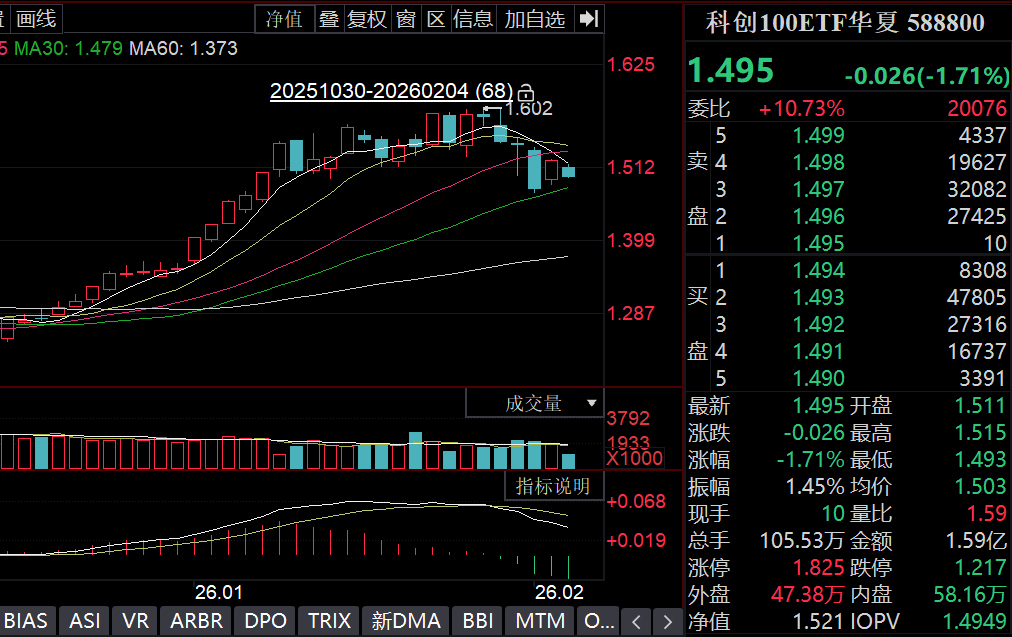
科创100ETF华夏(588800.SH)下跌1.71%,今日盘中成交额达1.58亿元
Mei Ri Jing Ji Xin Wen· 2026-02-04 03:15
Market Performance - On February 4, A-shares showed mixed performance with the Shanghai Composite Index rising by 0.17% [1] - The ChiNext 50 Index fell by 1.90%, while the STAR 50 Index decreased by 2.14% [1] ETF Performance - The Huaxia STAR 100 ETF (588800.SH) experienced a decline of 1.71%, with a latest price of 1.495 [2] - The ETF has seen a net inflow of 0.27 billion CNY over the last five trading days and 1.34 billion CNY over the last ten days, with a total scale reaching 30.28 billion CNY [3] Sector Performance - Within the STAR 100 Index, the semiconductor sector dropped by 2.67%, while the battery sector saw a slight increase of 0.07% [3] - Other sectors such as chemical pharmaceuticals and communication equipment also experienced declines of 0.59% and 3.64%, respectively [3] Investment Insights - The STAR 100 Index is designed to track medium-sized, liquid stocks from the STAR Market, suitable for investors seeking long-term growth and willing to accept higher volatility [4]

市场大跌后迎来强劲反弹,量能未能同步放大,后续修复过程或有震荡
British Securities· 2026-02-04 03:10
Market Overview - The A-share market experienced a significant drop on Monday, but rebounded strongly on Tuesday, with all three major indices showing a V-shaped recovery [1][8] - Key sectors that performed well included shipbuilding, aerospace, and various new energy applications, while banking stocks lagged behind [3][4] - Despite the strong rebound, trading volume did not increase correspondingly, indicating potential volatility in the market's recovery process [1][8] Industry Insights Military Industry - The military sector, particularly shipbuilding and aerospace, has shown strong performance, with significant past gains: 25.27% in H2 2020, 16.30% in H1 2023, and 25.46% in H1 2025 [5] - The Chinese defense budget has seen steady growth, with increases projected at 6.6% to 7.2% from 2020 to 2025, suggesting continued support for the military sector [5] - Geopolitical tensions are expected to drive demand in the military sector, with a focus on domestic production and technological self-sufficiency [5] - Key areas for investment include aerospace, missile technology, defense information systems, and shipbuilding, with an emphasis on companies with strong performance fundamentals [5] New Energy Sector - The new energy sector, particularly solar equipment and batteries, has shown significant activity, driven by ongoing global efforts to achieve carbon neutrality [6][7] - The Chinese government is implementing policies to reduce competition in the solar and battery sectors, which may enhance profitability for leading companies [6][7] - The goal for new energy storage capacity is set at 180 GW by 2027, with an expected investment of approximately 250 billion yuan [7] - Investors are encouraged to focus on leading companies with core technological advantages in the new energy sector [6][7] Strategic Recommendations - For investors heavily invested since 2024, a strategy of holding onto positions for potential gains or gradually selling off overvalued stocks is recommended [1][8] - Investors should seek opportunities in high-quality stocks with reasonable valuations and strong earnings prospects during market pullbacks [1][8] - New investors are advised to manage risk carefully and avoid chasing high prices, focusing instead on structural opportunities [1][8]
三星SDI跟踪
数说新能源· 2026-02-04 03:02
Core Viewpoint - The article discusses the performance and market outlook of the battery and electronic materials sectors, highlighting both challenges and growth opportunities in the context of the new energy landscape. Group 1: Company Performance - In Q4 2025, the company's revenue reached 18.822 billion yuan, a year-on-year increase of 2.8% and a quarter-on-quarter increase of 26.4%. However, the operating loss expanded to 1.458 billion yuan, a year-on-year increase of 16.3% but a quarter-on-quarter reduction of 49.4% [2] - The battery segment generated revenue of 17.666 billion yuan in Q4 2025, reflecting a year-on-year increase of 1.6% and a quarter-on-quarter increase of 28.4%. The operating loss was 1.654 billion yuan, with a year-on-year increase in loss of 26.5% but a quarter-on-quarter reduction of 46.2% [3] - The electronic materials segment maintained stable operating profit quarter-on-quarter, but overall revenue and profitability declined year-on-year due to weak OLED material sales, despite improvements in semiconductor material sales [4][6] Group 2: Market Trends and Forecasts - Global demand for electric vehicle batteries is expected to grow by 16% year-on-year, with a 6% increase excluding the Chinese market. The U.S. market is projected to decline by 9%, while Europe is expected to grow by 9% [8] - The demand for energy storage system batteries is anticipated to continue growing, driven by AI data centers and public utility needs. Non-Chinese companies are expected to gain more opportunities in the U.S. market due to IRA and tariff policies [9] - The global battery market is projected to reach 1,850 GWh by 2026 and 2,400 GWh by 2028. The U.S. energy storage system battery market is expected to grow to 100 GWh by 2026 and continue to 150 GWh by 2030 [12] Group 3: Strategic Initiatives - The company is advancing its Hungarian factory's production lines and aims to enter the HEV market while promoting high-power cylindrical batteries [13] - The U.S. SBB 2.0 production line is planned to achieve mass production by Q4 2026, with a target of 20 GWh for square energy storage batteries, expecting nearly 50% year-on-year revenue growth in ESS [14] - The company has partnered with Hyundai for robot batteries and is exploring high-safety, high-power battery supplies for various applications, targeting mass production by 2027 [15] Group 4: Investment and Innovation - Capital expenditure in 2026 will focus on the Hungarian production line, U.S. LFP ESS line upgrades, and technology applications in Malaysia, with a slight year-on-year decrease in overall capital spending [16] - The company aims to achieve mass production of solid-state batteries by 2027 and is focusing on R&D for energy storage systems and non-active material technologies [16]

第一创业晨会纪要-20260204
First Capital Securities· 2026-02-04 02:59
Group 1: Passive Components Industry - The largest passive component manufacturer, Murata Manufacturing, reported a 12.2% increase in capacitor revenue to 239.1 billion JPY for Q3 2025, and a 9.5% increase in inductor/EMI filter revenue to 56.4 billion JPY. Capacitor orders reached 268.1 billion JPY, a year-on-year increase of 29.4% [2] - The company noted that meeting the demand for electronic components, particularly MLCCs in the AI server sector, will be a significant challenge in 2026. While there are no discussions on price increases, the company will consider market conditions carefully [2] - The demand for passive components globally has accelerated, and domestic companies in this sector have a PE valuation of 30-40 times, which is relatively low compared to other segments of the electronics supply chain, indicating strong investment potential in the passive components industry [2] Group 2: Advanced Manufacturing - Tesla has achieved large-scale production of dry electrode technology, marking a transition from concept validation to practical manufacturing feasibility. The advantages of dry electrodes include reduced energy consumption and lower complexity in equipment and facilities [6] - The core of the dry electrode process is the roll-to-roll film forming equipment, with a value of approximately 50,000 USD per GWh, significantly higher than traditional wet processes. This development is expected to enhance the willingness of leading domestic battery manufacturers and equipment suppliers to invest in dry processes [6] - Long-term, this technology could become a fundamental process for the engineering of solid-state batteries, lowering the barriers to industrialization in this field [6] Group 3: Consumer Sector - Longping High-Tech forecasts a net profit of 130 to 190 million CNY for 2025, representing a year-on-year increase of 14% to 67%, marking a significant turnaround from previous losses. The improvement is largely attributed to the Brazilian operations transitioning from a drag to a contributor to profit [8] - The company has improved its gross margin by approximately 8 percentage points through optimized marketing and cost reduction strategies, while financial expenses have decreased by over 90% due to better management of local loans [8] - Looking ahead, management expects the Brazilian business to maintain its improvements, aiming for a complete turnaround in 2026, while domestic operations are expected to see stable revenue and profit growth amid industry adjustments [8] Group 4: Alcohol Industry - The management of Jinshiyuan indicated that despite a 9-day holiday boost, the market remains cautious, with sales expected to decline compared to the previous year. The overall trend is characterized by "weak volume and stable prices" [9] - Inventory levels are manageable, but pressure is concentrated among distributors, with low willingness to stock and a decrease in consumption intensity. The recovery in consumption is cautious and pragmatic, with fewer banquet tables and lower spending per table [9] - For 2026, management anticipates a negative year-on-year growth in industry sales volume for Q1, indicating a gradual recovery rather than a rapid rebound. The outlook suggests a "weak recovery with increasing differentiation" within the industry, favoring leading companies [9]
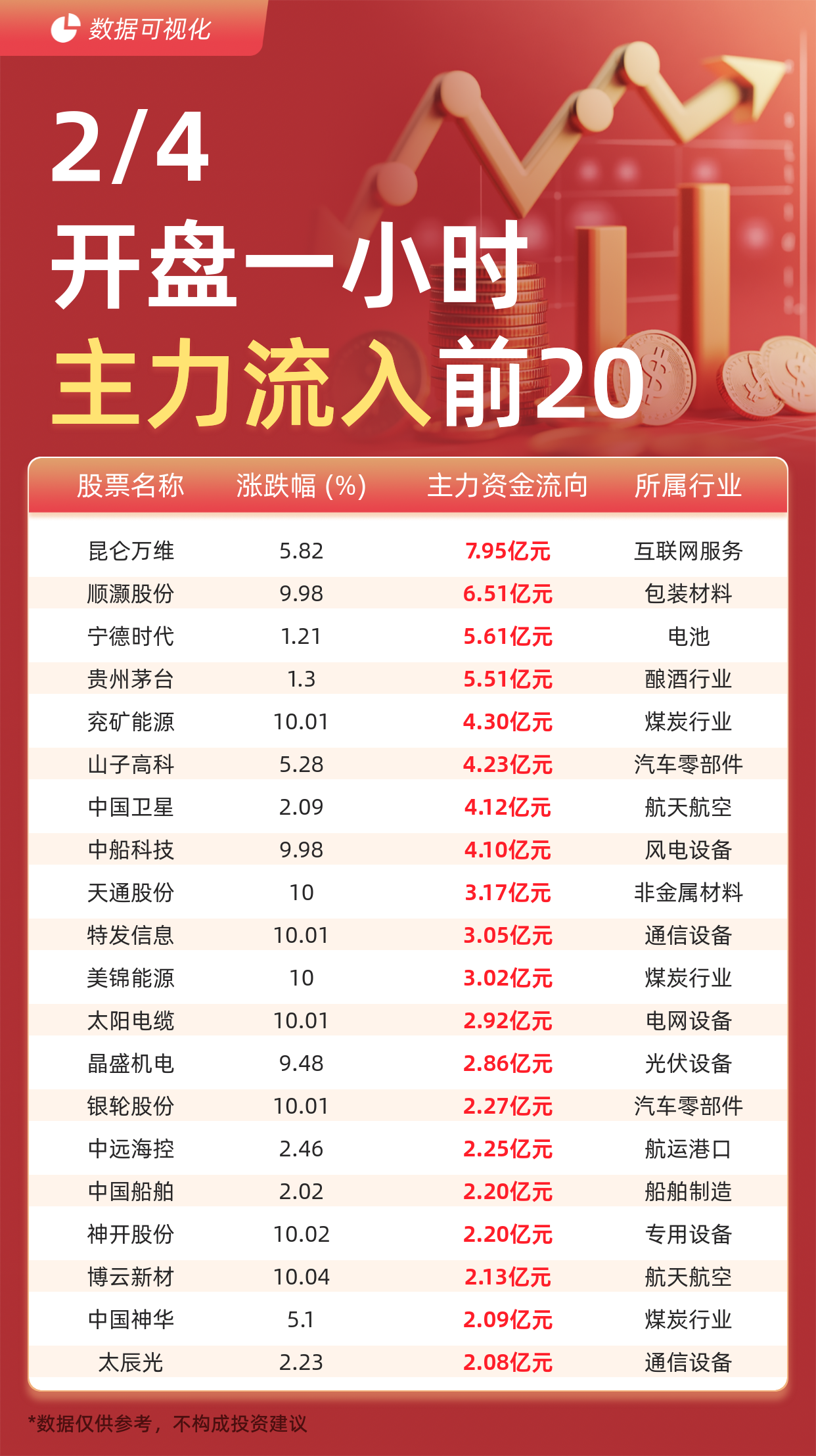
主力资金流入前20:昆仑万维流入7.95亿元、顺灏股份流入6.51亿元
Jin Rong Jie· 2026-02-04 02:55
Core Insights - The main focus of the news is the significant inflow of capital into specific stocks, indicating strong investor interest and potential growth in these companies and their respective industries [1][2][3] Group 1: Stock Performance and Capital Inflow - Kunlun Wanwei saw a capital inflow of 795 million yuan with a price increase of 5.82% [2] - Shunhao Co. experienced a capital inflow of 651 million yuan and a price increase of 9.98% [2] - Contemporary Amperex Technology (宁德时代) had a capital inflow of 561 million yuan with a price increase of 1.21% [2] - Kweichow Moutai (贵州茅台) attracted 551 million yuan in capital inflow and increased by 1.3% [2] - Yanzhou Coal Mining Company (兖矿能源) saw a capital inflow of 430 million yuan with a notable increase of 10.01% [2] - Other notable stocks include Shanzhi Gaoke, China Satellite, and China Shipbuilding, each with significant capital inflows and price increases [1][2][3] Group 2: Industry Insights - The internet services sector, represented by Kunlun Wanwei, is showing strong investor confidence [2] - The packaging materials industry, highlighted by Shunhao Co., is also attracting significant capital [2] - The battery industry, represented by Contemporary Amperex Technology, continues to draw investor interest despite a modest price increase [2] - The coal industry, with companies like Yanzhou Coal and Meijin Energy, is experiencing substantial capital inflows, indicating a potential resurgence [2][3] - The aerospace and wind energy sectors, represented by China Satellite and China Shipbuilding, are also gaining traction among investors [1][2][3]





未知机构:hcdx盟固利基本面拐点确立供货电科蓝天商业航天核心圈-20260204
未知机构· 2026-02-04 02:20
Summary of Conference Call Notes Company and Industry Involved - The company discussed is **HCDX Mengguli**, which is involved in the supply of materials for special power sources in deep-sea and space applications. - The industry focus includes **specialized power sources** for deep-sea, space, and photovoltaic applications, primarily under the umbrella of **China Electronics Technology Group Corporation (CETC)** through its subsidiary **Dian Ke Lantian**. Core Points and Arguments - **Supply Chain Integration**: HCDX Mengguli has successfully integrated into the supply chain of Dian Ke Lantian by supplying **6-series ternary materials** for special power sources used in deep-sea applications [1] - **Projected Supply and Revenue**: In 2025, Dian Ke Lantian is expected to supply approximately **300-400 tons** of materials, translating to an energy output of about **0.1 GWh** and generating a revenue of **50-60 million yuan** [2][3] - **Profitability Turnaround**: HCDX Mengguli anticipates achieving a net profit attributable to shareholders of **18-23 million yuan** in 2025, marking a significant turnaround from previous losses. This shift is attributed to a transition from low-margin traditional power batteries to higher-margin small power applications and high-end consumer electronics [3] - **Sales Volume and Profit Margins**: The company expects to ship **18,000 tons** in total for the year, with a profit of approximately **1,000 yuan per ton**. In Q4 alone, shipments are projected to be **4,000 tons** with a net profit of **2,500 yuan per ton** [3] - **Lithium Cobalt Supply**: In 2025, the company plans to supply **7,000 tons** of lithium cobalt oxide, benefiting from rising cobalt prices and increased processing fees, achieving a gross margin of **13-15%** [3] - **High Voltage Lithium Cobalt Supply**: In 2026, HCDX Mengguli is set to supply **4.5V and 4.53V high voltage lithium cobalt oxide** to major clients like BYD and Zhuhai Guanyu, which is expected to further enhance profit margins [3] - **NCA Business Growth**: The NCA (Nickel Cobalt Aluminum) segment is projected to grow significantly, with shipments expected to reach nearly **3,000 tons** in 2025, a substantial increase from **300-400 tons** in 2024. This growth is primarily driven by orders from **Weilan Lithium Core** and a **500-ton order** from Taiwan's Molicel, with a gross profit of over **20,000 yuan per ton** [3] Other Important Insights - **Market Positioning**: The company is shifting its focus from large power applications to small power applications, targeting sectors such as **electric tools, high-end home appliances, and humanoid robots**, indicating a strategic pivot towards higher value-added markets [3] - **Technological and Customer Endorsements**: The company has established a strong technical foundation and customer endorsements in specialized applications, which may facilitate the extension of its ternary technology into higher-value areas such as space power sources [2][3]
“太空光伏+固态电池”乘势而起,科创新能源ETF易方达(589960)等产品助力一键布局
Xin Lang Cai Jing· 2026-02-04 01:56
Core Viewpoint - The A-share market experienced a comprehensive rebound, led by the new energy industry chain, with significant increases in various indices, indicating a burgeoning transformation in space energy, particularly in space photovoltaics and solid-state batteries [1][5]. Group 1: Market Performance - The Kexin New Energy Index rose by 6.6%, leading all ETF-tracked indices, while the China Securities Photovoltaic Industry Index and the National Securities New Energy Battery Index increased by 5.8% and 2.6%, respectively [1][5]. - ETFs tracking these indices, such as the Kexin New Energy ETF (589960), Photovoltaic ETF (562970), and Energy Storage Battery ETF (159566), saw active trading [1][5]. Group 2: Space Photovoltaics - Space photovoltaics have transitioned from a science fiction concept to the forefront of industrialization, with the potential for solar power in space to be 5-10 times more efficient than on Earth [2][6]. - SpaceX plans to establish a total capacity of 200 gigawatts of photovoltaic facilities between 2026 and 2029, with 100 gigawatts specifically for space applications [2][6]. - The upgraded Starlink V3 satellites feature solar wings with an area of approximately 257 square meters and a power output exceeding 50 kilowatts, indicating substantial material demand in the future [2][7]. Group 3: Solid-State Batteries - Solid-state batteries are crucial for safely and efficiently storing energy in extreme space conditions, with properties that make them suitable for high radiation and vacuum environments [3][7]. - Current applications of solid-state batteries in space are progressing, with Japan's JAXA completing long-term tests on the International Space Station and NASA planning to use them for lunar bases by 2028 [3][7]. - The intersection of space photovoltaics and solid-state batteries represents a significant technological investment opportunity, although challenges exist for individual investors due to the fragmented nature of the industry and evolving technology [3][7]. Group 4: Investment Opportunities - Indices such as the China Securities Photovoltaic Industry Index and the National Securities New Energy Battery Index provide concentrated exposure to key sectors of the energy market, with the former covering various stages of the photovoltaic supply chain [4][8]. - The recently highlighted Shanghai Stock Exchange Sci-Tech Innovation Board New Energy Index closely aligns with the two major tracks of space photovoltaics and solid-state batteries, with nearly half of its components related to space photovoltaics and about 40% related to solid-state batteries [4][8].
鹏辉能源(300438.SZ):公司固态电池正在中试
Ge Long Hui· 2026-02-04 01:01
格隆汇2月4日丨鹏辉能源(300438.SZ)在投资者互动平台表示,公司固态电池正在中试,并持续推进技 术迭代优化。 ...
