
家政

Search documents
北京市商务局局长:发力创新消费,一批新消费地标将亮相
Xin Lang Cai Jing· 2026-01-27 13:43
Core Viewpoint - Beijing is focusing on enhancing its open economy and service industry, aiming to establish itself as an international consumption center while promoting cross-border e-commerce and high-quality consumption experiences [1][5][9]. Group 1: Open Economy Development - Beijing is developing an open economy plan for the "14th Five-Year Plan" period, with a focus on the "Two Zones" initiative to drive key breakthroughs [3][4]. - The city plans to implement a 3.0 version of the service industry opening-up comprehensive demonstration zone, aligning with international trade rules and introducing high-quality policy measures [4]. - Beijing aims to enhance its free trade zone construction and support innovative development in service trade and digital trade, providing a "Beijing experience" for national institutional exploration [4][9]. Group 2: International Consumption Center - The city will accelerate the construction of an international consumption center, enriching consumer supply and optimizing the consumption environment [5][6]. - Key initiatives include promoting high-quality outdoor sports destinations and enhancing cultural and entertainment consumption experiences [5][6]. - New consumption landmarks like Beijing Taikoo Li will emerge, and traditional commercial facilities will undergo upgrades to improve consumer experiences [6][8]. Group 3: New Consumption Models - Beijing has been approved as a pilot city for "Three New" (new formats, new models, new scenarios) and plans to release supportive policies before the Spring Festival [7][8]. - The focus will be on developing a first-release economic system and creating diverse service consumption scenarios, integrating culture, tourism, and commerce [8][9]. - The city will support the cultivation of local IPs and leverage digital technologies to create immersive consumption experiences [8][12]. Group 4: Cross-Border E-Commerce - The city has issued an action plan for promoting high-quality development in cross-border e-commerce, aiming to gather significant platform headquarters and brand merchants by 2027 [9][10]. - The "京品出海" (Beijing Products Going Global) initiative will leverage the advantages of the capital's airports to optimize logistics and attract leading cross-border e-commerce platforms [10][11]. - The plan includes promoting "experience consumption" and enhancing the quality of imports and exports to establish Beijing as a significant cross-border e-commerce hub [12]. Group 5: Quality of Life Improvements - The city aims to enhance the quality of life for residents by improving daily service quality and ensuring stable supply and pricing of essential goods [13][14]. - Initiatives include building a convenient living circle and promoting high-quality development in the home service industry [14][15]. - The city will ensure a stable supply of essential goods through market monitoring and emergency response mechanisms [14][15].


零工专场招聘“职”达家门口
Xin Lang Cai Jing· 2026-01-26 22:08
Core Viewpoint - The employment center in Hongwei District, Liaoyang City, organized a special recruitment fair for gig workers, aiming to support employment for this demographic [1] Group 1: Recruitment Event Details - The recruitment fair featured 21 quality local companies offering over 130 job positions [1] - Industries represented included logistics, catering, services, and housekeeping, with job types such as sorting workers, hourly workers, part-time sales assistants, and housekeeping [1] - The employment model is flexible, allowing workers to start on the same day and receive payment immediately, catering to diverse employment needs [1] Group 2: Target Audience and Services - The event attracted many job seekers, particularly older workers and those in new employment sectors [1] - A dedicated service area provided professional answers to questions regarding career guidance and social security subsidies for disadvantaged workers [1] - The employment center aims to enhance job seekers' competitiveness and job fit by helping them understand policy details [1] Group 3: Future Plans - The employment center plans to regularly hold special recruitment events focused on the actual needs of gig workers [1] - There will be improvements in both online and offline job search channels to provide quality services for flexible workers and employers [1]
2026年如何提振消费、稳定外贸、拓展双向投资?
Xin Lang Cai Jing· 2026-01-26 16:55
Group 1: Consumer Promotion and Service Sector Growth - In 2026, the Ministry of Commerce will optimize the implementation of the old-for-new consumption policy to boost sales of durable goods such as automobiles and home appliances [2] - The service sector is identified as a key driver for domestic demand expansion and transformation, with initiatives to enhance the supply levels in cultural, entertainment, tourism, and healthcare sectors [2] - The Ministry will continue to promote service consumption quality improvement actions and remove unreasonable restrictions in service consumption areas [2] Group 2: Foreign Trade Stability and Innovation - The Ministry of Commerce aims to stabilize the foreign trade base through a combination of policies and support for cross-border e-commerce development [4] - Service trade and digital trade are highlighted as important areas for innovation, with plans to establish national service trade innovation development demonstration zones [4] - The Ministry will promote the "Export China" brand and leverage major trade exhibitions to expand imports from countries involved in the Belt and Road Initiative [4][5] Group 3: Attracting Foreign Investment - In 2026, efforts will be made to enhance the attractiveness of foreign investment by expanding access in sectors like telecommunications, healthcare, and education [7] - The Ministry will implement policies to support foreign enterprises in participating in consumption stimulation and government procurement activities [7] - A national-level overseas comprehensive service platform will be established to provide a one-stop service for companies going abroad, integrating various service resources [8]
阳阳视野|养老、托育、家政等社区家庭服务业税费优惠政策延续实施
Sou Hu Cai Jing· 2026-01-22 09:33
Core Viewpoint - The announcement extends tax and fee preferential policies for community family service industries, including elderly care, childcare, and domestic services, to support their development until the end of 2027 [1][7]. Tax and Fee Policies - Institutions providing community elderly care, childcare, and domestic services will enjoy the following tax benefits: - Exemption from value-added tax (VAT) on income from these services [1]. - A 90% reduction in the income included in the taxable income calculation [2]. - Exemption from deed tax for properties and land used for these services [3]. - Exemption from various fees related to property and land used for these services, including real estate registration fees and urban infrastructure fees [3]. Community Definition - The term "community" refers to a social living entity composed of people residing within a specific geographic area, including both urban and rural communities [3]. Service Definitions - Community elderly care services include life care, rehabilitation, meal assistance, emergency rescue, and emotional support for the elderly [3]. - Community childcare services provide care, supervision, meals, and nurturing for children under three years old [3]. - Community domestic services involve providing care for pregnant women, infants, the elderly, patients, and disabled individuals, as well as cleaning and cooking services in households [4]. Compliance and Documentation - Taxpayers benefiting from these policies must retain documentation such as registration receipts for elderly and childcare institutions, service agreements with community organizations, and evidence of service provision for verification [4]. Specific Conditions for Domestic Service Enterprises - Domestic service enterprises must meet specific conditions to qualify for VAT exemption, including signing tripartite agreements with service workers and clients, paying wages to service workers, and managing them through a business management system [5][6]. Coordination and Oversight - Relevant departments, including civil affairs, health, commerce, and finance, are required to enhance coordination and establish an information-sharing mechanism to ensure the effective implementation of these preferential policies [6]. Implementation Timeline - The policies outlined in the announcement will take effect from January 1, 2026, and remain in force until December 31, 2027 [7].
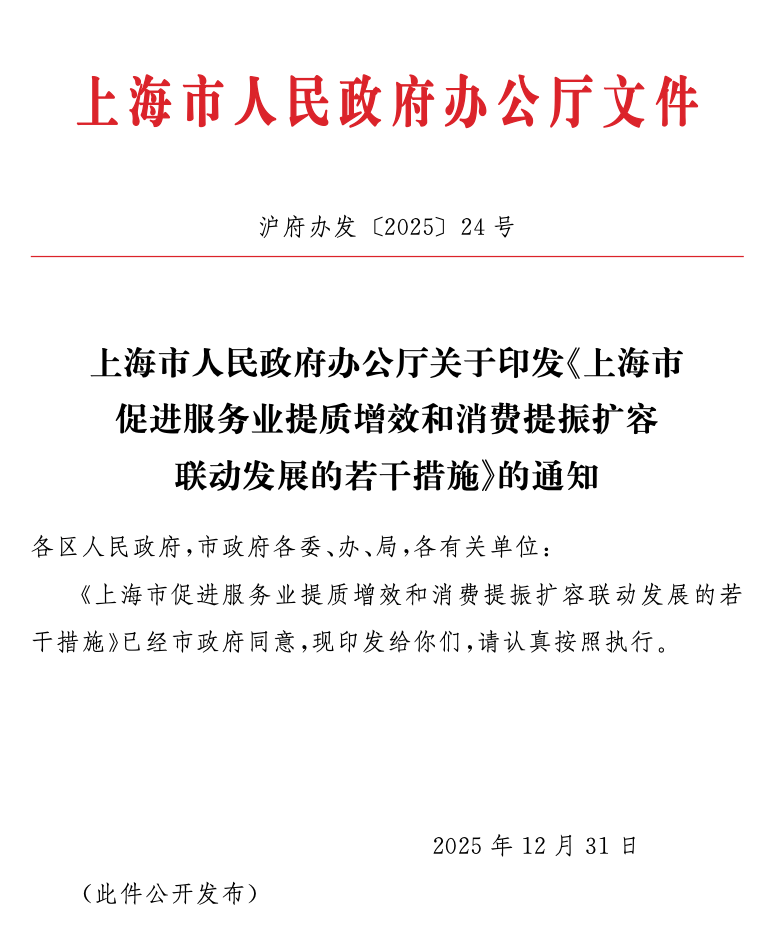
放大赛事溢出效应!上海发布28条举措促进消费提振扩容联动发展
Sou Hu Cai Jing· 2026-01-22 07:26
Core Viewpoint - Shanghai's Development and Reform Commission has introduced measures to enhance the quality and efficiency of the service industry while boosting consumption through coordinated efforts on both supply and demand sides [4] Group 1: Sports and Entertainment - Shanghai aims to host 182 international and domestic sports events by 2025, with a projected 35% year-on-year increase in sports consumption during major events [5] - The F1 China Grand Prix is expected to attract 220,000 spectators, generating a direct economic impact of approximately 2.47 billion yuan and an indirect impact of about 6.91 billion yuan [5] - The city plans to develop a globally influential esports ecosystem, becoming a leading hub for esports events and high-level clubs by 2025 [5] Group 2: Financial Innovation - Financial institutions are encouraged to innovate consumer finance products tailored to new consumption trends, including holiday, night-time, nostalgic, and anime economies [7] - Policies will be implemented to optimize personal consumption loans, including easing application conditions and enhancing credit products for large purchases like green smart home installations [7][8] Group 3: Infrastructure and Platform Economy - Financial support will be provided for the renovation of consumer infrastructure, including commercial facilities and community services, with an emphasis on real estate investment trusts (REITs) [10] - E-commerce and service platforms will be supported to develop specialized consumption platforms in sectors like maternal and child care, housekeeping, and elderly care [11] Group 4: Transportation and Connectivity - The city will enhance transportation services by encouraging airlines to open new international routes and improve the quality of travel services at airports and transport hubs [14] - Initiatives will be taken to create integrated consumption scenarios at transportation hubs, including commercial spaces and cultural exhibitions [15] Group 5: Quality of Life Services - Support will be provided to improve the quality of domestic services, including training and insurance for domestic workers, and enhancing the overall service quality in the elderly care sector [20][21] - The introduction of a pilot program for "no-accompaniment" care services in medical institutions is planned to improve healthcare accessibility [22] Group 6: Brand and Standards - The initiative includes the establishment of a recognizable "Shanghai brand" to enhance consumer trust and promote local products [24] - A focus on developing high-quality standards in emerging sectors such as e-sports and digital arts is emphasized to ensure competitive service quality [25] Group 7: Talent and Industry Development - Efforts will be made to attract talent in the service and consumption sectors, including international teams and specialized professionals [31] - The city aims to strengthen industry clusters by attracting high-growth companies and fostering a supportive ecosystem for startups [32]
养老、托育、家政等社区家庭服务业免税政策再续两年!
Sou Hu Cai Jing· 2026-01-21 05:55
Core Viewpoint - The Ministry of Finance and other departments have announced the extension of tax and fee preferential policies for community family services such as elderly care, childcare, and domestic services until the end of 2027 [2][3]. Tax and Fee Preferential Policies - Institutions providing community elderly care, childcare, and domestic services will enjoy the following tax benefits: - Exemption from value-added tax (VAT) on income from these services [2][3]. - Income from these services will be calculated at 90% for taxable income purposes [2][3]. - Exemption from deed tax for properties and land used for these services [2][3]. - Exemptions from various fees related to property and land used for these services, including real estate registration fees and urban infrastructure fees [2][3]. Definition of Community Services - The term "community" refers to a social living community composed of people in a specific geographic area, including urban and rural communities [4]. - Community elderly care services include life care, rehabilitation, meal assistance, emergency rescue, and emotional support for the elderly [4]. - Community childcare services provide care, supervision, meals, and nurturing for children under three years old [4]. - Community domestic services involve providing care and household services to families, including cleaning and cooking [4]. Compliance and Documentation - Taxpayers benefiting from these policies must retain documentation such as service agreements and proof of service provision for verification [5][6]. - Specific conditions must be met for domestic service enterprises to qualify for VAT exemption, including signing tripartite agreements and managing service personnel [6]. Implementation Timeline - The announcement will take effect from January 1, 2026, and will remain in force until December 31, 2027 [7].

养老、托育、家政等社区家庭服务业税费优惠政策延续实施
Zhong Guo Xin Wen Wang· 2026-01-21 02:29
Group 1 - The Ministry of Finance, State Taxation Administration, National Development and Reform Commission, Ministry of Civil Affairs, Ministry of Commerce, and National Health Commission jointly announced the extension of tax and fee preferential policies for community family services such as elderly care, childcare, and housekeeping [1] - The announcement will be effective from January 1, 2026, to December 31, 2027 [1] - Institutions providing community elderly care, childcare, and housekeeping services will enjoy the following tax benefits: exemption from value-added tax on income from these services [1] Group 2 - Income from community elderly care, childcare, and housekeeping services will be calculated at 90% for taxable income purposes [2] - Exemptions from deed tax will apply to housing and land used for providing community elderly care, childcare, and housekeeping services [2] - Properties and land used for these services will also be exempt from real estate registration fees, land reclamation fees, and urban infrastructure fees [2] Group 3 - Housekeeping service companies that meet specific conditions will be exempt from value-added tax on income from their services [2] - Conditions include signing a tripartite agreement with service workers and clients, paying wages to service workers, and providing training and management [2]
财政金融协同促内需一揽子措施出台 加大个人消费贷款和服务业经营主体贷款贴息力度
Zhong Guo Zheng Quan Bao· 2026-01-20 23:16
Group 1 - The core viewpoint of the article is the introduction of a comprehensive set of fiscal and financial policies aimed at boosting domestic demand, particularly through enhancing consumer spending and supporting private investment [1][4]. Group 2 - The optimization of the "dual subsidy" policy includes increased subsidy amounts for personal consumers, with the subsidy per transaction rising from 500 yuan to 3000 yuan, and for service industry enterprises, the loan subsidy limit increased from 1 million yuan to 10 million yuan [2]. - The implementation period for the optimized personal consumption and service industry loan subsidy policies has been extended to the end of 2026, with potential for further extension based on effectiveness [2]. - The coverage of financial institutions has expanded from over 20 national institutions to more than 500, enhancing accessibility for consumers and businesses [3]. Group 3 - The policy to stimulate private investment includes a subsidy of 1.5% on fixed asset loans for equipment updates, applicable for a maximum of two years, and covers loans issued from 2026 onwards for technology innovation [4]. - The subsidy for small and micro enterprises includes a 1.5% annual subsidy on fixed asset loans, with a maximum loan size of 50 million yuan, and is set to be implemented for one year with the possibility of extension [5]. - A special guarantee plan for private investment has been established with a total quota of 500 billion yuan, aimed at enhancing government financing guarantees and directing financial resources to support quality goods and services [5].
稳岗留人 用“薪”也要用心
Xin Lang Cai Jing· 2026-01-20 21:54
纵然时代变迁,但春节返乡仍是主流选择,特别是服务行业,外来务工人员占比高、人员流动性较强, 本就存在季节性用工缺口。像北京这样的超大型城市,对服务人员的需求量很大,逢年过节用工紧张更 加凸显。这些行业与日常生活又紧密相关。比如一些住家保姆返乡后,部分老人和孩子可能缺人照料。 再如外卖、代驾、网约车等行业,其从业人员供需情况一定程度上也关乎城市运行效率。 肖棠 春节临近,随着越来越多外来务工人员开始回乡行程,很多大城市都面临一定程度的用工紧张,外卖、 餐饮、家政、养老等服务行业可能会"一工难求"。 首先,针对不同工种可以有不同的策略。比如某老年公寓,90%以上的护理员是外地员工,但该公寓每 年11月会提前启动人员招聘储备,再进行集中培训,到春节前后,能保持正常用工量的八九成。而像文 创店、咖啡馆等,将招工信息放到社交平台,往往能吸引不少年轻人。在"涨薪"之外,还要注重"暖 心"。比如某外卖平台,每年都会发放春节签到补贴,站点还会准备年夜饭、现金红包。事实上,相关 部门也在积极行动。比如,今年一二月份,本市人力社保局将开展相关专项行动,聚焦餐饮、物流等节 日用工密集行业,打通用工对接"最后一公里"。 往深远看,热 ...
六部门延续养老托育家政等税费优惠
Zheng Quan Shi Bao· 2026-01-20 18:26
为社区提供养老、托育、家政等服务的机构,自有或其通过承租、无偿使用等方式取得并用于提供社区 养老、托育、家政服务的房产、土地,免征房产税、城镇土地使用税。 中央财经大学教授温来成曾在署名文章中指出,税收政策是推动养老服务产业高质量发展的重要工具。 税收政策可降低养老机构的运营成本和服务定价,进而促进技术创新和服务升级;可以引导资本流向养 老服务领域,进而优化资源配置;还可以减轻从业者的税负,提高养老服务行业对人才的吸引力,进而 提升服务质量。 温来成认为,我国支持养老服务产业发展的税收政策不够完善。现行税收政策对营利性养老机构的支持 不足,对医养结合服务的支持缺失,对养老服务机构人力资源的支持有限。他建议,对于现行较为碎片 化的各项养老服务产业税收政策,可进一步分税种、分适用对象进行政策梳理、整合和规范。同时,完 善养老服务全产业链税收政策。现行税收政策侧重对养老机构的建设和运营环节提供支持,在融资、改 造和接受捐赠环节仍需加强。 1月20日,财政部等六部门发布公告,宣布延续实施养老、托育、家政等社区家庭服务业税费优惠政策 至2027年12月31日,继续支持养老、托育、家政等社区家庭服务业发展。 2019年6 ...