健康

Search documents
估值驱动行情延续节后把握结构性机会
Zhong Guo Zheng Quan Bao· 2026-02-13 20:23
Core Viewpoint - The A-share market is expected to continue its upward trend post-Spring Festival, driven by a combination of trend inertia, seasonal effects, and policy environment support [3] Market Characteristics - The A-share market is influenced by multiple factors, exhibiting a complex overall pattern characterized by clear trends, numerous short-term disturbances, and significant structural differentiation [1] - The core support for the market's upward trend includes improving corporate profit prospects, increased willingness of residents to invest, and ongoing policies to reduce competition [1][2] Short-term Market Dynamics - The pre-Spring Festival period has led to a temporary decline in market activity as some funds opted to secure profits amid uncertainty, but this has not altered the core market trend [2] - Historical data shows that since 2009, the average spring market rally has lasted 57 days with an average increase of over 20% [2] Investment Strategy - Post-Spring Festival, the investment logic will focus on "value supporting growth," with a shift from low-risk to high-risk preferences, emphasizing technology and cyclical sectors [4] - Five key investment themes are recommended: 1. Artificial intelligence industry chain, shifting focus from hardware to application [5] 2. High dividend yield assets, particularly in stable cash flow sectors like white goods and banking [5] 3. Anti-involution sectors benefiting from improved competition dynamics, such as coal and steel [5] 4. Core areas of domestic demand recovery, focusing on sectors with strong growth potential like health and tourism [6] 5. Investment opportunities in strategic and industrial metals, anticipating a rebound in prices [6] Market Outlook - The market is expected to experience a "red envelope market" post-Spring Festival, with potential for further expansion if consumer data exceeds expectations [3] - The overall market is projected to maintain a "stable and upward" characteristic, with limited downside potential for indices [3]
泰勒斯2025财年财报将发布,AI战略与资本管理成焦点
Jing Ji Guan Cha Wang· 2026-02-11 22:44
Core Insights - The company is set to release its Q4 and full-year financial results for FY2025, with a focus on revenue growth in its technology segment and the achievement of AI revenue guidance [1][2] Performance Overview - The company typically announces its Q4 and full-year results in February, with investors keen on whether it meets its FY2025 targets, particularly a revenue growth of 2%-4% in the technology segment (including health) and AI revenue nearing $800 million [2] Strategic Developments - The company launched its first sovereign AI factory in Canada in September 2025, marking it as North America's first official NVIDIA cloud partner, with customer expansion and computing service revenue being key focus areas [3] - The company aims to increase AI-related revenue to approximately $2 billion by 2028, starting from a base of about $800 million in 2025, with attention on the latest growth data and modular construction progress in the upcoming financial report [3] Financial Movements - The company has announced a 4% increase in its quarterly dividend to CAD 0.4184, with plans to gradually eliminate the discounted dividend reinvestment plan starting in 2026 [4] - The company is seeking partners for its health and agriculture businesses, with any related transaction announcements potentially impacting its capital structure and leverage ratio (currently at 3.5x, with a target to reduce to 3x by the end of 2027) [4] Business Status - The integration of Workplace Options (WPO) is under scrutiny to see if the synergy effects continue, with this business segment reporting an 18% revenue growth in Q3 2025 [5] - The company faces challenges in its wireless business, with a focus on whether Average Revenue Per User (ARPU) can improve through product bundling and AI technology applications, as well as trends in customer churn rates [5] Financial Condition - Following the completion of a long-term debt acquisition tender in July 2025, the company’s weighted average cost of capital (4.61%) and free cash flow (reported at $611 million in Q3) will be critical in supporting future investments and dividends [6]
成都鼓励消费新业态新模式新场景 试点首发经济新场景最高可奖150万元
Sou Hu Cai Jing· 2026-02-09 17:19
Core Viewpoint - Chengdu has been officially approved as a pilot city for new consumption formats, models, and scenarios in 2025, with a focus on supporting various innovative consumption initiatives [2] Group 1: Support for New Consumption Formats - The government has established a management method to support the new consumption formats, including the "first launch economy" and diverse service consumption scenarios [2][3] - Financial incentives are provided, with rewards up to 1.5 million yuan for first launch economic scenarios and various amounts for different types of projects [3] Group 2: Development of First Launch Economy - The initiative aims to create a robust service system for the first launch economy, including the establishment of first launch centers and economic clusters in key commercial areas [3] - Specific financial rewards include 800,000 yuan for establishing first launch centers and 1.5 million yuan for flagship stores [3] Group 3: Innovation in Service Consumption Scenarios - The plan encourages innovation in service consumption, integrating digital technologies like AI and the metaverse into sectors such as entertainment, tourism, and health [4] - Financial support is available for projects that enhance service consumption areas, with subsidies up to 30% of effective investment, capped at 30 million yuan per project [4] Group 4: Collaboration with Known IPs - The initiative promotes collaboration with global and local IPs to develop a range of consumer products and experiences [5][6] - Financial incentives include 1.5 million yuan for projects that link with well-known IPs and a minimum investment requirement of 5 million yuan for comprehensive consumption scenarios [6]


四维共振驱动春季行情 多元策略适配不同风险偏好
Zhong Guo Zheng Quan Bao· 2026-02-06 20:24
Core Viewpoint - The current A-share market is characterized by a blend of upward continuation and short-term volatility, necessitating investment strategies that align with risk preferences and market dynamics [1][2]. Market Conditions - Analysts believe that the market is poised for an upward trend driven by four key factors: ample liquidity, policy catalysts, calendar effects, and the interplay of valuation and earnings [3][4]. - The upcoming Spring Festival is seen as a critical period for investment decisions, with historical data indicating a strong performance of the market during this time [2][4]. Investment Strategies - Analysts recommend focusing on two main lines: technology growth and resource products, while also diversifying into cyclical consumption, price increases, and defensive assets [6][7]. - For medium-risk investors, a balanced approach involving profit-taking and a "barbell strategy" is suggested, combining dividend and technology assets [2][3]. Sector Insights - The technology sector is expected to be a core focus for long-term investments, particularly in AI and related fields, with a shift from hardware to application-based investments anticipated in 2026 [6][7]. - The cyclical and resource sectors are highlighted for their potential price increases and recovery opportunities, with specific attention to industrial metals and energy products [7][8]. Defensive Assets - High-dividend assets are recommended as a core component of defensive strategies, with sectors such as utilities, banks, and consumer staples being favored for their stability and yield [8]. - Analysts emphasize the importance of maintaining a diversified portfolio that balances offensive and defensive assets to mitigate risks associated with market fluctuations and external uncertainties [8].
【数说经济】50万亿元不是中国消费故事的全部
Xin Lang Cai Jing· 2026-02-05 23:23
Group 1 - The core viewpoint is that China's retail sales of consumer goods have surpassed 50 trillion yuan in 2025, reflecting the sustained role of consumption as a key driver of economic development, with a year-on-year growth of 3.7% [2] - The increase in retail sales is attributed to policy efforts, supply-demand coordination, and structural optimization, with significant contributions from the replacement of old consumer goods, leading to sales of 2.61 trillion yuan in related products [2] - The penetration rate of new energy passenger vehicles reached 53.9%, with retail sales amounting to 12.81 million units, indicating a shift towards green and intelligent consumption [2] Group 2 - The structure of consumption is shifting from a focus on goods to a dual-driven model of "goods + services," with service retail sales growing by 5.5% year-on-year, outpacing goods retail sales by 1.7 percentage points [3] - The proportion of service consumption expenditure in per capita consumption reached 46.1%, highlighting the increasing importance of service sectors such as culture, tourism, education, and healthcare [3] - New consumption formats and models are emerging, with innovations in technology such as AI and VR enhancing consumer experiences, and a growing trend towards personalized and quality consumption [3][4] Group 3 - The focus for economic work in 2026 will be on strengthening domestic markets and expanding consumption, emphasizing the need to address real market demands and development trends [4] - Strategies will include optimizing the replacement of consumer goods and enhancing the supply of quality services in sectors like healthcare and education to meet new service consumption demands [5] - The future of China's consumption market is expected to be more diverse and rich, with a transition from scale advantages to quality advantages, and a simultaneous expansion of market depth and breadth [5]
东莞:今年将实现松山湖欢乐海岸、南城万象城、厚街山姆开业
Sou Hu Cai Jing· 2026-02-04 11:41
Core Insights - Dongguan is focusing on enhancing consumption as a key driver of economic growth, particularly during the "14th Five-Year Plan" period, with initiatives aimed at consumption upgrades and economic development [2][4] Group 1: Consumption Initiatives - Dongguan plans to implement a special action to boost consumption, aiming to leverage trade-in programs to stimulate related consumption worth 23.6 billion yuan, leading to a projected 2.8% growth in retail sales [4] - The city will enhance its internal sales service system and promote local products through various events and platforms, including the establishment of a "Dongguan Quality Products" exhibition center [4] - The initiative includes the development of a "Guanli Economy" to strengthen brand building and international outreach, enhancing the global influence of Dongguan's manufacturing [4] Group 2: New Consumption Models - Dongguan aims to accelerate the cultivation of new consumption formats and models, focusing on digital consumption and integrating AI with retail and service industries [6] - The city plans to introduce over 100 new stores in popular shopping areas and develop pet-friendly environments to tap into the growing pet consumption market [6] - Infrastructure investment will be prioritized to create new highlights in the local economy, supporting various new business models and enhancing consumer experiences [6] Group 3: Consumer Confidence and Safety - The city is optimizing consumption promotion activities, including the addition of 2,500 trusted consumption units to enhance consumer confidence [5] - Efforts are being made to ensure that citizens and visitors feel secure in their purchasing decisions, aligning the growth of internal demand with improved quality of life [5]

全域聚势,年货爆发,快手商家年货节喜迎开门红,多维度揭秘生意爆发秘籍
Quan Jing Wang· 2026-02-03 08:54
Core Insights - The New Year shopping festival serves as a critical marketing node for brands to capture consumer demand and gain a competitive edge for the year ahead [1] - Kuaishou's Magnetic Engine provides a comprehensive operational solution for merchants, focusing on traffic strategies, tool empowerment, and policy support to meet diverse industry needs [1] Group 1: AI Tools and Smart Investment - AI tools and precise investment strategies are essential for merchants to reduce costs and enhance efficiency during digital marketing [1] - The brand Yalu Fangge optimized its content strategy and utilized AI tools to significantly increase promotional spending by 92% during the New Year festival, achieving a 129% increase in daily average spending compared to December [1] - Baiyunshan leveraged AI tools and health-focused materials to enhance operational efficiency, resulting in a 30% increase in advertising spending during the early bird period and a 200,000 increase in material exposure [1] Group 2: C Subsidy Policies and Comprehensive Collaboration - Kuaishou's C subsidy policy aims to lower operational costs for merchants and stimulate consumer potential, helping them break through competitive bottlenecks [1][2] - The brand Deyou utilized a 16% C subsidy and a multi-matrix approach to improve its live streaming engagement by 22% and enhance its infrastructure by 50%, leading to a 9% increase in ROI [2] Group 3: Fine-tuned Operations and Long-term Brand Growth - Fine-tuned operations are crucial for merchants to build brand assets and explore new growth opportunities amid concentrated consumer demand [3] - The brand Fuyan Jie optimized its promotional strategies and enhanced user purchase intent, achieving a 200% increase in spending and a 161% increase in product CTR during the New Year festival [3] - The brand Qingquan Runjia shifted its operational strategy to a product and brand combination model, resulting in a 108% increase in ROI during the festival [4] Group 4: Market Adaptation and Product Strategy - The brand Meierya focused on expanding its product line during the New Year festival, utilizing a price-cutting strategy and various promotional methods to drive sales [5] - The overall operational ecosystem of Kuaishou supports brands, factories, and newcomers in finding suitable growth paths, emphasizing the platform's capability to adapt to market demands [6]


可享贴息贷款额度升至最高1000万
Xin Lang Cai Jing· 2026-02-01 17:15
Core Viewpoint - The Hainan Provincial Finance Department has issued a notice to optimize the implementation of loan interest subsidies for service industry operators, extending the policy period, increasing subsidy limits, and expanding support areas to boost consumption and domestic demand [1][2]. Group 1: Policy Implementation - The loan interest subsidy policy for service industry operators is extended until December 31, 2026 [1]. - Loans issued between March 16, 2025, and December 31, 2025, will continue to follow previous national and provincial guidelines, while new loans in 2026 will receive enhanced support [1]. Group 2: Subsidy Details - The maximum loan amount eligible for interest subsidies for individual operators in 2026 is raised to 10 million yuan, with a subsidy period not exceeding one year and an annual interest subsidy rate of 1% [1]. - The funding for the subsidies will be covered 90% by the central government and 10% by the provincial government, effectively reducing financing costs for enterprises [1]. Group 3: Expanded Support Areas - The support areas have been expanded to include three new emerging consumption sectors: digital, green, and retail, in addition to the existing eight service sectors [2]. - The digital sector includes "Internet and related services" and "digital content services"; the green sector covers industries meeting standards for green buildings, transportation, and logistics; the retail sector encompasses all retail industries as classified in the National Economic Industry Classification [2]. Group 4: Implementation and Supervision - The notice emphasizes the need for strong organizational implementation and supervision, with penalties for serious violations, including the recovery of subsidy funds and accountability for banks colluding with enterprises [2]. - Banks are required to strictly perform their loan approval duties, monitor fund flows, and prevent loans from being used for non-operational purposes, with measures in place to avoid duplicate subsidy claims [2]. - The policy encourages flexible borrowing and repayment models to enhance fund utilization efficiency, while also establishing risk constraints by denying subsidies for overdue or non-performing service industry loans [2].
激活消费主引擎 培育壮大“新”力量
Xin Lang Cai Jing· 2026-01-28 23:06
Group 1 - The core viewpoint emphasizes the importance of consumer spending as a driver of economic growth and a reflection of people's quality of life, with a projected retail sales total of 25,433.59 billion yuan in 2025, representing a 4.4% increase from the previous year, surpassing the national average [1] - The government aims to activate the consumption engine through special actions to boost consumer spending, with representatives advocating for policies that closely link improving people's livelihoods with stimulating consumption [1][2] Group 2 - The stable growth in retail sales is attributed to the synchronization of activities and policies, including nearly 10,000 promotional events and a trade-in program that generated 79.1 billion yuan in consumption, benefiting over 7.5 million consumers [2] - The continuation of the trade-in policy is expected, with suggestions to increase public service spending and provide differentiated subsidies for smart and green products to enhance consumer willingness to spend [2][3] Group 3 - There is a shift in consumer behavior from primarily goods consumption to a balanced focus on both goods and services, with service consumption expected to be a significant growth driver due to its high frequency and multiplier effect [3] - Recommendations include creating a comprehensive consumption IP that integrates shopping, entertainment, dining, and health, leveraging the region's rich resources and cultural heritage to enhance consumer experiences [3] Group 4 - The government report highlights the need to improve consumer capacity and optimize the consumption environment, with suggestions to enhance infrastructure in underserved areas and strengthen market regulation to combat fraud and improve consumer rights [4] - Emphasis is placed on tapping into domestic demand and facilitating efficient economic circulation, with calls for integrating into the national market and promoting local brand activities to shift consumption growth from recovery to sustainable expansion [4]
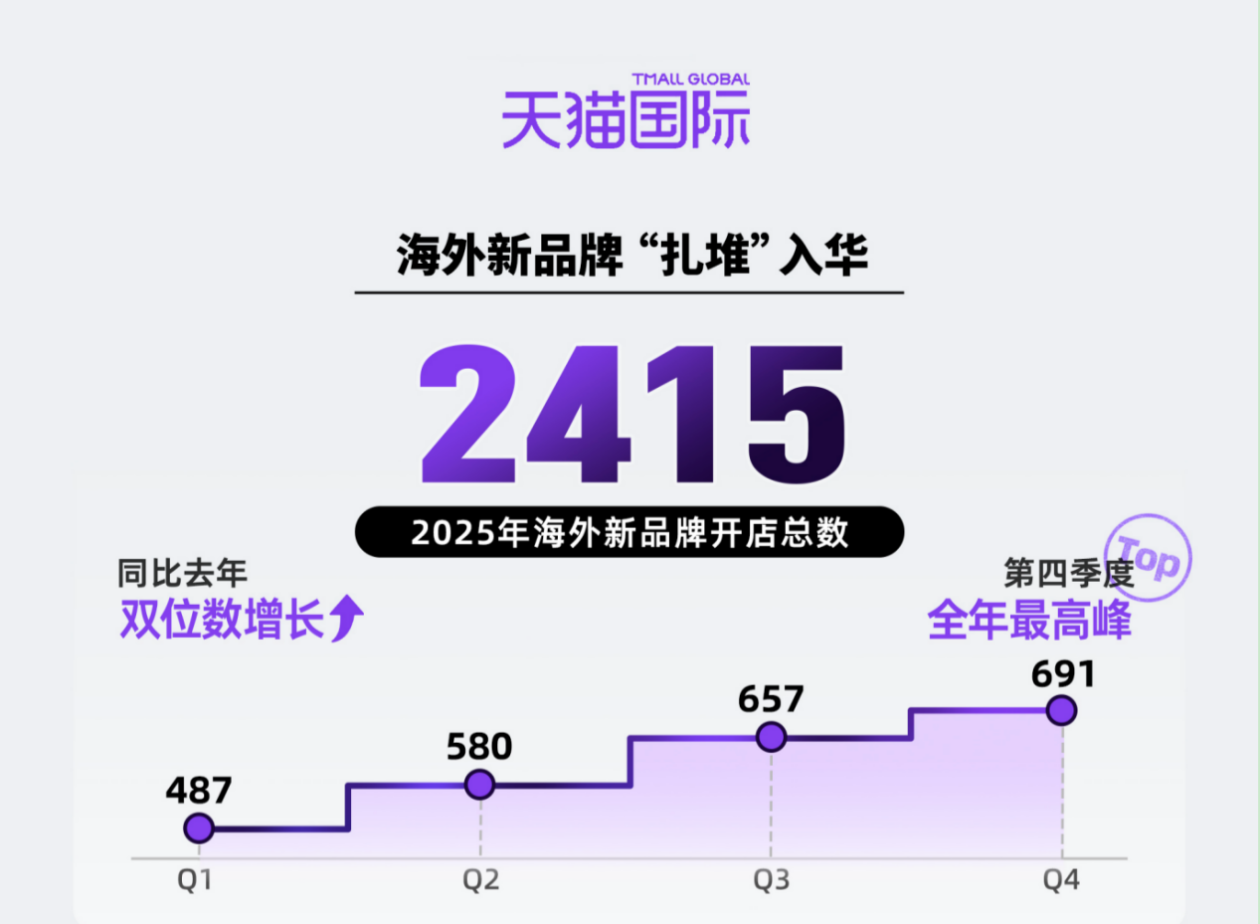
一年2415家海外企业开出首店,中国仍是全球品牌“试金石”
Huan Qiu Wang· 2026-01-28 11:56
Core Insights - The article highlights the structural changes in the entry of overseas brands into the Chinese consumer market, reflecting the evolving landscape of import consumption in China [2] Group 1: Brand Entry Strategies - The concept of "first store economy" is shifting from physical locations in key urban areas to online platforms, with e-commerce becoming the primary entry point for many overseas brands, especially smaller ones [2] - By establishing "online first stores," brands can conduct market testing and channel development at a lower cost, facilitated by platforms like Tmall International that provide essential infrastructure [2] - In 2025, brands from 52 countries are expected to enter China through this method, with the highest numbers from the US (555 brands) and South Korea, while countries like Cuba and Chile are also making their debut [2] Group 2: Competitive Strategies - New brands are increasingly focusing on niche markets rather than mass-market products, with health, beauty, and maternal and infant categories being the most attractive [3] - In the health sector, "precision nutrition" and "oral anti-aging" are emerging as key areas for new brand entries, while the maternal and infant sector sees a 128% increase in new baby food brands, indicating a growing demand for specialized dietary needs [3] - The beauty sector is witnessing a shift as overseas brands pivot towards personal care products, with a 37% increase in new personal care brands, many focusing on hair care [3] Group 3: Consumer Behavior Trends - The fastest-growing imported categories in 2025 include toys, outdoor gear, baby food, fashion cosmetics, and pet health, all showing growth rates exceeding 100% [4] - The growth in toy-related products is driven by fan economy and emotional consumption, while outdoor gear growth correlates with the rise of leisure lifestyles in China [5] - The high growth rates in baby food and pet health reflect families' increasing demand for quality in these areas, where imported brands hold a recognition advantage [5] Group 4: Platform Evolution - E-commerce platforms are evolving from mere entry points to providing operational support for overseas brands, as seen with Korean brands on Tmall International [7] - In 2023, eight of the top ten Korean brands by sales on Tmall International were beauty brands, but the platform is guiding these brands to diversify into apparel and other categories [7] - The structural shift in Korean brands from a beauty-centric focus to a broader distribution across various categories is supported by market insights and resources provided by the platform [7] Group 5: Market Attractiveness - The continuous entry of overseas brands is based on the stable demand from Chinese consumers for certain imported categories, particularly in health, maternal, and pet sectors [8] - Improved e-commerce infrastructure has lowered the cost for brands to test the market, allowing smaller brands to enter with manageable risks [9] - The segmentation and differentiation of the Chinese consumer market provide opportunities for brands with varying positioning, as evidenced by the growth of online first stores on Tmall International [10]