
海洋油气

Search documents
总量稳步增长 结构持续优化 动能加快转换
Zhong Guo Zi Ran Zi Yuan Bao· 2025-08-04 01:34
Core Viewpoint - The marine economy in China has shown resilience and growth in the first half of the year, with a total marine production value of 5.1 trillion yuan, representing a year-on-year increase of 5.8% [4]. Group 1: Traditional Marine Industry - The shipbuilding sector has improved production efficiency, with the completion of sea vessels increasing by 4.7% year-on-year [6]. - The marine tourism market has seen significant growth, with an added value of 771.8 billion yuan, up 8.0% year-on-year, driven by rising travel demand and favorable policies [6]. - The cruise tourism sector has experienced a surge, with passenger numbers and cruise ship calls increasing by 40.1% and 33.7% respectively [6]. Group 2: Emerging Marine Industry - The marine engineering equipment construction market has rebounded, with new orders, delivered orders, and hand-held orders accounting for 64.6%, 43.3%, and 62.6% of the international market share respectively [7]. - Significant advancements in marine biotechnology have been made, including the launch of the "Starfish Model" for marine drug research [7]. - Innovations in seawater desalination technology have progressed, with new methods developed for efficient solar-powered desalination [7]. Group 3: Marine Resource Supply Capacity - The approval of new marine and island usage areas has increased by 25.2%, with investments exceeding 500 billion yuan [9]. - Oil and gas production from marine resources has increased, with crude oil and natural gas output rising by 2.3% and 16.9% respectively [9]. - The capacity for clean marine energy has improved, with offshore wind power generation and new grid-connected capacity increasing by 2.2% and 199.4% respectively [9]. Group 4: Marine Enterprises and Innovation - A survey indicates that 87.6% of marine enterprises are optimistic about the economic environment for the second half of the year, with a majority expecting stable or increased profits [12]. - The proportion of enterprises reporting growth in R&D funding and personnel has reached 57.5% and 58.4% respectively [12]. - The establishment of the National Marine Comprehensive Test Field (Deep Sea) aims to support deep-sea technology and industry development [14]. Group 5: Marine Trade and Port Development - Marine trade has shown resilience, with total import and export volume increasing by 1.1% year-on-year [16]. - The construction of smart green ports is accelerating, with 23 automated container terminals and 29 automated bulk terminals established [16]. - New direct shipping routes have been opened, enhancing connectivity with Southeast Asia, Ecuador, and the Middle East [17].


总量稳步增长、结构持续优化、动能加快转换 上半年海洋生产总值超5万亿元(经济新方位)
Ren Min Ri Bao· 2025-08-02 21:44
Core Insights - The marine economy in China has shown resilience and positive growth in the first half of the year, with a marine GDP of 5.1 trillion yuan, reflecting a year-on-year increase of 5.8% [1] Marine Industry Performance - The shipbuilding sector continues to lead globally, with ship completion volume increasing by 4.7% year-on-year. China's market share in new ship orders, completed ships, and hand-held orders stands at 64.0%, 47.2%, and 57.6% respectively [2] - The marine transportation industry has demonstrated strong resilience, with marine cargo volume and turnover increasing by 5.2% and 6.9% year-on-year [2] Emerging Marine Industries - The marine engineering equipment construction market has rebounded, with new orders, delivered orders, and hand-held orders capturing 64.6%, 43.3%, and 62.6% of the international market share respectively [3] - The marine tourism sector has seen a significant increase in value added, reaching 771.8 billion yuan, a growth of 8.0% year-on-year, driven by favorable policies and rising travel demand [2] Marine Resource Development - The area approved for marine and island projects has increased by 25.2% year-on-year, involving investments exceeding 500 billion yuan, which supports major project needs [4] - The marine clean energy supply capacity has improved, with offshore wind power generation increasing by 2.2% and new grid-connected capacity rising by 199.4% [4] Business Outlook - Nearly 90% of marine-related enterprises expect stable or growing average employment numbers in the second half of the year, with 73.8% anticipating stable or increased profits [5] - The technological innovation capabilities of marine enterprises are on the rise, with over 57% of companies reporting growth in R&D funding and personnel [5] Marine Technology and Infrastructure - The establishment of the National Marine Comprehensive Test Field in Hainan aims to support deep-sea scientific research and technology innovation [6] - The construction of automated container and bulk cargo terminals is progressing, with 23 automated container terminals and 29 automated bulk terminals completed [7] Trade and Export Performance - The total import and export volume of marine shipping increased by 1.1% year-on-year, with significant growth in high-end, intelligent, and green marine products [7] - The expansion of foreign trade shipping routes continues, with new direct shipping lines established to Southeast Asia, Ecuador, and the Middle East [7]
上半年海洋经济稳中向好 海洋生产总值突破5万亿元
Xin Hua Wang· 2025-08-02 02:41
Core Insights - The marine economy in China has shown resilience and positive growth in the first half of the year, with a marine GDP of 5.1 trillion yuan, representing a year-on-year increase of 5.8% [1] Group 1: Marine Economic Performance - The supply capacity of marine resources has steadily increased, with a newly approved area for marine and island use of 167,000 hectares, up 25.2% year-on-year, involving investments exceeding 500 billion yuan [1] - Marine crude oil and natural gas production increased by 2.3% and 16.9% respectively [1] - The capacity and generation of offshore wind power saw significant growth, with new grid-connected capacity increasing by 199.4% and generation up by 2.2% [1] - The domestic marine aquaculture production increased by 4.8% [1] Group 2: Traditional Marine Industries - Traditional marine industries continue to play a stabilizing role in the marine economy, with the shipbuilding industry maintaining a leading position in the international market, accounting for 64.0% of new orders, 47.2% of completed orders, and 57.6% of hand-held orders globally [1] - The marine tourism sector's value added grew by 8.0%, with cruise ports receiving 40.1% more passengers year-on-year [1] - The marine transportation sector demonstrated resilience, with marine freight volume and cargo turnover increasing by 5.2% and 6.9% respectively [1] Group 3: Emerging Marine Industries - Emerging marine industries are also showing positive development, with marine engineering equipment deliveries and hand-held order amounts increasing by 39.3% and 9.7% respectively [2] - The "Sea Star Model" for marine drug research was launched in Qingdao [2] - The megawatt-level generator "Fengjin" has been continuously operating on the grid for over three years [2]
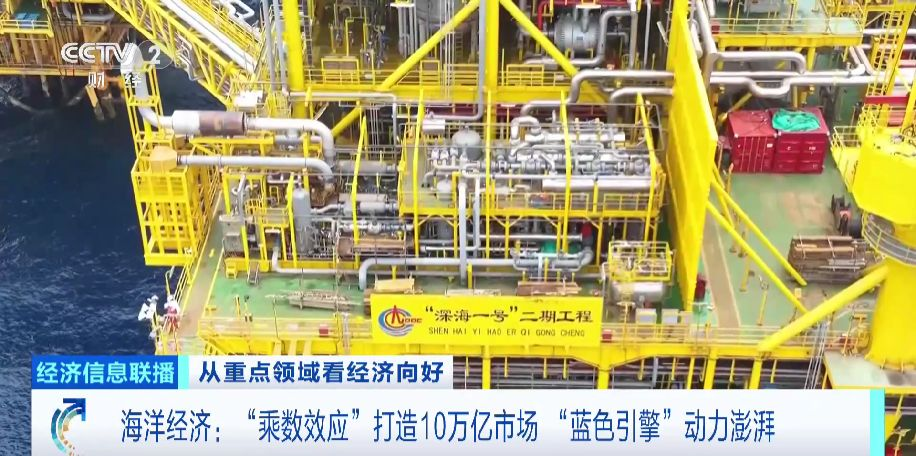
“乘数效应”打造10万亿市场 海洋经济成中国经济增长“蓝色引擎”
Yang Shi Wang· 2025-07-20 00:50
Core Viewpoint - The marine economy in China is emerging as a significant driver of economic growth, with a GDP exceeding 2.5 trillion yuan in the first quarter of this year, marking a year-on-year growth of 5.7% [1] Group 1: Marine Economy Development - The marine economy is becoming a "blue engine" for China's economic growth, as highlighted in the government work report and the recent Central Financial Committee meeting [1] - China's marine economy has surpassed 10 trillion yuan, growing by 75.9% over the past decade, indicating a shift from quantitative to qualitative changes in economic development [28] Group 2: Deep Sea Energy Resources - The "Deep Sea No. 1" gas field is producing over 4.5 billion cubic meters of natural gas annually, reaching its maximum design capacity, and is crucial for energy supply in the Guangdong-Hong Kong-Macao Greater Bay Area [3] - Deep water and ultra-deep water regions contribute 70% to 80% of major global oil and gas discoveries in the past decade, establishing deep sea as a core battlefield for oil and gas reserves [7] Group 3: Offshore Wind Power - The construction of the ±500 kV offshore converter station in Yangjiang is part of China's first offshore integrated flexible direct current project, expected to deliver 6 billion kilowatt-hours of offshore wind power annually by 2026 [9] - China's offshore wind power is transitioning from a follower to a leader, with advancements in core technologies such as large megawatt units and floating wind power [11] Group 4: Marine Aquaculture - The "Suhai No. 1," the world's first self-propelled closed salmon farming vessel, is set to produce 8,000 tons of salmon annually, with an investment of 600 million yuan [14] - Plans to promote five such vessels could lead to an annual production capacity of 40,000 tons, generating a market scale of 28 billion yuan [16] Group 5: Undersea Data Centers - The first commercial underwater intelligent computing center cluster in China has been launched, significantly reducing cooling energy consumption compared to land-based data centers [18] - Each underwater data module can save approximately 120 million kilowatt-hours of electricity annually compared to similar-sized land data centers [20] Group 6: Technological Innovations - The "Nanjiao No. 1" underwater cable-laying robot has achieved a speed of 1,000 meters per hour, doubling the efficiency of traditional operations [22] - This technology supports the establishment of underwater data centers and transoceanic communication systems, extending marine development capabilities [24] Group 7: Integrated Marine Development - The integration of offshore wind power, oil and gas development, marine aquaculture, and digital infrastructure is forming a comprehensive marine development strategy [26] - The marine economy's unique characteristics enable deep integration across primary, secondary, and tertiary industries, enhancing the utilization of marine resources [28]
中国海油亮相第三届中国国际供应链促进博览会
Xin Hua Cai Jing· 2025-07-19 00:51
Core Viewpoint - The China National Offshore Oil Corporation (CNOOC) is showcasing its commitment to energy stability and sustainable development at the third China International Supply Chain Promotion Expo, emphasizing its role as a leading offshore oil and gas producer in China and its efforts in technological innovation and environmental protection [1][2]. Group 1: Company Performance and Achievements - CNOOC has achieved a net proven reserve of 7.27 billion barrels of oil equivalent by the end of 2024, marking a year-on-year increase of 7.2%, with a stable reserve life of 10 years [1]. - The company has made 11 new oil and gas discoveries and successfully evaluated 30 oil and gas structures in 2024 [1]. - CNOOC is the largest LNG importer in China and the second largest in the world, with a cumulative LNG import of 330 million tons from 2006 to 2024, accounting for 39.3% of China's total LNG imports in 2024 [1]. Group 2: Environmental and Social Responsibility - CNOOC is actively pursuing a dual carbon strategy, focusing on building a new energy system and promoting green transformation in energy development, including investments in wind power, shore power, and carbon capture, utilization, and storage (CCUS) [2]. - The company has implemented nearly 200 marine ecological protection projects through its marine environment and ecology protection foundation, with a total investment exceeding 200 million RMB [2]. Group 3: International Cooperation and Community Engagement - CNOOC has established a presence in 20 countries and regions worldwide, with over 70% of its local employees, reflecting its commitment to mutual benefit and open cooperation [2]. - The company hosted the first "Blue Ocean Lecture" at the expo, highlighting its 40-year journey and commitment to building a maritime power, attracting nearly 100 participants from academia, industry, and media [3].

新思想引领新征程|推动海洋经济高质量发展 走出一条具有中国特色的向海图强之路
Yang Guang Wang· 2025-07-08 09:06
Group 1 - The core viewpoint emphasizes the need for high-quality development of the marine economy in China, aiming for a unique path towards maritime strength [1] - In 2024, China's marine economy is projected to exceed 10 trillion yuan for the first time, indicating a strong growth trend in marine industries [1] - The delivery of the first domestically built 16,000 TEU methanol dual-fuel container ship marks significant breakthroughs in the construction of large methanol dual-fuel vessels [1] Group 2 - The "Deep Sea No. 1" Phase II project has achieved full production, with a maximum daily output of 15 million cubic meters, making it the largest offshore gas field in China [1] - The integration of production, learning, and research has enhanced the capability to construct various types of deep-water oil and gas equipment tailored to different oil fields and sea areas [2] - New marine industries, such as marine oil and gas and offshore wind power, are showing positive developments, with continuous breakthroughs in marine pharmaceuticals and biological products [2] Group 3 - The first domestically developed LHD megawatt tidal energy generator is now operational, utilizing a modular technology approach to enhance tidal energy utilization [3] - China is focusing on the large-scale utilization of marine energy, aiming to promote new technologies and models in marine energy development [3] - The establishment of the first marine blue finance platform in Jiangsu aims to address the financing challenges faced by marine enterprises [4] Group 4 - The blue finance platform offers specialized financial products like blue loans and blue insurance, facilitating smoother financing for enterprises [4] - Guangdong province is striving to transition from a marine big province to a marine strong province, aiming to create a modern marine economic development hub [4] - The continuous optimization of marine industry structure and enhancement of technological innovation capabilities are driving forces for China's economic development [4][5]
午后爆拉!发生了什么?
Feng Huang Wang Cai Jing· 2025-07-02 13:38
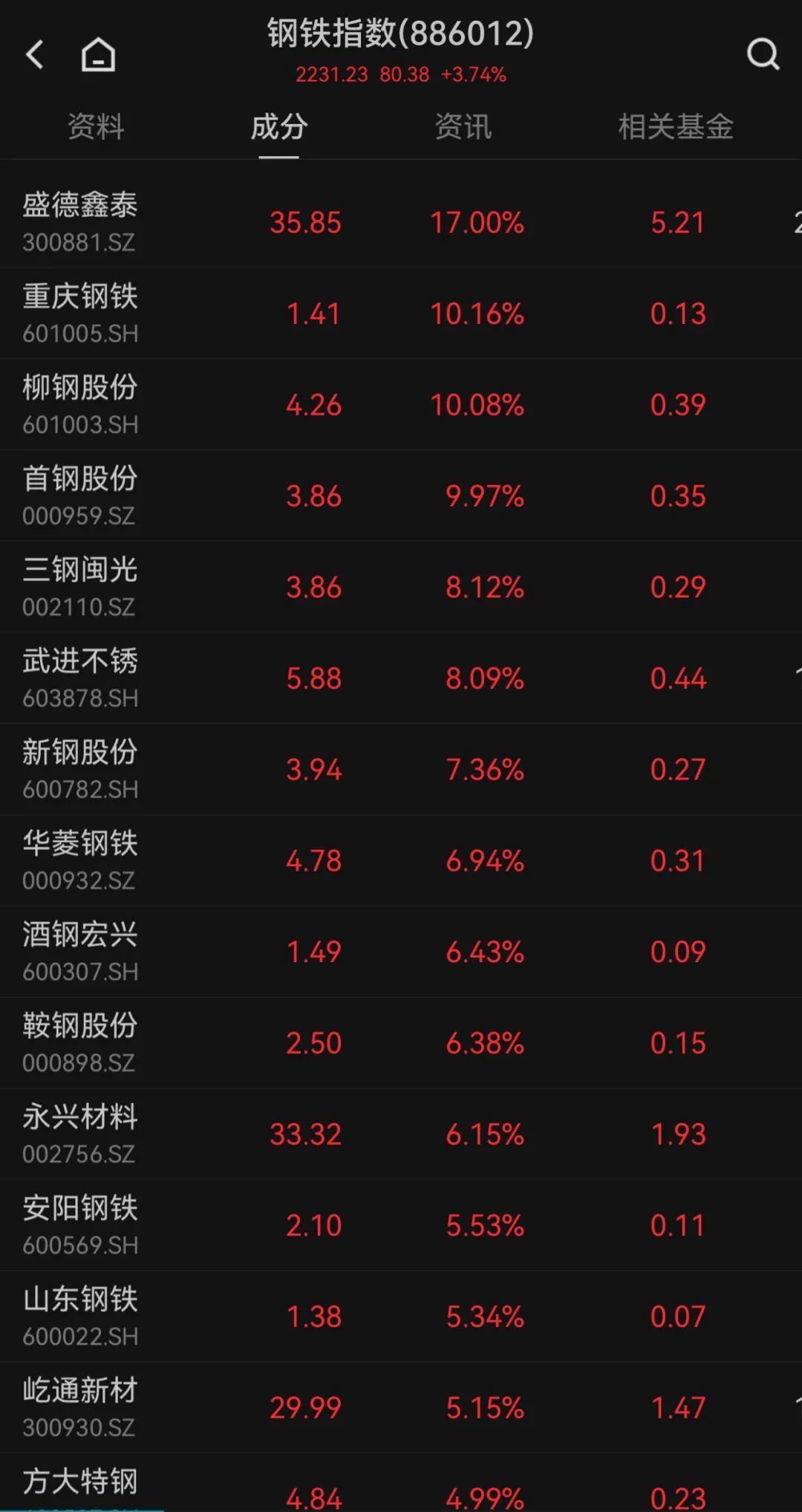
Group 1: Steel Industry Performance - The steel sector experienced significant gains, with the steel index rising by 3.74% to 2231.23 points [2] - Notable stocks included 盛德鑫泰, which surged by 17%, and 重庆钢铁, 柳钢股份, and others reaching their daily limit [3] - The market saw a strong correlation between the A-share market and commodity markets, with polysilicon and glass futures leading the gains [1] Group 2: Environmental Regulations Impact - Increased environmental restrictions in Tangshan are expected to affect steel production, with about half of the steel mills reporting notifications of production cuts [4] - The China Iron and Steel Association is set to hold a meeting to discuss the industry's progress and challenges, indicating a focus on future development strategies [4] Group 3: Marine Economy Development - The central government is promoting high-quality development of the marine economy, with policies encouraging social capital participation and innovation in marine technology [8] - The marine economy is expected to accelerate, supported by various regional policies aimed at optimizing and upgrading the marine industry structure [8] Group 4: Marine Economy Industry Chain - The marine economy industry chain is categorized into three levels: infrastructure, equipment technology, and resource development [9] - Key areas of focus include deep-sea technology, offshore wind power, and marine biological medicine, with significant investment opportunities identified [10]
主题策略专题:把握海洋经济投资机会
Guoxin Securities· 2025-07-02 12:23
Core Insights - The domestic marine economy is entering a new phase of high-quality development, supported by significant policy backing and an enhanced strategic position. Recent government policies provide a solid legal foundation for macro guidance, strategic planning, and sustainable development of the marine economy, which is increasingly contributing to GDP, indicating strong resilience and broad prospects [3] - Deep-sea technology is accelerating as a new engine for economic growth under the context of new productive forces. Various national-level research projects are being implemented to promote the coordinated development of the entire industrial chain, including deep-sea exploration, resource development, and equipment manufacturing. China has achieved multiple technological breakthroughs in areas such as deep-sea drilling vessels and manned submersibles, laying the foundation for commercial development [3][25] - The shipbuilding and marine engineering equipment industry is a core force supporting the development of the marine economy and represents future investment opportunities. This industry, as a key component of high-end equipment manufacturing, is capital and technology-intensive, providing technical equipment for maritime transportation, marine resource development, and national defense construction [3][49] - The marine economy theme index has shown strong performance, with investment opportunities in deep-sea oil and gas and marine ecological services. As of July 1, 2025, the marine economy index and marine technology index increased by 9.3% and 13.7%, respectively, reflecting positive market sentiment towards the marine economy sector [3] - The marine economy's contribution to GDP has been steadily increasing, with a compound annual growth rate of approximately 6% over the past five years, outpacing overall GDP growth [9] Marine Economy Policy and Industry Context - In recent years, a series of policies have been introduced by national and local governments to promote marine economic development. The "14th Five-Year Plan" for marine economic development provides macro guidance and strategic planning, while the revised Marine Environmental Protection Law offers legal support for sustainable development [8] - The marine production value reached 10.54 trillion yuan in 2024, growing by 5.9% year-on-year, with the marine industry value added at 4.37 trillion yuan [8][24] Deep-Sea Technology Industry Chain - The deep-sea technology sector is supported by government initiatives, with significant breakthroughs in deep-sea exploration and resource development technologies. The market size for deep-sea technology is expected to reach 3.25 trillion yuan by 2025 [25][41] Shipbuilding and Marine Engineering Equipment Investment Insights - The shipbuilding and marine engineering equipment industry is crucial for providing technical equipment for maritime transportation and resource development. The industry encompasses upstream raw material suppliers, midstream equipment manufacturers, and downstream application markets [49][50] - The marine engineering equipment industry is experiencing growth opportunities due to the continuous development of marine economic strategies and global marine economic trends [49]
中国海油发布“人工智能+”行动方案
Zhong Guo Hua Gong Bao· 2025-06-11 02:25
Core Viewpoint - China National Offshore Oil Corporation (CNOOC) has launched an "Artificial Intelligence+" initiative aimed at integrating AI technology into the entire marine energy industry chain, with a goal to develop over 10 high-quality datasets and establish more than 8 AI benchmark scenarios by 2027 [1][3] Group 1: Action Plan and Objectives - The action plan emphasizes four main areas: "Scenario Navigation," "Data Pulse," "Platform Foundation," and "Talent Introduction" to drive the integration of AI technology [1] - CNOOC aims to create over 10 high-quality marine oil and gas datasets and develop more than 3 professional-grade models by 2027 [1] Group 2: Technology and Product Launches - CNOOC introduced five products that leverage AI, big data, and industrial IoT technologies, including the integrated business management system (BMS) and the asset management system (EAM) [2] - The BMS focuses on core business indicators for exploration and development, ensuring data traceability across all business processes [2] - The EAM enhances asset management efficiency and reliability, promoting cost reduction and increased efficiency [2] - The "Xuanji Cloud" platform enables real-time monitoring and remote collaboration, achieving 100% coverage of domestic and international operations [2] - The "Tianshu Cloud" integrates six key processes in LNG resource management, facilitating data exchange and collaboration across various stakeholders [2] Group 3: Future Directions - CNOOC plans to continuously enhance its technological innovation and digital transformation capabilities, contributing to the establishment of a world-class demonstration enterprise in the marine energy sector [3]
“深海一号”累计生产天然气超百亿立方米 海洋能源新质生产力蓬勃发展
Hai Nan Ri Bao· 2025-06-07 23:56
Group 1 - The core viewpoint highlights the significant advancements in marine oil and gas resource exploration and development in Hainan during the 14th Five-Year Plan period, including the discovery of the world's first ultra-deep water ultra-shallow gas field Ling Shui 36-1 and the first deep water deep layer gas field Bao Dao 21-1 in China [1] - The "Deep Sea No. 1" project has shown remarkable economic performance and technological achievements since its launch, maintaining a stable production state with natural gas output exceeding 3 billion cubic meters annually for three consecutive years, totaling over 10 billion cubic meters of natural gas and over 1 million cubic meters of condensate oil produced [1] - In 2024, the overall production of the "Deep Sea No. 1" gas field is expected to increase with the addition of the second phase project and further optimization of offshore platform production processes, solidifying its role as a key gas supply source for economically developed coastal regions [1] Group 2 - The completion of offshore oil and gas projects like "Deep Sea No. 1" has significantly enhanced the infrastructure for marine energy development in Hainan, including the successful laying of longer and larger capacity subsea pipelines and the expansion of oil and gas processing terminals and logistics ports in areas like Sanya and Chengmai [2] - The improvements in material throughput, emergency support resources, and the digital and intelligent capabilities of related equipment and facilities have laid a solid foundation for further deep exploration of the "trillion-dollar gas zone" offshore from Hainan [2]