
燃气轮机制造

Search documents
欧美顶级VC大佬组团来中国实地考察,一周后,竟然绝望了……
36氪· 2025-10-07 04:08
Core Insights - The article emphasizes that the true barrier to competition lies in the systemic efficiency of a country or an industrial cluster [3][55]. - A group of top venture capitalists (VCs) from the West experienced a significant realization during their visit to China, leading to a "no-investment list" due to the overwhelming advantages of Chinese industries [4][28]. Group 1: Observations from the Visit - The VCs were struck by the scale and speed of Chinese manufacturing, particularly at CATL, where they witnessed highly automated production lines dominating the factory environment [10][11]. - CATL's advancements in battery technology, including the development of the Kirin battery and clear roadmaps for sodium-ion and solid-state batteries, highlighted China's rapid technological progress [12][13]. - At Marvel-Tech in Shanghai, the VCs learned about the advantages of China's integrated supply chain, which allows for rapid prototyping and cost-effective innovation [21][23]. - The visit to GCL-Poly in Kunshan showcased the swift iteration of next-generation perovskite solar technology, contrasting sharply with the lengthy commercialization processes typical in the West [24][26]. Group 2: Investment Implications - The VCs concluded that sectors such as battery manufacturing and its supply chain are no longer viable for Western investment due to China's overwhelming cost and scale advantages [32][34]. - The solar and wind energy hardware manufacturing sectors were also deemed uncompetitive for Western investors, as Chinese companies have significantly reduced production costs [34][35]. - The production of key equipment for green hydrogen, such as electrolyzers, was identified as another area where China has established a substantial cost advantage [38]. Group 3: New Paradigms for Collaboration - The article suggests a shift in strategy for Western investors, advocating for collaboration rather than competition, particularly in software and service innovations that complement Chinese hardware [42][44]. - The concept of "Western Software, Eastern Hardware" emerged as a new framework for global industrial cooperation, encouraging Western firms to focus on areas where they hold competitive advantages [46][47]. - The VCs recognized the need to pivot towards innovative business models and advanced software solutions that leverage China's manufacturing capabilities [48][50]. Group 4: Future Outlook - The insights gained from the trip indicate a profound shift in the global industrial landscape, where traditional competitive advantages are being redefined [53][54]. - The article warns that complacency in software and service sectors could hinder China's ability to maintain its competitive edge as hardware capabilities reach their peak [58].


从工业巨人到技术“被卡”,俄罗斯连燃气轮机都搞不好,要从伊朗进口,工业自信何在?
Sou Hu Cai Jing· 2025-10-03 06:01
Core Insights - Iran's announcement to export MGT-75 gas turbines to Russia highlights the industrial crisis faced by Russia and the complex geopolitical situation [1][3] - The historical context reveals that Russia was once a leader in gas turbine technology but has faced significant setbacks since the dissolution of the Soviet Union [1] - The ongoing Ukraine conflict and subsequent Western sanctions have severely impacted Russia's gas turbine production capabilities, leading to reliance on foreign technology [3][5] Group 1: Russia's Industrial Challenges - Russia's dependency on Siemens and General Electric for gas turbine technology has been disrupted by sanctions, resulting in significant project delays and financial losses [3] - The lack of components has halted military projects, showcasing the extent of Russia's industrial stagnation [3][5] - The collaboration with Iran, while providing short-term relief, reflects a deeper issue of technological inadequacy within Russia's industrial framework [5][7] Group 2: Iran's Role and Limitations - Iran's MGT-75 gas turbine, despite claims of full domestic production, still relies on imported core components, indicating limitations in its technological capabilities [5] - Previous plans for Iran to export 40 turbines to Russia were thwarted by technical challenges and sanctions, highlighting the ongoing struggle in meeting large-scale demands [5] - The partnership between Iran and Russia is characterized as a temporary solution rather than a sustainable technological alliance [5][7] Group 3: China's Emerging Influence - China's GT-25000 gas turbine has evolved from Soviet designs into a leading global product, marking a significant advancement in its energy technology sector [5][7] - Russia's recent procurement of 20 GT-25000 turbines from China signifies a shift in technological reliance and acknowledges China's role as a key partner [5][7] - The rise of China in the gas turbine market is reshaping the global energy landscape, indicating a move towards a more diversified technological ecosystem [7]
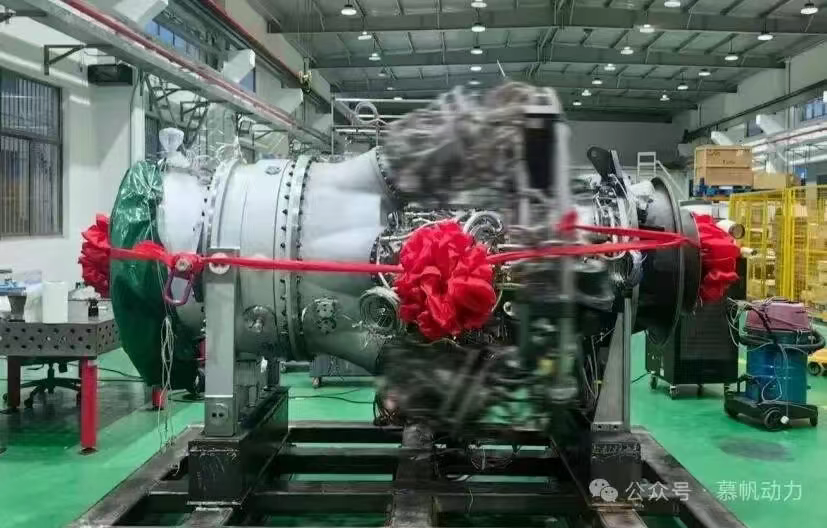
全球首台氢氨双燃料燃气轮机下线,欧美澳等国准备下单
Xin Lang Cai Jing· 2025-09-17 09:37
Core Insights - The successful assembly and launch of the world's first hydrogen-ammonia dual-fuel gas turbine by Shanghai Mufan Power Technology Co., Ltd. marks a significant breakthrough in zero-carbon hydrogen-ammonia dual-fuel power generation technology in China [1][2] - The gas turbine will undergo performance testing at the "Pan-Hydrogen Engine Testing Center" in Inner Mongolia before entering the market application phase [1] - There is a surge of interest from developed countries such as Germany, the United States, and Australia for this innovative technology, indicating its potential for rapid international adoption [1] Company Overview - Mufan Power was established in November 2015 by a team led by Lin Gang, focusing on the research and development of next-generation zero-carbon pan-hydrogen gas turbines [4] - The company aims to break the technological monopoly of foreign giants in the gas turbine sector and ensure China's self-sufficiency in core energy system equipment [2][4] - The product boasts 100% independent intellectual property rights and domestically produced components, with its technology reaching an internationally leading level [2] Technological Innovation - The gas turbine can achieve an annual power generation capacity of up to 70 million kilowatt-hours, utilizing hydrogen and ammonia as fuel to produce zero-carbon electricity [2] - The core technology is a groundbreaking tri-fuel zero-carbon dry low-nitrogen burner, which can combust hydrogen, ammonia, and natural gas without hardware modifications, covering a power range from kilowatts to tens of megawatts [4] - This burner supports various hydrogen carriers, including high-pressure hydrogen, liquid hydrogen, organic liquid storage hydrogen, and industrial by-product hydrogen, providing a critical technological pathway for carbon neutrality [4]
AIDC燃气轮机:燃气轮机海外需求强劲,中国供应链加速切入
2025-09-15 14:57
Summary of Gas Turbine Industry Conference Call Industry Overview - The global gas turbine market is projected to reach approximately $20 billion in 2024, with a high market concentration where Mitsubishi Heavy Industries, Siemens Energy, and GEV hold over 75% of the market share, and about 90% in the heavy-duty segment above 50 MW [1][6][11] - The global gas turbine installed capacity is expected to show cyclical fluctuations closely tied to oil and gas prices, with an estimated capacity of 70 GW in 2024, increasing to 80 GW from 2025 to 2027, and a significant rise in demand from data centers anticipated to add around 20 GW annually from 2028 to 2030 [1][7][10] Key Insights and Arguments - The manufacturing cost structure of gas turbines indicates that blades account for the largest share at 35%, followed by control systems at 18%, and disks at 17% [1][8] - The rapid growth of electricity consumption in U.S. data centers is expected to exceed 10% of total electricity consumption by 2028, with gas turbines likely becoming the primary power source due to the inability of renewable energy sources to meet stable demand in the short term [1][10] - Cumulative demand for gas turbines in U.S. data centers is projected to exceed 20 GW between 2025 and 2028, with global demand and installed capacity expected to reach around 50 GW during the same period [1][11] Competitive Landscape - The core supply chain for gas turbines is predominantly overseas, with companies like PCC, Howmet, IHI, and GEV leading the turbine blade market, while Chinese suppliers like Yingliu and Wanze have smaller scales [1][9] - Chinese companies such as Yingliu (turbine blades), Haomai Technology (heavy-duty turbine steel components), and Hangya Technology (compressor blades) are positioned to benefit from market growth and expand their market share [1][4][14] Development and Opportunities for Chinese Companies - China's gas turbine technology is relatively underdeveloped for capacities above 30 MW, with more maturity in capacities below 30 MW due to the country's abundant coal resources [1][5] - Chinese enterprises have opportunities to penetrate the global supply chain, with Yingliu holding substantial orders and Haomai Technology expected to maintain high growth rates in the coming years [1][14][16] Future Outlook - Major industry players like GEV, Siemens Energy, and Mitsubishi Heavy Industries anticipate sustained demand from data centers at least until 2030, with GEV planning to expand production significantly to meet this demand [1][13] - Companies like Jereh and Linde are also focusing on the power generation sector, with Jereh establishing a team dedicated to the U.S. data center market [1][17][18] Noteworthy Chinese Enterprises - Key Chinese companies to watch in the gas turbine manufacturing sector include Linde, Haomai Technology, Jereh, Hangyu Technology, Hangya Technology, and Wanze, all of which are expected to benefit from the increasing demand driven by AI computing power [1][19]
新华社权威快报丨国内功率最大国产商业投运重型燃气轮机!“太行110”首台套商业机组出厂
Xin Hua She· 2025-09-08 03:02
Core Points - The first commercial unit of the domestically produced heavy-duty gas turbine "Taihang 110" has been manufactured and is set for delivery, marking a significant milestone in China's independent research and development capabilities in this field [2][5]. - The "Taihang 110" is a 110 megawatt class heavy-duty gas turbine, which signifies the entry of China's self-developed technology into a new phase of commercialization [3][5]. - Heavy-duty gas turbines are essential for efficient energy conversion and clean utilization, serving as a core equipment in various applications and a key indicator of an industrially strong nation [5]. Industry Insights - The successful production of the "Taihang 110" highlights China's growing capabilities in heavy-duty gas turbine technology, an area where only a few countries globally possess independent research and development capabilities [5]. - The development of this gas turbine is expected to enhance China's energy efficiency and support the transition towards cleaner energy sources [5].
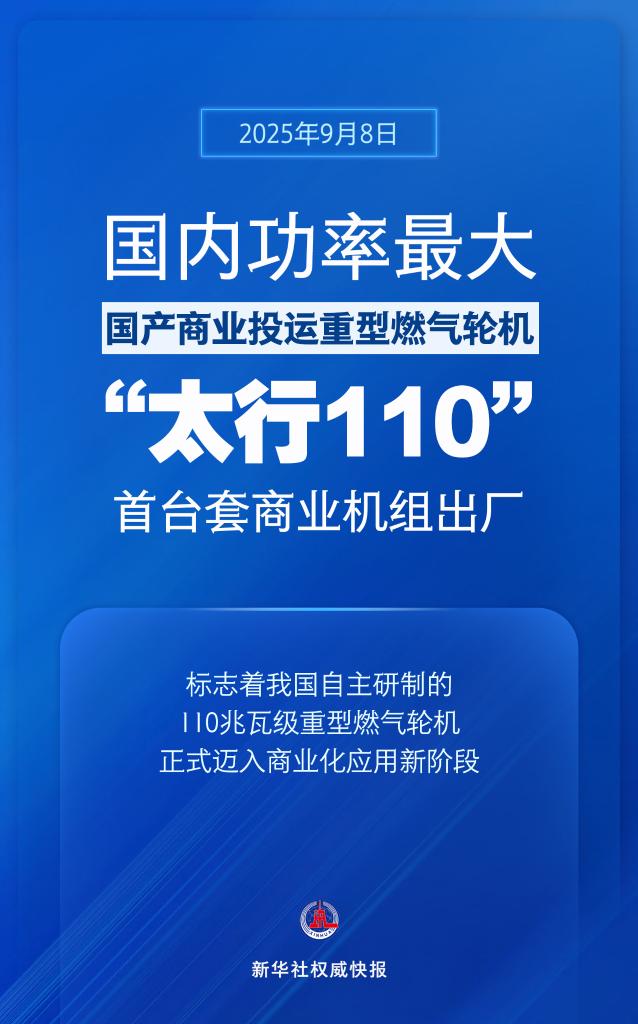
新华社权威快报|国内功率最大国产商业投运重型燃气轮机!“太行110”首台套商业机组出厂
Xin Hua She· 2025-09-08 02:58
Core Points - The first commercial unit of the domestically produced heavy-duty gas turbine "Taihang 110" has been manufactured and is set for delivery, marking a significant milestone in China's independent research and development capabilities in this field [2][4] - The "Taihang 110" is a 110 megawatt class heavy-duty gas turbine, which signifies the entry of China's self-developed technology into a new phase of commercialization [3][4] - Heavy-duty gas turbines are essential for efficient energy conversion and clean utilization, serving as a core equipment in various applications and a key indicator of an industrially strong nation [4] Industry Insights - The development of the "Taihang 110" highlights China's growing capabilities in high-tech manufacturing, particularly in the energy sector, where only a few countries possess the ability to independently develop such advanced technology [3][4] - The successful production of the "Taihang 110" is expected to enhance China's energy efficiency and contribute to the country's goals of cleaner energy utilization [4]
国内功率最大国产商业投运重型燃气轮机!“太行110”首台套商业机组出厂
Xin Hua She· 2025-09-08 02:56
Core Points - The first commercial unit of the domestically produced heavy-duty gas turbine "Taihang 110" has been manufactured and is set for delivery, marking a significant milestone in China's independent research and development capabilities in this field [2][5]. - The "Taihang 110" is a 110 megawatt class heavy-duty gas turbine, which signifies the entry of China's self-developed technology into a new phase of commercialization [3][5]. - Heavy-duty gas turbines are essential for efficient energy conversion and clean utilization, serving as a core equipment in various applications and a key indicator of an industrially strong nation [5]. Industry Insights - The development of the "Taihang 110" highlights China's growing capabilities in high-tech manufacturing, particularly in the energy sector, where only a few countries possess the ability to independently develop such technology [3][5]. - The successful production of the "Taihang 110" is expected to enhance China's energy efficiency and contribute to the country's goals of cleaner energy utilization [5].
国内功率最大国产商业投运重型燃气轮机“太行110”首台套商业机组出厂
Xin Hua She· 2025-09-08 02:42
Core Insights - The first commercial unit of the domestically developed heavy-duty gas turbine "Taihang 110" has been produced and is set for delivery, marking a new phase in the commercialization of China's 110 MW heavy-duty gas turbine technology [5] Group 1: Company Developments - The "Taihang 110" gas turbine is the largest domestically produced commercial heavy-duty gas turbine in China, indicating significant advancements in the country's energy technology capabilities [5] - The successful production of the "Taihang 110" highlights China's independent research and development capabilities in heavy-duty gas turbine technology, a field where only a few countries globally possess such capabilities [5] Group 2: Industry Significance - Heavy-duty gas turbines are essential for efficient energy conversion and clean utilization, serving multiple applications across various industries, thus representing a critical component for industrial power [5] - The development of the "Taihang 110" gas turbine is a significant milestone for China's energy sector, reflecting the country's ambitions to enhance its industrial strength and technological independence [5]
海联讯: 天健会计师事务所(特殊普通合伙)关于杭州海联讯科技股份有限公司换股吸收合并杭州汽轮动力集团股份有限公司申请的审核问询函中有关财务事项的说明(修订稿)
Zheng Quan Zhi Xing· 2025-09-03 05:11
Company Overview - Hangzhou Hailianxun Technology Co., Ltd. (referred to as Hailianxun or the company) is undergoing a share swap merger with Hangzhou Turbine Power Group Co., Ltd. [1] - The main business of the merged entity includes the design, manufacturing, installation, and operation of industrial steam turbines, gas turbines, generators, and hydraulic turbines [1][2]. Financial Performance of the Merged Entity - The financial performance of the merged entity shows a continuous decline in gross profit and profit margins over the reporting periods, with gross profits of 1.294 billion yuan, 1.178 billion yuan, and 939 million yuan, and gross margins of 29.30%, 26.78%, and 21.21% respectively [1][2]. - The net profit for the reporting periods was 708 million yuan, 736 million yuan, and 638 million yuan, indicating a downward trend [2][3]. Market Conditions and Competitive Landscape - The industrial steam turbine market is facing increased competition due to the "dual carbon policy" and the impact of new energy units on traditional turbine markets, leading to a decline in production and sales [1][9]. - The global steam turbine manufacturing market is projected to grow from 28.375 billion USD in 2024 to 33.752 billion USD by 2032, with a compound annual growth rate of 2.19% [9][24]. Product Segmentation and Sales Dynamics - The merged entity's product offerings include industrial drive steam turbines and industrial power generation steam turbines, with the former accounting for 33.61% of the revenue from steam turbine business [7][12]. - The sales price of industrial drive steam turbines was 1,003.82 thousand yuan in 2024, while the sales price for industrial power generation turbines was 870.79 thousand yuan [14]. Strategic Initiatives and Future Outlook - The company is focusing on enhancing its market position by improving order structures and cost control, with a reported increase in the proportion of industrial drive steam turbine revenue from approximately 40% in 2024 to around 50% in the first quarter of 2025 [18]. - The company has a robust order backlog exceeding 6 billion yuan for industrial steam turbines, indicating a solid foundation for future operations [22]. Technological Advancements - The company has established a comprehensive technology and product research and development system, with multiple national-level innovation platforms to support its technological capabilities [26][27]. - The company has developed unique technologies in the turbine field, enhancing production efficiency and product performance, which are critical for maintaining competitive advantages in the market [27][29].

海联讯: 关于杭州海联讯科技股份有限公司换股吸收合并杭州汽轮动力集团股份有限公司申请的审核问询函之回复报告(修订稿)
Zheng Quan Zhi Xing· 2025-09-03 05:11
Core Viewpoint - The merger between Hangzhou Hailianxun Technology Co., Ltd. and Hangzhou Turbine Power Group Co., Ltd. is under scrutiny, focusing on the operational performance and sustainability of the latter, which has shown declining profitability in recent years [1][2]. Group 1: Company Performance - Hangzhou Turbine Power Group's main business includes the design, manufacturing, installation, and operation of industrial steam turbines, gas turbines, generators, and hydraulic turbines [2]. - The company's gross profit and profit margins have been declining, with gross profits of 1.294 billion, 1.178 billion, and 939 million yuan, and gross margins of 29.30%, 26.78%, and 21.21% over the reporting periods [2][12]. - The net profits for the reporting periods were 708 million, 736 million, and 638 million yuan, indicating a downward trend [2]. Group 2: Market Conditions - The global steam turbine market is projected to grow from $28.375 billion in 2024 to $33.752 billion by 2032, with a compound annual growth rate of 2.19% [6][23]. - The Chinese steam turbine market is expected to maintain a scale of 35-40 billion yuan in the coming years, despite pressures from the "dual carbon policy" and adjustments in the traditional energy structure [6][23]. - The industrial steam turbine market in China is facing challenges due to increased competition and a shift towards renewable energy sources, impacting traditional steam turbine sales [7][10]. Group 3: Competitive Landscape - The steam turbine market is characterized by a "multi-polar and tiered" competition structure, with international leaders like Siemens Energy and General Electric dominating the global market [9][10]. - Domestic players such as Dongfang Electric and Shanghai Electric lead the market, with Hangzhou Turbine Power maintaining a significant share in the industrial drive turbine sector [10][21]. - Hangzhou Turbine Power has a competitive edge in customized turbine manufacturing, allowing it to meet specific client needs effectively [15][25]. Group 4: Future Prospects - The company has a robust order backlog exceeding 6 billion yuan, indicating a solid foundation for future operations [20]. - The focus on energy efficiency and carbon reduction is expected to create new growth opportunities in equipment upgrades and energy-saving retrofits [23][24]. - The company is actively expanding its market presence in Southeast Asia and the Middle East, targeting new projects that align with its capabilities [23][24].
