光伏制造

Search documents
金融法草案向社会公开征求意见,北证50下跌1.01%
Soochow Securities· 2026-03-22 07:50
Market Performance - On March 20, 2026, the Beijiao 50 index decreased by 1.01%[1] - The average market capitalization of Beijiao stocks is 2.799 billion yuan, with a trading volume of 16.230 billion yuan, down by 0.273 billion yuan from the previous trading day[1] - The ChiNext index rose by 1.30%, while the A-share index and the Shanghai Composite Index both fell by 1.24%[1] Capital Market News - The draft of the Financial Law was publicly solicited for opinions, aiming to enhance financial regulation and risk prevention[6] - Significant breakthroughs in mineral exploration were reported in Sichuan, including rare earths and fluorite[7] Company Announcements - Copper Crown Mining announced the resignation of a board member effective March 20, 2026, with no adverse impact on operations[21] - Yishin Precision proposed a stock incentive plan involving 3 million restricted shares, representing 2.59% of the total share capital[19] Risk Factors - Potential risks include individual stock earnings falling short of expectations, intensified industry competition, and worsening trade frictions[23]
2月9日主题复盘 | 三大指数集体大涨,光通信全线强势,光伏热度不减,AI应用再度爆发
Xuan Gu Bao· 2026-02-09 08:38
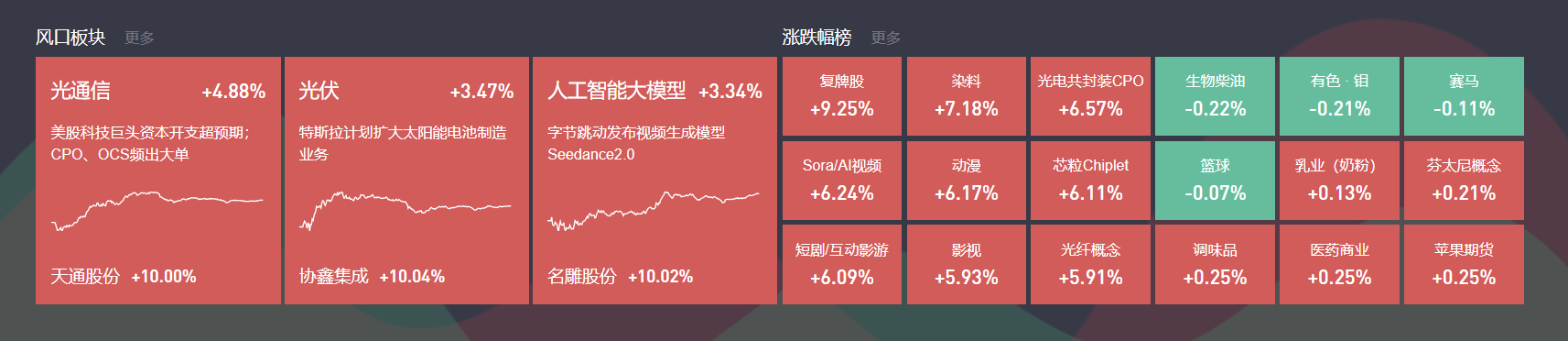
Market Overview - The market experienced a strong upward trend, with the Shanghai Composite Index rising over 1% and surpassing 4100 points, while the Shenzhen Component Index increased by over 2% and the ChiNext Index rose nearly 3% [1] - AI application stocks showed active performance, with companies like 360 and Zhongwen Online hitting the daily limit [1] - The computing power hardware sector saw explosive growth, with stocks like Jepu Tech and Changfei Fiber reaching new highs [1] - The photovoltaic sector continued its upward momentum, with stocks such as Jinjing Technology and TCL Zhonghuan also hitting the daily limit [1] - Overall, more than 4600 stocks in the Shanghai and Shenzhen markets were in the green, with a total trading volume of 2.27 trillion [1] Key Sectors Optical Communication - The optical communication sector saw significant gains, with stocks like Jepu Tech and Tiantong Co. hitting the daily limit, and Tianfu Communication rising over 17% to reach a historical high [4] - Lumentum, a leader in optical communication, reported new multi-million dollar CPO orders, contributing to a 9.4% increase in its stock price [4] - The overall market for optical interconnection is expected to maintain rapid expansion, driven by various network connection scenarios [6] Photovoltaics - The photovoltaic sector experienced another surge, with companies like GCL-Poly, Yamaton, and TCL Zhonghuan hitting the daily limit [6] - Tesla is evaluating multiple sites in the U.S. to expand its solar cell manufacturing business, aiming for an annual production capacity of 100 gigawatts over the next three years [6] AI Applications - AI application stocks surged, with companies like Mingdiao Co., Rongxin Culture, and Haikan Co. hitting the daily limit [8] - ByteDance launched the Seedance 2.0 video generation model, which supports various input types and significantly enhances video generation capabilities [8] - The introduction of Seedance 2.0 is expected to reduce production costs dramatically, making AI video generation a viable industrial tool [8][10] Notable Stocks - Jepu Tech (688025) saw a 20% increase, driven by CPO developments [15] - GCL-Poly (002506) achieved a 10.04% rise, reflecting strong market interest in photovoltaic solutions [7] - Mingdiao Co. (002830) rose by 10.02%, benefiting from advancements in AI applications [9]


沸腾!暴涨原因,找到了!
Zhong Guo Ji Jin Bao· 2026-02-09 07:52
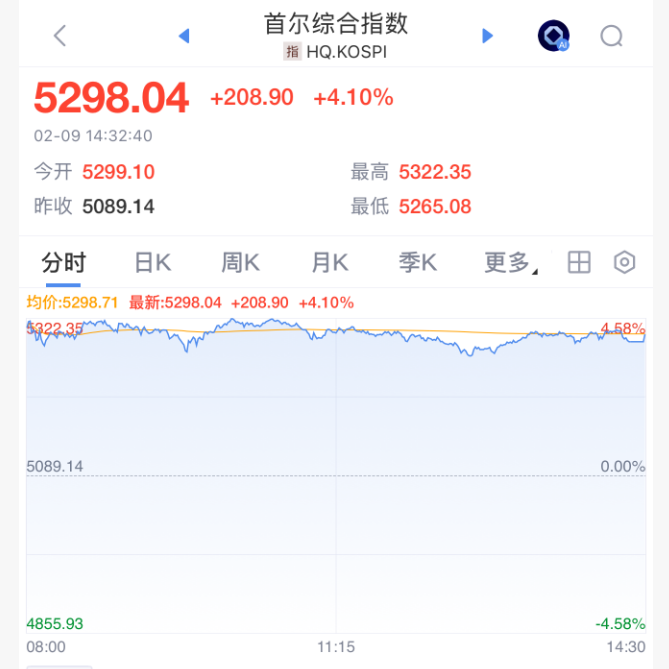
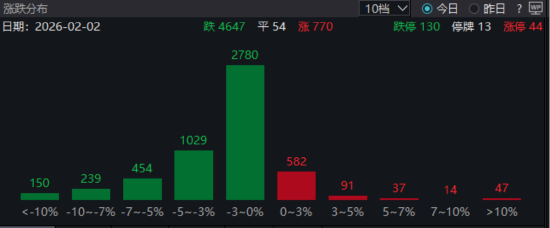
Market Overview - Risk assets across Asia surged, with the MSCI Asia Pacific Index rising 2.4% to reach a historical high, and the KOSPI index in South Korea increasing by 4.1% [1] - The Nikkei 225 index jumped 5.7% following the election victory of a pro-business candidate, marking a record high [1] Gold and Silver Performance - Gold and silver prices continued to rise, attributed to a rebound that reflects a recovery from uncertainty rather than a pursuit of risk [2] - Analysts noted that the strong performance of the U.S. market last Friday and clearer political outcomes in Japan and Thailand helped stabilize market sentiment [2] Chinese Market Surge - On February 9, Chinese A-shares and Hong Kong stocks experienced significant gains, with the Shanghai Composite Index rising 1.41% to surpass 4100 points [3] - The Shenzhen Component Index increased by 2.17%, and the ChiNext Index rose by 2.98% [3] Stock Performance Statistics - A total of 4,612 stocks in the A-share market rose, with 96 stocks hitting the daily limit up, while 759 stocks declined [5] - The total trading volume in the A-share market reached 22,701.79 billion [6] AI Sector Activity - The AI application sector saw active performance, with stocks like 360 and Chinese Online hitting the daily limit up [6] - The launch of the AI video generation model Seedance 2.0 by ByteDance has garnered significant attention, with analysts praising its capabilities [6][7] Semiconductor and Hardware Stocks - Semiconductor stocks, including Jeput and Changfei Optical Fiber, reached new highs, driven by a partnership between Tower Semiconductor and NVIDIA to enhance AI infrastructure [11][12] Solar Energy Sector - The solar panel sector continued its upward trend, with companies like Jinjing Technology and TCL Zhonghuan hitting the daily limit up, as Tesla accelerates its solar manufacturing plans [12]
中国光伏制造行业展望
Zhong Cheng Xin Guo Ji· 2026-02-06 09:36
Investment Rating - The report maintains a "stable weakening" rating for the Chinese photovoltaic manufacturing industry, with an expectation of overall credit quality weakening in the next 12 to 18 months, but still above a "negative" status level [6]. Core Insights - The report observes a slowdown in domestic photovoltaic installation demand in 2026, with a decline in export growth due to various factors including policy adjustments and geopolitical risks. The industry is expected to continue reducing production and controlling prices, leading to a gradual recovery in prices across the supply chain, although the overall supply-demand imbalance is unlikely to be fundamentally resolved in the short term [6][16]. - The long-term outlook suggests that as outdated capacities are eliminated, industry concentration will increase, and the development environment for the photovoltaic manufacturing industry is expected to improve [6]. Industry Fundamentals - The photovoltaic industry is supported by policy guidance focusing on "capacity control" and "price regulation," with efforts to eliminate "involution" competition. The industry is transitioning from administrative directives to a system of institutional constraints and market-based clearing [8]. - The domestic photovoltaic installation capacity saw a significant increase in the first half of 2025, driven by policy incentives, but is expected to decline in the latter half of the year due to market adjustments and reduced demand [10][11]. Financial Performance - The report indicates that the financial performance of the industry remains under pressure, with many companies facing liquidity challenges. However, leading firms are managing to maintain reasonable liquidity levels due to accumulated operational experience and bank credit support [6][16]. - The report highlights that the overall profitability of the industry is still low, with many companies experiencing losses, particularly in the component manufacturing segment [35][36]. Conclusion - The report concludes that while the photovoltaic manufacturing industry is facing significant challenges, including a complex international trade environment and domestic policy changes, there are opportunities for recovery through industry consolidation and improved operational efficiencies [6][16].
2025年A股1442家公司预亏,行业“亏损王”浮出
Di Yi Cai Jing Zi Xun· 2026-02-04 15:12
Core Insights - Nearly 50% of the 2957 A-share listed companies that disclosed their 2025 annual performance forecasts are expected to incur losses [2][3] - The real estate sector is identified as the most affected, with Vanke A (000002.SZ) being the largest loss-maker, projecting a net loss of approximately 82 billion yuan [6][7] Provincial Distribution of Losses - The provinces with the highest proportion of companies expecting losses are Hainan (44.44%), Jilin (41.67%), and Qinghai (40%) [4][5] - Guangdong has the highest number of companies expecting losses at 257, followed by Beijing (172), Jiangsu (160), and Zhejiang (133) [3][4] Industry Analysis - The IT services and software development sectors have the highest number of companies forecasting losses, with 60 companies each, followed by the real estate sector with 54 companies [6] - The top ten companies with the highest expected losses include five from the real estate sector, with Vanke A leading the list [6][7] Notable Loss-Makers - Vanke A is projected to incur a net loss of about 82 billion yuan due to decreased project settlement scale and increased business risks [6][7] - Other significant loss-makers in the real estate sector include China Fortune Land Development (华夏幸福) with expected losses between 16 billion to 24 billion yuan and Greenland Holdings (绿地控股) with losses of 16 billion to 19 billion yuan [7] - In the retail sector, M.K. Home (美凯龙) is expected to report a loss of 15 billion to 22.5 billion yuan, primarily due to investment property valuation losses [7][8] Sector-Specific Losses - The home appliance sector's largest loss-maker is Shenzhen Konka (深康佳A), projecting losses of 12.58 billion to 15.57 billion yuan [8] - The vaccine leader Zhifei Biological Products (智飞生物) is also expected to report a first-time loss of 10.7 billion to 13.73 billion yuan due to decreased public vaccination willingness [8] - In the photovoltaic sector, Tongwei Co. (通威股份) is projected to incur losses of 9 billion to 10 billion yuan due to industry oversupply and rising raw material costs [9]




光伏企业突遭立案调查,股价曾暴涨数倍
Xin Lang Cai Jing· 2026-02-04 13:34
Core Viewpoint - The company, Baoxin Technology, is facing significant scrutiny due to allegations of information disclosure violations and financial mismanagement, leading to a sharp decline in stock price and investor confidence [1][2][3] Group 1: Financial Performance and Issues - Baoxin Technology announced a substantial narrowing of losses in its annual performance forecast, but simultaneously disclosed an investigation into potential information disclosure violations [1] - The company reported a dramatic decline in revenue from its new energy business, plummeting from 242 million yuan in 2023 to 83 million yuan in 2024, and further down to just 7.32 million yuan in the first half of 2025 [3] - The company has entered a continuous loss cycle, with profits of 30.39 million yuan in 2022 turning into losses of 193 million yuan in 2023, 767 million yuan in 2024, and 54.46 million yuan in the first three quarters of 2025 [3] Group 2: Corporate Governance and Compliance Issues - The controlling shareholder and related parties have been involved in non-operating fund occupation, with a total of 88 million yuan occupied from September 2022 to October 2023, raising concerns about internal control mechanisms [2] - The company has a history of regulatory scrutiny, having received warnings from the Shenzhen Stock Exchange for delayed and inaccurate performance forecasts as early as 2017 [1][2] - An ongoing investigation by the China Securities Regulatory Commission could lead to administrative penalties for the company and responsible personnel if violations are confirmed [3] Group 3: Investment and Market Response - Baoxin Technology made significant investments in the photovoltaic manufacturing sector, announcing plans totaling nearly 9 billion yuan, despite having only about 365 million yuan in cash at one point [2] - The company's stock price surged dramatically after entering the photovoltaic sector, but has since faced a severe downturn, with a trading halt following the recent announcements [1][3] - The company is currently facing claims from local governments for over 470 million yuan in equity investment and penalties due to unfulfilled investment agreements [3]

中金 | 太空光伏:冉冉升起的卫星能源市场
中金点睛· 2026-02-02 23:55
Core Viewpoint - The rapid development of commercial aerospace is driving the evolution of space photovoltaics as a core direction for power system upgrades, with a focus on the transformation of the entire industry chain and the manufacturing sector's intensive delivery [1][2]. Group 1: Commercial Aerospace and Market Dynamics - The space economy has become a core competitive arena in technology, with photovoltaics being the preferred energy source in space environments [2]. - The global low Earth orbit (LEO) satellite layout is accelerating, driven by the increasing number of satellites and the expansion of single-satellite power consumption [2][3]. - The demand for space solar arrays is being driven by the need for cost reduction and efficiency improvements in the context of satellite manufacturing entering an industrialized production era [2][3]. Group 2: Technological Evolution and Market Potential - The technology routes for space photovoltaics are diversifying, with a market potential expected to reach hundreds of billions by 2025-2030, primarily serving traditional low Earth orbit applications [2][3]. - The evolution of solar cell technology is moving from silicon to gallium arsenide and high-efficiency heterojunction (HJT) and perovskite solutions, indicating a broad market space [2][3][26]. Group 3: Industry Chain and Competitive Landscape - The space photovoltaic industry chain includes manufacturing, launching, and operational services, with a focus on the verification cycles provided by actual satellite windows [3][5]. - Companies with the capability for in-orbit verification and production line implementation are expected to gain a first-mover advantage in the market [3][39]. - The competitive landscape is characterized by the need for space environment testing capabilities and collaboration with satellite constellation projects [39]. Group 4: Emerging Applications and Demand Forecast - The demand for space photovoltaics is projected to grow significantly, particularly with the rise of space computing applications, which will further expand the power consumption needs of satellites [2][10]. - The market for space photovoltaics is expected to see a stepwise increase post-2030, contingent on optimistic deployment scenarios for space computing [2][38]. Group 5: Technological Routes and Innovations - Various technological routes are emerging in space photovoltaics, including multi-junction gallium arsenide, HJT, and perovskite technologies, each with distinct advantages and challenges [26][30][36]. - The focus on energy quality ratio, flexibility, and cost-effectiveness is driving innovation in solar cell technologies suitable for space applications [26][30].

ETF日报:随着反内卷政策的实质性落地以及AI算力对能源需求的拉动 光伏行业有望迎来“量利齐升”的修复周期
Xin Lang Cai Jing· 2026-02-02 23:19
Market Overview - The A-share market experienced a significant decline, with the Shanghai Composite Index dropping 2.48% to 4015.75 points and the Shenzhen Component Index falling 2.69% to 13824.35 points, as trading volume reached 2.6 trillion yuan, slightly lower than the previous day [1] - The market sentiment was negatively impacted by the nomination of Kevin Warsh as the next Federal Reserve Chairman, raising concerns about prolonged high interest rates and a notable drop in risk appetite [1] Pharmaceutical and Biotech Sector - The pharmaceutical and biotech sector demonstrated strong capital attraction, with the Guotai Innovation Drug ETF (589720) seeing a net inflow of 667 million yuan over ten consecutive trading days [3][4] - Key mergers and acquisitions, such as China Biopharmaceutical's acquisition of Hejia Biotech for 1.2 billion yuan and Rongchang Biopharmaceutical's exclusive licensing agreement with AbbVie worth up to 650 million USD, have boosted market confidence and highlighted the global competitiveness of Chinese pharmaceutical companies [3][4] - The investment logic in the pharmaceutical sector is supported by "innovation realization" and "valuation recovery," as domestic innovative drugs enter a commercialization and internationalization phase [3][4] Solar Energy Sector - The solar energy sector saw a strong performance, with the solar industry index rising over 2% before retreating, driven by Tesla CEO Elon Musk's proposal for a "space solar" project [5][6] - The sector is transitioning from a "post-decline rebound" to a deeper "supply-demand pattern reshaping," with significant potential for Chinese solar companies due to their advantages in equipment and core material supply [5][6] - The solar industry has faced intense price competition, leading to significant losses for major players, but recent policies aimed at reducing competition and clearing out outdated capacity are expected to enhance market concentration and improve the profitability of leading firms [5][6] Electric Grid Sector - The electric grid sector is experiencing robust domestic demand, with transformer factories in regions like Guangdong and Jiangsu operating at full capacity, and significant investments expected from the State Grid Corporation [7][8] - Major electric grid equipment companies reported impressive earnings, with projected revenues of 21.205 billion yuan, a 37.18% increase year-on-year, and net profits of 3.163 billion yuan, up 54.35% from the previous year [7][8] - The global energy transition is driving demand for electric grid construction, particularly in underdeveloped regions, presenting substantial growth opportunities for domestic electric grid companies [7][8] Precious Metals Sector - The precious metals sector, particularly gold, is undergoing significant volatility, with COMEX gold prices dropping below 4500 [9][10] - Concerns over monetary policy tightening following Warsh's nomination have led to market sell-offs, exacerbated by high leverage and profit-taking after previous price surges [9][10] - Despite short-term adjustments, long-term support for gold prices remains due to expectations of Federal Reserve rate cuts and ongoing geopolitical tensions [9][10]
又一光伏企业及实控人遭立案调查,公司股价曾两个月内暴涨数倍
2 1 Shi Ji Jing Ji Bao Dao· 2026-02-02 13:09
Core Viewpoint - Baoxin Technology has faced significant scrutiny following a series of announcements regarding its financial performance and an ongoing investigation for suspected information disclosure violations, leading to a sharp decline in its stock price and investor confidence [1][3]. Group 1: Company Transformation and Financial Performance - Baoxin Technology, originally a traditional smart manufacturing company, began its transformation towards the renewable energy sector in 2020, with a focus on solar manufacturing starting in 2022 [3]. - The company announced nearly 9 billion yuan in investments for solar projects, despite having only about 365 million yuan in cash at the time, leading to a 3 billion yuan fundraising plan in March 2023 [3]. - By the end of 2024, out of multiple solar projects totaling over 12 GW, only a 500 MW project in Lianyungang was completed, resulting in a drastic decline in revenue from the renewable energy sector, dropping from 242 million yuan in 2023 to 83 million yuan in 2024, and further to just 7.32 million yuan in the first half of 2025 [5]. Group 2: Management Changes and Corporate Governance - The company has experienced significant management instability, changing its chairman three times within a year, alongside multiple high-level executive departures [5]. - The rapid turnover in leadership has coincided with the company's financial struggles, including a cumulative loss exceeding 1 billion yuan from 2023 to the third quarter of 2025, with a record loss of 767 million yuan in 2024 [5]. Group 3: Legal and Regulatory Issues - The ongoing investigation into Baoxin Technology is related to suspected violations of information disclosure laws, marking a continuation of regulatory scrutiny that began in 2017 due to inaccurate earnings forecasts [7]. - The company faces potential delisting risks if its audited financial data for 2025 shows negative net assets, as projected revenues may fall below 300 million yuan [7].

又一光伏企业及实控人遭立案调查,公司股价曾两个月内暴涨数倍
21世纪经济报道· 2026-02-02 12:58
Core Viewpoint - The article discusses the dramatic transformation and subsequent challenges faced by Baoxin Technology, highlighting its aggressive shift into the photovoltaic sector, significant financial losses, and management instability, culminating in a regulatory investigation for information disclosure violations [1][4][6]. Group 1: Company Background and Transformation - Baoxin Technology began as a traditional smart manufacturing company, primarily focused on precision CNC sheet metal manufacturing since its listing in 2010 [2]. - In 2020, the company aimed to pivot towards the renewable energy sector, with a significant shift occurring in 2022 as it announced multiple large-scale investments in the photovoltaic manufacturing industry, totaling nearly 9 billion yuan [2]. - The company’s stock price surged dramatically after entering the photovoltaic sector, increasing several times within two months and achieving 17 appearances on the stock market's leaderboard [2]. Group 2: Financial Performance and Losses - Despite the ambitious investments, Baoxin Technology's photovoltaic projects have largely stalled, with only one 500MW project completed by the end of 2024, while the company reported a sharp decline in revenue from its new energy business, dropping from 242 million yuan in 2023 to just 7.32 million yuan in the first half of 2025 [4]. - Cumulatively, the company has incurred losses exceeding 1 billion yuan from 2023 to the first three quarters of 2025, with a record loss of 767 million yuan in 2024, marking the worst financial year since its IPO [4]. Group 3: Management Instability - The company has experienced significant management turnover, changing its chairman three times within a year in 2024, alongside the departure of several key executives, including vice-chairmen and financial directors [4]. Group 4: Regulatory Issues and Investor Impact - Baoxin Technology is currently under investigation for suspected violations of information disclosure laws, a concern that has arisen previously due to inadequate performance forecasts and potential stock price manipulation [6]. - The company faces urgent performance pressures, with forecasts indicating a potential revenue drop below 300 million yuan in 2025, raising the risk of negative net assets and possible delisting warnings [6].