
生物能源

Search documents
生物航煤订单已排至年底!嘉澳环保:第三季度营收17.07亿元,同比增长511.45%!
synbio新材料· 2025-10-20 08:04
Core Viewpoint - The article highlights the significant growth in revenue for Jiaao Environmental Protection, driven by its successful expansion in the bio-aviation fuel sector, despite still facing net losses in the first three quarters of 2025 [1][2]. Group 1: Financial Performance - In Q3 2025, Jiaao Environmental Protection reported a revenue of 1.707 billion yuan, representing a year-on-year increase of 511.45% [1]. - For the first three quarters of 2025, the total revenue reached 3.005 billion yuan, with a year-on-year growth of 189.39% [1]. - The net profit attributable to shareholders for the first three quarters was a loss of 25.366 million yuan, indicating a reduction in the loss compared to the previous year [1]. Group 2: Business Expansion and Achievements - The substantial revenue growth is primarily attributed to the increase in sales of bio-aviation fuel from Lianyungang Jiaao, showcasing the company's successful positioning in this market [2]. - The Lianyungang Jiaao Bio-aviation Fuel Project, constructed by its subsidiary, began construction in April 2023 and is expected to start trial production in November 2024, featuring two new 500,000-ton/year bio-aviation fuel units [2]. - Jiaao Environmental Protection became the first company in China to be included in the "white list" for bio-aviation fuel exports, successfully exporting 13,400 tons of bio-aviation fuel [2]. Group 3: Product Performance - In the first three quarters of 2025, the production capacity for biomass energy products was 261,000 tons, with sales volume reaching 203,500 tons, generating revenue of 246.1 million yuan [3]. - The main products and their performance include: - Environmental plasticizers: Production of 54,244.47 tons, sales of 58,690.595 tons, and revenue of 498.59 million yuan [4]. - Environmental stabilizers: Production of 3,626.218 tons, sales of 3,474.100 tons, and revenue of 38.51 million yuan [4]. - Biomass energy: Production of 260,960.140 tons, sales of 203,512.742 tons, and revenue of 246.14 million yuan [4].



全球生物能源面临原料供应瓶颈
Zhong Guo Hua Gong Bao· 2025-10-20 03:27
Core Insights - The latest report by DNV indicates that sustainable biomass production can only meet 30% of the total demand for bio-based fuels across various industries, posing significant challenges for decarbonization efforts [1] - DNV forecasts that while bioenergy demand will grow from 57 exajoules to 77 exajoules by 2050, the limited supply of sustainable biomass will force competing industries to make difficult choices regarding resource allocation [1] Biofuels in Aviation - The impact of raw material limitations on bio-based aviation fuel is particularly severe, with DNV predicting that sustainable aviation fuel (SAF) will only meet 4% of global aviation fuel demand by 2030, peaking at 30% by 2060, which is significantly lower than industry visions and regulatory targets [1] - The HEFA (Hydroprocessed Esters and Fatty Acids) technology is currently the only viable method for large-scale production of sustainable aviation fuel, but it faces severe raw material shortages, with estimates suggesting it will only satisfy 5% of global aviation fuel demand by 2030 [1] Biofuels in Shipping - In contrast to the aviation sector, DNV predicts that by 2060, the shipping industry will become the largest consumer of bioenergy in the transportation sector, with biofuels accounting for 26% of its total energy demand, surpassing the 25% fossil fuel usage [2] - The International Maritime Organization's (IMO) binding "Net Zero Framework," which includes a global carbon pricing mechanism starting in 2028, is a key driver for the increased demand for biofuels in shipping [2] - DNV expects that by 2030, the market share of biofuels in the shipping industry will rise to 4%, with a projected 77% reduction in CO2 emissions by 2050, although the goal of "net zero emissions by around 2050" may not be fully achievable [2] Biofuels in Road Transport - The demand for biofuels in the road transport sector is expected to peak and then decline as the electrification process accelerates, with DNV forecasting that by 2032, electric vehicles will account for over 50% of global passenger car sales [2] - In regions like Latin America and Southeast Asia, biofuels will play a "moderate role" in replacing oil, making up about 5% of road transport energy demand, with bioenergy and hydrogen combined only meeting 1% of global passenger car energy needs by 2060 [2] Biofuels in Industrial Manufacturing - DNV emphasizes that industrial manufacturing, particularly in high-temperature production processes, is a key growth area for modern bioenergy, especially biogas [3] - Biogas is expected to meet 10% of total bioenergy demand by 2060, with the highest shares in Europe and the OECD Pacific region [3] - As the demand for biofuels approaches technical supply limits, sustainability pressures are increasing, with potential conflicts arising from land use for energy crops versus food crops and natural ecosystems [3]
海新能科获生物航煤出口资质,抢占SAF高景气赛道获资机构聚焦
Zheng Quan Shi Bao Wang· 2025-10-20 00:22
Core Viewpoint - Company has made significant progress in the bio-jet fuel (SAF) sector, obtaining export qualifications and enhancing its international competitiveness, which is expected to positively impact its business development [1][3][5]. Group 1: Export Qualification and Production Capacity - The company’s subsidiary, Shandong Sanju Bioenergy Co., has received approval for bio-jet fuel export with a certified capacity of 158,000 tons, which will help expand its overseas market presence [1][2]. - The company has established a stable operation for its 200,000 tons/year biodiesel isomerization project, producing approximately 160,000 tons of bio-jet fuel annually, with a full production schedule for Q4 [2][5]. Group 2: Market Trends and Future Demand - The SAF market is expected to grow significantly, with China's SAF demand projected to reach about 3 million tons by 2030, and global demand expected to rise to 18 million tons by 2030 and 350 million tons by 2050 [5][6]. - The company is well-positioned in the SAF market due to its early compliance with regulatory requirements and its status as one of the few companies on the bio-jet fuel export "white list" [3][4]. Group 3: Financial Performance and Cost Management - The company has improved its operational management and reduced processing costs, enhancing its cost competitiveness for export products [6][7]. - Recent trends indicate a rise in SAF prices due to mandatory blending policies and increasing raw material costs, suggesting a favorable market environment for the company [7][9]. Group 4: Corporate Structure and Strategic Support - The company has undergone a change in its indirect controlling shareholder, which is expected to optimize management efficiency and enhance support for its operations [10][12]. - The new shareholder structure aims to facilitate the sustainable development of the company and strengthen its position in the bio-energy sector [10][12].

海新能科(300072) - 300072海新能科投资者关系活动记录表附件:海新能科及生物能源产业介绍
2025-10-16 09:48
Group 1: Company Overview and Achievements - Beijing Haineng Energy Technology Co., Ltd. is a publicly listed company controlled by the State-owned Assets Supervision and Administration Commission of Haidian District, Beijing [6] - Established in 1997 and listed in 2010 with stock code 300072 [7] - One of the first domestic enterprises to research, produce, and sell hydrocarbon-based biodiesel [8] - Focuses on innovation-driven development, forming a business model centered on bioenergy, catalytic purification (environmental materials), and specialty chemicals [9] Group 2: Core Business Areas - Main business areas include bioenergy and environmentally friendly materials [12] - Bioenergy is the primary focus, encompassing technology R&D, product production, raw material procurement, and sales [13] - Hydrocarbon-based biodiesel has high calorific value, low oxygen content, high cetane number, and extremely low levels of aromatics and sulfur, achieving a sulfur content of less than 1 ppm [14][16] - Production capacity includes approximately 300,000 tons of high-congealing biodiesel and 200,000 tons of low-congealing biodiesel [18] Group 3: Industry Trends and Market Potential - Global hydrocarbon-based biodiesel consumption has grown at an average annual rate of 26.9% from 2014 to 2023, with a projected growth rate of 16.38% from 2024 to 2028 [37] - The EU is the largest biodiesel production region, implementing policies to promote healthy industry development [40] - China's biodiesel industry is supported by continuous government encouragement and policy releases, indicating a growing market demand [41] Group 4: Sustainable Aviation Fuel (SAF) Development - SAF is produced from biomass and has similar combustion properties to traditional fossil jet fuel, with a lifecycle CO2 reduction of 50% to 90% compared to conventional jet fuel [33] - By 2025, global SAF consumption is expected to reach 6.4 million tons, increasing to 36 million tons by 2050 [45] - China is expected to reach a SAF demand of approximately 3 million tons by 2030, aligning with international aviation industry targets [48] Group 5: Policy Support and Future Outlook - The Chinese government has issued various policies to support the development of SAF, indicating a positive attitude towards the industry's growth [57] - The EU has implemented mandatory SAF blending policies, with plans to increase the blending ratio significantly by 2050 [51] - The market demand for SAF is expected to rise steadily, maintaining a high level of industry prosperity in the coming quarters [65]
海新能科(300072) - 300072海新能科投资者关系活动记录表
2025-10-16 09:48
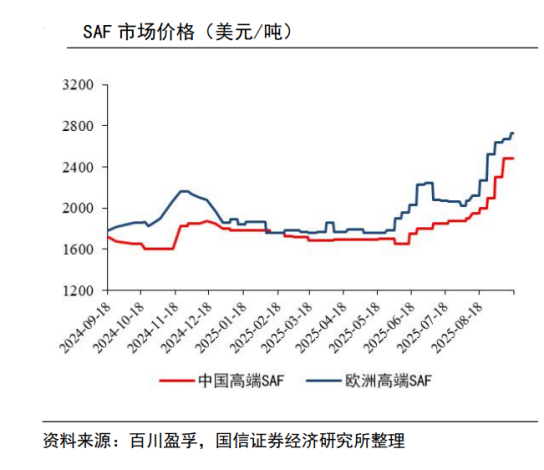
Group 1: Company Overview and Recent Developments - Beijing Haineng Technology Co., Ltd. has obtained approval for 158,000 tons of bio-jet fuel export capacity, enhancing its international competitiveness and market expansion [2][3] - The company’s 200,000 tons/year bio-diesel isomerization project is operational, producing approximately 160,000 tons of bio-jet fuel annually [3][8] Group 2: Financial Performance - In the first half of 2025, the company reduced its losses by 89.15% year-on-year, with a positive trend continuing into the third quarter [4] - The company has successfully diversified its customer base and increased sales in non-EU markets, leading to significant growth in this segment [4] Group 3: Production and Cost Management - The company has improved key operational parameters of its Shandong Sanju project, achieving better performance than design specifications and reducing processing costs [4] - Through refined management and strategic supplier partnerships, the company has lowered sales, management, and financial expenses year-on-year [4] Group 4: Market Trends and Pricing - Recent prices for Sustainable Aviation Fuel (SAF) have risen to approximately $2,700 per ton due to increased demand and regulatory support from the EU [5][6] - The EU has implemented subsidy programs to encourage SAF procurement, which is expected to sustain high industry demand [6] Group 5: Future Development Plans - The company aims to become a world-class green energy supplier and a leader in bio-energy technology over the next three years, focusing on core business growth and innovation [7] - Strategic initiatives include enhancing bio-energy production, improving supply chain management, and expanding market share in catalyst purification products [7] Group 6: Production Capacity and Certifications - The company’s existing bio-jet fuel capacity is 50,000 tons, with an additional 160,000 tons/year expected from the new project [8] - The bio-jet fuel products have received certifications from the Civil Aviation Administration of China and international standards [8]
海南思可源年产30万吨生物能源项目启动
Zhong Guo Hua Gong Bao· 2025-10-15 05:28
Core Insights - The Hainan Sike Source 300,000 tons/year bioenergy project, constructed by China Chemical's subsidiary China Five Ring Engineering Co., has officially launched [1] - The project aims to process 300,000 tons of waste oils annually, contributing to the reduction of greenhouse gas emissions and providing clean, low-carbon renewable biomass liquid fuel [1] Project Overview - The project is located in the Yangpu Economic Development Zone, Danzhou City, Hainan Province, covering an area of 100,000 square meters [1] - It will utilize waste oils such as kitchen waste oil and acidified oils through hydrogenation refining and hydrogen isomerization to produce bio-jet fuel [1] Environmental Impact - The implementation of this project will replace traditional fossil fuels in the transportation sector, thereby reducing greenhouse gas emissions [1] - It enhances Hainan's capacity for the reduction, harmless treatment, and resource utilization of kitchen waste, supporting the province's waste resource management efforts [1] Company Commitment - The company’s deputy general manager, Yan Shuanghua, emphasized the commitment to leverage the company's technological, talent, and management advantages in the energy sector to ensure the project's timely completion and production [1]

海新能科控股子公司获批生物航油出口先行先试
Zhi Tong Cai Jing· 2025-10-14 08:49
Core Viewpoint - Company Shandong Sanju Bioenergy Co., Ltd., a subsidiary of Haineng Energy Technology Co., Ltd. (holding 84.62% stake), has received approval from four government agencies to conduct a pilot program for the export of bio-jet fuel in Rizhao City, Shandong Province [1] Group 1 - Shandong Sanju is authorized to produce up to 158,000 tons of bio-jet fuel annually under maximum production conditions [1] - The company is allowed to apply for the 2025 bio-jet fuel export license based on its actual production within the approved capacity [1]
海新能科(300072.SZ):控股子公司获批生物航油出口先行先试
Ge Long Hui A P P· 2025-10-14 08:34
Core Viewpoint - Haineng Technology (300072.SZ) announced that its subsidiary, Shandong Sanju Bioenergy Co., Ltd., has received approval from four Chinese government agencies to conduct a pilot program for the export of bio-jet fuel under a "white list" in Rizhao City, Shandong Province [1] Group 1 - Shandong Sanju holds an 84.62% stake in the subsidiary [1] - The company is authorized to produce up to 158,000 tons of bio-jet fuel annually under maximum production conditions [1] - The approval allows Shandong Sanju to apply for export licenses for bio-jet fuel based on its actual production in 2025 within the approved capacity [1]
四部门批复,日照市获批成为全国生物航油“白名单”出口试点城市
Qi Lu Wan Bao Wang· 2025-10-14 08:15
Group 1 - The city of Rizhao has been approved as one of the second batch of pilot cities for the national bio-aviation fuel "white list" export, with Shandong Sanju Bioenergy Co., Ltd. included as one of the three companies with a certified export capacity of 158,000 tons [1] - Bio-aviation fuel is produced from waste oils such as kitchen waste oil, creating a low-carbon economic model from "waste oil" to "aviation fuel" [1] - The national bio-aviation fuel "white list" export pilot program is an innovative measure by multiple government departments to promote bio-aviation fuel exports, allowing eligible companies to apply for export licenses within their certified capacity [1] Group 2 - Rizhao City aims to leverage its new energy industry foundation and port advantages to enhance the international competitiveness of bio-aviation fuel, focusing on supporting Shandong Sanju Bioenergy Co., Ltd. in exporting its products [2] - The local government has actively engaged with various departments to establish a regulatory framework for the bio-aviation fuel export "white list" system, ensuring comprehensive oversight and support for the industry [2] - A collaborative mechanism has been established to facilitate inter-departmental coordination and information sharing, ensuring seamless regulation of the entire bio-aviation fuel export process [2] Group 3 - Shandong Sanju Bioenergy Co., Ltd. has developed a production line capable of processing 500,000 tons of waste animal and plant oils annually, utilizing advanced processing techniques to produce clean biofuels [3] - The company plans to invest in a bio-aviation fuel production line, which is expected to start normal operations by May 2025, with an annual production capacity of 160,000 tons and a reduction of 350,000 tons in carbon emissions per year [3] - The anticipated annual export revenue from bio-aviation fuel is projected to exceed 2 billion yuan, significantly contributing to the outward-oriented economic development of Rizhao City [3]
海新能科:公司主营业务为生物能源、催化净化环保材料
Zheng Quan Ri Bao Wang· 2025-09-26 09:43
Core Viewpoint - The company focuses on bioenergy and catalytic purification environmental materials, with a core development direction in bioenergy, primarily producing biodiesel and sustainable aviation fuel (SAF) [1] Company Overview - The main products of the company include biodiesel and biojet fuel, with a significant emphasis on the production of high-quality hydrocarbon-based biodiesel [1] - The hydrocarbon-based biodiesel can reduce carbon dioxide net emissions by 80% compared to fossil-based diesel, highlighting its low-carbon, clean, and environmentally friendly advantages [1] Production Capacity - The company has launched a 200,000-ton SAF isomerization project through its subsidiary, Shandong Sanju, adding approximately 160,000 tons/year of biojet fuel production capacity, with a biojet fuel yield of about 80% [1] - The biojet fuel products have received airworthiness certification from the Civil Aviation Administration of China and international certifications under ISCCCORSIA and ISCC-EU for HEFA [1] Business Focus - The company does not currently engage in liquid cooling, data center, or optical module business areas [1]