
中医医疗服务

Search documents
固生堂(02273):2025半年报点评:业绩符合预期,AI分身如期落地
Huafu Securities· 2025-09-01 09:44
Investment Rating - The investment rating for the company is "Buy" (maintained) [2][9] Core Views - The company's performance in the first half of 2025 met expectations, with revenue of 1.495 billion yuan (+9.52%) and net profit attributable to shareholders of 152 million yuan (+41.9%) [3][9] - The offline business showed steady growth, with a revenue increase of 11.1% to 1.37 billion yuan, driven by new acquisitions and existing business growth [5] - The company is actively embracing AI technology, having launched its first "National Medicine AI Avatar" in June 2025, with a total of 10 avatars covering eight core traditional Chinese medicine specialties by August [8][9] Financial Performance - The company achieved a gross profit margin of 30.6% (+1.2 percentage points) and a net profit margin of 10.1% (+2.3 percentage points) in the first half of 2025 [6] - The company has expanded its network to 83 medical institutions across 20 cities in China, with one institution in Singapore as of June 30, 2025 [7] - The adjusted net profit for 2025 is forecasted at 398 million yuan, with subsequent years projected at 492 million yuan in 2026 and 588 million yuan in 2027 [9][10] Market Outlook - The demand for traditional Chinese medicine services is strong, supported by favorable policies, indicating a period of rapid growth for the industry [9] - The company is positioned as a leading chain in the traditional Chinese medicine service sector, with significant long-term growth potential due to its brand, talent, and resource advantages [9]
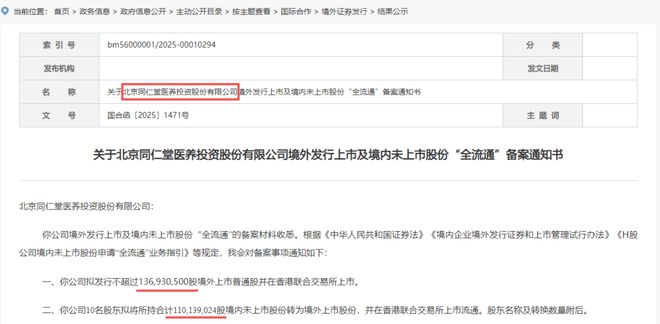
同仁堂医养,拟赴香港上市,获中国证监会备案通知书
Xin Lang Cai Jing· 2025-09-01 05:01
Core Viewpoint - Beijing Tongrentang Medical and Health Investment Co., Ltd. is planning to issue up to 136.93 million shares for overseas listing and convert 110.39 million shares held by 10 shareholders from domestic unlisted shares to overseas listed shares [2][4]. Group 1: Company Overview - Beijing Tongrentang Medical and Health Investment Co., Ltd. was established in 2015 and is a leading traditional Chinese medicine group, providing integrated medical solutions using both traditional Chinese medicine and non-drug therapies [4][5]. - As of June 24, 2025, the company has established a tiered medical service network, including 12 self-owned medical institutions and one internet hospital, along with 10 managed medical institutions [4]. Group 2: Market Position - According to Frost & Sullivan, Beijing Tongrentang Medical and Health is the largest non-public traditional Chinese medicine hospital group in China, holding a market share of 1.7% based on total outpatient and inpatient visits in 2024 [5]. Group 3: Shareholder Information - The top shareholders applying for the conversion of unlisted shares to listed shares include: - China Beijing Tongrentang (Group) Co., Ltd. with 5,293,050 shares - Beijing Tongrentang Elderly Care Industry Investment Operation Center (Limited Partnership) with 1,760,573 shares - Beijing Tongqing Equity Investment Partnership (Limited Partnership) with 844,607 shares - Other shareholders collectively hold the remaining shares, totaling 110,139,024 shares [3]. Group 4: IPO Details - The company submitted its prospectus to the Hong Kong Stock Exchange on three occasions: June 28, 2024, December 31, 2024, and June 30, 2025, with China International Capital Corporation as the sole sponsor [4].


【固生堂(2273.HK)】业绩符合预期,名医“AI分身”持续赋能——2025半年报点评(王明瑞/吴佳青)
光大证券研究· 2025-08-31 23:03
查看完整报告 点击注册小程序 特别申明: 本订阅号中所涉及的证券研究信息由光大证券研究所编写,仅面向光大证券专业投资者客户,用作新媒体形势下研究 信息和研究观点的沟通交流。非光大证券专业投资者客户,请勿订阅、接收或使用本订阅号中的任何信息。本订阅号 难以设置访问权限,若给您造成不便,敬请谅解。光大证券研究所不会因关注、收到或阅读本订阅号推送内容而视相 关人员为光大证券的客户。 报告摘要 事件: 近期,公司公布2025年中期业绩,2025年上半年公司实现总营业收入14.95亿元,同比增长9.5%;净利润 1.52亿元,同比增长41.6%;经营活动现金流3.0亿元,同比增长111%。 点评: 业绩稳健增长,盈利能力持续优化 2025年上半年,公司收入稳步增长至14.95亿元,同时盈利能力显著提升,净利润同比增长41.6%至1.52亿 元,主要得益于毛利率的提升及费用的有效管控。2025年上半年,公司毛利率同比提升1.2个百分点至 30.6%;销售费用率为11.8%,同比保持稳定;管理费用率同比降低1.8个百分点至6.3%。运营指标方面, 2025年上半年,客户就诊人次增长至274.7万人次,就诊次均消费保持稳定, ...

固生堂(2273.HK):业绩符合预期 名医“AI分身”持续赋能
Ge Long Hui· 2025-08-31 19:54
Core Viewpoint - The company reported a steady growth in revenue and profit for the first half of 2025, driven by improved gross margins and effective cost control [1] Financial Performance - In the first half of 2025, the company achieved total revenue of 1.495 billion, representing a year-on-year growth of 9.5% [1] - Net profit reached 152 million, showing a significant year-on-year increase of 41.6% [1] - Operating cash flow was 300 million, reflecting a substantial year-on-year growth of 111% [1] - The gross margin improved by 1.2 percentage points to 30.6% [1] - The sales expense ratio remained stable at 11.8%, while the management expense ratio decreased by 1.8 percentage points to 6.3% [1] Operational Metrics - The number of patient visits increased to 2.747 million, with average spending per visit remaining stable [1] - The member customer retention rate was maintained at 85%, indicating strong customer loyalty [1] - The company expanded its national and international presence by establishing 7 new clinics, bringing the total number of offline medical institutions to 83 by the end of June 2025 [1] AI Development - The company is accelerating the development of "AI avatars" of renowned doctors, leveraging extensive and high-quality clinical data [1] - A total of 10 "National Physician AI Avatars" have been launched, covering 8 core specialties including oncology, dermatology, and gastroenterology [1] - The DeepSeek deep learning algorithm enables the replication of top experts' diagnostic capabilities, facilitating the transfer of expertise to junior doctors and enhancing the supply of quality medical resources [1] Profit Forecast and Valuation - The adjusted net profit forecasts for 2025, 2026, and 2027 are 493 million, 594 million, and 708 million respectively [2] - The company is expected to benefit significantly from the aging population, supportive policies in the traditional Chinese medicine sector, and AI empowerment, maintaining a "buy" rating [2]
固生堂(02273):2025半年报点评:业绩符合预期,名医“AI分身”持续赋能
EBSCN· 2025-08-31 07:03
Investment Rating - The report maintains a "Buy" rating for the company [5] Core Insights - The company reported a total revenue of 1.495 billion yuan for the first half of 2025, representing a year-on-year growth of 9.5%, and a net profit of 152 million yuan, which is a 41.6% increase year-on-year [1][2] - The operating cash flow reached 300 million yuan, showing a significant increase of 111% year-on-year [1] - The company is focusing on the development of "AI avatars" for renowned doctors, which aims to enhance the quality of traditional Chinese medicine services and improve operational efficiency [3] Summary by Sections Financial Performance - In the first half of 2025, the company's revenue grew to 1.495 billion yuan, with a net profit of 152 million yuan, driven by improved gross margins and effective cost control [2] - The gross margin increased by 1.2 percentage points to 30.6%, while the management expense ratio decreased by 1.8 percentage points to 6.3% [2] - The number of patient visits increased to 2.747 million, with a stable average spending per visit and a member retention rate of 85% [2] Strategic Initiatives - The company is accelerating its national and international expansion, having established 7 new clinics, bringing the total number of global offline medical institutions to 83 by the end of June 2025 [2] - The development of "AI avatars" is expected to alleviate the supply bottleneck of quality traditional Chinese medicine resources and enhance the company's capacity for revenue growth [3] Profit Forecast and Valuation - The adjusted net profit forecasts for 2025, 2026, and 2027 are 493 million yuan, 594 million yuan, and 708 million yuan respectively [3] - The company is expected to benefit significantly from the aging population and supportive policies in the traditional Chinese medicine sector, alongside the advantages brought by AI [3]
固生堂:矩阵式流量生态布局,构筑增长新引擎
Ge Long Hui A P P· 2025-08-29 08:27
Core Insights - The company has successfully established a matrix-style traffic ecosystem platform, driving strong growth in its diagnostic and treatment services [1] Group 1: Traffic Growth and Performance - In July 2025, the company achieved over 40,000 customer orders, a month-on-month increase of 13,000 orders, representing a 40% growth [1] - Compared to July 2024, the orders increased by nearly 20,000, marking a 75% year-on-year growth [1] - The Meituan platform alone accounted for over 30,000 customer orders in July, with a month-on-month growth of 35% [1] Group 2: Cost Reduction through Traffic Matrix - The company has built a diverse platform traffic matrix by collaborating with major platforms like Meituan, Xiaohongshu, Douyin, and Gaode Map, effectively reducing customer acquisition costs [2] - The strategic partnership with Meituan, established in September 2024, has allowed the company to leverage Meituan's extensive local service traffic [2] - The multi-platform cooperation model has not only expanded customer acquisition channels but also significantly lowered acquisition costs compared to industry averages [2] Group 3: Efficient Traffic Conversion - The matrix-style traffic ecosystem operates on a "multi-channel reach + multi-scenario conversion" model, enhancing operational efficiency [3] - The company collaborates with registration platforms and local health committee systems to diversify registration entry points and accurately reach users [3] - By streamlining the conversion process and leveraging platform-specific characteristics, the company has improved traffic conversion efficiency [3] Group 4: Professional Operations and Growth Assurance - The company has assembled a professional operations team of over 200 members in cities like Guangzhou and Shenzhen, focusing on refined operations across platforms [4] - The team has successfully created numerous expert IPs, enhancing both individual expert visibility and overall traffic for the company [4] - The company is also exploring high-net-worth user channels, integrating public and private resources to maximize traffic value [4]
固生堂(02273)拟回购股份
智通财经网· 2025-08-29 04:30
Core Viewpoint - The company, Gushengtang (02273), has announced a share buyback plan, which is expected to enhance shareholder value and demonstrate confidence in its long-term business prospects [1] Summary by Relevant Sections Share Buyback Authorization - The shareholders approved a resolution at the annual general meeting on June 20, 2025, granting the board the authority to repurchase up to 23.6965 million shares, representing 10% of the total issued shares as of that date [1] Financial Commitment - The board has resolved to exercise the buyback authorization on August 29, 2025, with a maximum expenditure of HKD 300 million for the repurchase [1] Strategic Rationale - The board believes that the proposed share buyback will enhance share value, benefiting shareholders, and reflects confidence in the company's long-term business outlook [1] - The board also stated that the company's financial position is stable, allowing for the buyback while maintaining sufficient financial resources for ongoing business growth [1]
AI开方,年轻人看病:问止中医头顶超4亿亏损二闯IPO,背后投诉有点多
Sou Hu Cai Jing· 2025-08-21 01:39
Core Viewpoint - The company, Wanzhi Traditional Chinese Medicine, is attempting to leverage AI technology in traditional Chinese medicine, but faces challenges related to efficacy, significant financial losses, and concerns over the qualifications of its young medical staff [2][10]. Company Overview - Wanzhi Traditional Chinese Medicine was established in 2018 and focuses on AI-assisted traditional Chinese medical diagnosis and treatment [2]. - The company claims to be the largest provider of AI-assisted traditional Chinese medical services in mainland China, with market shares of 1.5% and 1.3% for 2023 and 2024, respectively [2]. - Wanzhi operates eleven physical clinics and four herbal medicine preparation centers across various cities in China [2]. Financial Performance - The company reported revenues of RMB 62.169 million, RMB 189 million, RMB 236 million, and RMB 100 million for the years 2022 to 2025, with nearly 90% of revenue coming from online services [3]. - Cumulative losses exceeded RMB 400 million over the reporting period, with losses of RMB 154 million, RMB 194 million, RMB 45.367 million, and RMB 43.841 million for the respective years [3]. Medical Staff and AI System - The average age of the medical staff is 30, with all 93 full-time physicians utilizing the proprietary AI-assisted diagnostic system known as "Traditional Chinese Medicine Brain" [4][9]. - The AI system is claimed to be the first and only one in mainland China to have undergone clinical consistency studies and expert reviews [4]. Patient Concerns and Complaints - There are significant patient complaints regarding the effectiveness of treatments, with issues such as ineffective medication and excessive medical procedures being reported [10][12]. - Complaints on platforms indicate dissatisfaction with treatment outcomes and concerns about the transparency and integrity of the company's practices [10][12].

固生堂(02273.HK)加码医联体布局,AI 技术与创新中药齐发力加速中医出海
Ge Long Hui· 2025-08-18 04:19
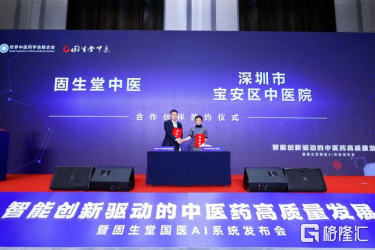
Core Insights - The conference on high-quality development of traditional Chinese medicine (TCM) and the launch of the Guoshengtang National Medicine AI system took place in Guangzhou, highlighting significant collaborations and achievements by Guoshengtang [1] Group 1: Partnerships and Collaborations - Guoshengtang signed medical alliance agreements with Shenzhen Baoan District Traditional Chinese Medicine Hospital and Guangzhou University of Traditional Chinese Medicine Shenzhen Hospital, marking a milestone in expanding quality TCM services [3] - The company acquired a secondary specialized hospital in Shenzhen, enhancing its offline and online medical service capabilities [3] - Collaborations with various partners, including Xiaohongshu and Guotu Innovation, aim to integrate resources, improve patient services, and provide technical support [1][3] Group 2: Service Enhancement - Guoshengtang's partnership with Xiaohongshu represents a significant step in digitalizing TCM services, allowing for a more extensive reach to both domestic and international audiences [6][8] - The collaboration will enable Guoshengtang to utilize Xiaohongshu's content ecosystem for better customer engagement through various formats like notes and live broadcasts [8][9] Group 3: Technological Innovation - The launch of 10 National Medicine AI avatars aims to accelerate the internationalization of TCM by enhancing diagnostic capabilities and ensuring consistency with expert decision-making [10][12] - The AI avatars are designed to improve the productivity of experts significantly, allowing for more efficient online consultations [12] - Guoshengtang is also establishing a TCM inheritance studio in Singapore to train overseas practitioners, thereby addressing the talent gap in international TCM services [12][13] Group 4: Strategic Vision - Guoshengtang aims to combine traditional TCM with modern technology and AI, positioning itself as a leading TCM brand for the global Chinese community [13][14] - The company's mission is to facilitate the global reach of TCM, leveraging technology to enhance its traditional practices [14]
全国首家!固生堂(02273.HK)与小红书达成官方合作,多维构建矩阵式流量生态
Ge Long Hui· 2025-08-18 04:19
Core Insights - The article highlights the strategic partnership between Guoshengtang and Xiaohongshu, marking a significant step in the digital transformation of traditional Chinese medicine (TCM) services [1][2] Group 1: Partnership with Xiaohongshu - Guoshengtang has established a deep commercial collaboration with Xiaohongshu, becoming the first TCM institution in China to do so, which signifies a shift from single-brand traffic to a platform-based traffic matrix [1][2] - Xiaohongshu's user demographic aligns well with TCM, as over 70% of its users are aged 20-35, and the number of TCM-related posts has increased by over 200% in the past year [2] Group 2: Multi-Platform Ecosystem - The partnership with Xiaohongshu is a crucial part of Guoshengtang's strategy to build a matrix-style traffic ecosystem, complementing existing collaborations with platforms like Meituan, Douyin, and Gaode Map [3] - This multi-channel approach allows for diverse entry points for users and enhances the conversion process by leveraging the unique characteristics of each platform [3] Group 3: Focus on Traffic Entry Capabilities - Guoshengtang's focus on building traffic entry capabilities is a strategic move, with plans to enhance partnerships with popular platforms to improve customer acquisition efficiency [4] - As of July 2025, Guoshengtang reported over 40,000 traffic acquisition orders, a 40% increase from June 2025, indicating the effectiveness of its traffic platform ecosystem [4] Group 4: Empowering TCM Popularization - The formation of a matrix-style traffic ecosystem not only improves operational efficiency for Guoshengtang but also serves as a vital platform for the popularization of TCM services [5] - The collaboration with younger platforms facilitates the dissemination of TCM knowledge to younger audiences, promoting cultural penetration among Generation Z [5] Group 5: Future Outlook - As platform collaborations deepen and operational capabilities enhance, the traffic ecosystem is expected to continuously drive business growth for Guoshengtang, aiming to create diverse value for customers [6]