电机

Search documents
收评:沪指涨1.38% 保险板块全天领涨
Zhong Guo Jing Ji Wang· 2026-01-05 07:31
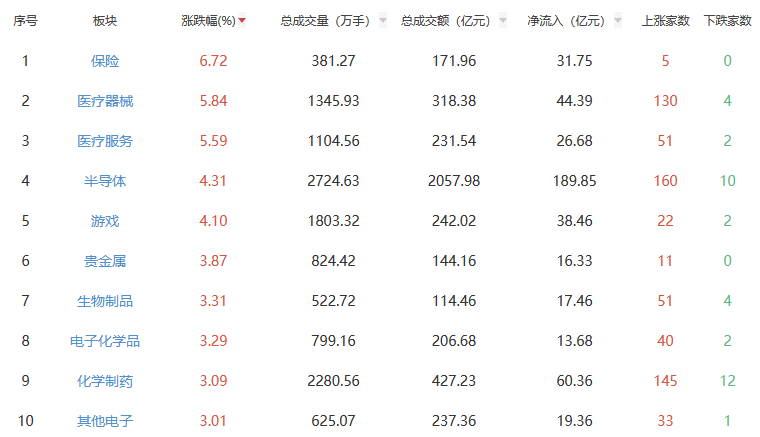
Market Overview - The A-share market saw all three major indices rise, with the Shanghai Composite Index closing at 4023.42 points, up 1.38%, and a total trading volume of 10,673.34 billion yuan [1] - The Shenzhen Component Index closed at 13,828.63 points, up 2.24%, with a trading volume of 14,789.37 billion yuan [1] - The ChiNext Index closed at 3,294.55 points, up 2.85%, with a trading volume of 6,962.18 billion yuan [1] Sector Performance - The insurance sector led the gains with a rise of 6.72%, totaling a trading volume of 381.27 million hands and a net inflow of 31.75 billion yuan [2] - The medical device sector increased by 5.84%, with a trading volume of 1,345.93 million hands and a net inflow of 44.39 billion yuan [2] - The medical services sector rose by 5.59%, with a trading volume of 1,104.56 million hands and a net inflow of 26.68 billion yuan [2] - Other notable sectors with positive performance include gaming (up 4.10%) and biotechnology (up 3.31%) [2] Declining Sectors - The diversified financial sector experienced a decline of 0.72%, with a trading volume of 1,487.42 million hands and a net outflow of 4.55 billion yuan [2] - The electrical machinery sector fell by 0.71%, with a trading volume of 641.98 million hands and a net outflow of 8.83 billion yuan [2] - The road and railway transportation sector decreased by 0.57%, with a trading volume of 799.34 million hands and a net outflow of 8.40 billion yuan [2]

行业景气度系列十:去库延续,需求仍待改善
Hua Tai Qi Huo· 2026-01-05 01:16
Report Industry Investment Rating - Not provided in the given content Core Viewpoints Manufacturing - Overall: In December, the manufacturing PMI's five - year percentile was at 57.6%, with a change of 37.3%. Four industries had their manufacturing PMI in the expansion range, 4 less than the previous month and 3 less than the same period last year [4]. - Supply: Slightly declined. The 3 - month average of the manufacturing PMI production index in December was 50.5, a 0.1 - percentage - point decrease from the previous month. Five industries showed month - on - month improvement, while 10 industries declined [4]. - Demand: Still needed improvement. The 3 - month average of the manufacturing PMI new orders in December was 49.6, a 0.4 - percentage - point increase from the previous month. Three industries showed month - on - month improvement, and 12 industries declined [4]. - Inventory: Continued destocking. The 3 - month average of the manufacturing PMI finished - goods inventory in December remained flat at 47.9. Five industries saw inventory increase, and 10 industries saw inventory decrease [4]. Non - Manufacturing - Overall: In December, the non - manufacturing PMI's five - year percentile was at 22.0%, with a change of 10.2%. Eleven industries had their non - manufacturing PMI in the expansion range, 5 more than the previous month and 1 more than the same period last year [5]. - Supply: Employment remained at a low level. The 3 - month average of the non - manufacturing PMI employee index in December was 45.5, a 0.4 - percentage - point increase from the previous month. Both the service and construction sectors increased by 0.4 percentage points [5]. - Demand: Still needed improvement. The 3 - month average of the non - manufacturing PMI new orders in December was 46.3, a 0.4 - percentage - point increase from the previous month. The service sector's new orders increased by 0.2 percentage points, and the construction sector's new orders increased by 1.7 percentage points [5]. - Inventory: Continued destocking. The 3 - month average of the non - manufacturing PMI inventory in December was 45.3, with no change from the previous month. The service sector's inventory remained unchanged, and the construction sector's inventory increased by 0.8 percentage points [5]. Summary by Directory Overview - Manufacturing PMI: In December, the manufacturing PMI's five - year percentile was at 57.6%, with a change of 37.3%. Four industries had their manufacturing PMI in the expansion range, 4 less than the previous month and 3 less than the same period last year [10]. - Non - Manufacturing PMI: In December, the non - manufacturing PMI's five - year percentile was at 22.0%, with a change of 10.2%. Eleven industries had their non - manufacturing PMI in the expansion range, 5 more than the previous month and 1 more than the same period last year [10]. Demand - Manufacturing: The 3 - month average of the manufacturing PMI new orders in December was 49.6, a 0.4 - percentage - point increase from the previous month. Three industries showed month - on - month improvement, and 12 industries declined. - Non - Manufacturing: The 3 - month average of the non - manufacturing PMI new orders in December was 46.3, a 0.4 - percentage - point increase from the previous month. The service sector's new orders increased by 0.2 percentage points, and the construction sector's new orders increased by 1.7 percentage points. Five industries showed month - on - month improvement, and 10 industries declined. Pay attention to the improvement in textiles and pharmaceuticals and the decline in petroleum [16]. Supply - Manufacturing: The 3 - month average of the manufacturing PMI production index in December was 50.5, a 0.1 - percentage - point decrease from the previous month. Five industries showed month - on - month improvement, and 10 industries declined. The manufacturing PMI employee index in December was 48.3, a 0.1 - percentage - point decrease from the previous month. Five industries showed month - on - month improvement, and 10 industries declined. - Non - Manufacturing: The 3 - month average of the non - manufacturing PMI employee index in December was 45.5, a 0.4 - percentage - point increase from the previous month. The service and construction sectors both increased by 0.4 percentage points. Eleven industries showed month - on - month improvement, and 3 industries declined. Pay attention to the decline in non - ferrous metals and农副食品 and the improvement in ferrous metals [25]. Price - Manufacturing: The 3 - month average of the manufacturing PMI ex - factory price index in December was 48.2, a 0.2 - percentage - point increase from the previous month. Seven industries saw their ex - factory prices improve, and 8 industries declined. In terms of profit, the profit trend in December increased by 0.4 percentage points, and the overall continued to converge. - Non - Manufacturing: The 3 - month average of the non - manufacturing charge price index in December was 48.3, a 0.2 - percentage - point increase from the previous month. The service sector increased by 0.3 percentage points, and the construction sector decreased by 0.2 percentage points. Eight industries showed month - on - month improvement, and 7 industries declined. In terms of profit, the profit in December remained unchanged. The service sector decreased by 0.1 percentage points, and the construction sector increased by 0.5 percentage points. Pay attention to the improvement in non - ferrous metals and the decline in petroleum [34]. Inventory - Manufacturing: The 3 - month average of the manufacturing PMI finished - goods inventory in December remained flat at 47.9. Five industries saw inventory increase, and 10 industries saw inventory decrease. The manufacturing PMI raw - material inventory in November decreased by 0.2 percentage points to 47.5. Seven industries saw inventory increase, and 8 industries saw inventory decrease. - Non - Manufacturing: The 3 - month average of the non - manufacturing PMI inventory in December was 45.3, with no change from the previous month. The service sector's inventory remained unchanged, and the construction sector's inventory increased by 0.8 percentage points. Five industries saw inventory increase, and 10 industries saw inventory decrease. Pay attention to the destocking of non - metallic products and the increase in construction inventory [42]. Main Manufacturing Industry PMI Charts - The report provides data on the PMI of various manufacturing industries, including general equipment, special equipment, automobiles, computers, motors, pharmaceuticals,农副食品, textiles, non - ferrous metals, petroleum, chemicals, ferrous metals, non - metallic products, metal products, and chemical fiber and rubber products, showing values, month - on - month changes, three - year averages, and year - on - year changes [53][54][57][58][59][66][67][68].
中山大洋电机股份有限公司关于“头部狼计划四期”员工持股计划锁定期届满的提示性公告
Shang Hai Zheng Quan Bao· 2026-01-04 22:53
Core Viewpoint - The announcement details the completion of the lock-up period for the "Top Wolf Plan Phase IV" employee stock ownership plan of Zhongshan Dayang Electric Co., Ltd, which allows employees to manage their shares following the expiration of the lock-up period [2][3]. Group 1: Employee Stock Ownership Plan Details - The "Top Wolf Plan Phase IV" involved the purchase of 3,980,800 shares, representing 0.16% of the company's total share capital, with a total transaction amount of 22.82 million yuan and an average price of approximately 5.73 yuan per share [2]. - The lock-up period for this employee stock ownership plan lasted for 12 months, from January 3, 2025, to January 2, 2026 [2]. Group 2: Post-Lock-Up Arrangements - After the lock-up period, the management committee will decide whether to sell the purchased shares based on the plan's arrangements and market conditions, adhering to trading rules and regulations [3]. - Specific periods during which the company stock cannot be traded include 15 days before the annual and semi-annual report announcements, 5 days before quarterly reports, and other periods as defined by regulatory authorities [3]. Group 3: Plan Duration, Changes, and Termination - The duration of the employee stock ownership plan is set for 24 months, automatically terminating at the end of this period unless extended by a two-thirds majority agreement from the participants [5]. - The plan can be modified or terminated early under certain conditions, such as the complete sale of shares or changes in relevant laws and regulations [5][6]. Group 4: Ongoing Monitoring - The company will continuously monitor the implementation of the employee stock ownership plan and fulfill its information disclosure obligations as required by law [7].

化工下游利润承压,地产下游回暖
Hua Tai Qi Huo· 2026-01-04 11:53
1. Report Industry Investment Rating - No relevant information provided 2. Core Viewpoints of the Report - In December, the previously persistent pattern of industry prosperity differentiation reversed. The overall prosperity level of the manufacturing industry significantly rebounded, with the official manufacturing PMI returning to the expansion zone of 50.3%. This was mainly due to the continuous release of the effects of stable - growth policies and the pre - festival stocking activities. However, the core contradictions in the motor and chemical fiber & rubber - plastic industries became more prominent and showed different paths: the main pressure on the motor industry shifted from demand fluctuations to severe cost shocks, leading to a collective price increase in late December to early January; while the chemical fiber & rubber - plastic industry continued to face the structural pressure of "strong supply and weak demand", with low operating rates, weak product prices, and squeezed profit margins. Overall, the challenges in the industrial chain are evolving from general demand shortages to more structural cost reshaping and supply - demand rebalancing [1] 3. Summary by Relevant Catalogs 3.1 Medium - term Overview 3.1.1 Manufacturing - **Prosperity Overview**: In December, the prosperity of the pharmaceutical and textile - clothing industries increased significantly, while that of the petroleum and metal products industries declined [8] - **Demand Overview**: In December, the demand for the pharmaceutical and textile - clothing industries increased, while that for the petroleum and electronic information industries declined [8] - **Supply Overview**: In December, the supply of the chemical, automotive, textile - clothing, and pharmaceutical industries increased significantly, while that of the agricultural and sideline food, petroleum, and general equipment industries declined [8] - **Inventory Overview**: In December, the inventory of the chemical, motor equipment, and special equipment industries increased, while the non - metallic products, agricultural and sideline food, and metal products industries reduced their inventory [8] - **Export Sub - sectors**: In December, the exports of the non - ferrous metal processing, non - metallic products, and tobacco products industries declined significantly [8] - **Cost Sub - sectors**: In December, the costs of the textile - clothing, apparel, and cultural, educational, and sports goods industries declined significantly [8] - **Income Sub - sectors**: In December, the incomes of the textile - clothing, apparel, and wine, beverage, and refined tea industries declined significantly [8] - **Profit Sub - sectors**: In December, the profits of the tobacco products, printing, and reproduction media industries declined significantly [8] 3.1.2 Non - manufacturing - **Prosperity Overview**: In December, the prosperity of the civil engineering, environmental, and construction industries increased, while that of the postal, information, and accommodation industries declined [23] - **Demand Overview**: In December, the demand for the building installation and decoration, environmental, and construction industries increased, while that for the aviation, postal, and civil engineering industries declined [23] - **Supply Overview**: In December, the supply of the environmental and construction industries increased significantly, while that of the postal and civil engineering industries declined [23] - **Inventory Overview**: In December, the inventory of the construction industry increased, while the IT and aviation industries reduced their inventory [23] 3.2 Chemical Product Price Fluctuations Squeeze Mid - stream Profits - **Price Trends of Chemical Products**: In December, most major chemical products rose in price, with a few declining. PTA/PX prices continued to rise in December due to upstream cost support and low mid - stream operating rates; urea prices were supported by supply contraction from gas - head device maintenance and seasonal demand for compound fertilizer production; PVC price increases were driven by macro - policy expectations and commodity market sentiment; ethylene glycol prices were mainly affected by raw material cost support and market expectations of possible production conversion in EO/EG co - production plants. PP and PE prices declined due to supply - side pressure and weak downstream demand [29] - **Situation of the Textile and Chemical Fiber Industry Chain**: In December, the textile and chemical fiber industry chain showed a typical pattern of "hot upstream and cold downstream". The prices of upstream raw materials such as PX and PTA continued to rise, but the price transmission to the mid - stream polyester segment was blocked. The profit margins of mid - stream textile manufacturing enterprises were severely squeezed. The textile and clothing, apparel industries have entered the production off - season, and production cuts may be a future direction. The comprehensive operating rate of the polyester industry has been declining since December, and it is expected to drop by more than 5 percentage points in January. High upstream raw material inventories and falling operating rates may suppress the profit margins of the entire industrial chain [29][30][31] 3.3 Real Estate Downstream Consumption Warms Up - **Market Performance**: From November to December 2025, the downstream real estate sales in China showed signs of a phased recovery. The new - home market saw an increase in new supply and a decrease in inventory in November, and the transaction area continued to grow in December. The second - hand housing market also had significant month - on - month growth in transaction areas in November and December. Nationally, the unsold commercial housing area decreased in November [39] - **Reasons for the Recovery**: The policy environment has been continuously optimized, releasing demand; real - estate developers actively promoted projects to meet annual performance targets; the market showed structural differentiation, with core cities and high - quality projects acting as stabilizers. However, the current recovery is a month - on - month improvement based on a deep year - on - year adjustment, and most transaction data still have large year - on - year declines, with housing prices still in a downward trend. The market is still in the bottom - building stage of the transformation from the old to the new model [39][40]
每周股票复盘:迪贝电气(603320)拟2026年开展铜铝及外汇套保
Sou Hu Cai Jing· 2026-01-01 19:38
Core Viewpoint - The company, Dibai Electric (603320), plans to engage in commodity futures and foreign exchange hedging activities in 2026 to manage risks associated with raw material prices and exchange rate fluctuations [1][2]. Company Announcements - The company will hold its sixth board meeting on December 30, 2025, to approve the hedging proposals for 2026 [1]. - The board has approved the use of self-owned funds for hedging copper and aluminum futures, as well as foreign exchange hedging, to mitigate risks from price and exchange rate volatility [1][4]. - The hedging activities will be limited to production-related commodities, with a maximum margin of 1 million RMB for copper and aluminum, and a maximum contract value of 10 million RMB [2][4]. Risk Management - The company has established a management system for the hedging activities, ensuring that they are not speculative in nature [2][4]. - The maximum margin for foreign exchange hedging will be 100,000 USD, with a maximum contract value of 1 million USD [2][4]. - A dedicated hedging management team will be set up to oversee the activities, with strict risk control measures in place [2][4].

机构席位卖出1390.44万 北交所上市公司三协电机登龙虎榜
Sou Hu Cai Jing· 2025-12-31 13:52
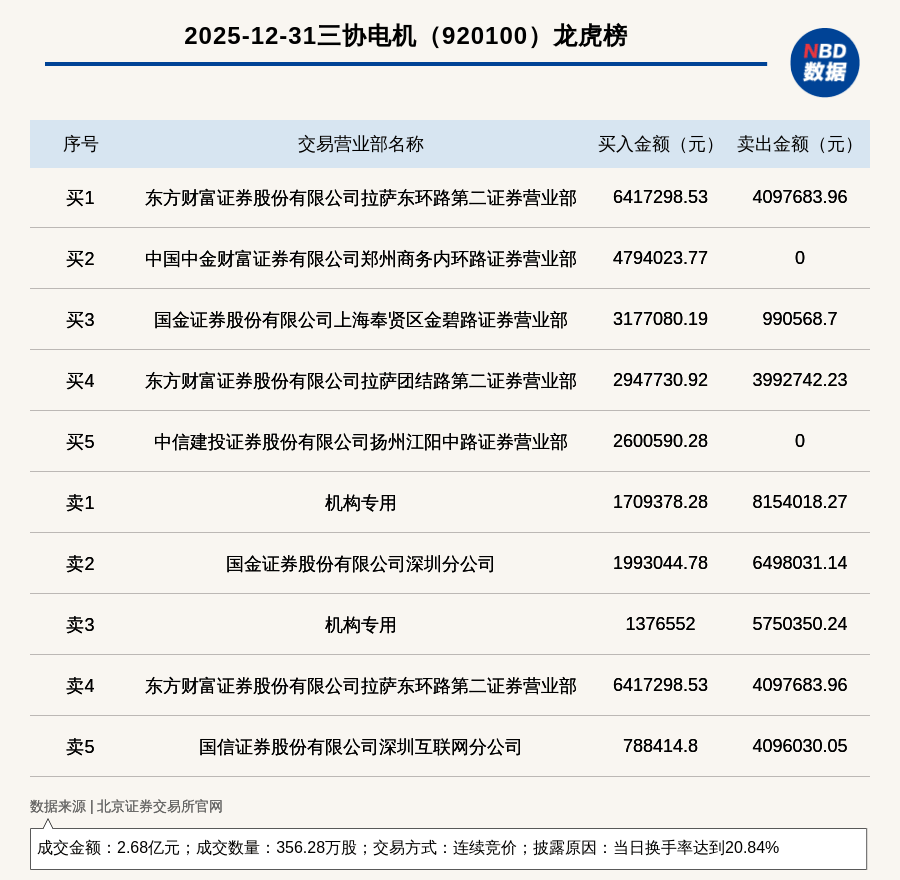
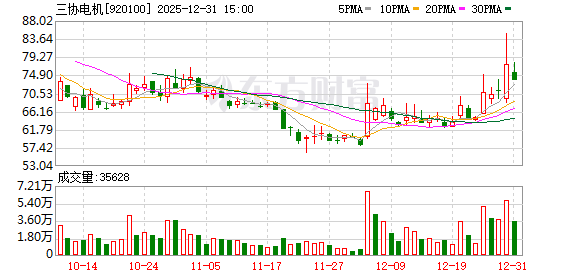
Core Insights - On December 31, 2025, Sanxie Electric (stock code: 920100) was featured on the trading leaderboard of the Beijing Stock Exchange due to a turnover rate of 20.84% and a trading volume of 3.5628 million shares, amounting to a transaction value of 268 million yuan [1][2]. Group 1 - The trading method for Sanxie Electric was continuous bidding, with a closing price of 73.66 yuan [1]. - The top buying seat was from Dongfang Caifu Securities Co., Ltd., Lhasa East Ring Road Second Securities Business Department, with a purchase amount of approximately 6.42 million yuan [2]. - The top selling seat was an institutional account, which sold shares worth approximately 8.15 million yuan [2]. Group 2 - The total transaction amount for Sanxie Electric on that day was 268 million yuan, with a significant trading volume of 3.5628 million shares [1][2]. - Other notable buying and selling activities included China International Capital Corporation's Zhengzhou Business Inner Ring Road Securities Business Department, which bought approximately 4.79 million yuan worth of shares [2]. - The trading data was sourced from the official website of the Beijing Stock Exchange [2].
三协电机龙虎榜数据(12月31日)
Zheng Quan Shi Bao Wang· 2025-12-31 09:19
Core Viewpoint - Sanxie Electric (920100) experienced a decline of 5.07% today, with a turnover rate of 20.84% and a transaction volume of 268 million yuan, indicating significant trading activity and potential volatility in the stock [2]. Trading Activity - The stock was listed on the龙虎榜 due to its turnover rate reaching 20.84%, with institutional investors net selling 10.82 million yuan [2]. - The top five trading departments accounted for a total transaction volume of 59.38 million yuan, with a buying amount of 25.80 million yuan and a selling amount of 33.58 million yuan, resulting in a net sell of 7.78 million yuan [2]. - Among the trading departments, two institutional specialized seats were involved, with a total buying amount of 3.09 million yuan and a selling amount of 13.90 million yuan, leading to a net sell of 10.82 million yuan [2]. Historical Performance - Over the past six months, the stock has appeared on the龙虎榜 17 times, with an average price drop of 0.10% the day after being listed and an average decline of 3.84% over the following five days [2].
电机板块12月31日跌0.48%,三协电机领跌,主力资金净流出9.25亿元
Zheng Xing Xing Ye Ri Bao· 2025-12-31 09:06
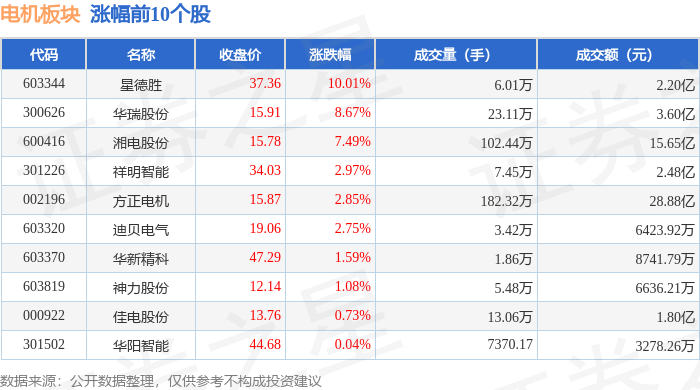
Market Overview - The electric motor sector experienced a decline of 0.48% on the trading day, with Sanxie Electric leading the drop [1] - The Shanghai Composite Index closed at 3968.84, up 0.09%, while the Shenzhen Component Index closed at 13525.02, down 0.58% [1] Stock Performance - Notable gainers in the electric motor sector included: - Xingdesheng (603344) with a closing price of 37.36, up 10.01% and a trading volume of 60,100 shares, totaling 220 million yuan [1] - Runse Station (300626) closed at 15.91, up 8.67% with a trading volume of 231,100 shares, totaling 360 million yuan [1] - Xiangdian Co. (600416) closed at 15.78, up 7.49% with a trading volume of 1,024,400 shares, totaling 156.5 million yuan [1] - Major decliners included: - Sanxie Electric (920100) closed at 73.66, down 5.07% with a trading volume of 35,600 shares, totaling 268 million yuan [2] - Zhaowei Electromechanical (003021) closed at 124.18, down 3.67% with a trading volume of 88,400 shares, totaling 1.108 billion yuan [2] - Jiangsu Leili (300660) closed at 54.82, down 2.89% with a trading volume of 190,400 shares, totaling 1.051 billion yuan [2] Capital Flow - The electric motor sector saw a net outflow of 925 million yuan from institutional investors, while retail investors contributed a net inflow of 688 million yuan [2] - The capital flow for specific stocks showed: - Xiangdian Co. (600416) had a net inflow of 1.09 billion yuan from institutional investors [3] - Xingdesheng (603344) experienced a net inflow of 58.98 million yuan from institutional investors [3] - Jiadian Co. (000922) had a net inflow of 13.70 million yuan from institutional investors [3]

通达动力:公司客户分布于电机行业
Mei Ri Jing Ji Xin Wen· 2025-12-31 07:39
Core Viewpoint - The company, Tongda Power, has a diverse client base in the motor industry, including several well-known partners, and encourages stakeholders to refer to its regular reports for detailed operational information [1] Client Distribution - Tongda Power's clients include major companies such as BMW Group, ZF Friedrichshafen, Valeo, Bosch Group, Inovance Technology, Delta Electronics, Eldor Group, SMP Group, Zhongce Rubber, Stanley Black & Decker, and Nord Drivesystems [1]

帮主收评:指数红了,账户绿了!3400股下跌的“假反弹”怎么看?
Sou Hu Cai Jing· 2025-12-30 14:55
Core Viewpoint - The market is experiencing a significant structural divergence, with a stark contrast between hot and cold sectors, indicating a fierce competition for capital rather than a bullish trend reversal [3]. Group 1: Market Performance - The three major indices showed a rebound in the afternoon, particularly the ChiNext, but over 3,400 stocks declined, revealing a disparity between the index performance and individual stock results [1]. - The human-shaped robot sector emerged as a key highlight, driving related industries such as motors and film theaters, reflecting a concentrated investment in sectors with clear growth trends for the upcoming year [3]. Group 2: Sector Analysis - The human-shaped robot and film sectors are currently strong, but caution is advised against chasing highs during peak emotions; instead, investors should look for potential stocks within these sectors that have lagged behind [4]. - Conversely, sectors like solar equipment and insurance are experiencing significant declines, which may present long-term investment opportunities if the fundamental logic remains intact [4]. Group 3: Investment Strategy - In a market characterized by reduced trading volume, any potential upward movement in the market requires increased trading volume to be sustainable; otherwise, caution is warranted [4]. - Investors should either engage in short-term trading within the strongest sectors or focus on research in quieter areas to prepare for future market rotations, avoiding indecision that could lead to losses [5].