矿产开采

Search documents
“冷水江锡矿山青丰河水体呈黄色”,官方再回应
Xin Lang Cai Jing· 2025-12-21 03:17
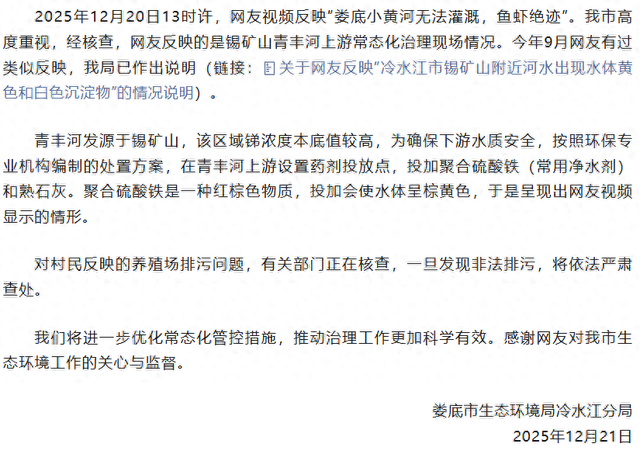
据微信公众号"冷水江新闻"消息,12月21日凌晨,湖南娄底市生态环境局冷水江分局发布情况说明: 2025年12月20日13时许,网友视频反映"娄底小黄河无法灌溉,鱼虾绝迹"。我市高度重视,经核查,网 友反映的是锡矿山青丰河上游常态化治理现场情况。今年9月网友有过类似反映,我局已作出说明。 青丰河发源于锡矿山,该区域锑浓度本底值较高,为确保下游水质安全,按照环保专业机构编制的处置 方案,在青丰河上游设置药剂投放点,投加聚合硫酸铁(常用净水剂)和熟石灰。聚合硫酸铁是一种红 棕色物质,投加会使水体呈棕黄色,于是呈现出网友视频显示的情形。 对村民反映的养殖场排污问题,有关部门正在核查,一旦发现非法排污,将依法严肃查处。 我们将进一步优化常态化管控措施,推动治理工作更加科学有效。感谢网友对我市生态环境工作的关心 与监督。 微信公众 号"冷水江新闻"截图 今年9月18日,娄底市生态环境局冷水江分局也曾发布声明,对相关问题做出类似解释: 网友视频反映"冷水江市锡矿山附近河水出现水体黄色和白色沉淀物",我市高度重视,迅速组织专业人 员赴现场勘查。经核查,网友反映的是锡矿山青丰河上游常态化治理现场情况。 青丰河发源于锡矿山,该 ...

西部矿业迎喜讯子公司取得采矿许可证
Zheng Quan Ri Bao· 2025-12-19 16:13
12月19日,矿业龙头企业西部矿业(601168)股份有限公司(以下简称"西部矿业")发布关于全资子公司 取得采矿许可证的公告。公告显示,公司全资子公司格尔木西矿资源开发有限公司(以下简称"格尔木西 矿资源")于近日取得青海省自然资源厅颁发的《中华人民共和国采矿许可证》。 根据公告,矿区位于青海省海西蒙古族藏族自治州格尔木市它温查汉西C5异常区,开采矿种包括铁 矿、硫矿、铜矿、锌矿、铅矿和金矿。许可证有效期限自2025年11月26日至2044年11月25日。该矿区拥 有铁多金属矿资源量2007万吨,平均品位mFe31.59%,同时伴生有铜金属量7.61万吨、锌金属量6.04万 吨、金金属量2.86吨。 北方民族大学经济学院教授张晓凤向《证券日报》记者表示,我国铁矿石对外依存度较高,国产矿在成 本和品位上短期内面临挑战。在此背景下,西部矿业作为区域性资源整合平台和重要供应商,其加强国 内资源储备的举动,是对国家资源安全战略的响应,也是提升自身原料保障能力、平滑行业周期波动的 重要举措。 此次获得新采矿权并非孤立事件,而是西部矿业系统性资源战略的一部分。 在今年5月份召开的业绩说明会上,西部矿业在回复投资者提问时 ...

超额认购超5000倍,智汇矿业(02546.HK)上市首日市值破40亿港元
Sou Hu Cai Jing· 2025-12-19 09:35
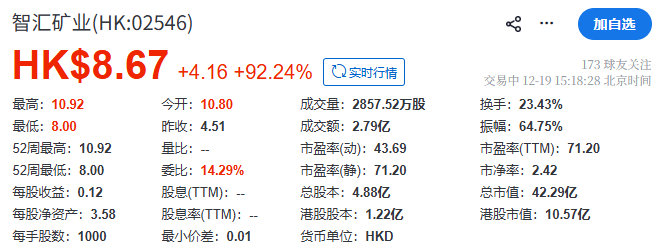
Group 1 - The core point of the article is that Zhihui Mining officially listed on the Hong Kong Stock Exchange on December 19, with a final offer price of HK$4.51 per share, raising approximately HK$550 million [1] - On its first trading day, the stock opened at HK$10.80 but later declined to HK$8.67, giving the company a total market capitalization of HK$4.229 billion [1] - The company offered approximately 122 million H-shares globally, with the Hong Kong public offering receiving a strong response, achieving an oversubscription rate of 5248.15 times [5] Group 2 - Zhihui Mining focuses on the exploration, mining, and production of zinc, lead, and copper in the Tibet Autonomous Region of China, with core assets located in the Nagqu region [5] - The company holds exploration rights over approximately 58.5 square kilometers and mining rights over about 4.5 square kilometers [5] - According to data from Shanghai Nonferrous Metals Network, the company's production of zinc, lead, and copper concentrates ranks fifth, fourth, and fifth respectively in the local market for 2024 [5] Group 3 - The company's financial performance showed fluctuations in revenue from 2022 to 2024, with net profits of RMB 118 million, RMB 155 million, and RMB 55.85 million, corresponding to gross profit margins of 36.3%, 39.9%, and 34.6% [5] - Revenue for 2024 is projected to decline to RMB 301 million, with a corresponding decrease in profits; however, the financial data for the first seven months of 2025 indicates a recovery, with revenue of RMB 257 million and profits of RMB 51.74 million [5] Group 4 - The high valuation and turnover on the first trading day reflect short-term enthusiasm from investors for scarce mineral resources [6] - The inherent cyclical volatility of mining companies, uncertainty in metal prices, and the unique operational and policy environment at high altitudes are long-term considerations for investing in Zhihui Mining [6] - The future stability and growth of the company's market value will depend on its ability to enhance resource reserves, optimize operational efficiency, and navigate industry cycles with the support of capital markets [6]
西藏本土领先矿业企业登陆港股!资源、产能与战略收购共筑增长蓝图
Zheng Quan Shi Bao Wang· 2025-12-19 07:22
Core Insights - The value logic of mining companies is changing due to tightening global resource supply and a reassessment of "certainty assets" in capital markets [1] - Companies with resource endowment, regional barriers, and clear long-term expansion capabilities are becoming the focus of investors [1] Company Overview - Tibet Zhihui Mining Co., Ltd. ("Zhihui Mining") officially listed on the Hong Kong Stock Exchange on December 19, 2023, after a successful IPO that saw a subscription rate of 5248.15 times [2] - The company has a market capitalization of approximately HKD 20 billion to 22 billion and issued 12.2 million shares at a price range of HKD 4.1 to 45.1 [2] Resource Endowment - Zhihui Mining's core competitiveness stems from its unique and irreplaceable resource base, particularly the Mengya Mine located in a significant polymetallic mineralization belt in Tibet [3] - The mine has an estimated mineral resource of 16,813.0 thousand tons with average grades of 4.70% zinc, 3.29% lead, 0.24% copper, and 38.0 grams per ton of silver, providing a solid foundation for long-term stable operations [3][4] Production Capacity Expansion - The company is transitioning from a "resource-driven" to a "capacity-driven" model, with the underground mine expected to enter commercial operation in Q2 2025, allowing for a licensed annual mining capacity of 400.0 thousand tons [5] - The existing open-pit mine has an estimated service life of about 8 years, while the underground mine has a remaining service life of 31 years, ensuring a stable supply of raw materials for decades [5] Strategic Growth and Governance - Zhihui Mining plans to pursue strategic acquisitions of quality mineral assets in Tibet, focusing on those with clear mineral resource quantities and containing non-ferrous and precious metals [6][7] - The company's mixed-ownership structure, which includes state-owned and private investors, provides institutional support for strategic expansion while maintaining operational flexibility [7] Market Position and Future Outlook - The combination of resource endowment and localized operational capabilities allows Zhihui Mining to convert mineral resources into stable cash flows, establishing a solid valuation foundation in the capital market [4][8] - With the gradual release of underground mining capacity, exploration potential, and strategic acquisitions, the company's growth logic is being reinforced, enhancing its long-term investment value [8]

宝地矿业:公司董事会秘书对投资者问题均认真阅读并仔细回复
Zheng Quan Ri Bao Wang· 2025-12-18 14:11
证券日报网讯12月18日,宝地矿业(601121)在互动平台回答投资者提问时表示,公司董事会秘书对投 资者问题均认真阅读并仔细回复。公司董事会及管理层高度重视投资者关系工作,在规范履行信息披露 义务的前提下,积极通过业绩说明会、接待调研、回复E互动平台提问、接听股东热线等多种方式与投 资者进行沟通交流,听取投资者对公司发展的意见与建议。公司也将继续做好生产经营工作,严格履行 信息披露义务,规范运作,加强与投资者沟通交流,积极传递公司价值,提升投资者对公司的关注和认 可。 ...

宝地矿业:将根据战略发展等因素不断优化高管绩效管理办法
Zheng Quan Ri Bao Zhi Sheng· 2025-12-18 10:22
(编辑 任世碧) 证券日报网讯 12月18日,宝地矿业在互动平台回答投资者提问时表示,公司根据相关法律法规和《公 司章程》等规定,结合目前地区、行业、经营情况和盈利水平等实际情况,根据高管岗位职责、工作绩 效和确定的经营目标,在保障股东利益、实现公司与管理层共同发展的前提下,制定年度高管人员绩效 管理办法,强化高管个人绩效与公司整体业绩的关联。未来公司将根据战略发展、经营情况、内部管理 需要等因素,不断优化高管绩效管理办法,不断提高公司经营效益和资产质量。 ...
列国鉴丨记者观察:刚卢和平协议背后的美国矿产算计
Xin Hua She· 2025-12-18 08:01
12月5日,在卢旺达布加拉马,来自刚果(金)的民众乘车前往难民营。新华社发(扎内姆·内蒂·扎 伊迪摄) 新华社金沙萨12月18日电(记者史彧)12月4日,在美国总统特朗普的高调主持下,刚果(金)总 统齐塞克迪与卢旺达总统卡加梅在美国首都华盛顿正式签署和平协议。美方宣称此举旨在推动非洲大湖 地区化解恩怨,重塑区域稳定前景。但事实却是,刚果(金)东部冲突非但没有偃旗息鼓,反而愈演愈 烈。 这一所谓的和平协议,在停火、监督、武装组织处置等核心议题上均缺乏可执行机制,对消弭冲突 根源和弥补治理赤字更是无济于事。特朗普一方面鼓吹刚果(金)冲突是他今年上任以来化解的"八场 战争之一";一方面公开承认通过与刚卢签订多项协议,"为美国获取关键矿产开辟新的机遇"。 和平秀场 事实上,刚卢两国外交部长今年6月已在华盛顿签署相关文本,11月又在美方主导下达成区域经济 一体化初步框架。12月4日的仪式由特朗普主持,刚卢两国总统难得同框,更多展现的是政治姿态。 特朗普将刚卢和平协议称为"前无古人的成就",强调"美国在大湖地区发挥关键调停作用"。 自2021年底刚果(金)反政府武装"M23运动"重新活跃以来,刚果(金)与卢旺达关系迅速恶 ...

驻几内亚比绍大使杨仁火赴奥约省走访慰问中资矿企
Shang Wu Bu Wang Zhan· 2025-12-14 01:55
Group 1 - The core viewpoint of the article emphasizes the importance of the Falun phosphate project in enhancing Guinea-Bissau's economic and social development through Sino-Guinean mining cooperation [1] - The Chinese ambassador to Guinea-Bissau, Yang Renhuo, visited the Chinese mining company Kubo Mining in the Oyo province to assess the exploration status of the Falun phosphate mine [1] - The ambassador acknowledged the company's progress in production and highlighted the need for the enterprise to operate legally and responsibly while fulfilling its social responsibilities [1] Group 2 - The visit included participation from a Chinese medical aid team, which provided free medical services to the employees of the mining company [1]

远景能源等在宜昌成立矿业公司
Zheng Quan Shi Bao Wang· 2025-12-12 03:51
人民财讯12月12日电,企查查APP显示,近日,宜昌景投矿业有限公司成立,法定代表人为赵卫军,注 册资本为1.5亿元,经营范围包含:非煤矿山矿产资源开采;矿产资源勘查;金属与非金属矿产资源地 质勘探;金属矿石销售等。企查查股权穿透显示,该公司由远景能源有限公司全资子公司远景创业投资 (海南)有限公司、宜昌国有资本投资控股集团有限公司等共同持股。 ...
中铝青年突击队:做创新阵地上的“尖兵”
Zhong Guo Qing Nian Bao· 2025-12-10 22:40
Core Viewpoint - The article highlights the significant role of youth innovation teams within the China Aluminum Group, emphasizing their contributions to high-quality development through technological advancements and digital transformation in various sectors of the company [1][6]. Group 1: AI and Digital Innovation - At China Aluminum Capital, a youth team has developed an industrial big data platform that enhances futures brokerage services through algorithmic analysis, generating over 300,000 yuan in direct economic benefits within six months [2]. - The team has created four AI application scenarios, including a risk warning assistant, which advanced to the semifinals of the first "Kun'an Cup" AI application innovation competition [2]. Group 2: Transformation of Traditional Industries - In Baotou Aluminum, a youth team has implemented a "smart" approach to revitalize a 60-year-old electrolytic aluminum plant, achieving a cumulative economic benefit of 97.25 million yuan through automation and digitalization [3]. - The team consists of 39 highly educated members, with a focus on practical and efficient project management, leading to significant energy savings and operational improvements [3]. Group 3: Technological Breakthroughs in Mining - In Ningxia, a youth innovation team has developed a dual-directional monorail system for underground transport, improving efficiency by 30% and reducing costs by 25%, with a U.S. patent granted for the technology [4]. - In Shanxi, a youth innovation group has increased bauxite extraction rates from 50% to 70% through a new "filling mining" technique, generating nearly 40 million yuan in economic benefits [5]. Group 4: Youth Innovation Ecosystem - The rapid development of youth teams is supported by a structured innovation model within China Aluminum Group, which includes competitions and direct support from senior experts to foster practical skills and innovation [6][7]. - Initiatives like the "Youth Technology Arena" provide a platform for young engineers to showcase their work, enhancing their visibility and engagement in the industry [6].