
卫星导航

Search documents
一月金股汇
Dongxing Securities· 2026-01-05 07:16
Group 1: Stock Recommendations - Torch Electronics (603678.SH) shows improving industry conditions with a 24.20% revenue growth to 17.72 billion CNY and a 59.04% increase in net profit to 2.61 billion CNY in H1 2025[10] - Huace Navigation (300627.SZ) achieved a revenue of 32.51 billion CNY in 2024, a 21.38% year-on-year growth, with a net profit of 5.83 billion CNY, up 29.84%[17] - Kingsoft Office (688111.SH) reported a revenue of 41.78 billion CNY for the first three quarters of 2025, a 15.21% increase, with a net profit of 11.78 billion CNY, up 13.32%[22] Group 2: Market Trends and Performance - The global MLCC market is projected to reach 132.6 billion CNY by 2029, with a CAGR of 5.7% from 2024 to 2029[13] - The lithium business of Zhongmin Resources (002738.SZ) saw a revenue increase of 34.99% to 48.18 billion CNY in the first three quarters of 2025, despite a net profit decline of 62.58%[36] - The automotive sealing strip market is benefiting from the rise of European-style door designs, with a projected revenue growth for Zhejiang Xiantong (603239.SH) to 14.7 billion CNY in 2025, a 20.2% increase[31] Group 3: Investment Ratings and Risks - Torch Electronics maintains a "recommended" rating with expected EPS of 1.09 CNY, 1.36 CNY, and 1.81 CNY for 2025-2027[14] - Huace Navigation is rated "recommended" with a target price indicating a potential upside of 16%-36%[22] - Risks include potential market fluctuations, increased competition, and technological advancements not meeting expectations[35]



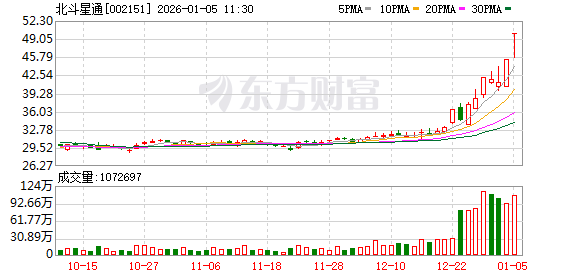
北斗星通成交额创2020年8月14日以来新高
Zheng Quan Shi Bao Wang· 2026-01-05 03:32
数据宝统计,截至11:03,北斗星通成交额49.56亿元,创2020年8月14日以来新高。最新股价上涨 9.99%,换手率23.51%。(数据宝) (文章来源:证券时报网) ...


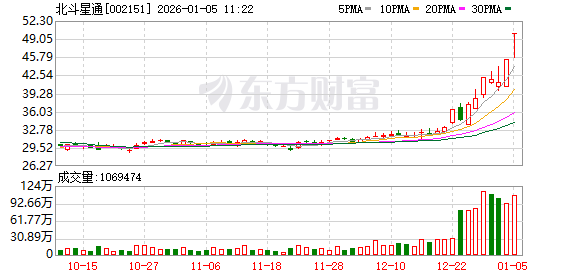
北斗星通录得5天3板
Zheng Quan Shi Bao Wang· 2026-01-05 03:21
北斗星通再度涨停,5个交易日内录得3个涨停,累计涨幅为30.33%,累计换手率为118.16%。截至 11:05,该股今日成交量1.06亿股,成交金额50.31亿元,换手率23.85%。最新A股总市值达271.29亿元, A股流通市值221.28亿元。 近日该股表现 | 日期 | 当日涨跌幅(%) | 换手率(%) | 主力资金净流入(万元) | | --- | --- | --- | --- | | 2025.12.31 | 10.00 | 20.95 | 69106.86 | | 2025.12.30 | -1.01 | 23.05 | -22957.67 | | 2025.12.29 | -1.07 | 24.41 | -65016.90 | | 2025.12.26 | 9.99 | 25.91 | 81135.75 | | 2025.12.25 | 2.65 | 18.97 | -61.34 | | 2025.12.24 | 8.42 | 18.02 | 25288.18 | | 2025.12.23 | -5.44 | 18.25 | -20667.88 | | 2025.12.22 | 9.99 ...
振芯科技股价跌5.03%,长信基金旗下1只基金重仓,持有913.52万股浮亏损失1306.33万元
Xin Lang Cai Jing· 2026-01-05 02:13
Group 1 - The core point of the article highlights the recent decline in the stock price of Zhenxin Technology, which fell by 5.03% to 27.00 CNY per share, with a trading volume of 453 million CNY and a turnover rate of 2.93%, resulting in a total market capitalization of 15.333 billion CNY [1] - Zhenxin Technology, established on June 12, 2003, and listed on August 6, 2010, is based in Chengdu, Sichuan Province. The company focuses on the "components-terminal-system" industry chain related to Beidou satellite navigation, providing products and services including key components for Beidou satellite navigation applications, high-performance integrated circuits for special industries, and the development and construction of Beidou satellite navigation positioning application systems [1] - The revenue composition of Zhenxin Technology includes integrated circuit business at 50.23%, comprehensive Beidou navigation applications at 35.43%, smart city construction and operation services at 11.34%, machine perception and intelligent products at 2.44%, and others at 0.57% [1] Group 2 - Longxin Fund's Longxin National Defense and Military Industry Quantitative Mixed A Fund (002983) has entered the top ten circulating shareholders of Zhenxin Technology, holding 9.1352 million shares, which accounts for 1.61% of the circulating shares. The estimated floating loss today is approximately 13.0633 million CNY [2] - The Longxin National Defense and Military Industry Quantitative Mixed A Fund was established on January 5, 2017, with a current scale of 905 million CNY. It has achieved a return of 48.32% this year, ranking 1284 out of 8155 in its category, and has the same return for the past year [2] - The fund manager of Longxin National Defense and Military Industry Quantitative Mixed A Fund is Song Haikuan, who has a cumulative tenure of 7 years and 330 days, with the fund's total asset scale at 6.495 billion CNY. The best return during his tenure is 179.05%, while the worst is -26.88% [3] Group 3 - Longxin National Defense and Military Industry Quantitative Mixed A Fund holds Zhenxin Technology as its eighth largest heavy stock, with 9.1352 million shares accounting for 5.09% of the fund's net value. The estimated floating loss today is approximately 13.0633 million CNY [4]

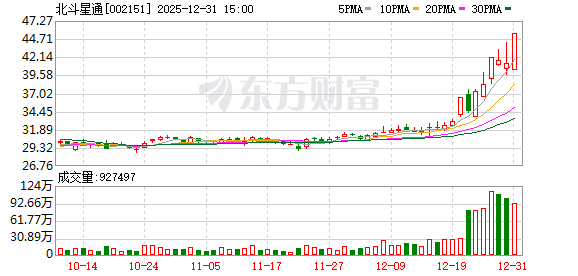
北斗星通龙虎榜数据(12月31日)
Zheng Quan Shi Bao Wang· 2025-12-31 09:15
北斗星通今日涨停,全天换手率20.95%,成交额40.52亿元,振幅12.65%。龙虎榜数据显示,机构净卖 出853.66万元,深股通净卖出4283.41万元,营业部席位合计净买入2.32亿元。 深交所公开信息显示,当日该股因日涨幅偏离值达10.31%上榜,机构专用席位净卖出853.66万元,深股 通净卖出4283.41万元。 证券时报·数据宝统计显示,上榜的前五大买卖营业部合计成交10.10亿元,其中,买入成交额为5.95亿 元,卖出成交额为4.15亿元,合计净买入1.81亿元。 具体来看,今日上榜的营业部中,共有3家机构专用席位现身,即买二、卖二、卖三、卖五,合计买入 金额1.42亿元,卖出金额1.51亿元,合计净卖出853.66万元,深股通为第一大买入营业部及第一大卖出 营业部,买入金额为1.71亿元,卖出金额为2.13亿元,合计净卖出4283.41万元。 资金流向方面,今日该股主力资金净流入6.91亿元,其中,特大单净流入7.90亿元,大单资金净流出 9918.39万元。近5日主力资金净流入6.22亿元。 融资融券数据显示,该股最新(12月30日)两融余额为10.94亿元,其中,融资余额为10.84亿 ...
中科星图成立低空装备系统公司
Zheng Quan Shi Bao Wang· 2025-12-31 07:33
Group 1 - The core point of the article is the establishment of a new company, 中科星图低空装备系统(安徽)有限公司, which is fully owned by 中科星图 [1] - The registered capital of the new company is 200 million yuan [1] - The business scope of the company includes satellite navigation services, manufacturing and sales of intelligent unmanned aerial vehicles, and manufacturing of radar and supporting equipment [1]

伟星股份股价跌1.03%,东方阿尔法基金旗下1只基金重仓,持有57.06万股浮亏损失6.28万元
Xin Lang Cai Jing· 2025-12-31 07:02
Group 1 - The core point of the news is that Zhejiang Weixing Industrial Development Co., Ltd. (伟星股份) experienced a stock decline of 1.03%, with a current share price of 10.58 yuan and a total market capitalization of 12.578 billion yuan [1] - The company, established on May 11, 1988, and listed on June 25, 2004, specializes in the research, manufacturing, and sales of clothing accessories such as buttons, zippers, and metal products, as well as high-end military satellite navigation products [1] - The revenue composition of the company is as follows: zippers account for 55.30%, buttons for 39.61%, other clothing accessories for 3.62%, and other products for 1.47% [1] Group 2 - From the perspective of major fund holdings, the Dongfang Alpha Fund has a significant position in Weixing shares, with the Dongfang Alpha Xingke One-Year Holding Mixed A Fund (015900) holding 570,600 shares, representing 8.3% of the fund's net value [2] - The fund has reported a floating loss of approximately 62,800 yuan as of the latest data [2] - The Dongfang Alpha Xingke One-Year Holding Mixed A Fund was established on September 28, 2022, with a current scale of 57.058 million yuan, achieving a year-to-date return of 14.96% and a one-year return of 13.88% [2]

罕见!“卫星导航第一股”董事长带头发千字长文 声讨实控人!公司已内斗多年
Zheng Quan Shi Bao Wang· 2025-12-31 03:20
Core Viewpoint - The public letter from the management team of Zhenxin Technology highlights internal conflicts and disputes regarding the actual control of the company, particularly targeting the contributions and qualifications of the actual controller, He Yan [1][2]. Group 1: Internal Conflicts - The public letter, signed by Chairman Xie Jun, Vice Chairman Xu Jin, and Director Bai Jie, accuses He Yan of not contributing to the company's development and causing significant obstacles due to personal issues [1]. - The letter claims that He Yan has never held a position or participated in the management of the company since its establishment, and her past legal issues have negatively impacted the company's reputation and market value [1][3]. - The management team asserts that He Yan has disrupted the company's stability and decision-making processes, including repeatedly rejecting legitimate resolutions from the shareholders' meetings [1]. Group 2: Legal Background - The public letter was issued following a shareholders' meeting on December 26, where several key proposals were rejected, likely due to opposition from the controlling shareholder, Chengdu Guoteng Electronics Group, which He Yan holds a 51% stake in [3]. - Zhenxin Technology, originally named Chengdu Guoteng Electronics Technology Co., Ltd., was co-founded by He Yan and others, and it specializes in products related to the BeiDou satellite navigation system [3]. - A series of lawsuits initiated by shareholders against Guoteng Group since 2018 reflect ongoing disputes over control, with a court ruling in 2021 ultimately deciding against the dissolution of Guoteng Group [4][6]. Group 3: Governance Issues - The company has been in a state of governance deadlock, with claims that it has a controlling shareholder but lacks an actual controller, which complicates its operational stability [5][6]. - Despite the court ruling that Guoteng Group should not be dissolved, the management team of Zhenxin Technology has maintained control over the board, indicating ongoing power struggles [6]. - The situation emphasizes the need for the company to resolve shareholder disputes and ensure fair representation of all parties involved [6].
卫星导航指数盘中拉升,长江通信触及涨停
Mei Ri Jing Ji Xin Wen· 2025-12-31 02:40
Group 1 - The satellite navigation index experienced a significant increase on December 31, with notable stock performances from various companies in the sector [1] - LeiKe Defense reached its daily limit increase, while Changjiang Communication also hit its daily limit [1] - Aerospace Huanyu saw a peak increase of 12%, China Satellite rose by 6%, and China Satcom increased by 5% [1]


资金融贯“天地人” 服务助力新发展——湖南银行业精准赋能新质生产力调查
Zheng Quan Ri Bao Zhi Sheng· 2025-12-30 16:07
本报记者 杨洁 在湖南省这片创新热土上,新质生产力正以前所未有的速度茁壮成长。从仰望星空的北斗产业,到深耕 大地的绿色物流枢纽和地热系统,再到投资于人的科创企业与人才培育,一场以金融赋能高质量发展的 生动实践正在三湘大地全面展开。 近期,《证券日报》记者跟随中国银行业协会到湖南省实地调研了解到,当地金融机构正以精准、创 新、前瞻性的金融服务,融贯"天地人"三大维度,为培育新质生产力注入源源不断的金融活水。 天空:北斗闪耀 金融赋能空天信息新赛道 "复移小凳扶窗立,教识中天北斗星。"自古以来,北斗七星便是中国人辨明方向、追寻时空的指引。如 今,北斗之光已悄然融入人们的寻常生活,无需仰首寻觅,近在身边的中国北斗产业,正以璀璨科技之 辉照亮千行百业。 北斗产业是指基于北斗全球卫星导航系统的产业。近年来,我国持续推动北斗与5G通信、大数据、物 联网等新兴技术领域深度融合,全面推动北斗系统规模应用示范,在重点行业、区域创新应用上进行示 范引导,发展形成更多"北斗+"和"+北斗"的新产业新业态新模式。湖南作为北斗技术创新的引领区,其 发布的《湖南省北斗产业发展规划(2023—2027年)》提出"力争到2027年全省北斗产 ...
