
Internet

Search documents
Alphabet Dethrones Apple Amid Tech Stock Shuffle
ZACKS· 2026-01-08 21:10
Core Insights - Alphabet has overtaken Apple as the world's second most valuable public company, with a market capitalization trailing only Nvidia at approximately $4.6 trillion, marking the first time since 2019 that Alphabet has surpassed Apple [1] Group 1: Alphabet's Performance - Alphabet shares surged roughly 65% over the last year, the strongest performance among the Magnificent Seven, driven by the positive market response to the adoption of its Gemini 3 AI models [2][4] - The November launch of the Gemini 3 model has positioned Alphabet as a leader in AI, shifting investor perception from a defensive internet incumbent to an active player in AI innovation [4] - Alphabet's vertically integrated AI stack, which includes both software models and custom hardware (TPUs), allows for greater flexibility and optimization compared to competitors [5] Group 2: Market Dynamics - Industry data indicates a slowdown in ChatGPT traffic following the release of Gemini 3, suggesting that Alphabet is regaining market share in the AI ecosystem [6] - In contrast, Apple shares have fallen approximately 5% over six consecutive sessions, with uncertainty surrounding Tim Cook's impending retirement contributing to the decline [7] - Despite Alphabet's strong rally, it still trades at a discount to Apple, having previously traded at an earnings multiple in the teens due to concerns about its mature search-based business [8] Group 3: Future Outlook - The shift in market leadership reflects the emerging hierarchy among AI leaders, with Nvidia as the primary beneficiary of AI infrastructure spending and Alphabet positioned as a close second [10] - Tracking developments in artificial intelligence can provide investors with a significant edge, highlighting ongoing opportunities for outperformance among major companies [11]



Exclusive: Big Tech spared strict rules in EU digital rule overhaul, sources say
Reuters· 2026-01-08 19:33
Core Viewpoint - Major tech companies including Alphabet's Google, Meta Platforms, Netflix, Microsoft, and Amazon are unlikely to face stringent regulations in the ongoing overhaul of Europe's digital rules, despite pressure from telecom companies [1] Group 1 - Telecom companies have been advocating for stricter regulations on large tech firms, arguing that these companies should contribute more to the infrastructure costs [1] - The European regulatory landscape is evolving, but the current sentiment suggests a more lenient approach towards the major tech players [1] - The potential for heavy-handed regulations appears diminished, indicating a possible shift in the balance of power between telecoms and tech giants [1]


全省唯一!芜湖一企业已连续13年入选中国互联网百强!
Sou Hu Cai Jing· 2026-01-08 16:08
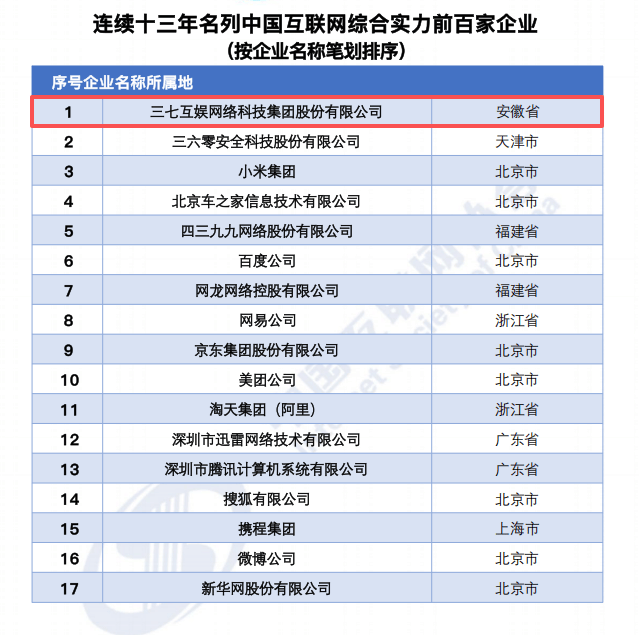
Core Viewpoint - The 2025 China Internet Enterprise Comprehensive Strength Index was released, highlighting the top companies in the industry, with Sanqi Interactive Entertainment ranking 17th, marking a significant achievement for the company and the province of Anhui [1][4]. Group 1: Company Rankings - Sanqi Interactive Entertainment has been included in the China Internet Top 100 for 13 consecutive years, ranking 17th in 2025, the highest among A-share companies and the only representative from Anhui province [1][5]. - The top five companies in the 2025 China Internet Comprehensive Strength Index include Shanghai Xunmeng Information Technology Co., Ltd., Beijing Douyin Information Service Co., Ltd., Ant Group, Taotian Co., Ltd., and Tencent [4]. Group 2: Company Performance - Sanqi Interactive Entertainment's rise in ranking is attributed to its strong performance in enterprise scale, credit, AI innovation, overseas market expansion, and social responsibility [4][6]. - The company aims to continue leveraging Anhui's favorable business environment and policy support to enhance its operations and contribute to the digital economy's high-quality development in the province [6].

百度:围绕AI“魔改”经典IP等场景,累计巡查清理违规视频284条
Xin Lang Cai Jing· 2026-01-08 15:54
Core Viewpoint - The announcement highlights Baidu's commitment to addressing the issue of "AI-modified" videos in response to a national initiative aimed at regulating such content starting January 1, 2026 [1][5]. Group 1: Governance Measures - Baidu is actively responding to the national governance initiative by enhancing content review processes and implementing a collaborative mechanism between technical identification and manual review [1]. - The company aims to accurately target key areas of AI content violations, focusing on identifying sensitive elements such as military uniforms, notable figures, and classic IP images through advanced detection methods [1]. - A specialized model for political content control is being developed to improve semantic recognition and intent prediction, thereby preventing the generation of inappropriate "AI-modified" content at the source [1]. Group 2: Progress and Achievements - To date, Baidu has inspected and removed a total of 284 videos related to AI-modified classic IPs and politically sensitive content, resulting in the closure of 2 accounts [2]. - Specific cases of violations include inappropriate AI-generated portrayals of military figures and classic literary characters, which have been promptly addressed by removing the offending videos and closing the accounts involved [3]. Group 3: Future Commitment - Baidu is committed to continuing its efforts in regulating "AI-modified" videos to create a healthier online environment for youth [4].

Alphabet overtakes Apple as world's second-most-valuable company behind Nvidia
Yahoo Finance· 2026-01-08 15:47
Core Insights - Alphabet has overtaken Apple as the second most valuable company globally, with a market capitalization of $3.89 trillion compared to Apple's $3.85 trillion, marking the first time since 2019 that Alphabet has surpassed Apple in value [1] - Alphabet has successfully repositioned itself as a leader in AI innovation, leveraging its scale to compete effectively against rivals like OpenAI and Nvidia, particularly with its AI chips (TPUs) and the Gemini 3 AI model [2] - Alphabet was the top-performing stock among the "Magnificent Seven" Big Tech companies in 2025, achieving a 65% gain, and is expected to maintain strong performance in 2026 [3] Company Developments - Apple is facing executive departures and is preparing for a transition after CEO Tim Cook's expected departure, while struggling to establish itself as an AI leader [4] - Alphabet's market cap of $4 trillion is still below Nvidia's $4.5 trillion, indicating competitive pressure in the AI chip market [4] - In 2026, Alphabet will need to demonstrate how its AI capabilities contribute to revenue growth, as investor scrutiny increases regarding the returns on investments in technology infrastructure [5]
美股异动丨Gemini访问量及日活同比暴增!谷歌A涨2.6%续创新高,总市值逼近4万亿美元
Ge Long Hui· 2026-01-08 15:33
Core Insights - Google A (GOOGL.US) was selected as one of the "Top 10 Core Assets" in the "Global Vision" list for 2026, leading to a 2.6% increase in stock price, reaching a historical high of $330.32, with a market capitalization approaching $4 trillion [1] Group 1: Web Traffic and User Engagement - According to Similarweb, Gemini's average daily web visits reached 56 million in December, representing a year-over-year increase of 567% and a month-over-month growth of 24% [1] - Gemini's daily active users reached 62 million, showing a year-over-year growth of 351% and a month-over-month increase of 17% [1] - In contrast, ChatGPT's average daily visits decreased by 9% month-over-month to 178 million, while its daily active users grew by 2% to 392 million [1] Group 2: Product Enhancements - Google announced plans to gradually integrate more Gemini AI features into Gmail, including upgrades such as automatic email conversation summaries [1]

Alphabet (GOOGL) Strengthens Data Center and Renewable Power Push Amid Analyst Price Target Upgrade
Yahoo Finance· 2026-01-08 15:09
Core Viewpoint - Alphabet Inc. is making a significant move in the clean energy sector by acquiring Intersect Power for $4.75 billion, which will enhance its data center and renewable power capabilities [1][2]. Group 1: Acquisition Details - The acquisition of Intersect Power includes its development team, platform, and multiple gigawatts of energy and data center projects that are either in development or under construction [3]. - The deal will also see Alphabet assume Intersect's existing debt, further solidifying its investment in renewable energy infrastructure [1]. Group 2: Strategic Partnerships - This acquisition builds on a previous partnership where Google, alongside TPG Rise Climate, led an over $800 million funding round in Intersect in December 2024, securing a minority stake [2]. - The collaboration aims to develop gigawatts of co-located data center capacity, with plans for up to $20 billion in renewable power investments by the end of the decade [2]. Group 3: Market Performance and Analyst Ratings - Wedbush has raised its price target on Alphabet shares from $320 to $350, maintaining an Outperform rating, reflecting a strong performance in the consumer internet sector throughout 2025 [4]. - Consumer internet companies, including Alphabet, have shown solid gains, with an average return of 23% among 24 companies covered by Wedbush, outperforming the NASDAQ's 19% gain [4]. Group 4: AI Integration - Alphabet integrates AI across its core businesses, including Google Search, YouTube, and Google Cloud, with advancements from its DeepMind subsidiary in generative AI and reinforcement learning [5]. - The Gemini AI models developed by Alphabet are powering advanced applications in productivity, search, and enterprise solutions [5].
Alphabet (Google) Surpasses Apple in Market Cap as AI Momentum Reshapes Fintech and Web3 Ecosystems
Crowdfund Insider· 2026-01-08 15:03
Core Insights - Alphabet Inc. has surpassed Apple in market value for the first time since 2020, with a valuation of $3.88 trillion compared to Apple's $3.84 trillion, driven by enthusiasm for its advancements in artificial intelligence [1][2] Company Developments - Alphabet's resurgence is largely due to strategic investments in AI technologies, such as the Gemini AI suite, which promise transformative applications across various sectors [2][3] - Apple is facing challenges in its AI initiatives, including key personnel departures and delays in enhancing its Siri virtual assistant, raising concerns about its innovation pipeline [3][4] Industry Implications - The market cap shift highlights broader implications for the financial technology sector, where both companies have significant influence [4][11] - Alphabet's AI-driven tools, including fraud detection algorithms and personalized financial recommendations, are increasingly integrated into banking apps and investment platforms, fostering innovation among startups [5][6] Fintech Landscape - The fintech market is projected to grow to over $500 billion by 2030, driven by AI adoption and enhanced user experiences [7] - Alphabet's Google Cloud is actively supporting blockchain developers, positioning the company as a bridge between traditional tech and web3, potentially driving mainstream crypto adoption [8][9] Competitive Dynamics - Apple's recent AI setbacks may hinder its progress in fintech features, allowing competitors like Alphabet to gain an advantage [6][10] - The evolving digital economy, influenced by Alphabet's role, could invigorate web3 investments and encourage institutional participation [10][11]
Chinese Stock Charts Reach a Turning Point. What to Watch.
Barrons· 2026-01-08 14:26
Core Viewpoint - Alibaba, NetEase, and H World Group are experiencing positive technical indicators, suggesting potential bullish trends in their stock performance [1] Company Summaries - **Alibaba**: The company is showing strong technical signals, indicating a favorable outlook for investors [1] - **NetEase**: Similar to Alibaba, NetEase is also displaying bullish technical indicators, which may attract investor interest [1] - **H World Group**: The hotel operator is witnessing positive technical trends, suggesting a potential rise in stock value [1]

The S&P 500 Just Did Something Seen Only Twice in the Last 45 Years. Here's What History Says Happens Next and Why You Should Take It With a Grain of Salt.
Yahoo Finance· 2026-01-08 13:35
Group 1 - The current excitement around artificial intelligence (AI) is reminiscent of the 1990s internet and telecom boom, with high stock valuations reflecting this optimism, although many companies have yet to demonstrate significant earnings growth from AI innovations [1] - The S&P 500's forward price-to-earnings (P/E) ratio has increased from approximately 15 at the market bottom in 2022 to over 23, indicating a rapid rise in stock prices that outpaces the underlying fundamentals of most companies [3][5] - Historical data suggests that when the S&P 500 forward P/E ratio exceeds 23, the subsequent 10-year returns are typically negative, indicating potential declines in portfolio values for investors fully invested in S&P 500 stocks [6][9] Group 2 - The current bull market has seen the S&P 500 reach levels not seen in 45 years, with investor optimism around AI driving this growth, particularly in the tech-heavy Nasdaq Composite [5][4] - Despite warnings from economists about potential negative returns for U.S. stocks over the next decade, there is a caution against over-relying on historical data due to the limited sample size of previous occurrences [7][10] - The average annualized 10-year total return for the S&P 500 over the last century is 10.6%, suggesting that while current valuations may lead to lower returns, they are likely to be closer to historical averages than the negative projections based on limited data [11][12]