Real Estate

Search documents
DSS, Inc. Reports Strong Q1 2025 Financial Performance, Setting the Stage for Strategic Growth
Globenewswire· 2025-05-22 12:31
Core Insights - DSS, Inc. reported significant financial improvements in Q1 2025, indicating progress in its financial repositioning strategy and setting a strong foundation for future corporate execution [1][2] Financial Performance - Total revenues increased by 28% year-over-year, driven by a 30% rise in printed product sales and nearly doubling rental income from the real estate segment, which grew from $400,000 to $714,000 [5] - The company completed the sale of its Plano, TX facility for $9.5 million, contributing to $12.88 million in cash from investing activities during the quarter [5] - DSS reduced over $8 million in total debt, demonstrating a commitment to balance sheet optimization [5] - The company raised $1.5 million in new equity capital through its partner company Impact BioMedical during Q1 [5] - Net cash used in operations improved from $2.15 million in Q1 2024 to $1.64 million in Q1 2025, highlighting early operational efficiencies [5] Strategic Focus - The company is focused on streamlining operations and financial discipline, with plans to showcase measurable results from development, operations, and M&A activities as the year progresses [2] - DSS aims to identify high-potential business units and allocate capital effectively to drive long-term value [2]



揭示一个天津楼市的真相!
Sou Hu Cai Jing· 2025-05-22 11:46
Core Insights - The new housing market has not gained momentum despite policy support, product updates, and price stabilization [1] - The primary reason for the stagnation is the prevailing expectation issues among potential buyers [2] - The second-hand housing market has emerged as a significant obstacle to new housing sales [3] Market Dynamics - A market survey by 365 Market Research revealed that the typical "sell one buy one" replacement strategy has failed since 2021, leading to a decline in new housing transactions and an increase in second-hand housing transactions [4][5][6] - The gap between new and second-hand housing transactions has widened, with second-hand housing sales nearly doubling those of new homes in recent years [8][10] - The price difference between new and second-hand homes has increased from a maximum of 25% before 2021 to 66% currently, causing buyers to favor second-hand homes due to better pricing [9][10] Demand Shifts - The structural shift in demand has allowed first-time buyers to enter the market, competing with new homes for prime locations [11] - The current new housing market is primarily driven by improvement buyers, but the failure of the replacement chain has led to a backlog of improvement demand [14][16] - The urbanization rate in Tianjin has reached 86% by 2024, indicating a saturation point that limits new housing demand [17][21] Economic Context - The economic environment is currently in a downturn, leading to a downgrade in consumer spending and a preference for stable asset investments [22][23] - The consensus among sellers is that second-hand homes must lower prices to sell, with many opting to hold cash rather than reinvest in new homes [24][26][27] Policy Efforts - Recent policy measures, such as the "Good House" initiative and reductions in mortgage rates, aim to stimulate the new housing market [30][31] - However, the key to revitalizing new housing demand lies in stabilizing the second-hand housing market [32]

2025年6月起,中国或将迎来5大降价潮,这些东西要降价了
Sou Hu Cai Jing· 2025-05-22 00:55
Inflation and Deflation Trends - Industry experts predict a new inflation cycle in China due to M2 scale reaching 326.06 trillion yuan, which is double the GDP, but currently, deflation is observed with April CPI rising only 0.3% [1] - From June 2025, five major price drops are anticipated in China [3] Real Estate Market - Since 2022, housing prices have been on a downward trend, with cities like Tianjin and Shijiazhuang experiencing declines, and major cities like Shanghai seeing significant adjustments, with prices dropping from 95,000 yuan per square meter to 65,000 yuan, a decrease of over 30% [5] - By the second half of 2025, housing price differentiation is expected, with second and third-tier cities slowing their decline while first-tier cities like Shanghai and Shenzhen may experience further drops [5] Seafood Prices - Seafood prices are becoming more affordable, with prices for king crabs dropping below 200 yuan each and salmon prices decreasing by 40%, while shrimp prices fell from 38 yuan per jin to 28 yuan per jin [7] - The decline in seafood prices is attributed to consumer hesitance following Japan's nuclear wastewater discharge, leading to reduced demand despite no contamination in domestic seafood [7] Automotive Market - A price reduction trend is observed in the domestic automotive market, with mid-range cars dropping by 15,000 to 20,000 yuan and luxury imports seeing reductions up to 100,000 yuan [9] - Factors contributing to the decline include an influx of new energy vehicles, increased competition from tech companies like Huawei and Xiaomi, and reduced consumer purchasing power [9] Home Appliance Prices - Home appliance prices are expected to adjust downwards by 10% to 15% for items like refrigerators, TVs, and air conditioners by 2025 [12] - The rapid technological advancement in appliances and decreased consumer spending due to lower incomes are driving the need for discounts and promotions to clear inventory [12] Pork Prices - Pork prices are decreasing, with supermarket prices dropping from 26-28 yuan per jin to 18-20 yuan per jin, and further declines are expected [13] - The price drop is due to overproduction from previous years' high prices attracting investment in pig farming and a shift in consumer preference towards healthier meat options [13]

A股指数涨跌不一,创业板指涨0.17%,贵金属、并购重组等板块涨幅居前
Feng Huang Wang Cai Jing· 2025-05-21 01:35
Market Overview - The three major indices opened mixed, with the Shanghai Composite Index down 0.01%, the Shenzhen Component Index down 0.03%, and the ChiNext Index up 0.17% [1] - The Shanghai Composite Index is at 3380.21, with a decline of 0.01% and 741 gainers against 1107 losers [2] - The Shenzhen Component Index is at 10246.52, down 0.03%, with 745 gainers and 1668 losers [2] - The ChiNext Index is at 2052.00, up 0.17%, with 357 gainers and 855 losers [2] External Market - The US stock market has paused its rebound, with the S&P 500 down 0.39% to 5940.46, the Nasdaq down 0.38% to 19142.71, and the Dow Jones down 0.27% to 42677.24 [3] - The Nasdaq China Golden Dragon Index fell 0.65%, with mixed performances from major Chinese tech stocks [3] Institutional Insights - CITIC Securities highlights rapid progress in the AI industry chain, expecting continued upward trends due to ongoing iterations of AI models and technologies, benefiting software companies with data, customers, and scenarios [4] - Huatai Securities continues to recommend the pet sector, noting strong Q2 performance data and upcoming catalysts such as events and promotions [5] - Guotai Junan Securities reports high growth in feed production, with a 4.2% month-on-month increase and a 9.0% year-on-year increase in April 2025, driven by recovery in livestock and aquaculture [6] - Huatai Securities also recommends real estate stocks with a "three good" logic, focusing on companies with good credit, good cities, and good products, particularly in core cities [7]


Reading International(RDI) - 2025 Q1 - Earnings Call Transcript
2025-05-20 13:02
Financial Data and Key Metrics Changes - For Q1 2025, consolidated revenue decreased by $4.9 million to $40.2 million compared to Q1 2024, primarily due to lower attendance across all markets and the closure of two cinemas [40][42] - The net loss attributable to Reading International Inc. for Q1 2025 was $4.8 million, a decrease of $8.5 million from a loss of $13.2 million in Q1 2024 [42] - Adjusted EBITDA increased by $6.9 million to $2.9 million in Q1 2025, compared to a negative EBITDA of $4 million in Q1 2024 [43] Business Line Data and Key Metrics Changes - Global cinema revenue for Q1 2025 was $36.4 million, down 12% from Q1 2024, representing just under 63% of pre-pandemic Q1 2019 levels [15][40] - Global real estate revenue decreased by 2% to $4.8 million, while operating income increased by 79% to $1.6 million, driven by improved live theater performance and reduced holding expenses [13][30] Market Data and Key Metrics Changes - The average exchange rates for the Australian and New Zealand dollars weakened against the U.S. dollar by 4.5% and 7.3% respectively compared to Q1 2024, impacting revenue [10][40] - The cinema industry faced challenges due to the underperformance of major film releases, notably Disney's Snow White, which affected box office results [9][40] Company Strategy and Development Direction - The company is focused on reducing debt and rebuilding operational cash flow, with plans for cinema renovations and upgrades in the U.S., Australia, and New Zealand [50][52] - Strategic initiatives include enhancing food and beverage offerings, expanding loyalty programs, and recalibrating occupancy costs with landlords to reflect current economic conditions [20][25] Management's Comments on Operating Environment and Future Outlook - Management expressed optimism for a stronger 2026 and beyond, citing an improving interest rate environment and a promising film slate for the upcoming summer and holiday periods [38] - The company acknowledged the challenges faced over the past five years but emphasized efforts to streamline operations and monetize real estate assets to support the cinema business [37][38] Other Important Information - The company completed the sale of its Wellington, New Zealand property for NZD 38 million, which helped reduce debt and interest expenses [5][45] - The company is working on selling its Cannon Park assets in Townsville, Australia, with an expected closing date of May 21, 2025 [8][47] Q&A Session Summary Question: What is your cinema CapEx forecast for 2025? - The company plans to convert 10 auditoriums to recliners and add a Titan Luxe screen in one U.S. theater, with additional upgrades planned for four other cinemas [50] Question: What are Reading's intermediate term plans for the Minetta Lane and Orpheum sites? - The focus is on reducing debt and maintaining cash flow, with ongoing reviews of asset values and potential future opportunities [52][54] Question: Do you expect to refinance the Santander loan? - Discussions are ongoing with Santander to extend the existing loan for another year, with expected interest rates remaining stable [55] Question: What steps will the company take to attract analysts and investors? - The company will participate in the Sidoti conference and host one-on-one meetings with potential shareholders, while maintaining contact with existing analysts [56]

Reading International(RDI) - 2025 Q1 - Earnings Call Transcript
2025-05-20 13:00
Financial Data and Key Metrics Changes - For Q1 2025, consolidated revenue decreased by $4.9 million to $40.2 million compared to Q1 2024, primarily due to lower attendance across all markets and the closure of two cinemas [40][41] - The net loss attributable to Reading International for Q1 2025 was $4.8 million, an improvement from a loss of $13.2 million in Q1 2024, with basic loss per share decreasing to $0.21 from $0.59 [42] - Adjusted EBITDA increased to $2.9 million in Q1 2025, a significant improvement from a negative EBITDA of $4 million in Q1 2024 [43] Business Line Data and Key Metrics Changes - Global cinema revenue for Q1 2025 was $36.4 million, down 12% from Q1 2024, representing just under 63% of pre-pandemic levels [13] - Global real estate revenue decreased by 2% to $4.8 million, while operating income increased by 79% to $1.6 million, driven by improved live theater performance and reduced holding expenses [12][30] Market Data and Key Metrics Changes - The average exchange rates for the Australian and New Zealand dollars weakened against the U.S. dollar by 4.5% and 7.3% respectively, impacting revenue as approximately 50% of total revenue is generated internationally [9] - The cinema industry faced challenges due to a weaker box office, attributed to the lingering effects of the 2023 Hollywood strikes and underperforming film releases [8][15] Company Strategy and Development Direction - The company is focused on reducing debt and rebuilding operational cash flow, with plans for cinema renovations and upgrades in the U.S., Australia, and New Zealand [50][51] - Strategic initiatives include enhancing food and beverage offerings, expanding loyalty programs, and recalibrating occupancy costs with landlords to reflect current economic conditions [20][25] Management's Comments on Operating Environment and Future Outlook - Management expressed optimism for a stronger 2026 and beyond, anticipating improvements in the interest rate environment and a stabilizing film slate [38] - The second quarter of 2025 has shown better box office performance, with successful film releases contributing to improved theater-level cash flow [15][17] Other Important Information - The company completed the sale of its Wellington assets for NZD 38 million, which helped eliminate significant debt and reduce annual interest expenses [6] - The company is actively working on selling its Cannon Park assets in Townsville, Australia, with an expected closing date of May 21, 2025 [7][47] Q&A Session Summary Question: What is your cinema CapEx forecast for 2025? - The company plans to renovate one theater in the U.S. and is working on upgrades for several others in New Zealand and Australia, though completion is not guaranteed [50][51] Question: What are Reading's intermediate term plans for the Minetta Lane and Orpheum sites? - The focus is on reducing debt and maintaining cash flow from these assets while exploring future opportunities [52][54] Question: Do you expect to refinance the Santander loan? - Discussions are ongoing to extend the existing loan for another year, with expected terms including a partial pay down [56] Question: What steps will the company take to attract analysts and investors? - The company will participate in the Sidoti conference and host one-on-one meetings with potential shareholders to enhance visibility and valuation [57][58]
4月70城房价出炉,上海等城市新房领涨
Zhong Guo Xin Wen Wang· 2025-05-19 07:45
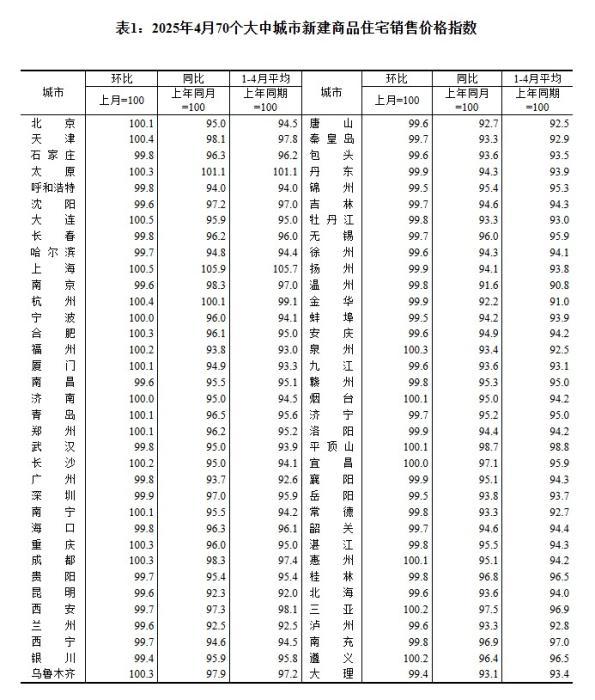
Core Viewpoint - The real estate market in major cities is showing signs of stabilization, with new residential sales prices in first-tier cities experiencing slight increases, while second and third-tier cities face downward pressure due to high inventory and insufficient demand [1][4][6]. Group 1: Price Trends - In April 2025, new residential sales prices in first-tier cities remained flat month-on-month, with Beijing and Shanghai seeing increases of 0.1% and 0.5% respectively, while Guangzhou and Shenzhen experienced declines of 0.2% and 0.1% [1]. - Second-tier cities' new residential sales prices remained unchanged month-on-month, while third-tier cities saw a decrease of 0.2%, consistent with the previous month [5]. Group 2: Market Dynamics - The increase in new home prices in Beijing and Shanghai indicates underlying support factors in these markets, particularly in Shanghai where both new and second-hand homes have shown slight increases [4]. - The high-end improvement projects in Shanghai have contributed to sustained market activity, with significant demand reflected in record subscription numbers for new projects [4]. Group 3: Future Outlook - The overall real estate market is stabilizing due to various policies aimed at preventing further declines, but challenges remain as the market continues to adjust and transform [6]. - There is an increasing demand for quality housing that is green, smart, and safe, indicating potential growth in the market for upgraded and improved residential properties [6].
Tariffs Up, Inflation Down
Seeking Alpha· 2025-05-18 13:00
Core Insights - The article discusses the investment landscape in the real estate sector, particularly focusing on the performance and potential of various real estate investment trusts (REITs) and housing-related companies [1][2]. Group 1: Company Insights - Hoya Capital Research & Index Innovations is affiliated with Hoya Capital Real Estate, which provides investment advisory services and focuses on publicly traded securities in the real estate industry [2]. - The commentary emphasizes that the information provided is for educational purposes and does not constitute investment advice or recommendations for specific securities [2][3]. Group 2: Industry Insights - The real estate industry is highlighted as having unique risks associated with investments in real estate companies and housing industry companies, which may not be suitable for all investors [2]. - The article notes that past performance of market data does not guarantee future results, indicating the inherent volatility and unpredictability of the real estate market [3].


倒计时2天 | 克而瑞《阿联酋房地产住宅白皮书》,5.20即将发布!
克而瑞地产研究· 2025-05-18 01:43
Overview of UAE - The UAE is experiencing significant economic growth, driven by diversification efforts and investments in various sectors [1] Key Market Analysis - The real estate sector is a major contributor to the UAE's economy, with a projected growth rate of 5% annually over the next five years [1] - The tourism industry is also expanding, with visitor numbers expected to reach 25 million by 2025, reflecting a 15% increase from previous years [1] Real Estate Industry Landscape - The real estate market is characterized by high demand in luxury and commercial properties, particularly in Dubai and Abu Dhabi [1] - Key projects include the development of smart cities and sustainable living spaces, which are attracting both local and foreign investments [1] High-Value Areas and Benchmark Projects - Areas such as Downtown Dubai and Yas Island are highlighted as high-value regions, with property prices increasing by 10% year-on-year [1] - Benchmark projects include the Dubai Creek Tower and the Abu Dhabi Midfield Terminal, which are set to enhance the region's global competitiveness [1] Future Trends and Risks - Future trends indicate a shift towards eco-friendly developments and smart technology integration in real estate [1] - Potential risks include market saturation and regulatory changes that could impact foreign investment [1]

别看挂牌价,直接砍!悉尼折扣最多区揭晓,多个华人区上榜
Sou Hu Cai Jing· 2025-05-17 12:48
Core Insights - The Sydney real estate market is experiencing significant differentiation, with some buyers benefiting from lower mortgage rates and rare price discounts on properties [1][3] - Many buyers are closing deals at prices 10% below the listing price, saving over 100,000 AUD, which is uncommon since the COVID-19 pandemic [3][5] - Certain areas, particularly central Sydney apartments and detached houses along train lines, are identified as "high discount zones" where buyers have increased bargaining power [3][10] Market Trends - SuburbData's analysis indicates that Merrylands West and Rosebery are areas with particularly high discounts on apartment sales, with discounts averaging 15% and 13% respectively [4] - In contrast, the average discount for private treaty sales across Sydney is only 1-2%, while auction prices typically exceed price guides [5] - Buyers in areas like Hurstville, Epping, and Surry Hills are purchasing apartments at an average of 10% below the listing price, while Rockdale buyers are seeing discounts close to 9% [5] Buyer Sentiment - Recent buyers have expressed disbelief at the favorable prices they are securing, with one buyer in Rockdale feeling fortunate to have found a great apartment at a lower price [6][8] - A family in Revesby managed to purchase a duplex at 10.5% below the listing price, highlighting the potential for significant savings in the current market [8] Regional Disparities - Conversely, other regions in Sydney are seeing properties sell above the listing price, such as Sutherland where buyers pay an average of 13% over the listing price [10] - In North Kellyville and Ingleburn, properties are also selling above the listing price by 10% and 11% respectively, indicating a competitive market driven by high demand [10] Future Outlook - Mortgage brokers suggest that the current favorable buying conditions may be short-lived, as declining interest rates could quickly heat up market demand [10] - There is a notable increase in pre-approved loans for investors, with some looking to purchase through self-managed super funds due to improved cash flow capabilities [10]