
中试服务

Search documents
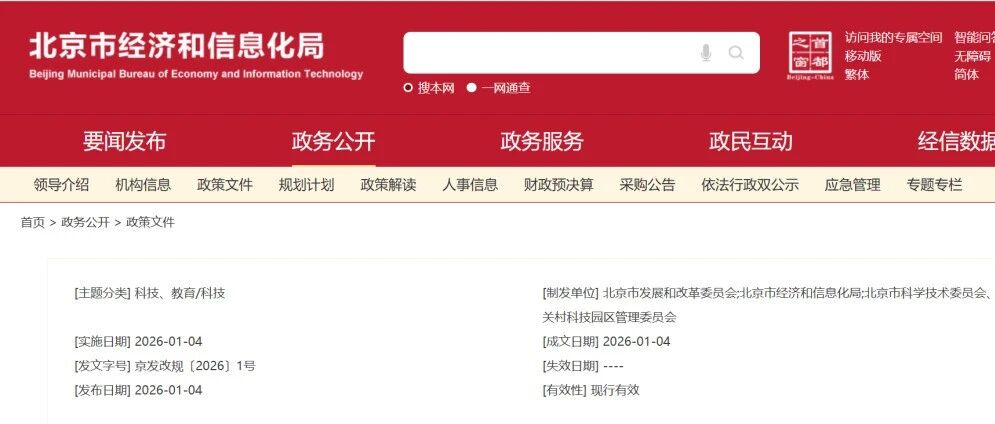
北京发布新年首个产业政策:新建中试平台最高可获1亿元支持
中关村储能产业技术联盟· 2026-01-06 08:17
Core Viewpoint - Beijing aims to enhance its pilot testing service capabilities to promote the integration of technological innovation and industrial development, with a goal of establishing a comprehensive pilot testing system by 2030 [2][8]. Group 1: Policy Measures - The document outlines 14 policy measures to support the construction and efficient operation of pilot testing platforms, with a focus on key industries such as artificial intelligence, healthcare, and green technology [3][9]. - New pilot testing platforms can receive subsidies of up to 100 million yuan, covering 35% of total investment for leading industries and 25% for emerging technology sectors, with specific caps for different categories [3][9]. Group 2: Development Goals - By 2030, Beijing aims to establish 10 national-level and 50 municipal-level pilot testing platforms to meet the needs of a modern industrial system [2][8]. - The initiative emphasizes the importance of pilot testing as a transitional phase for new products, facilitating the commercialization of technological achievements [8]. Group 3: Support for Enterprises - The policies encourage collaboration among leading enterprises and research institutions to build pilot production lines, enhancing the overall testing capabilities within the industry [9][10]. - Financial support mechanisms, including tax deductions and streamlined project approvals, are introduced to facilitate the rapid establishment and operation of pilot testing projects [10][12]. Group 4: Service Ecosystem Enhancement - The document emphasizes the need for a collaborative approach in building pilot testing bases across the Beijing-Tianjin-Hebei region, focusing on key sectors like hydrogen energy and biomedicine [11]. - A platform for matching supply and demand for pilot testing services will be developed to enhance resource allocation and support industrial innovation [11][12]. Group 5: Talent and Standards Development - The initiative includes plans to strengthen the talent pool for pilot testing by fostering partnerships between universities and industry, aiming to cultivate skilled professionals [12]. - Support for the establishment of standards related to pilot testing services is also highlighted, encouraging participation from various stakeholders in the development of national and international standards [12].

北京推动科技创新和产业创新深度融合 在发展新质生产力上奋勇争先
Ren Min Ri Bao· 2026-01-03 23:57
Group 1 - The core viewpoint emphasizes the importance of technological and industrial innovation in enhancing productivity and economic growth in Beijing, with a focus on building a modern industrial system aligned with new productivity standards [1][2] - Beijing's high-tech industries contribute over 40% to economic growth, with plans to establish three trillion-yuan industrial clusters and seven hundred-billion-yuan clusters during the 14th Five-Year Plan [1] - The city aims to accelerate the construction of an international technology innovation center and deepen the integration of technological and industrial innovation during the 15th Five-Year Plan [1] Group 2 - Beijing hosts four out of 21 national-level manufacturing pilot platforms, which are crucial for the transition of new products from trial to production [2] - The city plans to strengthen its pilot platform capabilities by 2027, focusing on enhancing public service functions and establishing clear development paths [2] - Companies like Beijing Yuli Technology Co., Ltd. are providing comprehensive services from research and design to mass production through their pilot platforms [2] Group 3 - Over 1,000 national-level specialized and innovative "little giant" enterprises exist in Beijing, with a strong demand for technology and innovation [3] - The city utilizes a joint funding model involving enterprises and research institutions to drive technological solutions [3] - A "pay after use" model is being explored to support the high-quality development of small and micro enterprises, allowing them to access over 440 technology achievements from universities [3] Group 4 - Beijing is fostering a competitive open innovation ecosystem with vibrant science parks and industrial bases [4] - The city encourages cross-field collaboration and the formation of innovation alliances to target future industrial directions [4] - The Changping Laboratory is making significant progress in life sciences, with research on Parkinson's disease expected to be published in top journals and applied in clinical trials [5]
促进民间投资!国家发改委,最新发声
Zhong Guo Zheng Quan Bao· 2025-11-11 12:10
Core Viewpoint - The National Development and Reform Commission (NDRC) is introducing measures to further promote private investment development, aiming to enhance investment vitality and overall effectiveness [1][2]. Group 1: Policy Measures - The NDRC will encourage industry authorities and local governments to refine specific requirements for private capital participation in project construction [2]. - Measures will focus on encouraging private enterprises to enter high-value-added technology service industries, such as industrial design and common technology services [3]. - The NDRC supports the construction of significant pilot platforms by private enterprises, particularly in advanced manufacturing clusters [5]. Group 2: Investment Opportunities - The NDRC has recommended 105 projects to the China Securities Regulatory Commission (CSRC), with 83 projects already listed, raising a total of 207 billion yuan, expected to drive over 1 trillion yuan in new project investments [7]. - Among private investment projects, 18 have been recommended, with 14 successfully listed, raising nearly 30 billion yuan [7]. - The NDRC aims to broaden financing channels for private enterprises by supporting more eligible private investment projects to issue infrastructure REITs [7][8]. Group 3: Digital Transformation - The NDRC emphasizes the importance of digital transformation in manufacturing and service industries, proposing the establishment of comprehensive digital empowerment platforms to facilitate this transition [6]. - The initiative includes leveraging industry leaders to drive small and medium enterprises into the transformation ecosystem, enhancing their operational capabilities [6].
成都这场生态大会,探索打通成果转化堵点 中试+基金=?
Si Chuan Ri Bao· 2025-10-22 06:54
Core Insights - The article discusses the integration of pilot testing and capital investment in the technology transfer sector, highlighting the establishment of a "pilot + fund" ecosystem to address bottlenecks in technology commercialization [1] Group 1: Pilot Testing and Funding - Pilot funds are emerging as a new investment vehicle focused on projects in the pilot testing phase, addressing the funding gap faced by project teams [2][3] - The Chengdu High-tech Zone has signed three pilot funds, indicating a collaborative effort among project teams, pilot platforms, and local governments to foster industry growth [2] - The Chengdu Hummingbird Pilot Equity Investment Fund, managed by a pilot platform, aims to invest in verified quality projects, contributing to the platform's self-sustainability [4] Group 2: Government Initiatives and Industry Development - The Sichuan provincial government has launched a plan to accelerate the development of the technology service industry, emphasizing the establishment of pilot platforms within key industrial chains [5] - The plan encourages collaboration between leading enterprises, universities, and local governments to build independent pilot platforms, exploring various operational models [5] Group 3: Investment Trends and Market Dynamics - Investors are increasingly seeking early-stage opportunities and engaging with research institutions and pilot platforms to bridge the gap between prototypes and market-ready products [6] - The importance of pilot platforms is growing as they serve as accelerators and connectors between scientists and enterprises, facilitating technology transfer [6][7] - There is a consensus among industry experts that pilot testing will evolve into a distinct industry, driven by increasing market demand [7][8]