
中试服务

Search documents
海洋三所生物资源开发利用中试平台获省级认定
Zhong Guo Zi Ran Zi Yuan Bao· 2026-01-08 06:17
Core Insights - The "Biological Resource Development and Utilization Pilot Service Platform" has been approved as a provincial pilot platform, indicating recognition of its technical service capabilities and role in the biological resource development sector [1] Group 1: Platform Recognition and Purpose - The platform serves as a critical link between laboratory research and industrial production, facilitating the scaling up of successful lab results under simulated industrial conditions [1] - The recognition by the Fujian Provincial Department of Industry and Information Technology includes 14 pilot platforms across nine key industrial sectors, aimed at accelerating the engineering breakthroughs and market transformation of technological innovations [1] Group 2: Platform Development and Services - The Ocean Research Institute has been exploring the construction and operation of the pilot platform since 2010, supported by national and local projects, resulting in a comprehensive biotechnology pilot service platform equipped with essential testing equipment [1] - The platform is applicable to various product categories, including biomedicine, functional foods, biological products, and cosmetics [1] - A multi-tiered technical service and development model has been established, targeting enterprises, research institutions, industrial parks, local governments, and industry associations, providing services such as pilot testing, new product development, quality enhancement, and personnel training [2] - The establishment of a third-party pilot model for technology transfer has significantly improved the efficiency and success rate of converting research results into practical applications [2]
北京发布新年首个产业政策:新建中试平台最高可获1亿元支持
中关村储能产业技术联盟· 2026-01-06 08:17
Core Viewpoint - Beijing aims to enhance its pilot testing service capabilities to promote the integration of technological innovation and industrial development, with a goal of establishing a comprehensive pilot testing system by 2030 [2][8]. Group 1: Policy Measures - The document outlines 14 policy measures to support the construction and efficient operation of pilot testing platforms, with a focus on key industries such as artificial intelligence, healthcare, and green technology [3][9]. - New pilot testing platforms can receive subsidies of up to 100 million yuan, covering 35% of total investment for leading industries and 25% for emerging technology sectors, with specific caps for different categories [3][9]. Group 2: Development Goals - By 2030, Beijing aims to establish 10 national-level and 50 municipal-level pilot testing platforms to meet the needs of a modern industrial system [2][8]. - The initiative emphasizes the importance of pilot testing as a transitional phase for new products, facilitating the commercialization of technological achievements [8]. Group 3: Support for Enterprises - The policies encourage collaboration among leading enterprises and research institutions to build pilot production lines, enhancing the overall testing capabilities within the industry [9][10]. - Financial support mechanisms, including tax deductions and streamlined project approvals, are introduced to facilitate the rapid establishment and operation of pilot testing projects [10][12]. Group 4: Service Ecosystem Enhancement - The document emphasizes the need for a collaborative approach in building pilot testing bases across the Beijing-Tianjin-Hebei region, focusing on key sectors like hydrogen energy and biomedicine [11]. - A platform for matching supply and demand for pilot testing services will be developed to enhance resource allocation and support industrial innovation [11][12]. Group 5: Talent and Standards Development - The initiative includes plans to strengthen the talent pool for pilot testing by fostering partnerships between universities and industry, aiming to cultivate skilled professionals [12]. - Support for the establishment of standards related to pilot testing services is also highlighted, encouraging participation from various stakeholders in the development of national and international standards [12].

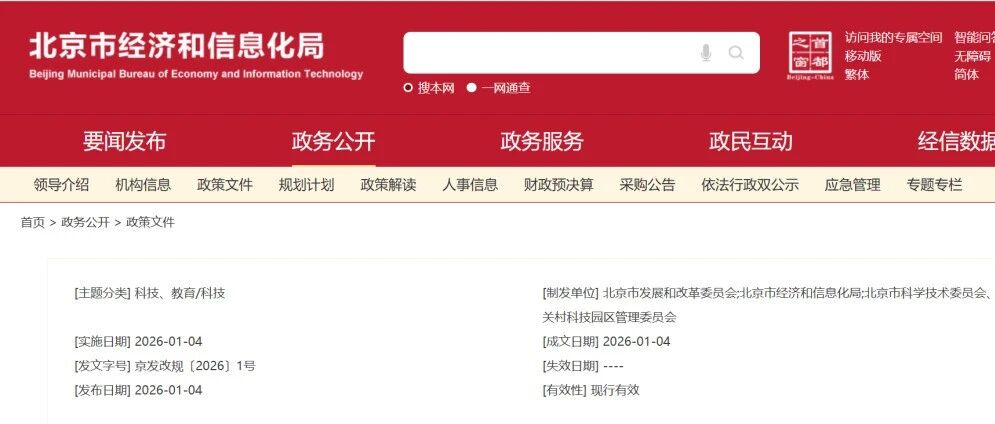
出台“中试十四条” 北京提速科技成果产业化
Bei Jing Shang Bao· 2026-01-05 11:40
Core Viewpoint - Beijing has launched a series of measures to enhance its pilot testing service capabilities, aiming to promote the integration of technological innovation and industrial innovation, with a target of establishing 10 national-level pilot testing platforms and 50 municipal-level platforms by 2030 [1][4]. Group 1: Pilot Testing Platforms - The pilot testing platforms are crucial for transitioning new products from the trial production stage to the manufacturing process, serving as a key link in the industrialization of technological achievements [1][3]. - Beijing has identified 146 pilot testing platforms, primarily concentrated in the fields of pharmaceuticals, new materials, and intelligent equipment, accounting for nearly 70% of the total [1][3]. - The city aims to support leading enterprises and research institutions in building collaborative pilot testing production lines that meet national and local strategic needs [3][4]. Group 2: Support Measures - The measures include financial support for new projects, with up to 35% of total investment or a maximum of 100 million yuan in subsidies for qualifying projects [5]. - For projects in emerging industries like new-generation information technology and intelligent connected vehicles, subsidies can reach 25% of total investment, capped at 50 million yuan [5]. - The initiative also encourages the establishment of a regional pilot testing industry alliance in the Beijing-Tianjin-Hebei area to facilitate technology transfer and application scenario demonstrations [4][6]. Group 3: Talent Development - The measures emphasize the importance of building a skilled workforce by promoting collaboration between universities and pilot testing platforms to cultivate professionals who understand products, manufacturing, testing, and safety [4][5]. - The city plans to support the development of a talent pool capable of addressing complex engineering challenges, thereby enhancing the overall innovation capacity [4][7]. Group 4: Financial and Operational Support - Financial institutions are encouraged to develop innovative insurance products for pilot testing-related risks and to enhance credit support for technology transfer projects [6]. - The city will streamline project management and approval processes to accelerate the establishment and operation of pilot testing projects [6][7]. - An upgraded industrial map will be created to consolidate resources and facilitate connections between technology achievements and financial support [6].

新年开工首日 北京推新政提速建设中试平台
Xin Lang Cai Jing· 2026-01-04 23:12
Core Viewpoint - Beijing aims to establish a robust pilot testing platform system by 2030, focusing on industries such as healthcare, new materials, and intelligent equipment, to enhance the integration of technological and industrial innovation [1][2]. Group 1: Pilot Testing Platforms - Beijing has identified 146 pilot testing platforms, which are crucial for transitioning new products from the trial phase to production [1][3]. - The city plans to establish 10 national-level and 50 municipal-level pilot testing platforms by 2030 to support the modernization of its industrial system [1][2]. Group 2: Policy Measures - The Beijing Development and Reform Commission has released a set of measures aimed at enhancing pilot testing service capabilities, which includes 14 specific policy initiatives [3][4]. - The new measures emphasize the independent legal entity reform of pilot testing platforms, particularly in leading industries such as artificial intelligence, healthcare, and green technology [3][4]. Group 3: Financial Support - Financial support for new independent pilot testing platforms has been increased, with investment subsidies of up to 45% for fixed assets [4]. - For new projects in key industries, subsidies are set at 35% with a maximum of 100 million yuan, and for emerging technology sectors, the support is 25% with a cap of 50 million yuan [3][4]. Group 4: Ecosystem Development - The measures aim to create a more comprehensive ecosystem for the transformation of scientific achievements into productive forces, enhancing the overall innovation landscape in Beijing [4].
10家国家级制造业中试平台将在京落地
Xin Lang Cai Jing· 2026-01-04 20:04
Core Viewpoint - The Beijing municipal government is enhancing support for pilot testing platforms to promote the integration of technological and industrial innovation, aiming to establish 10 national-level and 50 municipal-level pilot platforms by 2030 [1][2]. Group 1: Policy Measures - The new measures include 14 policy initiatives focused on improving pilot testing service capabilities, optimizing the service ecosystem, and strengthening support mechanisms [2]. - Financial support for new independent pilot platforms will be increased, with investment subsidies of up to 45% or 35% for fixed assets [2]. Group 2: Focus Areas for Platform Development - The development of pilot platforms will focus on key industries, including next-generation information technology and smart connected new energy vehicles, with subsidies based on 25% of total investment, capped at 50 million yuan [2][3]. - Four types of pilot platforms will receive priority support: innovation centers, leading enterprises, technology commercialization lines, and research institutions offering testing services [3]. Group 3: Resource Sharing and Collaboration - The measures encourage universities and research institutions to open their resources, such as testing facilities and equipment, to startups and research teams, reducing the barriers for technology commercialization [4]. - Collaborative efforts will be made to establish cross-regional pilot transformation bases in fields like hydrogen energy and biomedicine, enhancing the synergy of innovation across the Beijing-Tianjin-Hebei region [4].
政策速递丨加快制造业中试平台高水平建设
Ren Min Ri Bao· 2025-12-24 07:36
Core Insights - The article emphasizes the importance of manufacturing pilot testing platforms in accelerating the commercialization of scientific research outcomes, highlighting that over 300 products have been successfully launched through such platforms [1][2]. Group 1: Manufacturing Pilot Testing Platforms - The construction of over 2,400 pilot testing platforms has been achieved in China, with 241 selected as key cultivation platforms by the Ministry of Industry and Information Technology, which have undertaken 25,000 pilot service projects [2]. - The success rate of industrialization for technologies that undergo pilot testing is 80%, compared to only 30% for those that do not [1]. Group 2: Guidelines and Strategic Development - The "Manufacturing Pilot Testing Platform Construction Guidelines (2025 Edition)" addresses key issues such as what to build, who will build it, and how to build it, focusing on six critical areas and 37 industry directions for platform development [3]. - The strategy includes strengthening, activating, and supplementing pilot testing platforms to enhance their capabilities and competitiveness, with a focus on addressing challenges in key sectors like artificial intelligence and biotechnology [3][4]. Group 3: Avoiding Redundancy and Promoting Collaboration - The guidelines stress the importance of avoiding redundant construction and "involutionary" competition by adhering to industrial development laws and leveraging local resources and research conditions [4].
中央企业190个平台开放 提供逾400项中试服务
Xin Hua Wang· 2025-11-10 09:55
Group 1 - The core viewpoint is that the State-owned Assets Supervision and Administration Commission (SASAC) is actively promoting the opening of application scenarios by central enterprises to inject strong momentum into high-quality development [1][2] - Central enterprises have established 190 pilot verification platforms, providing over 400 pilot services to society, enhancing the supply of scenarios for the transformation of innovative achievements [1][2] - In terms of scenario cultivation, SASAC guides central enterprises to empower key links in the industrial and innovation chains, with over 800 application scenarios laid out and the release of the first batch of 40 high-value scenarios [2] Group 2 - Central enterprises have increased investment in key areas such as technological innovation, industrial renewal, and equipment updates, completing fixed asset investments exceeding 3 trillion yuan in the first three quarters, with emerging industry investments accounting for about 40% [2] - SASAC has established a green channel for the procurement of the first set, first batch, and first version of innovative products, creating a "friendly market" for independent innovation products [2] - The next steps involve SASAC working with relevant departments to promote the implementation of policies aimed at accelerating scenario cultivation and opening, enhancing the supply of high-value scenarios, and deepening the integration of technological and industrial innovation [3]
建强中试基地 促进产业转型
Liao Ning Ri Bao· 2025-09-12 01:20
Group 1 - The D District project of the Liaoning Panjin Fine Chemical Pilot Base has been completed with a total investment of 260 million yuan and is ready for occupancy [2] - D District is the new core area of the Liaoning Panjin Fine Chemical Pilot Base, covering an area of 70.3 acres and includes 8 pilot workshops, 2 Class A warehouses, 1 hazardous waste warehouse, 1 high-efficiency power workshop, and a central control room [2] - Panjin City has focused on enhancing the pilot base, emphasizing fine chemical project trials to promote the transformation of innovative achievements into industrial projects, accelerate industrial agglomeration, and facilitate the upgrading of the petrochemical industry [2]

上海:加大重点行业中试服务供给
news flash· 2025-06-11 06:24
Core Viewpoint - Shanghai aims to enhance its pilot testing service supply in key industries by establishing around 20 municipal pilot testing platforms by 2027, with a goal of creating 3 national-level platforms [1] Group 1: Pilot Testing Platforms - The implementation plan includes building comprehensive, specialized, and distinctive pilot testing platforms in key industrial sectors [1] - The focus will be on industries such as integrated circuits, large aircraft, gas turbines, and industrial mother machines to improve testing and validation service capabilities [1] Group 2: Software and AI Development - The plan emphasizes accelerating the construction of pilot testing platforms for foundational software, industrial software, and artificial intelligence, including model training and evaluation [1] Group 3: New Materials and Biomanufacturing - There will be efforts to promote the conversion of technological achievements into process packages and complete equipment in fields like new materials and biomanufacturing [1] - The development of contract research outsourcing models will be encouraged [1] Group 4: Future Industry Integration - The initiative aims to facilitate the integration of production, education, research, and application in future industries, shortening the pilot testing maturation cycle and addressing gaps from engineering to industrialization [1]