
光互连

Search documents
AI算力投资新主轴! 2025年市场真金白银选出AI交易大赢家:存储、光互连与TPU
Zhi Tong Cai Jing· 2025-12-25 09:13
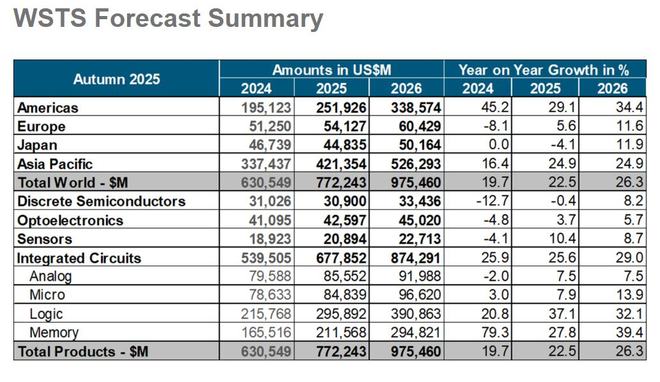
Core Insights - Nvidia has been a major player in the AI computing infrastructure sector, but five other tech stocks focused on AI data centers have shown even more remarkable growth in 2025 [1][2] - The AI infrastructure spending by major tech companies like Amazon, Microsoft, Google, and Meta is projected to reach approximately $380 billion in 2025, with a potential 50% increase in 2026 [3] - The semiconductor market is expected to see significant growth, with a projected total value of $772.2 billion in 2025 and $975.5 billion in 2026, driven by AI infrastructure demands [7][6] Group 1: AI Computing Stocks - Lumentum is highlighted as a key winner in the AI computing supply chain, with its stock price increasing nearly 400% in 2025, driven by demand for optical components in AI data centers [1][11] - Western Digital's stock has surged nearly 300% in 2025, as AI data centers require massive storage solutions for large datasets [14][15] - Micron Technology, as a major U.S. memory chip manufacturer, is benefiting from the AI infrastructure boom, with its stock price rising approximately 240% in 2025 [17][20] Group 2: Market Trends and Projections - Analysts predict that the semiconductor industry will experience a "super cycle," with significant growth in AI chip, storage, and optical interconnect sectors [4][5] - The global AI infrastructure investment wave is expected to reach $3 trillion to $4 trillion by 2030, indicating a long-term growth trajectory for AI-related investments [5][19] - The demand for high-performance storage solutions, particularly HBM and SSDs, is expected to continue to rise, with Micron and other storage companies positioned to benefit significantly [18][21] Group 3: Company-Specific Developments - Celestica, a key player in manufacturing high-performance network switches for AI data centers, has seen its stock rise over 230% in 2025 [27][28] - Seagate's stock has increased by 231% in 2025, driven by the growing demand for HDDs and SSDs in AI data centers [23][25] - The competitive landscape between Google and OpenAI in the AI computing space is expected to benefit companies like Lumentum and Western Digital, as both companies require advanced storage and optical interconnect solutions [10][12]






算力瓶颈突围 一线资本押注“光互连”赛道
Di Yi Cai Jing· 2025-11-07 15:16
Core Viewpoint - The market is actively seeking solutions to alleviate the AI computing power bottleneck, with optical interconnect technology being viewed as a key path to overcome current limitations in computing power [1]. Group 1: Investment and Market Dynamics - Optical interconnect startup Lightlink Semiconductor has secured significant early-stage financing, becoming the largest in the domestic optical interconnect chip sector [1]. - Companies like Ayar Labs and Lightmatter in the U.S. have also completed new funding rounds, attracting investments from major players such as NVIDIA, AMD, and Intel [1]. - The optical module market has seen a surge, with leading companies like NewEase and Zhongji Xuchuang emerging as key players in the optical module sector [2]. Group 2: Technical Advancements and Challenges - Traditional copper interconnects face significant limitations, with over 90% of energy consumption in large model computing clusters being used for data movement rather than computation [3]. - The effective distance of copper interconnects has drastically reduced to mere centimeters, creating a hidden constraint on computing power expansion [3]. - Optical modules are evolving towards 800G and even 1.6T to meet the increasing demands for speed and energy efficiency [3]. Group 3: Competitive Landscape - Ayar Labs has introduced the first universal chip interconnect optical chip, TeraPHY, enabling efficient communication over kilometers for GPU clusters [5]. - Intel and NVIDIA are also developing their optical interconnect capabilities, with Intel showcasing a fully integrated optical computing interconnect chip capable of supporting high data transfer rates [5]. - NVIDIA plans to commercialize its next-generation optical interconnect solutions by 2026, indicating a move towards practical application [6]. Group 4: Domestic vs. International Developments - Huawei's "Lingqu Interconnect" protocol is facilitating the implementation of optical interconnect technology, with new supernode products being launched [6]. - Lightlink Semiconductor aims to create an open interconnect platform, contrasting with the closed ecosystems of companies like NVIDIA and Huawei [7]. - Despite a 2-3 year technological gap, domestic optical interconnects are expected to catch up quickly due to faster iteration speeds and cost advantages [7].
算力瓶颈突围,一线资本押注“光互连”赛道
Di Yi Cai Jing Zi Xun· 2025-11-07 15:13
Core Insights - The market is actively seeking solutions to alleviate the AI computing power bottleneck, with optical interconnect technology being viewed as a key path to breakthrough [1] - Domestic companies like Guanglian Chip and international firms such as Ayar Labs and Lightmatter are rapidly securing funding to advance optical interconnect technology [1][5] - The shift from electrical to optical interconnects is driven by the need for higher efficiency in data transmission, as traditional copper interconnects face significant limitations [3][4] Industry Developments - The optical module market has seen significant growth, with leading companies emerging in the sector, such as New Yisheng, Zhongji Xuchuang, and Tianfu Communication [2] - A report from China Mobile Research Institute highlights that over 90% of energy consumption in large model computing clusters is used for data movement between chips, emphasizing the need for more efficient interconnect solutions [3] - The transition to optical interconnects is expected to enable data centers to achieve better performance and lower overall costs compared to traditional methods [4] Competitive Landscape - Companies like Ayar Labs have introduced innovative optical interconnect solutions, enabling efficient communication over long distances, supported by major chip manufacturers [5] - Intel and NVIDIA are also developing their optical interconnect capabilities, with Intel showcasing a fully integrated optical computing interconnect chip [5][6] - Huawei's "Lingqu Interconnect" protocol is pushing the boundaries of optical interconnect technology, with new products designed to exceed existing performance requirements [6] Future Outlook - The CEO of Guanglian Chip envisions a collaborative ecosystem akin to "Android" for optical interconnects, contrasting with the closed ecosystems of companies like Apple [7] - Despite a 2-3 year technological gap, domestic companies are expected to leverage faster iteration speeds and cost advantages to potentially surpass international competitors in the optical interconnect space [7]

