
存储芯片超级周期

Search documents
存储芯片“超级周期”还能持续多久?
硅谷101· 2026-04-12 00:00
手机和PC 今年至少会要跌5个点 但没人会在乎这个事情 就这个市场变成0 我都无所谓 因为我不做了 全球存储芯片正在经历的 40年来最严重的供需失衡 那么这轮周期 到底能够持续多久呢 我们现在的短缺的情况是 26年已经全部卖完 27年大概率也差不多卖完 可能会到2028年 才会有真正的好转 所以 这是一个接下来 两到三年短缺的一个情况 我们要扩产能也需要几年 说不定那个时候 AI这个周期就爆掉了 所以我宁可不扩产 我就很保守 我就不求挣500块钱了 我就挣100块钱 也挺好 但是呢 更值得关注的 是一个更大的问题 这个行业 会不会从此告别周期呢 或者说它把一个周期性的行业 变成一个结构性增长的行业 它就不再是一个周期了 持续很多年的话 它们的市盈率都可以再翻倍了 存储芯片价格的疯涨 当然不是没有代价的 它正在重新分配 整个电子产业链的利润 PC和手机这些厂商 现在在我们这里 它哪怕名字再响 它都没有那么大的议价权 它们现在不是那么吃香 因为它们的margin(利润) 就是比云厂商的低 就是它们(云厂商)不是很在意 到底这个内存多少钱 手机和PC大家都知道 今年至少会要跌5个点 这是没得说的 有可能会更多 但没 ...


AI救活了一家马桶公司,也点燃了存储芯片超级周期
硅谷101· 2026-04-10 02:00
什么 AI救活了一家马桶公司 TOTO这家日本高端智能马桶企业 因为AI在过去几个月股价飙升 这并不是因为马桶卖得更好了 而是因为TOTO有一个隐藏业务 就是高纯度陶瓷静电吸盘 那这是个啥呢 这个东西 是芯片制造时固定晶圆用的关键耗材 TOTO把精度做到了头发丝的1/80 纯度业界第一 恰逢存储芯片需求爆发 上游厂商疯狂扩产 这一业务就成为了绝对的刚需 这使得高盛等投行 纷纷上调TOTO的股价评级 原因很简单 静电吸盘的订单已经排到了2027年 现在这块业务 占了TOTO超过四成的营业利润 就这样 一家马桶公司成为了AI概念股 你就知道目前的AI存储赛道有多火爆了 内存股年初全线大幅上涨 移动设备、个人电脑、数据中心和服务器 还有汽车 目前整个存储行业极度短缺 三星(Samsung)、SK海力士(SK Hynix) 美光(Micron)、闪迪(SanDisk) 这些存储行业的重要玩家股价疯涨的背后 是全球存储芯片正在经历的 四十年来最严重的供需失衡 哈喽 大家好 欢迎收看《硅谷101》 我是陈茜 我们这期视频就带大家来好好梳理一下 这轮存储的“超级周期” 我们与三星业内人士和华尔街投资人 深度盘点一下 为什么 ...

韩国股市巨震,存储见顶还是被战争误伤?
36氪· 2026-03-09 14:28
Core Viewpoint - The recent volatility in the South Korean stock market, characterized by a dramatic drop followed by a sharp recovery, highlights the fragile balance in the global AI computing power supply chain amid supply chain bottlenecks and cost inflation [4][5]. Group 1: Market Volatility - The KOSPI index experienced a significant decline, losing nearly 20% over two trading days, with a record single-day drop of 12.06% on March 4, marking the largest drop in South Korean stock market history [5][10]. - Following the downturn, the KOSPI index rebounded sharply on March 5, driven by policy stabilization expectations and technical buying, with an intraday increase of up to 12% and a closing surge of 9.6% [5][20]. Group 2: Causes of Market Decline - The direct trigger for the stock market crash was panic selling due to heightened geopolitical tensions in the Middle East, which led to a surge in oil prices and fears of "secondary inflation" [8][10]. - The South Korean stock market, heavily reliant on semiconductor stocks, became a target for capital outflows as foreign investors reacted to the panic, exacerbating the sell-off due to high leverage among retail investors [11][19]. Group 3: Economic Impact - South Korea's energy dependency on the Middle East poses a significant risk, with over 95% of its energy needs imported, leading to concerns about potential supply disruptions due to geopolitical conflicts [22]. - The semiconductor sector, a crucial pillar of the South Korean economy, has seen a substantial increase in exports, with semiconductor exports rising approximately 47% compared to December of the previous year [23][25]. Group 4: Semiconductor Market Dynamics - The semiconductor market is experiencing a significant price increase, with DRAM contract prices doubling year-on-year by February 2026, driven by the demand from AI applications [32][34]. - The supply-demand dynamics in the semiconductor market are critical, as any disruption in supply could lead to further price increases, impacting both the South Korean stock market and the global AI sector [28][36]. Group 5: Future Outlook - Despite current concerns, the systemic risks in the semiconductor market remain manageable, with strong pricing power and profitability expectations continuing to support the sector [34][35]. - The focus for investors is shifting from whether prices will rise to how long and how quickly they will increase, with capital expenditure in AI expected to reach $650 billion by 2026 [35][36].

最高涨超67%!海外股市开年来狂飙带火跨境ETF,有产品溢价率已超20%,基金公司连发风险提示公告
Mei Ri Jing Ji Xin Wen· 2026-02-26 15:45
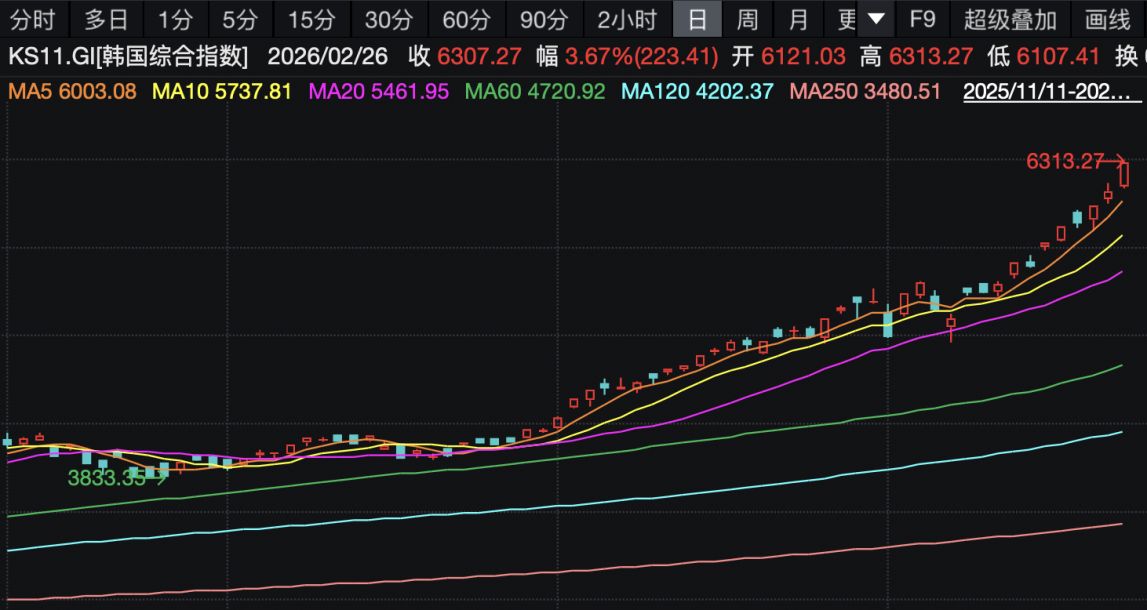
Core Viewpoint - Recent surges in stock markets across countries such as South Korea, Brazil, Japan, and France have led to significant gains in cross-border ETFs, attracting investor attention and prompting risk warnings from fund companies [1][12]. Group 1: South Korea Market Performance - The South Korean stock market has seen a cumulative increase of 75.63% in 2025, with a year-to-date rise of 49.67% as of February 26, 2026, reaching a historical high of 6313.27 points [4][2]. - The Huatai-PineBridge China-Korea Semiconductor ETF has surged by 9.64% today, with a 5-day increase of 26.27% and a year-to-date rise of 67.68%, leading the market [1][4]. - Major contributors to this growth include Samsung Electronics and SK Hynix, with stock price increases of 81.82% and nearly 80% respectively since early 2026 [4]. Group 2: Brazil Market Performance - The Brazilian IBOVESPA index has increased by over 30% in 2025 and continues to rise, with an 18.69% increase year-to-date as of February 25, 2026 [1][4]. - The E Fund Brazil ETF has seen a nearly 10% increase in the last 5 days and a year-to-date rise of 34.70%, ranking among the top ETFs in the market [1][7]. - The China Asset Management Brazil ETF has also performed well, with a year-to-date increase of 35.21% [7]. Group 3: France Market Performance - The French CAC40 index has reached approximately 8640 points, marking a historical high, with a 10.42% increase in 2025 and nearly a 6% rise this year [7][9]. - The Huazhong Fund's CAC40 ETF has recorded a 13.07% increase in February, continuing its upward trend from the previous year [9]. Group 4: Risk Warnings from Fund Companies - Several fund companies, including E Fund, Huaxia, and Huatai-PineBridge, have issued warnings regarding high premium risks in the secondary market for cross-border ETFs, with some products experiencing premiums exceeding 20% [12][13]. - The E Fund Brazil ETF reported a premium of 8.16% on February 26, prompting the company to issue risk alerts and consider temporary suspensions to protect investors [12]. - The Huazhong Nomura Nikkei 225 ETF also announced significant premiums and may request temporary suspensions if premiums do not decrease effectively [12].
存储的超级周期被质疑了?
投中网· 2026-02-26 06:27
Core Viewpoint - The article discusses the impact of Citron Research's short-selling of SanDisk, highlighting concerns about the storage chip market and questioning the sustainability of the so-called "super cycle" driven by AI demand [5][8][27]. Group 1: Citron's Short-Selling and Market Reaction - Citron Research has established a short position against SanDisk, claiming that its valuation is misaligned and that there is a significant bubble [5]. - Following the announcement, SanDisk's stock price dropped over 8% at one point, ultimately closing down 4.2% [6]. - The A-share market reacted similarly, with several storage stocks experiencing a collective pullback, indicating a shift in market sentiment from enthusiasm to hesitation [7]. Group 2: Reasons for Citron's Bearish Stance - Citron presents three main arguments for its bearish outlook on SanDisk: 1. "Shareholder Exodus": Notably, Western Digital, a long-term investor in SanDisk, has significantly reduced its holdings at a price 25% lower than the current market price, which is often a strong signal of a market peak [13]. 2. "Illusory Supply and Demand": Citron argues that the NAND flash memory industry is cyclical, with current production capacity being double that of the 2018 peak, suggesting that perceived supply constraints may be misleading [14]. 3. "Threat from Samsung": Citron notes that Samsung is shifting its strategy to focus on higher-margin products, potentially threatening SanDisk's position in the high-end SSD market [16]. Group 3: Broader Market Implications - The article emphasizes that SanDisk is not representative of the entire storage market, as NAND flash memory does not encompass the full picture of the current storage cycle [21]. - The real driver of the current storage boom is DRAM, particularly HBM (High Bandwidth Memory), with major players like Samsung, SK Hynix, and Micron reallocating capacity towards higher-margin products [23]. - Despite concerns about competition, Samsung's stock has reached historical highs, with analysts projecting significant profit growth driven by resilient storage chip prices [26]. Group 4: Future Outlook for the Storage Cycle - The article argues that the storage super cycle is not over, with Nomura Securities predicting it will last at least until 2027, and meaningful supply increases are not expected until 2028 [29]. - Citigroup forecasts that average prices for DRAM and flash products will rise by 88% and 74% respectively by 2026, exceeding previous estimates [31]. - The article concludes that the storage super cycle remains intact and may last longer and be more robust than initially anticipated [32][44]. Group 5: Valuation Considerations - The article discusses the potential shift in valuation logic for storage companies, suggesting that the current market may start to view them as growth stocks rather than just cyclical commodities [37]. - Some institutions are already applying PE (Price-to-Earnings) ratios for valuation, indicating a growing belief in the sustainability of earnings growth driven by AI demand [39]. - The performance of storage companies in the coming years will significantly influence their valuation, with expectations for substantial earnings growth in 2026 and 2027 [42].

芯片为王!韩国股市年内涨超40%,冲破6000点
Guo Ji Jin Rong Bao· 2026-02-25 08:09
Core Viewpoint - The South Korean stock market has seen a remarkable increase of over 40% in 2026, driven by the global AI wave and the "super cycle" of storage chips, alongside the government's "Value-up Program" starting in 2025 as a key catalyst [1][3]. Industry Analysis - The "super cycle" of storage chips, fueled by AI demand, is the main driver of the current market rally, with chip exports in February 2026 showing a year-on-year increase of 134%, reaching $15.12 billion, accounting for 34.7% of total exports [3][4]. - Major companies like Samsung Electronics and SK Hynix are benefiting significantly, with their stock prices rising by 125.4% and 274.35% respectively in 2025, contributing 49% to the KOSPI index's increase [3][4]. - Analysts predict that the AI-driven demand cycle will continue until 2027, supporting profit growth for related companies [4]. Company Insights - Samsung Electronics' stock recently surpassed 200,000 KRW per share, with its market capitalization approaching $1 trillion, driven by strong demand for new HBM4 chips, which may see a price increase of 20%-30% compared to the previous generation [4]. - Morgan Stanley analysts believe that Samsung's path to a $1 trillion market cap will be supported by stronger profitability and pricing power in the memory sector, with Macquarie setting a target price of 340,000 KRW, anticipating a tenfold increase in net profit from 2025 to 2028 [4]. Government Policy Impact - The South Korean government's "Value-up Program" aims to systematically improve corporate governance and enhance shareholder returns, addressing long-standing valuation issues in the market [6]. - The program includes measures such as mandatory stock buybacks and board reforms, which have restored market confidence and are expected to attract long-term investors [6]. Market Projections - Analysts from Morgan Stanley and Nomura Securities have set optimistic targets for the KOSPI index, with projections of reaching 7,500 points in 2026 and even 8,000 points in the first half of the year, driven by the storage chip super cycle and strong earnings in AI-related sectors [7][8]. - The KOSPI index's recent rise has led to concerns about potential market volatility, with external factors such as U.S. monetary policy and geopolitical uncertainties posing risks [8][9].
美股前瞻 | 三大股指期货齐跌 应用材料绩后走高 美国1月CPI重磅来袭
智通财经网· 2026-02-13 12:14
Market Movements - US stock index futures are all down, with Dow futures down 0.37%, S&P 500 futures down 0.33%, and Nasdaq futures down 0.31% [1] - European indices also show declines, with Germany's DAX down 0.04%, UK's FTSE 100 down 0.01%, France's CAC40 down 0.36%, and the Euro Stoxx 50 down 0.43% [2][3] - WTI crude oil is down 0.78% at $62.35 per barrel, while Brent crude is down 0.55% at $67.15 per barrel, amid OPEC+ discussions on potential production increases starting in April [3] Economic Data and Predictions - The US January Consumer Price Index (CPI) is expected to show a year-on-year increase slowing to 2.5%, down from 2.7% in December, marking the lowest level since May 2025 [5] - Both overall CPI and core CPI are anticipated to rise by 0.3% month-on-month, consistent with the previous month [5] Company News - Application Materials (AMAT.US) reported Q1 revenue of $7.01 billion, slightly down 2% year-on-year but above market expectations of $6.86 billion, with a Non-GAAP EPS of $2.38, exceeding the forecast of $2.21 [10][11] - Roku (ROKU.US) exceeded Q4 revenue expectations with a 16.1% year-on-year increase to $1.395 billion, and a GAAP EPS of $0.53, surpassing analyst consensus by 88.8% [11] - Airbnb (ABNB.US) reported Q4 revenue of $2.78 billion, up 12% year-on-year, exceeding analyst expectations, and provided an optimistic revenue outlook for 2026 [12] - Vale (VALE.US) reported Q4 revenue of $11.06 billion, up 9% year-on-year, but faced a significant net loss of $3.844 billion due to a $3.5 billion impairment on nickel assets [13] - NatWest (NWG.US) reported a 30% increase in pre-tax profit to £1.94 billion ($2.6 billion), exceeding analyst expectations, and plans to leverage AI for cost reduction and efficiency improvements [14]





供应链失序时代 联想集团何以成为业绩"异类"?
Ge Long Hui· 2026-02-13 05:13
Core Viewpoint - The global technology industry is experiencing a stark contrast, with major players like Microsoft, Google, and Amazon announcing significant AI capital expenditure plans, yet facing market declines due to ROI concerns, resulting in a collective market value loss of nearly $900 billion [1] Group 1: Lenovo's Performance Amidst Market Challenges - Lenovo Group's third-quarter performance for the fiscal year 2025/26, reported on February 12, 2026, showcased a record revenue of $22.2 billion (157.5 billion RMB), an 18% year-on-year increase, with adjusted net profit growth reaching 36%, double the revenue growth rate [1][2] - Lenovo's resilience during supply chain disruptions and the downturn of global tech giants is attributed to its strong delivery capabilities and operational discipline, allowing it to maintain steady performance [2][3] - The company has consistently demonstrated strong delivery resilience during past supply chain crises, regaining its position as the world's leading PC manufacturer even when the market faced stagnation [2][3] Group 2: Supply Chain Management and Operational Strategy - Lenovo's unique operational strategy, termed "global resources, local delivery," enables it to integrate resources across various regions, ensuring consistent procurement and delivery despite supply chain disruptions [4] - The company's "ODM+" model allows it to mitigate localized disruptions and maintain operational continuity, earning recognition as a global supply chain leader [4] - Lenovo's proactive asset management, including signing annual framework agreements with key suppliers, has secured supply and cost stability, providing a competitive edge during market volatility [7][8] Group 3: Market Position and Competitive Advantage - Lenovo's global PC market share increased from 23.7% in the fiscal year 2024/25 to 25.3%, enhancing its bargaining power with suppliers during periods of component shortages [6] - The company's scale advantage allows it to achieve optimal procurement prices, positioning it favorably against competitors amid rising costs [6][8] - Lenovo's customer base, predominantly composed of enterprise and government clients, enables it to absorb cost pressures more effectively than competitors reliant on price-sensitive consumer markets [8][9] Group 4: Long-term Operational Discipline - Lenovo's operational discipline and risk management culture have allowed it to avoid common pitfalls during supply chain disruptions, maintaining stable inventory levels and cash flow [9][10] - The company has successfully locked in low-cost components through strategic inventory management, preventing significant financial losses during price fluctuations [10] - Lenovo's ability to navigate supply chain challenges is attributed to its evolution beyond a traditional PC company, leveraging its position within the global supply chain and AI ecosystem [11][12] Group 5: Future Outlook and AI Integration - Lenovo is well-positioned to capitalize on the AI industry's growth, integrating hardware and software to meet emerging demands for computational power and infrastructure [12][13] - The company's strategy of combining AI PCs, smartphones, and servers with a robust service framework is expected to enhance its order stability and cash flow, solidifying its leadership in the global AI ecosystem [12][13]

AI算力与存储需求爆表, 半导体设备迎接超级周期!应用材料业绩展望碾压预期!
美股IPO· 2026-02-13 03:27
Core Viewpoint - Applied Materials (AMAT.US) reported stronger-than-expected quarterly results and provided a robust future outlook, highlighting the significant growth cycle in the semiconductor equipment sector driven by the AI computing infrastructure and the "super cycle" of storage chips [1][3]. Financial Performance - For Q1 FY2026, Applied Materials reported revenue of $7.01 billion, a slight year-over-year decline of 2%, but better than the expected $6.86 billion. Non-GAAP EPS was $2.38, exceeding the analyst average of $2.21, with a gross margin of 49% compared to 48% the previous year [4]. - The company anticipates Q2 FY2026 revenue to be approximately $7.65 billion, with a range of $500 million, significantly above the Wall Street consensus of $7.03 billion. The projected Non-GAAP EPS is between $2.44 and $2.84, well above the analyst average of $2.29 [3][4]. Market Dynamics - The demand for semiconductor manufacturing equipment is being driven by the expansion of DRAM and NAND storage chip production, as major clients like Samsung and Micron accelerate capacity expansion to address market shortages [5]. - The high bandwidth memory (HBM) technology is becoming increasingly critical for AI computing systems, with Applied Materials expecting a growth of over 20% in its semiconductor equipment business this year [6][9]. Industry Trends - The semiconductor equipment sector is positioned as a major beneficiary of the AI computing and storage chip demand surge, with significant investments from tech giants like Microsoft, Google, and Meta in AI data centers [9][10]. - The transition from traditional DRAM to HBM systems is leading to a structural expansion cycle in semiconductor equipment demand, driven by the need for advanced manufacturing processes and technologies [11][12]. Regulatory and Operational Challenges - Applied Materials is navigating challenges from U.S. export restrictions to China, which have impacted its revenue potential. The company recently agreed to pay $252.5 million to settle a long-standing investigation regarding improper exports [8]. - Despite a strong stock performance, Applied Materials' shares have lagged behind other semiconductor equipment manufacturers, indicating competitive pressures in the market [8].

供需紧俏助推存储涨价周期延续,科创芯片设计ETF易方达(589030)逆市拉升涨近1%,助力把握存储芯片“超级周期”布局机遇
Xin Lang Cai Jing· 2026-02-13 02:31
Core Viewpoint - The semiconductor design sector in the STAR Market is experiencing significant growth, with key stocks showing strong performance and an increase in ETF investments, driven by rising demand and pricing in the memory and storage markets [1][2]. Group 1: Market Performance - The STAR Market Chip Design Theme Index (950162) rose by 1.10% as of February 13, 2026, with notable increases in constituent stocks such as Shengke Communication (+10.18%) and Jiewate (+6.45%) [1]. - The E Fund STAR Chip Design ETF (589030) increased by 0.94%, with a recent price of 1.07 yuan, and has seen a cumulative increase of 6.74% over the past week [1]. - The ETF recorded a turnover rate of 2.01% during the trading session, with a total transaction volume of 9.3767 million yuan [1]. Group 2: Fund Growth and Inflows - The E Fund STAR Chip Design ETF has seen a significant increase in scale, growing by 1.7171 million yuan over the past two weeks, ranking second among comparable funds [1]. - The ETF's share count increased by 14.1 million in the past month, also ranking second among comparable funds [1]. - Over the last ten trading days, the ETF attracted a total of 10.7451 million yuan in inflows [1]. Group 3: Industry Insights - According to TrendForce, DRAM contract prices have risen by over 40% in Q4 2025, with further increases expected in Q1 2026, particularly in the DDR4 market due to supply-demand imbalances [2]. - Wanlian Securities highlights the ongoing AI wave driving demand for key hardware components, suggesting that storage and PCB sectors are in an expansion cycle, with potential growth in AI consumer electronics [2]. - The E Fund STAR Chip Design ETF has achieved an 80.00% weekly profit percentage and a 77.78% monthly profit probability since its inception [2]. Group 4: Fee Structure and Index Composition - The management fee for the E Fund STAR Chip Design ETF is 0.50%, and the custody fee is 0.10%, which are among the lowest in comparable funds [3]. - The STAR Market Chip Design Theme Index primarily includes companies involved in chip design, with digital chip design accounting for 76.8% of the index weight, benefiting from industry uptrends [3]. - As of January 30, 2026, the top ten weighted stocks in the index account for 58.7% of the total index, including companies like Lanqi Technology and Haiguang Information [3].


