
化学制造

Search documents
招商宏观:在中性情境下,2026年PPI同比大概率于二季度中后期转正
Sou Hu Cai Jing· 2026-02-12 03:45
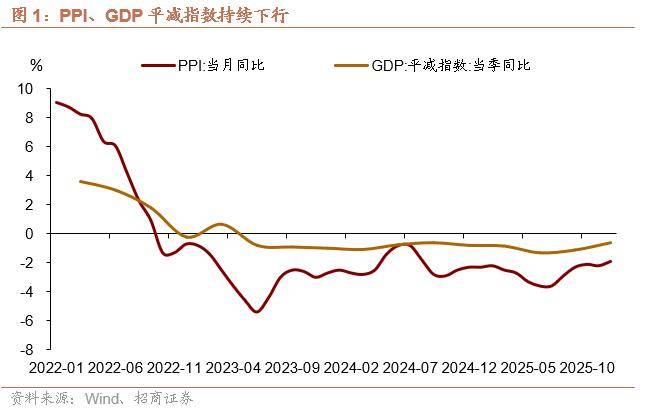
Core Viewpoint - The return of inflation is one of the macro themes in China for 2026, driven by three main factors: the marginal demand for commodities like copper due to artificial intelligence, the decline of the US dollar index since 2025 enhancing the financial properties of commodities, and resource populism increasing global investor concerns about commodity supply [1][2]. Group 1: PPI Trends and Influences - Insufficient domestic demand is the primary drag on PPI from 2022 to 2025, with real estate investment being the decisive factor contributing over 60% to the decline [3][4]. - The PPI's low performance and the divergence between nominal GDP and real GDP highlight the negative impact of price declines on economic perception, with PPI being negative for 39 consecutive months by the end of 2025 [3][4]. - The contribution of various factors to PPI changes shows that demand factors, particularly in real estate, have the most significant impact, while supply and oil price factors contribute less [4][10]. Group 2: Industry Contributions to PPI - Since 2022, key industries such as oil and coal processing, chemical manufacturing, and non-ferrous metallurgy have significantly increased their contribution to PPI, shifting the pricing power from traditional real estate to energy, resources, and high-end manufacturing [10][11]. - The eight major industries contributing to PPI include oil and coal processing, chemical manufacturing, and electrical machinery, accounting for approximately 70% of the overall PPI changes [10][11]. Group 3: Commodity Market Dynamics - The commodity market has entered a significant upward cycle since the second half of 2025, supported by a depreciating dollar and global credit expansion, which improves the financial environment for commodities [2][24]. - Industrial metals have seen substantial price increases, with copper and aluminum prices rising by 18.51% and 45.78% respectively since early 2025, driven by structural demand and supply constraints [17][26]. - Energy and chemical sectors are currently lagging in price recovery but are expected to gain momentum as geopolitical tensions and domestic economic recovery support demand [21][22]. Group 4: Future PPI Projections - The PPI is likely to turn positive in the second half of 2026, with key commodities like iron ore, crude oil, and copper expected to drive this change, showing a strong correlation with PPI movements [2][36]. - The analysis indicates that the PPI's upward movement will be influenced by the ongoing price increases in major commodities, with a potential earlier turnaround in PPI if commodity prices rise significantly [39][40].

构建招商中国金融条件指:假如PPI同比提前转正
CMS· 2026-02-11 14:34
Group 1: PPI Trends and Influences - Domestic PPI has been in a downward trend from 2022 to 2025, primarily due to insufficient domestic demand, with real estate investment contributing over 60% to the decline[6] - The core logic behind the PPI decline is not merely supply imbalance but rather weak domestic demand, particularly in the real estate sector[6] - The PPI is expected to turn positive in Q2 2026, with significant contributions from rising commodity prices, particularly iron ore, crude oil, coal, copper, silicon, and lithium carbonate[51] Group 2: Commodity Price Dynamics - Since the second half of 2025, international and domestic commodity prices have begun a significant upward trend, driven by a depreciating dollar and increased structural demand from sectors like AI and renewable energy[2] - Key industrial metals such as copper and aluminum have seen price increases of 18.51% and 45.78% respectively since early 2025, while lithium carbonate prices surged by 93%[27] - The financial environment for commodities has improved due to a weakening dollar, which historically correlates with rising commodity prices[34] Group 3: Sector Contributions to PPI - The contribution of various sectors to PPI has shifted, with energy, resources, and high-end manufacturing gaining pricing power, while traditional real estate has diminished[1] - Eight key industries, including non-ferrous metallurgy and chemical manufacturing, now account for approximately 70% of the overall PPI pricing influence[14] - In the latter half of 2025, the month-on-month PPI growth was driven significantly by non-ferrous metallurgy, contributing 15.40% to the increase[15]