
地产服务

Search documents
多只地产服务商一夜暴跌 AI“狼人杀”还没结束:点谁谁崩
Feng Huang Wang· 2026-02-13 02:14
Core Viewpoint - The recent sell-off in the U.S. stock market, particularly affecting real estate service stocks, is driven by investor fears regarding the disruptive potential of AI applications in various industries [1][3]. Group 1: Market Impact - Several real estate service stocks, including CBRE Group and JLL, experienced significant declines, with CBRE dropping 12% and JLL falling 14%, marking their largest single-day drops since the COVID-19 pandemic [3]. - The commercial real estate sector is facing renewed challenges, exacerbated by the pandemic's impact on office demand and high interest rates affecting transaction volumes [3]. - Investors are increasingly withdrawing from high-fee, labor-intensive business models perceived as vulnerable to AI disruption, as noted by analysts [3][4]. Group 2: Broader Industry Concerns - The sell-off has extended beyond real estate, affecting SaaS, insurance brokerage, and wealth management stocks, indicating a widespread concern about AI's potential to disrupt various sectors [4][5]. - Companies like CBRE and JLL are attempting to mitigate downward pressure by diversifying into property management and valuation across various sectors, including hotels and life sciences [4]. - Analysts express that the recent stock price declines may be overreactions, as the risks associated with AI disruption have been present for some time and are not new [4][5]. Group 3: AI Disruption Debate - The introduction of AI tools, such as those by Anthropic, has intensified fears of industry-wide disruption, leading to a "sell first, ask questions later" mentality among investors [4][6]. - Concerns about AI's impact on employment and commercial real estate demand are prevalent, but some analysts argue that the actual threat to leasing and capital markets is limited [4][6]. - The market's reaction reflects a broader anxiety about potential reversals in stock valuations, driven by recent AI spending and a resilient U.S. economy [6][7].

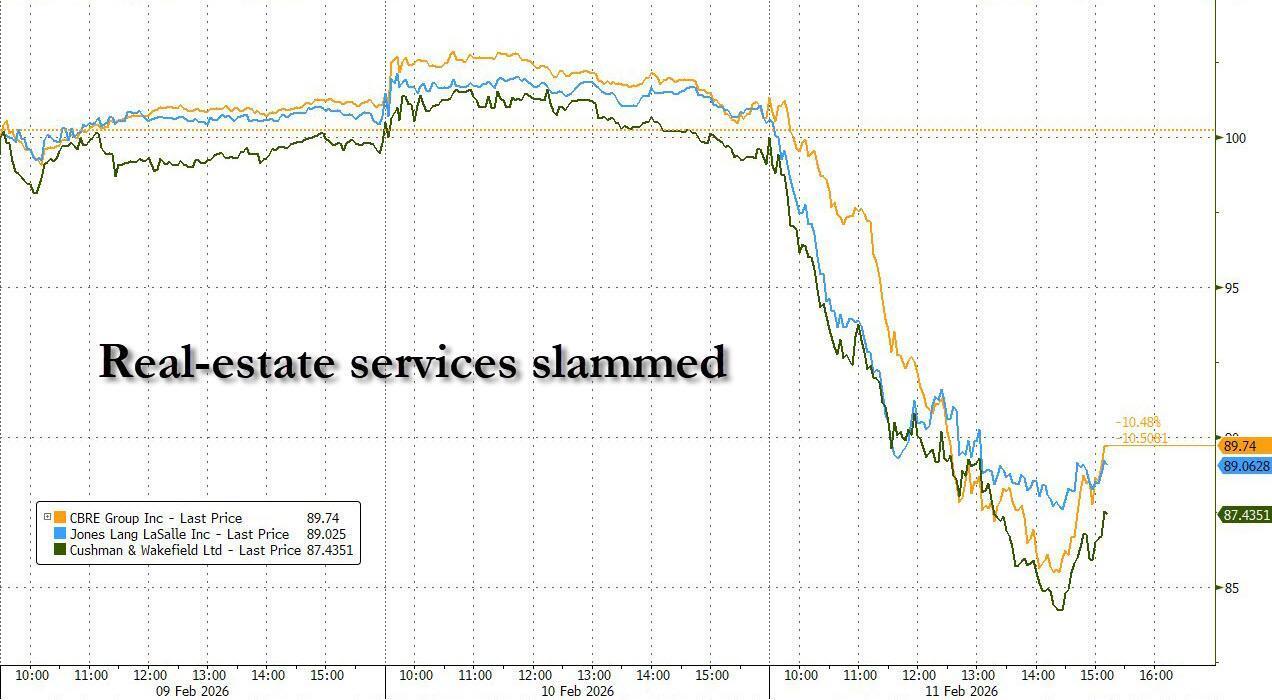
AI恐慌交易席卷美国地产服务板块,头部企业股价暴跌12%-14%,创2020年以来最大单日跌幅
Jin Rong Jie· 2026-02-12 03:32
Group 1 - The U.S. real estate services sector has been significantly impacted by the latest wave of AI-induced panic selling, with major companies like CBRE and JLL experiencing stock price drops of 12% and 14% respectively, marking their largest single-day declines since the COVID-19 pandemic began in 2020 [1] - The commercial real estate industry in the U.S. has been struggling to recover due to the pandemic's disruption of office space demand and high interest rates suppressing transaction volumes, despite some growth in niche areas like data centers and high-end office leasing driven by the AI boom [1] - Investors are increasingly wary of the potential impact of AI technology on the industry, fearing that automation and streamlined transaction processes could disrupt high-fee, labor-intensive business models, leading to a shift away from real estate service firms perceived as vulnerable to AI disruption [1] Group 2 - Barclays analyst Brendan Lynch noted that the recent stock price declines appear "excessive" given that there were no significant negative developments in the news, indicating that the associated risks have not changed [2] - Jefferies analyst Joe Dickstein believes that the threat of AI to leasing and capital markets is limited, asserting that firms like CBRE will maintain their positions as large leasing and transaction intermediaries due to their scale advantages in data accumulation and industry relationships [2] - The panic selling triggered by AI concerns has spread across multiple sectors, including SaaS, insurance brokerage, and wealth management, with significant stock pressure observed following the launch of AI-based applications in these industries [2]


失灵的魔咒 | 谈股论金
水皮More· 2025-12-19 09:31
Market Overview - A-shares saw a collective rise in the three major indices, with the Shanghai Composite Index up 0.36% closing at 3890.45 points, the Shenzhen Component Index up 0.66% at 13140.21 points, and the ChiNext Index up 0.49% at 3122.24 points [3][4] - The trading volume in the Shanghai and Shenzhen markets reached 1.7259 trillion yuan, an increase of 70.4 billion yuan compared to the previous day [3][5] Market Characteristics - The market exhibited a clear upward trend with approximately 4290 stocks rising and only 869 declining, resulting in a median increase of 1.19% across all stocks [4] - Key characteristics of the market included: - A broad-based rally with most stocks performing steadily [6] - Significant rebound in previously underperforming sectors, particularly in consumer-related fields such as real estate services, commercial retail, food and beverage, packaging materials, textiles, and light industry [6] - Micro-cap stocks showed strong performance, with an average increase of about 2.5% today, contributing to market enthusiasm [6] Sector Performance - Financial stocks showed lackluster performance, with the securities sector up 0.48%, banks down 0.11%, and insurance remaining flat [7] - Technology stocks continued to decline, with notable drops in semiconductors (down 0.76%), electronic chemicals (down 0.49%), and precious metals (down 0.72%) [7] - Some high-profile stocks experienced significant volatility, with notable declines in stocks like Moller Thread (down approximately 5.8%) and Muxi Co. (down about 9.08%) [7] International Market Influence - Following the Bank of Japan's interest rate hike, the Nikkei index rose by 1.03%, while South Korean indices increased by 0.65%. The Hang Seng Index also saw a rise of 0.75%, marking three consecutive days of gains [7]
