奢侈品回收

Search documents
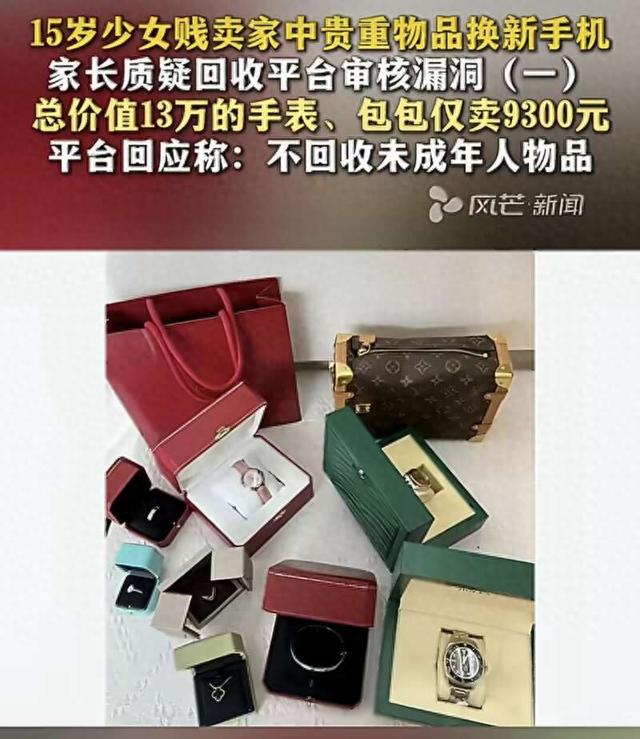
13万元奢侈品被女儿9300元贱卖,谁的错?
Xin Lang Cai Jing· 2026-02-24 11:04
Group 1 - A 15-year-old girl in Changsha, Hunan sold luxury items worth 130,000 yuan for only 9,300 yuan to buy a new phone, raising concerns about the transaction's legitimacy [1][3] - The girl's parents questioned the luxury goods recycling platform's verification process, highlighting potential loopholes in their operations [1][4] - Legal experts noted that the girl, being a minor, lacks the capacity for civil conduct, making the sale contract potentially void due to her age and understanding [3][4] Group 2 - The luxury goods recycling platform failed to verify the identity of the seller adequately, allowing the girl to use an adult's ID to complete the transaction [4][5] - The incident underscores the need for better risk management and compliance measures within the luxury goods recycling industry to protect both buyers and sellers [4][5] - The lack of parental guidance in financial matters for minors is identified as a contributing factor to the incident, emphasizing the importance of educating children about the value of money and responsible consumption [5][6]

今日黄金价格行情(2月11日):金价触底反弹站稳关键关口,小年消费旺季添支撑
Sou Hu Cai Jing· 2026-02-11 08:20
Core Viewpoint - International and domestic gold prices have rebounded and stabilized, with institutions predicting short-term fluctuations and an unchanged long-term bullish outlook [1] Group 1: International Gold Market - The international gold market shows a low opening and high closing, stabilizing at $5,050 per ounce, driven by geopolitical tensions in the Middle East, weak U.S. employment data, and expectations of Federal Reserve rate cuts [6] - London gold is priced at $5,058.53 per ounce (+$17.08, +0.34%), with a daily range of $5,068.89 to $5,027.54 per ounce [6] - New York gold is priced at $5,075.70 per ounce (+$44.70, +0.89%), with a daily range of $5,093.30 to $5,046.30 per ounce [6] Group 2: Domestic Gold Market - In the domestic market, physical gold consumption is expected to rise as the Spring Festival approaches, leading to price increases in gold shops, while bank gold bars remain stable [5] - Gold T+D is priced at ¥1,124.3 per gram (+¥3.83, +0.34%), with a daily range of ¥1,128.1 to ¥1,115 per gram [7] - Shanghai gold main contract is priced at ¥1,130.4 per gram (+¥6.34, +0.56%), with a daily range of ¥1,132.6 to ¥1,117 per gram [7] Group 3: Market Predictions and Demand - Geopolitical risks, such as tensions in the Middle East and the ongoing Russia-Ukraine conflict, are driving safe-haven investments into gold [12] - The demand for physical gold is supported by seasonal factors, including weddings and traditional gifting during the Spring Festival [12] - Central banks globally and in China continue to purchase gold, contributing to a technical rebound from oversold conditions [12] - Morgan Stanley predicts short-term fluctuations with a target of $6,000 per ounce by 2026, while Wells Fargo raises its target to $6,100-$6,300 per ounce [12] Group 4: Practical Tips for Consumers - Consumers are advised to compare prices and styles when purchasing physical gold and to retain purchase receipts [10] - For investment purposes, it is recommended to focus on bank gold bars during market dips [13] - When liquidating gold, consumers should consider purity and market prices, choosing reputable channels to avoid high-price traps [13]

超级会员9月学习实录:银发经济新机遇与未来三年投资方向
吴晓波频道· 2025-09-30 00:29
Core Insights - The article emphasizes the importance of identifying wealth opportunities for ordinary individuals in the current economic climate, focusing on both entrepreneurial ventures and investment strategies [2][32]. Group 1: Online Workshops - The online workshops are designed to explore two main paths for personal wealth growth: earning through work and earning through investments [5][6]. - The first workshop, led by investor Wang Cen, discusses low-cost business opportunities suitable for ordinary people, particularly in a slowing economy [6][12]. - Key insights include the CHEES model for market scanning, which focuses on five consumer needs: affordability, health, emotional connection, entertainment, and lifestyle [7][11]. - Three high-potential business sectors are highlighted: - The "无人经济" (无人自助娱乐,无人情趣用品, and 无人自助健身房) which leverages technology for cost efficiency and convenience [9]. - The second-hand market, particularly in restaurant equipment and luxury goods, which addresses information asymmetry in high-value asset transactions [9]. - The light model for small shops, emphasizing "single product hits" and operational efficiency with investment thresholds between 150,000 to 500,000 yuan [10]. Group 2: Investment Strategies - The second workshop, led by economist Zhu Zhenxin, focuses on core investment logic and market valuation principles for the A-share market [12][17]. - Five core principles for understanding market valuation are presented: - Profitability is prioritized over asset value, with a focus on cash flow generation [13]. - Long-term stability is favored over short-term performance [14]. - Growth potential is more valuable than current performance [15]. - Macro factors should be considered over micro factors in investment decisions [16]. - Focus on leading companies with competitive advantages in a differentiated market [17]. Group 3: Offline Practical Course - An offline course held on September 20 in Hangzhou aimed to bridge theory and practice, featuring real-world case studies from successful entrepreneurs [19][21]. - Key highlights include: - Wang Cen's analysis of three high-potential sectors using the CHEES model, including the "银发经济" (silver economy) and its opportunities in senior care and health products [22]. - The "宠物经济" (pet economy) focusing on high-margin services like pet funerals, showcasing a successful case with annual revenue of 230 million yuan [22]. - The community dining model exemplified by "元气考拉," which operates as a second kitchen with a focus on efficiency and low investment [25]. Group 4: Membership Value - The membership program offers a comprehensive growth support system, combining online learning, offline engagement, and community networking [27][32]. - Members have access to over 180 courses, including ongoing updates on business insights and investment trends [28][31]. - The program aims to provide a systematic understanding of wealth generation and practical methodologies for implementation [33].

越来越多人靠着二手生意赚翻了
虎嗅APP· 2025-03-09 13:29
Group 1: Second-Hand Market Insights - The second-hand market is evolving beyond just reselling old goods, representing a significant industry derivative, particularly in luxury goods recycling [3][5]. - In Q3 2024, Gucci reported a revenue of €1.64 billion, a 25% year-over-year decline, while LVMH's revenue fell 3% to €19.076 billion [3]. - The second-hand luxury goods market is thriving, with a high repurchase rate of 80% for buyers and 70% for sellers [5]. Group 2: Robotics and AI in Second-Hand Business - The rise of AI and robotics is creating new opportunities in the second-hand rental market, with companies like Yush Robot capitalizing on this trend [6][12]. - The rental price for second-hand robots ranges from ¥5,000 to ¥10,000 per day, significantly lower than the purchase price of over ¥100,000 [12][15]. - The demand for robots is increasing, with rental businesses seeing substantial profits from leasing out these devices [15][18]. Group 3: Growth of Second-Hand Electric Vehicles - The second-hand electric vehicle market is booming, with a projected transaction volume of 19.6142 million vehicles in 2024, a 6.52% increase year-over-year [24]. - In 2024, the transaction volume for second-hand electric vehicles reached 1.1285 million, marking a significant milestone [26]. - The average price of second-hand electric vehicles is approximately 30% lower than new models, appealing to cost-conscious consumers [27]. Group 4: Opportunities in Restaurant Equipment Resale - The restaurant industry is facing significant closures, with over one million establishments shutting down in the first half of 2024 [32]. - Second-hand equipment from closed restaurants is being sold at steep discounts, allowing resellers to profit significantly [36][39]. - Resellers can achieve profit margins of up to 100% by acquiring equipment at low prices and reselling them at a markup [38][41]. Group 5: Second-Hand Clothing Market - The second-hand clothing market is thriving, with a notable increase in exports to Africa, where demand for affordable clothing is high [50][55]. - In 2016, China's second-hand clothing export value was ¥218 million, ranking fifth globally, with significant growth observed in subsequent years [49]. - The affordability and suitability of Chinese second-hand clothing make it a lucrative market for resellers targeting developing countries [54][56]. Group 6: Conclusion on Circular Economy - The rise of second-hand businesses reflects a shift towards a circular economy, maximizing resource utilization and minimizing waste [58][60]. - The ability to capitalize on idle assets and transform them into profitable ventures is becoming increasingly important in various industries [63][64].

越来越多人,靠着二手生意赚翻了
创业邦· 2025-03-09 03:27
Core Viewpoint - The article discusses the emerging opportunities in the second-hand market, highlighting how various industries are capitalizing on the trend of reselling and recycling goods, particularly in luxury items, robots, and electric vehicles [4][6][30]. Group 1: Second-Hand Luxury Market - The second-hand luxury market is thriving, with companies like "只二奢侈品透明仓" successfully raising funds and achieving high repurchase rates among buyers (80%) and sellers (70%) [6]. - Major luxury brands like Gucci and LVMH are experiencing significant revenue declines, indicating a shift towards second-hand luxury goods as a viable market [4]. Group 2: Second-Hand Robotics - The rental market for second-hand robots is growing, with companies offering rental prices between 5,000 to 10,000 yuan per day, significantly lower than the purchase price of over 100,000 yuan [18][19]. - The demand for robots in various sectors, including education and public services, is increasing, suggesting a robust market for second-hand rentals [16][22]. Group 3: Second-Hand Electric Vehicles - The second-hand electric vehicle market is booming, with a projected transaction volume of 1,961.42 million units in 2024, a 6.52% increase year-on-year [28][30]. - The average price of second-hand electric vehicles is significantly lower than new models, making them attractive to cost-conscious consumers [31]. Group 4: Second-Hand Equipment from Closed Restaurants - The closure of numerous restaurants has created a market for second-hand equipment, with recovery rates as low as 30% of original prices, allowing resellers to profit significantly [44][46]. - The article notes that over a million restaurant closures occurred in the first half of 2024, providing ample opportunities for second-hand equipment resellers [41][42]. Group 5: Second-Hand Clothing Exports - The export of second-hand clothing to Africa has surged, with China becoming a leading exporter, driven by affordability and demand in regions where new clothing is a luxury [56][57]. - The market for second-hand clothing is expanding, with significant sales reported, indicating a lucrative opportunity for businesses involved in this trade [60]. Group 6: Circular Economy and Resource Utilization - The article emphasizes the concept of a circular economy, where maximizing the use of idle resources can lead to profitable ventures in various sectors, including real estate [62][65]. - Companies that effectively manage and repurpose idle assets are positioned to thrive in the evolving market landscape [64][66].