微短剧制作

Search documents
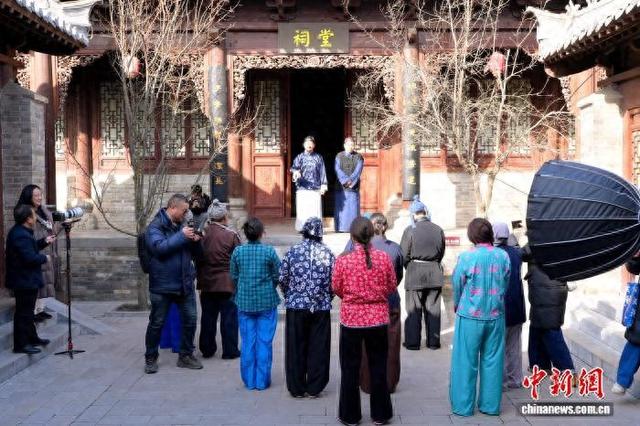
(新春见闻)小年夜“微短剧之村”上演三场“好戏”
Xin Lang Cai Jing· 2026-02-11 03:18
Core Viewpoint - The article highlights the revitalization of the ancient village of Yuanqiao in Dengfeng, Henan, through community-driven cultural activities and the filming of micro-short dramas, which have significantly boosted local tourism and community engagement [1][3]. Group 1: Community Engagement and Activities - On February 10, the village celebrated the "Little New Year" with a series of community events, including a warm-hearted gathering for over 170 elderly residents who received red envelopes, pork, and couplets, fostering a sense of joy and community spirit [1]. - The village's activities are organized by residents, with three villagers who have achieved personal success giving back to the community by providing benefits to the elderly for 11 consecutive years [1]. Group 2: Cultural and Economic Impact - The filming of over 50 micro-short dramas in Yuanqiao village since the beginning of 2024 has transformed it into a popular filming location, referred to as an "ancient village vertical store" by production crews [3]. - The village offers comprehensive services for film crews, including venue rental, extras, accommodation, and props, which not only increases the income of local residents but also enhances tourism in the area [3]. - Local youth are returning to the village, engaging in various roles such as logistics for film crews and learning video editing, indicating a shift towards modern skills and opportunities [3]. Group 3: Artistic Expression and Local Crafts - The village's residents are actively participating in the arts, with local artisans like An Qing'e practicing their lines for performances that showcase their hometown's history, contributing to cultural preservation [5]. - The popularity of local crafts, such as flower basket weaving, has surged, with more young people showing interest in learning these traditional skills, further enriching the village's cultural landscape [5].

“女强逆袭”“悬疑探案”……让你“上头”的微短剧,原来有他们力挺!
Jin Rong Shi Bao· 2026-02-05 13:00
Core Viewpoint - The micro-drama industry in Xi'an is experiencing rapid growth, supported by innovative financial solutions that address the unique challenges faced by light-asset companies in securing funding [1][2][3]. Group 1: Industry Overview - The micro-drama sector has evolved from low-quality productions to high-quality content, with Xi'an being a hub that produces 60% of the nation's micro-dramas, housing over 600 companies [1]. - The industry is characterized by a complete production chain, with an average of over 60 crews operating simultaneously each day in film studios [1]. - Financial support is crucial for the transition from rapid profit-making to producing high-quality content, as many companies face difficulties in obtaining traditional bank loans due to lack of collateral [2]. Group 2: Financial Innovations - Financial institutions are adapting their services to meet the needs of the micro-drama industry, moving away from traditional collateral-based lending to tailored financial products [3][4]. - The "Cultural and Creative Service Team" was established by a local bank to provide customized financial solutions based on the unique characteristics of the micro-drama industry [3]. - The introduction of the "Micro-Drama Loan" by another bank has successfully addressed financing challenges for small and medium-sized enterprises in the sector, facilitating quicker access to funds [4][5]. Group 3: Impact of Financial Support - Financial backing has enabled companies to upgrade their production capabilities, such as acquiring advanced equipment and establishing creative labs, leading to the production of hit series [3]. - The financial support has resulted in significant growth, with one company projecting to produce over 1,000 short videos and dramas annually by 2025, contributing to the local economy [3]. - The innovative loan products have been designed to minimize financing costs while maximizing support for the micro-drama industry, ensuring sustainable growth [6].
这些霸总富婆,救活郑州烂尾楼
盐财经· 2025-11-11 09:36
Core Viewpoint - The article discusses the transformation of abandoned real estate projects in Zhengzhou into short drama filming locations, highlighting the intersection of the real estate and entertainment industries, and the economic opportunities arising from this trend [2][14][49]. Group 1: Real Estate Situation - The "养生谷" project in Zhengzhou, originally intended to provide a comprehensive health and wellness community, has faced significant delays, with some units overdue by over 1000 days [6][10]. - The project, which was supposed to include various health services, has largely failed, leading to many buildings being left unfinished [9][10]. - The area has seen a shift from real estate development to short drama filming, with the abandoned buildings being repurposed for creative projects [14][41]. Group 2: Short Drama Industry Growth - Zhengzhou has become a hub for the short drama industry, with over 4,000 professionals and more than 800 companies involved in the sector [30][38]. - The short drama market is projected to reach 500 billion yuan by 2024, surpassing the national box office for films [38]. - Filming costs in Zhengzhou are 30%-40% lower than in first-tier cities, making it an attractive location for production [30][38]. Group 3: Economic Implications - The repurposing of abandoned properties for short drama filming is seen as a way to revitalize the local economy, with local governments encouraging such initiatives [41][43]. - The short drama industry is characterized by low investment and high efficiency, allowing for rapid production cycles and quick returns on investment [39][49]. - Real estate companies are increasingly engaging with the short drama sector, seeking to leverage their properties for filming opportunities [47][50].

85家微短剧制作企业联合倡议,反对“税后片酬”
Sou Hu Cai Jing· 2025-09-17 08:36
Core Viewpoint - The joint statement from 85 leading micro-short drama production companies highlights concerns over the rising costs associated with "after-tax remuneration" for flexible workers, advocating for these workers to bear their own individual income tax responsibilities [1][3]. Group 1: Industry Concerns - The joint statement reflects the industry's response to the skyrocketing actor remuneration in recent years [3]. - Initially, most lead actors in the micro-short drama industry were amateurs, receiving daily remuneration ranging from hundreds to thousands of yuan [3]. - With market growth and capital influx, top actors' daily remuneration has surged to tens of thousands of yuan, while significant supporting roles have also seen increases, with some earning as much as six to seven thousand yuan per day [3]. Group 2: Financial Implications - "After-tax remuneration" requires production companies to pay additional income tax on top of the agreed remuneration for actors, leading to increased production costs [3]. - This increase in costs may squeeze budgets for other aspects of production and obscure the legal responsibilities of tax payment, posing significant tax risks [3].