房地产研究

Search documents
上海易居房地产研究院成立二十周年:深耕行业沃土 沉淀专业价值
Zheng Quan Ri Bao Wang· 2026-01-30 13:53
Core Viewpoint - Shanghai E-House Real Estate Research Institute has celebrated its 20th anniversary, emphasizing its commitment to professionalism and its evolution from inception to a leading real estate research institution [1][2]. Group 1: Historical Development - The institute was founded with a vision to bridge the gap between theory and practice, policy and market, and industry and the public [2]. - Over the past two decades, particularly in the last five years, the institute has navigated significant industry adjustments, focusing on professionalism as its core competitive advantage [2][3]. Group 2: Role and Impact - The institute has established partnerships with over 500 enterprises, creating a robust ecosystem that allows it to stay attuned to market dynamics and fulfill its social responsibilities [3]. - It has played a crucial role as a trusted information source, providing rational insights during market fluctuations and guiding public expectations [3]. Group 3: Future Strategy - The institute recognizes the need for higher standards in professional think tanks amid significant changes in supply and demand relationships in the real estate market [4]. - Future strategies include focusing on "high-quality development," with pillars of "steady progress in operations" and "continuous professional improvement," alongside embracing AI technologies [4][5]. - Plans to establish a "Real Estate Artificial Intelligence Research Office" aim to enhance research efficiency and depth through AI applications in data mining and trend simulation [4][5]. Group 4: Professional Growth and Collaboration - The institute aims to cultivate "human-machine collaboration" among its researchers, which is seen as key to exponentially increasing professional value [5]. - It will leverage its extensive network across government, industry, academia, and media to foster cross-disciplinary exchanges and knowledge sharing [5].
上海易居房地产研究院发布2026年发展战略
Zhong Zheng Wang· 2026-01-26 14:08
Core Viewpoint - The 2026 Yi Ju Forum emphasizes the importance of high-quality development in China's real estate and urban renewal sectors, introducing a "123" strategic framework focused on professional enhancement, service optimization, and embracing AI innovation [1] Group 1: Strategic Framework - The "123" strategic framework includes a commitment to high-quality development, focusing on two main pillars: continuous professional improvement and ongoing service optimization [1] - The three development paths outlined are: enhancing professionalism to empower the industry, gathering resources to build an ecosystem, and embracing AI for innovative progress [1] Group 2: Management and Operational Trends - The president of Shanghai Yi Ju Real Estate Research Institute suggests that real estate companies should adopt a flatter management model to respond to the demand for "good houses" and the trend of selling existing homes, which will drive upgrades in operational systems and development models [1] Group 3: Urban Renewal and Market Stability - The vice president of Shanghai Urban Investment Holding Co., Ltd. highlights the role of urban renewal in stabilizing the real estate market, advocating for the use of REITs, digital empowerment, and brand output to balance economic benefits with social effects [1] - Recommendations include optimizing land supply, enhancing departmental collaboration, and providing financial support to facilitate urban renewal's contribution to market stability [1]

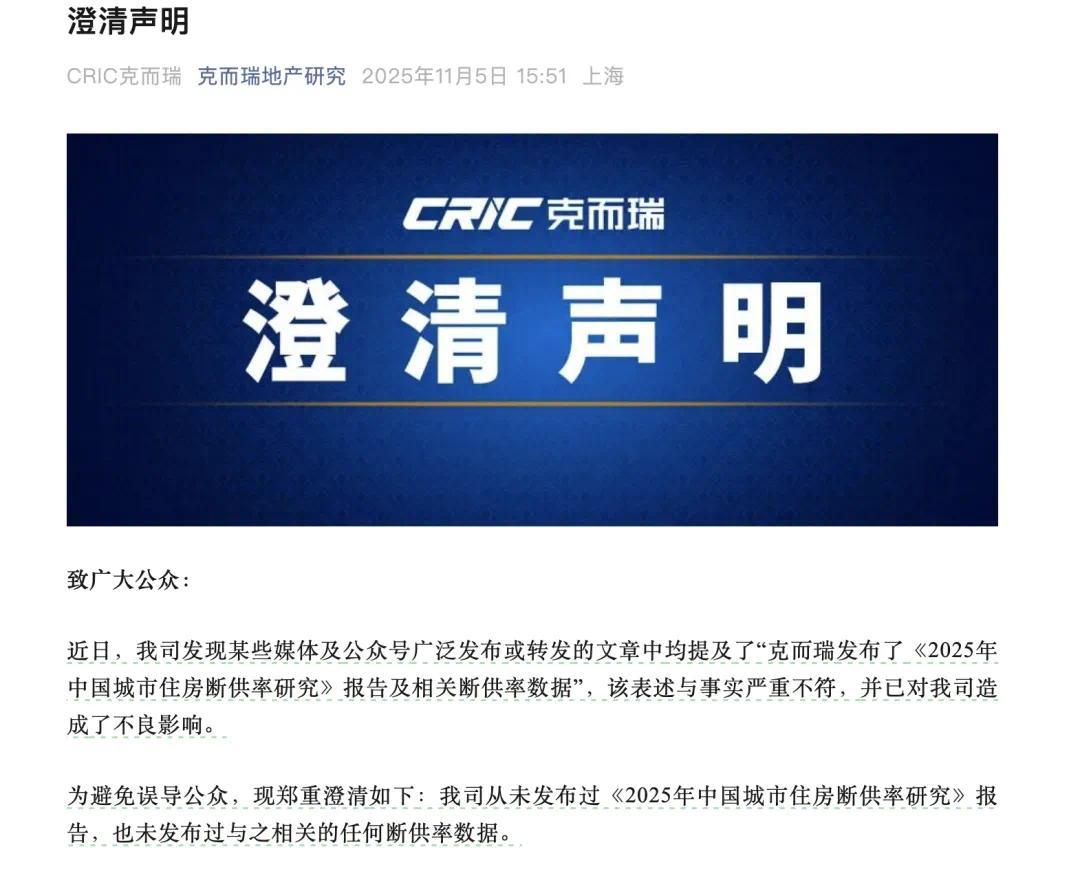
莫须有的“断供率”?
Mei Ri Jing Ji Xin Wen· 2025-11-08 00:27
Group 1 - The core point of the article revolves around the controversy regarding the housing default rate data presented in the China Banking Research Institute's fourth quarter report, which has sparked significant discussion on social media [1][2][4] - The report claims that the current national average housing default rate is higher than in 2022, with some third and fourth-tier cities experiencing even higher rates [1] - The data cited in the report was supposedly sourced from a non-existent study by "CRIC Real Estate Research," which has publicly denied releasing any such report or related data [2][4] Group 2 - The term "default" is not officially recognized; instead, it is categorized under loan delinquency, with banks classifying loans based on the duration of delinquency and conducting investigations [6] - The report's reliance on third-party data raises questions about the accuracy and credibility of the information, as data research institutions typically do not possess such critical credit data [6] - Following the controversy, significant portions of the report related to the real estate market's supply and demand analysis were removed, reducing the report's length to 61 pages [7] Group 3 - In the broader market context, data from the China Index Academy indicates that in October, new home prices increased in 8 out of the top 10 cities, with notable year-on-year increases in Shanghai (10.7%), Hangzhou (6.51%), and Chengdu (6.18%) [7] - National Bureau of Statistics data shows that in September, the sales area of newly built commercial housing reached 85.31 million square meters, a month-on-month increase of 48.5%, while sales revenue amounted to 802.5 billion yuan, up 47.3% month-on-month [7]

地产研究革新利器!CRIC深度智联重新定义行业效率
克而瑞地产研究· 2025-06-08 03:08
Core Viewpoint - The article emphasizes the transformative impact of CRIC Deep Intelligence in the real estate industry through the integration of data, AI, and practical applications, marking a significant shift towards efficiency in research outcomes [1][2]. Group 1: Data Infrastructure - CRIC Deep Intelligence leverages 20 years of data accumulation from the real estate sector, covering 426 cities and 11 major real estate fields, creating a comprehensive professional database [4]. - The data system includes exclusive industry data sourced from offline research and authoritative channels, ensuring authenticity and timeliness [4]. - A dynamic knowledge graph integrates policy documents, market reports, and case studies, forming a four-dimensional network that supports cross-dimensional research analysis [4]. - The platform allows companies to build personalized knowledge bases, enabling customized research foundations for AI-generated reports [4]. Group 2: AI Capabilities - CRIC Deep Intelligence creates a closed research loop covering search, analysis, creation, and validation, transforming data handling into value production [6]. - The intelligent search feature allows natural language queries, providing structured results in seconds, thus avoiding fragmented manual searches [6]. - Advanced analysis capabilities utilize professional models to conduct multi-factor correlation analysis, revealing insights that are difficult for humans to detect [6]. - The system can generate over a hundred types of reports and articles quickly, significantly enhancing report production efficiency [7]. Group 3: Application Scenarios - The platform offers customized solutions for various stakeholders in the real estate industry, including developers, financial institutions, and research organizations [8]. - For developers, it provides comprehensive support from land acquisition to marketing, including feasibility studies and competitive analysis [9][10]. - Financial institutions benefit from improved risk management and asset evaluation, with faster credit assessments and more accurate risk identification [11][12]. - Research institutions can produce industry reports and track policy developments efficiently, enhancing content production capabilities [13]. Group 4: Future Outlook - CRIC Deep Intelligence signifies the beginning of a new era in real estate research, promoting three major transformations: democratization of research capabilities, expansion of cognitive boundaries, and leap in industry efficiency [15]. - The platform aims to automate 80% of foundational research tasks, allowing human resources to focus on strategic thinking [15]. - As the industry evolves, companies embracing AI-driven transformations will gain structural competitive advantages, with CRIC Deep Intelligence leading the way [16].