
棕榈油种植

Search documents
MPOA:马来西亚12月1日-20日棕榈油产量预估环比减少7.44%
Xin Hua Cai Jing· 2025-12-24 07:15
Core Viewpoint - Malaysia's palm oil production is projected to decrease by 7.44% from December 1 to December 20, according to the Malaysian Palm Oil Association (MPOA) [1] Group 1: Production Estimates - The production in Peninsular Malaysia is expected to decline by 11.66% [1] - Sabah's production is forecasted to decrease by 2.12% [1] - Sarawak's output is anticipated to drop by 0.75% [1] - Borneo's production is estimated to reduce by 1.73% [1]
SPPOMA:2025年12月1-20日马来西亚棕榈油单产环比上月同期减少6.26%
Xin Hua Cai Jing· 2025-12-22 07:46
Core Viewpoint - The data from the Southern Peninsula Palm Oil Millers Association (SPPOMA) indicates a significant decline in palm oil production metrics in Malaysia for the period of December 1-20, 2025, compared to the previous month [1] Group 1: Production Metrics - Malaysia's palm oil yield per hectare decreased by 6.26% compared to the same period last month [1] - The extraction rate of palm oil also saw a reduction of 0.17% compared to the previous month [1] - Overall production volume dropped by 7.15% compared to the same period last month [1]
印尼制定规则,对在林区运营的矿产商处以罚款
Wen Hua Cai Jing· 2025-12-11 00:35
Core Viewpoint - The Indonesian Ministry of Energy and Mineral Resources has imposed fines on mining companies operating illegally in forest areas as part of efforts to protect forests from illegal logging [1] Group 1: Fines Imposed - Nickel miners found illegally logging forests will face fines of 6.5 billion Indonesian Rupiah per hectare [1] - Bauxite miners will incur fines of 1.76 billion Indonesian Rupiah per hectare [1] - Tin miners will be fined 1.25 billion Indonesian Rupiah per hectare [1] - Coal operators will face fines of 354 million Indonesian Rupiah per hectare [1] Group 2: Enforcement and Compliance - A government forestry task force, composed of military personnel and law enforcement officials, will collect fines based on investigation results [1] - Earlier this week, the task force ordered dozens of palm oil plantation and mining companies to pay a total of 38.62 trillion Indonesian Rupiah in fines for illegal operations in forest areas [1]
【环球财经】泰国南部洪灾将导致橡胶减产超4.3万吨
Xin Hua Cai Jing· 2025-11-30 13:47
Core Insights - The Thai Rubber Authority (RAOT) predicts significant impacts on rubber production due to ongoing rainfall and flooding in southern Thailand, with an estimated loss of over 43,000 tons [1] - The flooding has affected over 4.1 million rai (approximately 6 million hectares) of rubber plantations, preventing farmers from tapping rubber and harvesting [1] - The Thai Rubber Authority plans to assess the damage and provide guidance to rubber growers to help them recover post-flood [1] Group 1 - The flooding is expected to cause a total loss of 6.698 billion Thai Baht in rubber and palm oil production, with rubber production decreasing by 83,000 tons valued at 4.456 billion Thai Baht [2] - Palm oil production is projected to decrease by 340,000 tons, valued at 2.242 billion Thai Baht [2] - The total death toll from the flooding in southern Thailand has reached 162, with the highest number of fatalities in Songkhla province at 126 [2] Group 2 - The main rubber cultivation areas are in southern Thailand, accounting for 57% of the national planting area, primarily located in Surat Thani, Songkhla, and Nakhon Si Thammarat [2] - Palm oil cultivation areas occupy 86% of the national planting area, mainly in Surat Thani, Krabi, and Chumphon [2] - Weather conditions are improving, with rainfall expected to decrease and floodwaters likely to recede within 3 to 5 days [2]
印尼国有化进程加速,棕榈油价格底部或抬升
Xin Hua Cai Jing· 2025-11-26 07:14
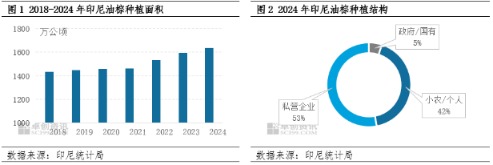
Core Viewpoint - The Indonesian government is intensifying efforts to combat illegal palm oil plantations, leading to significant ownership changes in nearly 20% of the country's palm oil plantations by 2025, which is expected to elevate palm oil prices by 2026 due to reduced planting area and rising costs [1][2]. Group 1: Government Actions and Impact - In 2025, Indonesia is implementing strong measures to clear illegal palm oil plantations, with enforcement efforts surpassing previous years [2]. - The ongoing extension of Indonesia's "New Plantation Moratorium" is hindering the traditional growth model based on land expansion, raising concerns about potential reductions in total planting area [2]. - The confiscation of 3.1 million hectares of illegal plantations, if fully counted as palm oil land, represents about 19% of the national palm oil area, potentially affecting an annual production of approximately 10 million tons [2]. Group 2: Production and Yield Concerns - The management quality of palm oil plantations in Indonesia varies significantly, with government and state-owned plantations achieving yields of up to 4.5 tons per hectare, while smallholders typically maintain yields below 3.5 tons per hectare [4]. - The confiscated lands may not be suitable for continued cultivation or could be converted back to forest, leading to a reduction in effective planting area [4]. - Future production growth will heavily depend on improving yields through high-yield varieties and technological advancements, which require substantial capital investment [4]. Group 3: Cost and Pricing Dynamics - The nationalization of plantations will introduce stricter environmental and social responsibility standards, increasing compliance costs that will become a fixed part of production costs [6]. - The costs associated with replanting and technological upgrades will likely be passed on to palm oil pricing, raising the price floor [7]. - The government's enhanced control over the market through nationalization will increase the sensitivity of palm oil prices to export taxes and domestic market obligations, potentially maintaining higher price levels in the long term [7]. Group 4: Market Outlook - The expected average price for domestic 24-degree palm oil in 2026 is projected to be 9,210 yuan per ton, which will continue to exert pressure on downstream industries such as food, personal care, and biofuels due to rising raw material costs [7].

MPOA:马来西亚11月1-20日棕榈油产量预估增加3.24%
Xin Hua Cai Jing· 2025-11-26 06:15
Core Insights - Malaysia's palm oil production is projected to increase by 3.24% for the period of November 1-20 according to the Malaysian Palm Oil Association (MPOA) [1] Group 1 - The Malaysian Palm Oil Association (MPOA) has released data indicating an increase in palm oil production [1]
MPOA:马来西亚10月1日-20日棕榈油产量预估增加10.77%
Xin Hua Cai Jing· 2025-10-22 11:32
Core Insights - Malaysian palm oil production is estimated to increase by 10.77% from October 1 to 20, with significant contributions from various regions [1] Group 1: Production Estimates - Production in Peninsular Malaysia is expected to rise by 4.54% [1] - Sabah's production is projected to increase by 21.99% [1] - Sarawak's output is anticipated to grow by 16.69% [1] - Borneo's production is estimated to increase by 20.45% [1]
【环球财经】印尼计划到2030年将毛棕榈油年产量提高至6000万吨
Xin Hua Cai Jing· 2025-08-21 14:23
Core Viewpoint - Indonesia plans to increase crude palm oil (CPO) production from 48.2 million tons in 2024 to 60 million tons by 2030 in response to rising demand in food, biofuels, and oleochemical sectors [1] Group 1: Production Goals and Challenges - The Indonesian Palm Oil Association (Gapki) indicates that due to aging plantations, CPO and palm kernel oil (PKO) production is expected to see a modest increase of 1.7% to 53.6 million tons by 2025 [1] - Aging palm oil plantations are causing stagnation in CPO production growth, which is gradually pushing prices higher [1] Group 2: Market Dynamics - Recent increases in palm oil prices have drawn market attention, with the Indonesian President announcing a crackdown on illegal resource extraction [1] - Government investigations have revealed the seizure of 3.1 million hectares of illegal palm oil plantations, contributing to supply tightening and concerns over export restrictions, which support the strengthening of international palm oil prices [1]
8月1日-15日马来西亚棕榈油单产环比前一月同期减少1.78%
Xin Hua Cai Jing· 2025-08-18 07:45
Group 1 - The core point of the article indicates that Malaysia's palm oil production metrics show a mixed performance for the period of August 1-15, 2025, with a decrease in yield per hectare but an increase in extraction rate and overall production compared to the previous month [1] Group 2 - Malaysia's palm oil yield per hectare decreased by 1.78% compared to the same period last month [1] - The extraction rate increased by 0.51% compared to the same period last month [1] - Overall production increased by 0.88% compared to the same period last month [1]
SPPOMA:2025年7月1日-31日马来西亚棕榈油单产环比增加7.19%
Xin Hua Cai Jing· 2025-08-01 11:41
Group 1 - The core point of the article indicates that Malaysia's palm oil production is showing a positive trend in yield and overall production for the period of July 1-31, 2025, with a month-on-month increase of 7.07% in production [1] - The palm oil yield per hectare has increased by 7.19% compared to the same period last month, indicating improved agricultural efficiency [1] - However, the extraction rate has slightly decreased by 0.02% compared to the previous month, suggesting a minor decline in the efficiency of oil extraction from the palm fruit [1]