
氨基酸生产

Search documents
研判2026!中国L-茶氨酸行业概述、产业链、产量、竞争格局、发展趋势分析:行业产量增长,未来应用领域有望进一步拓展[图]
Chan Ye Xin Xi Wang· 2026-02-14 01:39
Core Insights - The L-theanine market in China is rapidly growing due to increasing consumer demand for healthy lifestyles and the expanding tea market [1][8] - L-theanine, a significant tea extract, offers various health benefits such as antioxidant, anti-inflammatory, and anti-depressant properties, leading to heightened market interest [1][8] - China's position as the world's largest tea producer ensures a steady supply of raw materials for L-theanine production, further supporting market growth [1][8] Industry Overview - L-theanine, a unique non-protein amino acid found in tea leaves, is closely related to the quality of green tea, comprising about 50%-60% of the total amino acids in tea [3] - The primary production methods for L-theanine include plant extraction, chemical synthesis, and microbial fermentation, each with its advantages and limitations [3][4] Production and Supply Chain - The upstream raw materials for L-theanine production include tea leaves, L-glutamic acid, and glucose, with tea leaves being the main source [5] - China's tea plantation area reached 28.487 million hectares in 2017, projected to grow to 34.49 million hectares by 2024, supporting increased tea production [5][6] - The tea production in China is expected to reach 3.7369 million tons by 2024, reflecting a year-on-year increase of 5.5% [6] Market Demand and Trends - The demand for L-theanine is rising alongside the growth of the tea beverage market, which is projected to reach a market size of 157.3 billion yuan by 2024, a 5.0% increase year-on-year [6][7] - The global L-theanine production is expected to grow from 1,270 tons in 2019 to 2,085 tons by 2025, with a compound annual growth rate (CAGR) of 8.6% [7][8] Competitive Landscape - The L-theanine industry is characterized by a fragmented competitive landscape, with market share gradually consolidating among leading companies [8] - Key players in the L-theanine market include Hebei Huayang Biotechnology Co., Guangdong Leerkang Biotechnology Co., and Jiangxi Chengzhi Biological Engineering Co., among others [8][9] Future Development Trends - Consumer demand is driving the high-end development of L-theanine products, focusing on efficacy, safety, and experience [10] - L-theanine is expanding into new application areas, including baked goods, snacks, and oral care products, enhancing market demand [11] - Technological innovation is crucial for improving production efficiency and developing new L-theanine products to meet diverse consumer needs [12]


华恒生物:公司L-缬氨酸等氨基酸系列产品供应牧原股份、海大集团等客户
Mei Ri Jing Ji Xin Wen· 2026-01-16 11:23
Group 1 - The core viewpoint of the article highlights the increasing demand for amino acids in various industries, particularly in animal feed, pharmaceuticals, and food sectors [1] - Huaheng Biological (688639.SH) confirmed that its L-valine and other amino acid products play a crucial role in promoting protein synthesis and maintaining normal metabolism and health in animals [1] - The company supplies its amino acid products to major clients, including Muyuan Foods and Haida Group [1]


合作伙伴将对簿公堂!梅花生物遭味之素索赔
Shen Zhen Shang Bao· 2025-11-22 12:30
Core Viewpoint - Meihua Biological has been sued by Ajinomoto Co., Ltd. for allegedly infringing on two of its patents related to the production of L-glutamate and L-amino acids, with claims for significant financial damages totaling RMB 260 million [1][3]. Group 1: Legal Proceedings - Ajinomoto has filed a lawsuit in the Guangdong High Court, claiming that Meihua Biological and its subsidiaries have infringed on its patents during the production and sale of monosodium glutamate [1][3]. - The lawsuit requests an immediate cessation of the alleged infringing activities, destruction of equipment used for production, and compensation for economic losses amounting to RMB 130 million for each patent [3]. Group 2: Company Operations and Financial Performance - Meihua Biological maintains that its operations are normal and that it will actively respond to the lawsuit, emphasizing its commitment to protecting its and its shareholders' legal rights [4][7]. - The company has faced declining revenues and net profits in 2023 and 2024, with a reported net profit of RMB 3.025 billion in the first three quarters of 2025, reflecting a year-on-year increase of 51.61%, despite a revenue decline of 2.49% to RMB 18.215 billion [4][7]. Group 3: Corporate Governance and Market Impact - The company has stated that the legal issues involving its major shareholder, Meng Qingshan, who was sentenced for market manipulation, do not affect its operations or governance structure, as he has not held any position in the company since January 2017 [7]. - Following the announcement of the lawsuit and the shareholder's legal troubles, Meihua Biological's stock price fell by 2.35%, closing at RMB 10.37 per share, with a total market capitalization of RMB 29.08 billion [7].


全球氨基酸产业进入“中国时间”:一张技术路线图看懂国内产业的升级与主导权转移
Quan Jing Wang· 2025-11-21 11:44
Core Insights - The global amino acid industry has undergone three key technological iterations since its industrialization in the early 20th century, with Japan historically leading the technology direction through companies like Ajinomoto and Degussa [1] - China's amino acid industry, initially constrained by reliance on imported core strains and lack of patents, is now shifting the global technology focus towards itself due to rapid advancements in synthetic biology and technological innovations [1][2] - The acquisition of the amino acid business from Kyowa Hakko by Meihua Biotechnology marks a significant transfer of technology and capabilities, allowing Chinese companies to enter the high-margin pharmaceutical amino acid market [2][4] Industry Dynamics - The decline of Japan's fermentation industry and the migration of technology have accelerated the shift of industry leadership towards China, with Japanese companies unable to sustain higher investments due to rigid cost structures and market contraction [1][3] - Meihua Biotechnology's acquisition provides it with a complete technical system for pharmaceutical-grade amino acids, including chassis strains and quality systems, positioning it strongly in a market where Kyowa Hakko holds over 40% market share in critical amino acids [2][3] - The Chinese amino acid industry is expected to expand its production capacity significantly, with lysine production projected to reach 3.47 million tons and output at 2.82 million tons in 2024, reflecting over a 50% increase from five years ago [2] Global Supply Chain Changes - China's amino acid exports have increased for five consecutive years, with lysine exports expected to reach 1.1062 million tons in 2024, accounting for nearly 40% of total production [3] - The global market is increasingly reliant on China's supply chain for cost, supply security, and high-end product demands, indicating a shift from a "China-Japan-Korea triangle" to a "China dual-pole" supply structure [3] - The transfer of technological sovereignty is expected to further alter the competitive landscape of the global amino acid industry, with Chinese companies gaining a dominant position in the market [3][4] Competitive Landscape - The amino acid industry has traditionally been characterized by cyclicality and cost competition, but the current technological transformation emphasizes the importance of comprehensive production capabilities [4] - Meihua Biotechnology's acquisition of Kyowa Hakko's pharmaceutical-grade products positions it at the core of the global pharmaceutical amino acid supply chain, showcasing a pathway for Chinese companies to achieve technological leaps through mergers and acquisitions [4]
梅花生物前三季度净利飙升51.6%,海外并购与成本优势共振释放盈利弹性
Quan Jing Wang· 2025-11-10 02:57
Core Insights - Meihua Biological reported a revenue of 18.215 billion yuan for the first three quarters of 2025, a year-on-year decrease of 2.49%, while net profit attributable to shareholders increased by 51.61% to 3.025 billion yuan [1] - The company achieved a significant increase in profitability in Q3 2025, with a single-quarter net profit of 1.257 billion yuan, up 141.06% year-on-year, despite a 1.71% decline in main business revenue [1] - Moody's confirmed the company's "Baa3" issuer rating and upgraded the outlook from "stable" to "positive," reflecting market recognition of the company's operational quality and credit status [1] Revenue and Profit Analysis - The slight decline in revenue was primarily due to falling market prices for products such as monosodium glutamate, threonine, lysine, and xanthan gum [1] - The company managed to achieve significant net profit growth through capacity release, cost advantages, and overseas acquisitions [1] - Increased sales volumes from subsidiaries producing monosodium glutamate and isoleucine contributed to the profit growth, alongside higher sales of lysine, feed valine, and starch by-products [1] Overseas Acquisition and Market Position - Meihua Biological made significant progress in overseas acquisitions, with an assessed value of 1.626 billion yuan for the combined equity of the acquired amino acid and HMO businesses [2] - The company expects to recognize approximately 780 million yuan in additional non-operating income in the 2025 fiscal year from this acquisition [2] - Successful completion of the acquisition of Japanese companies in July 2025 extended the product line and enhanced the company's international presence [2] Trade and Regulatory Response - In response to the EU's anti-dumping investigation on lysine, Meihua Biological effectively reduced the final tax rate from an initial 84.8% to 47.7%, improving price competitiveness [2] - The company demonstrated its expertise in handling international trade disputes through close communication with overseas clients [2] Project Development and R&D Investment - The Tongliao monosodium glutamate capacity upgrade project has reached full production, becoming one of the largest single monosodium glutamate production lines globally [2] - The Jilin lysine project is under construction and is expected to commence trial production in Q4 2025, contributing to the company's operational scale expansion [2] - Increased R&D investment has been made to advance the industrialization of synthetic biology technology, with a pilot research platform established in Jilin [3] Overall Performance and Future Outlook - Meihua Biological achieved significant net profit growth in the first three quarters of 2025 through various initiatives, including capacity release, cost optimization, overseas acquisitions, project development, and R&D investment [3] - The company is well-positioned to maintain a positive growth trajectory with the upcoming project launches and integration of acquisition activities [3]
华恒生物股价涨5.17%,兴银基金旗下1只基金重仓,持有4.11万股浮盈赚取6.99万元
Xin Lang Cai Jing· 2025-09-26 03:29
Group 1 - Core viewpoint: Huaheng Biological Technology Co., Ltd. has shown a significant stock price increase of 5.17%, reaching 34.60 CNY per share, with a total market capitalization of 8.654 billion CNY [1] - Company overview: Established on April 13, 2005, and listed on April 22, 2021, the company specializes in the research, production, and sales of amino acids and their derivatives [1] - Revenue composition: The main business revenue is derived from amino acid series (70.96%), followed by other products (20.96%), vitamin series (5.34%), and miscellaneous products (2.74%) [1] Group 2 - Fund holdings: Xinyin Fund has a significant position in Huaheng Biological, with its Xinyin Research Selected Stock A fund holding 41,100 shares, accounting for 2.42% of the fund's net value [2] - Fund performance: The Xinyin Research Selected Stock A fund has achieved a year-to-date return of 24.07% and a one-year return of 54.23%, ranking 2354 out of 4220 and 1673 out of 3824 in its category, respectively [2] - Fund manager: The fund is managed by Qiao Huaguo, who has been in the position for 1 year and 323 days, with the best and worst fund returns during his tenure being 60.78% and 22.15%, respectively [3]
研判2025!中国氨基酸行业发展历程、市场政策、产业链、供需现状、市场规模及发展趋势分析:小品种氨基酸有望成为行业新的增长点[图]
Chan Ye Xin Xi Wang· 2025-08-21 01:35
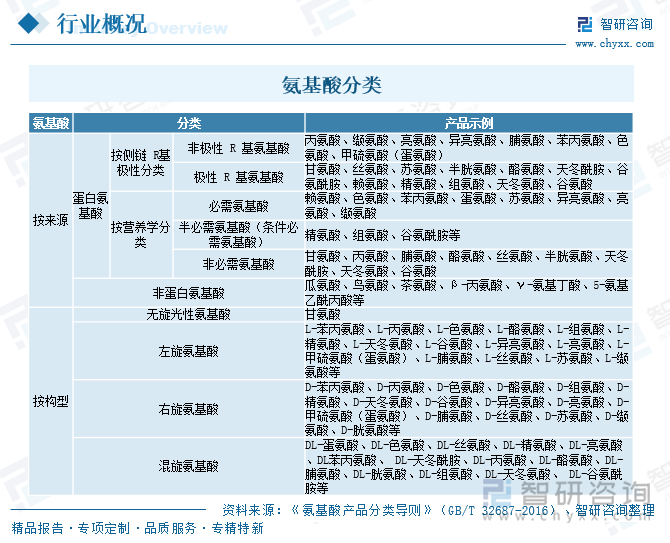
Core Viewpoint - The amino acid market in China is experiencing growth driven by downstream sectors such as feed, food processing, pharmaceuticals, and health products, with a projected demand of 575.08 million tons in 2023, but expected to decline to 561.52 million tons in 2024 due to macroeconomic factors [1][19]. Overview - Amino acids are essential components of proteins and are widely used in various industries, including feed, food, and pharmaceuticals [2][6]. - The classification of amino acids includes essential, semi-essential, and non-essential types, with specific applications based on their properties [3][4]. Market Demand and Trends - The demand for amino acids is projected to decrease in 2024, with the market size expected to drop to 60.862 billion yuan, where glutamic acid accounts for 33.35%, lysine for 32.79%, threonine for 10.11%, methionine for 13.73%, and tryptophan for 2.15% [1][19]. - There is a growing consumer preference for natural and healthy products, which is expected to boost the demand for green and environmentally friendly amino acids and derivatives [1][19]. Industry Development - The amino acid industry in China has evolved from extraction methods to microbial fermentation, significantly reducing production costs and increasing efficiency [6][7]. - The industry is witnessing consolidation, with larger companies acquiring smaller ones to enhance market share and competitiveness [7][8]. Market Policies - Recent policies in China support technological innovation and industrial upgrades in the amino acid sector, promoting the use of amino acids in feed to ensure supply safety [10][12]. Industry Chain - The upstream of the amino acid industry includes suppliers of raw materials like corn, soybeans, and wheat, while the downstream encompasses applications in feed, food processing, pharmaceuticals, and health products [13][15]. - The feed sector is the largest market for amino acids, accounting for over 60% of demand, with significant growth in industrial feed production [17][19]. Competitive Landscape - The amino acid market in China is concentrated among leading companies such as Meihua Biological Technology Group, Fujian Fufeng Group, and Zhejiang New Hope Liuhe, which dominate the market [21][25]. - Meihua Biological is the largest producer of lysine, while Fufeng Group leads in MSG production, indicating a competitive environment with significant market players [21][27]. Future Trends - There is an increasing demand for high-purity amino acids in pharmaceuticals and cosmetics, supported by national policies favoring green production methods [29][30].


梅花生物(600873.SH) 2025 年半年报:盈利增长态势延续,全球化布局取得实质性进展
Xin Lang Cai Jing· 2025-08-20 01:43
Core Viewpoint - The company, Meihua Biological, demonstrated strong resilience and growth potential in its 2025 semi-annual report despite a complex market environment, achieving significant profit growth and substantial progress in its global expansion strategy [1] Financial Performance - The company reported operating revenue of 12.28 billion, a year-on-year decrease of 2.87%, while the net profit attributable to shareholders, excluding non-recurring gains and losses, reached 1.628 billion, a year-on-year increase of 24.98% [1] - The growth in net profit was primarily driven by increased product sales and cost optimization, with major products such as monosodium glutamate, 98% lysine, and feed-grade isoleucine showing sales growth [1][2] - The gross profit increased by 382 million, supporting the net profit growth [1] Global Expansion - The company made significant strides in its global layout, completing a cross-border acquisition on July 1, 2025, marking the transition from strategic planning to substantial operational implementation [1][2] - The acquisition provided over 30 core patents, enhancing the company's international competitiveness and filling knowledge gaps in the synthetic biology and amino acid fermentation industries [2] Operational Efficiency - The company optimized its global competitiveness by reducing the anti-dumping tax rate on lysine in the EU from an initial 84.8% to 47.7%, the lowest in the country [3] - Following the acquisition, the company established overseas production bases and strengthened its supply chain management by collaborating with global suppliers [3] Capacity Upgrade and Digital Transformation - The company invested 1.087 billion in project expenditures, achieving full production efficiency in the Tongliao monosodium glutamate capacity upgrade project [4] - The implementation of the MES system has improved production management efficiency, with inventory turnover days at 50 and accounts receivable turnover days at 9 [5] Research and Development - The company increased R&D investment, focusing on core technology platform construction and strain optimization, and established a trial production platform to support the commercialization of new products [6] - The company distributed a total cash dividend of 1.699 billion (including tax) and repurchased shares worth 571 million, totaling 2.270 billion, which accounted for 83% of the net profit attributable to shareholders for 2024 [6] Future Outlook - The achievements in various aspects such as product, cost, global layout, operational system, capacity upgrade, digital transformation, R&D investment, and intellectual property lay a solid foundation for the company's future development [7]
无锡晶海(836547) - 投资者关系活动记录表
2025-05-09 12:00
Group 1: Investor Relations Activity Overview - The investor relations activity was an earnings briefing held on May 7, 2025, from 15:00 to 17:00 [3] - The event was conducted online via the Shanghai Securities News and China Securities Network [3] - Key participants included the Chairman and General Manager, CFO, and sponsoring representatives [4] Group 2: Sales and Production Capacity - The company reported a decline in sales revenue for 2024 and discussed strategies to absorb increased production capacity from the new factory [3] - Strategies to manage new capacity include developing new products for existing customers, increasing demand in the domestic special medical food sector, and expanding into overseas markets [4] Group 3: Research and Development Progress - The project on "Preparation Method and Industrialization Research of High Purity L-Leucine" is currently in the industrialization verification stage, with expected sales in the second half of the year [4] - The histidine project is also in the industrialization verification phase, with significant progress noted in the establishment of a production line [5] Group 4: Supplier Relations and Market Impact - The acquisition of Japan's Kyowa by Meihua Group may have implications for the supply of raw materials, but the company believes the impact will be minimal due to a sufficient supply of amino acid raw materials [5] - The company is focused on enhancing its technological innovation and overall strength to mitigate potential supply chain risks [5]