
电动汽车行业

Search documents
卡尼访华签下关键协议,特朗普能源阴谋破产,对华围堵被轻松破局
Sou Hu Cai Jing· 2026-02-25 15:03
Group 1 - The core achievement of the China-Canada cooperation includes eight major areas and twenty-eight initiatives, with a focus on energy and electric vehicle collaboration [1] - Canada will provide a quota of 49,000 electric vehicles to China and grant the most favored nation tariff status, while China will adjust its canola seed policy [1] - The energy cooperation is a strategic response to the U.S. tariffs and aims to break Canada's long-standing reliance on U.S. exports, especially after the U.S. increased global tariffs from 10% to 15% [1] Group 2 - The completion of the Trans Mountain pipeline expansion allows Canada to transport an average of 890,000 barrels per day, with two-thirds of its crude oil exports directed towards China [1] - By September 2025, Canada's daily crude oil exports to China are expected to increase nearly thirtyfold compared to the ten-year average, indicating a significant shift in energy trade dynamics [1] - The cooperation between China and Canada in the energy sector reflects both economic interests and political values, enhancing China's energy security [1]


金银价创新高,引发全球“贵金属抢购”潮
Huan Qiu Shi Bao· 2026-01-29 22:40
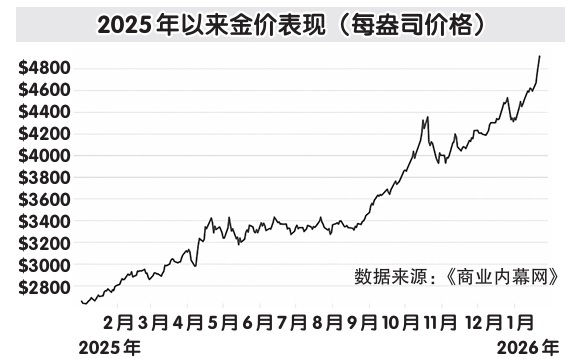
Core Viewpoint - The international market for gold and silver has seen a significant surge in prices, with gold nearing $5600 and silver approaching $120, reflecting a year-to-date increase of approximately 50% [1][3]. Group 1: Market Demand - There is a global frenzy for precious metals, with record-high sales reported by the Royal Mint in the UK, leading to system overload due to unprecedented demand [3]. - Retail investors have been actively entering the gold and silver markets, with an average daily net inflow of $1.5 million into gold and $700,000 into silver last year [4]. - In Turkey, retail investors are willing to pay a premium of $9 per ounce over the London benchmark price for silver due to high demand [4]. Group 2: Influencing Factors - The recent surge in gold prices coincides with the U.S. dollar hitting a four-year low, prompting investors to sell U.S. assets as a hedge against perceived economic instability [5]. - Analysts suggest that the current rise in gold prices is not solely driven by panic but reflects a gradual shift in how investors view gold as a neutral store of value rather than just a crisis hedge [5]. Group 3: Industrial Demand for Silver - The demand for silver is being bolstered by its applications in rapidly growing industries such as electric vehicles, semiconductors, and solar energy, which adds additional price-driving factors [6]. - Analysts warn that while silver prices are currently strong, they are susceptible to significant price drops after substantial increases [6]. Group 4: Future Price Predictions - Major financial institutions like Deutsche Bank and Morgan Stanley have set optimistic year-end price targets for gold, with predictions reaching $6000 and $5700 respectively [7]. - The strong industrial demand for silver, particularly in the photovoltaic sector, is expected to provide solid fundamental support for silver prices, despite potential impacts on downstream industries [7].
铝的长期展望_正梦游进入 20 多年来最大的供应缺口-Global Commodities_ Aluminium long-term outlook_ sleepwalking into the biggest deficits in over 20 years _ Sleepwalking into the biggest deficits in over 20 years
2025-09-18 13:09
Aluminium Industry Research Summary Industry Overview - The aluminium market is projected to face significant deficits over the next 1-5 years, with a long-term bullish outlook driven by structural demand growth and constrained supply [3][4][7]. Key Points Supply and Demand Dynamics - Current aluminium prices around $2,500 per tonne are deemed too low to stimulate sufficient supply growth, leading to unsustainable deficits if prices do not rise [3][7]. - A price increase above $3,000 per tonne is necessary to incentivize over 10 million tonnes of supply growth by 2030, with potential demand-destruction prices around $4,000 per tonne [3][7]. - The era of rapid aluminium capacity expansion has ended, with primary production growth now limited, while demand is expected to continue increasing, particularly with cyclical demand returning [7][12]. Market Tightness - The aluminium market is showing signs of tightness, with physical balance indicators indicating repeated deficits as inventories reach multi-year lows [13][14]. - Genuine stockouts and backwardation are more likely in aluminium than in copper due to the slower response of aluminium scrap to price increases [6][12]. China's Role in the Aluminium Market - China's aluminium supply growth has effectively plateaued, with government policies limiting capacity expansion and environmental regulations making new investments unattractive [15][17][22]. - The country is unlikely to raise its capacity cap, maintaining a de facto ceiling of 45 million tonnes, which constrains future supply growth [17][22]. - China's domestic primary aluminium production growth is projected to reach zero by 2027, increasing reliance on imports to meet demand [49][50]. Emerging Demand Drivers - New demand segments such as AI-driven data centers, robotics, and electric vehicles are expected to significantly boost aluminium consumption [6][54][69]. - The electrical sector in China, driven by decarbonization efforts, is a key growth area for aluminium demand, particularly in power transmission and generation [52][65]. Indonesia's Aluminium Capacity Expansion - Indonesia is emerging as a critical growth region for primary aluminium capacity, with expected capacity reaching 2.3 million tonnes by 2029 [35][32]. - The expansion of aluminium projects in Indonesia is heavily dependent on access to affordable and reliable power, which poses regulatory and financing challenges [33][35]. Risks and Challenges - Several downside risks could derail the bullish outlook, including weaker demand recovery, unexpected supply surges, and technological advancements in scrap recovery [76][77]. - The potential for China to overproduce or for Indonesia to oversupply could undermine the market's balance [78][79]. Price Forecasts - The forecast scenarios suggest that aluminium prices will need to rise significantly to balance supply and demand, with projections indicating prices could exceed $3,000 to $4,000 per tonne in the coming years [3][7][12]. Conclusion - The aluminium market is poised for significant changes driven by structural demand growth and supply constraints, particularly influenced by China's policies and emerging technologies. Investors should closely monitor price movements and market dynamics to identify potential opportunities and risks in the aluminium sector.